

About this worksheet
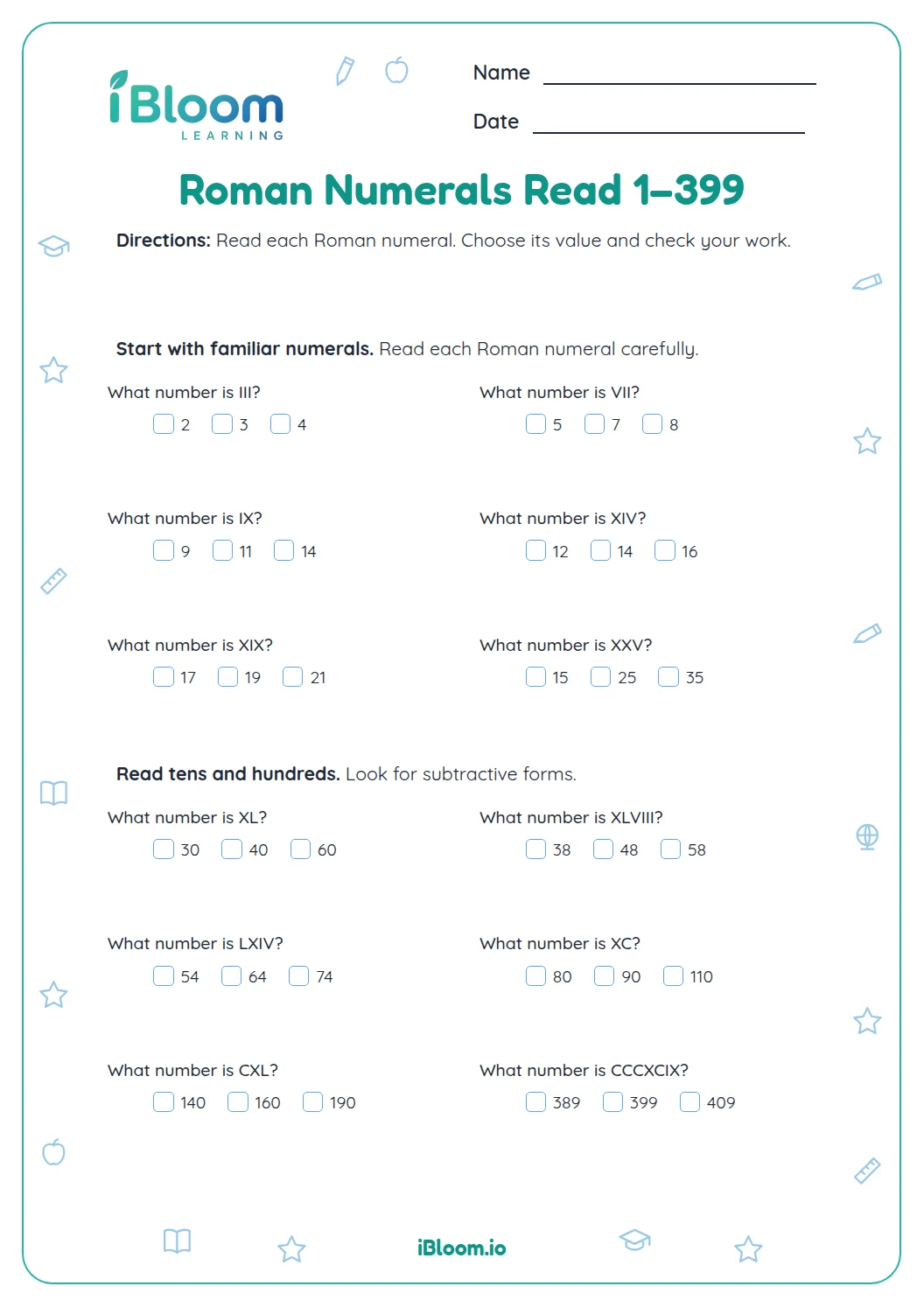
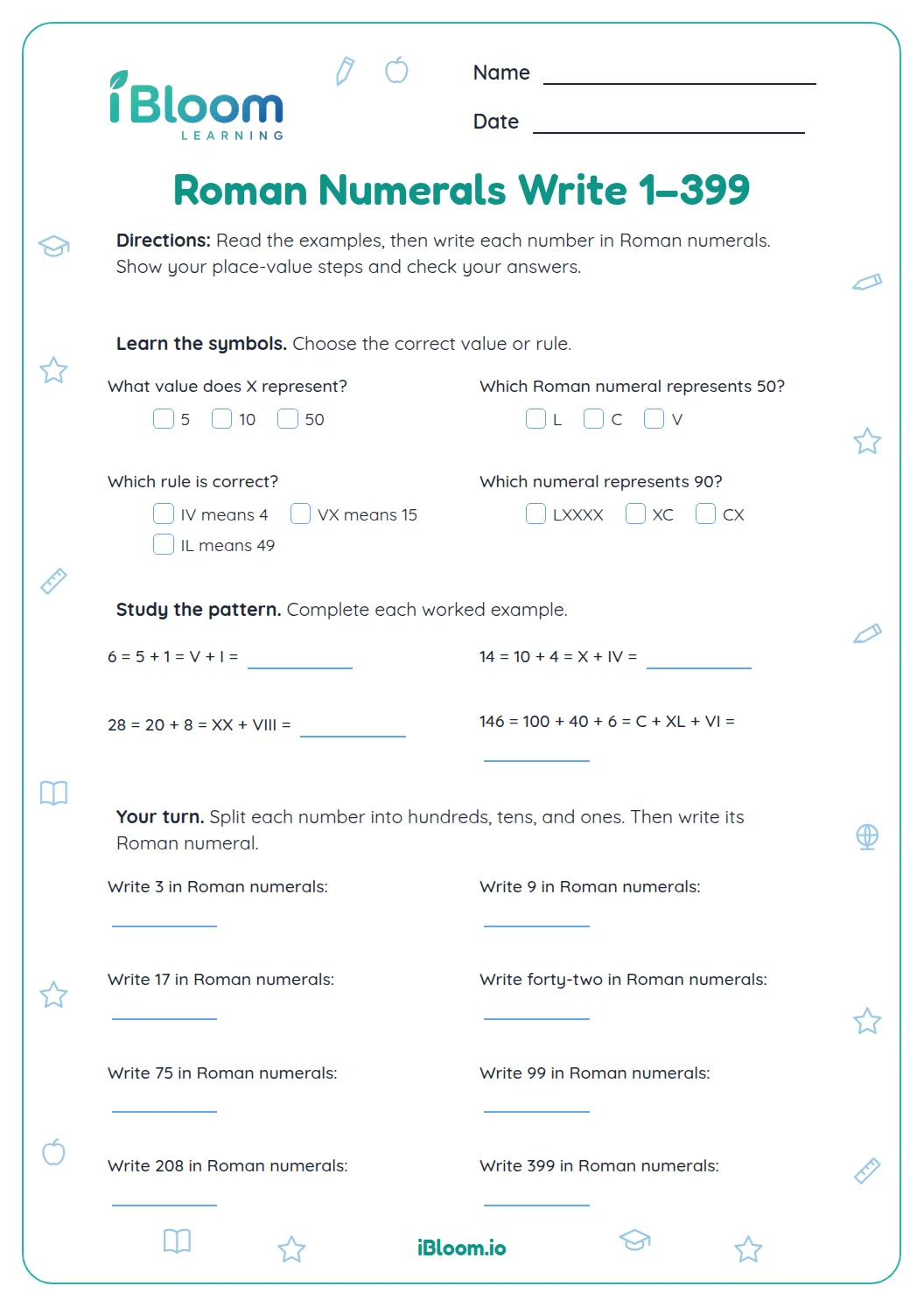
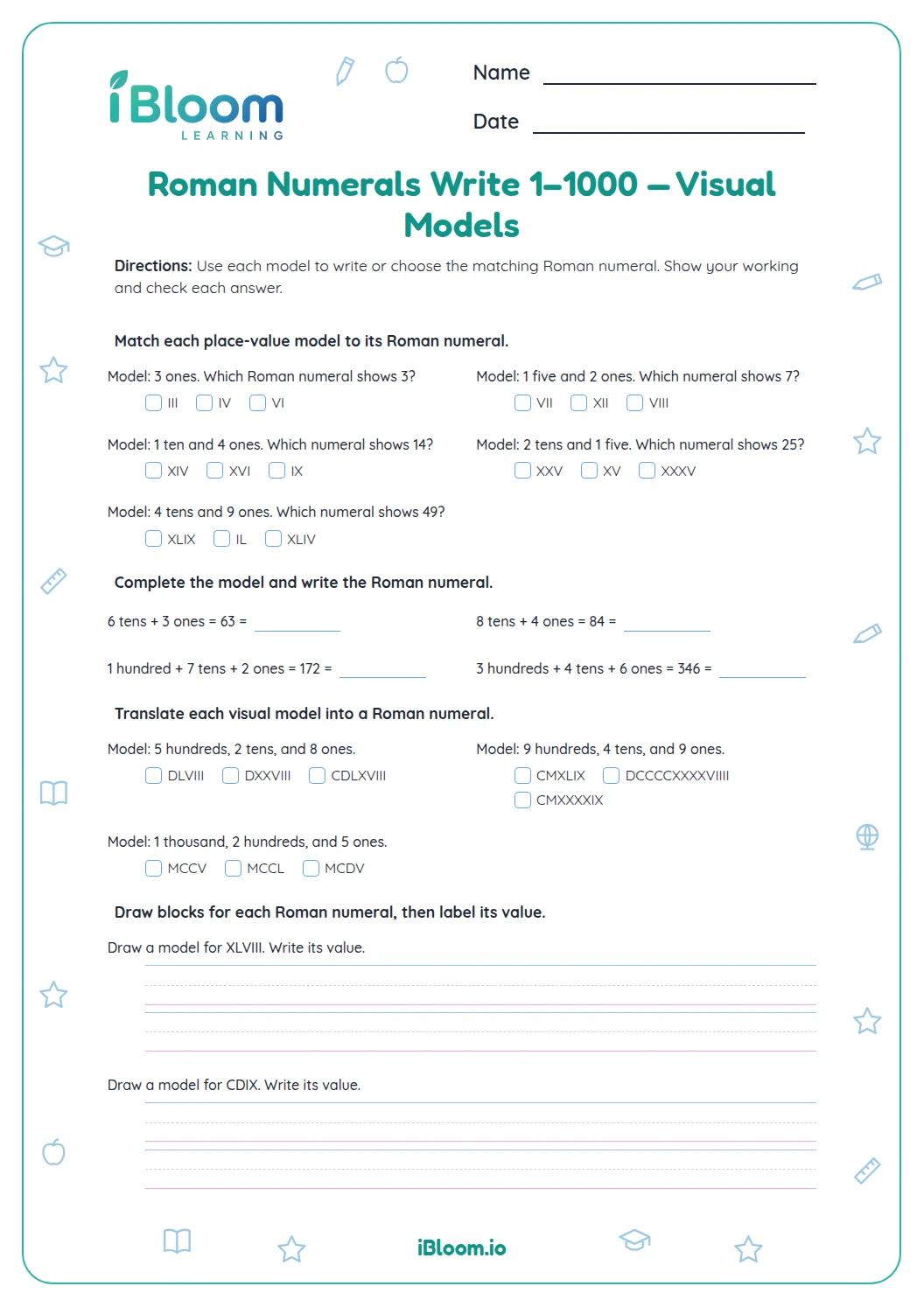
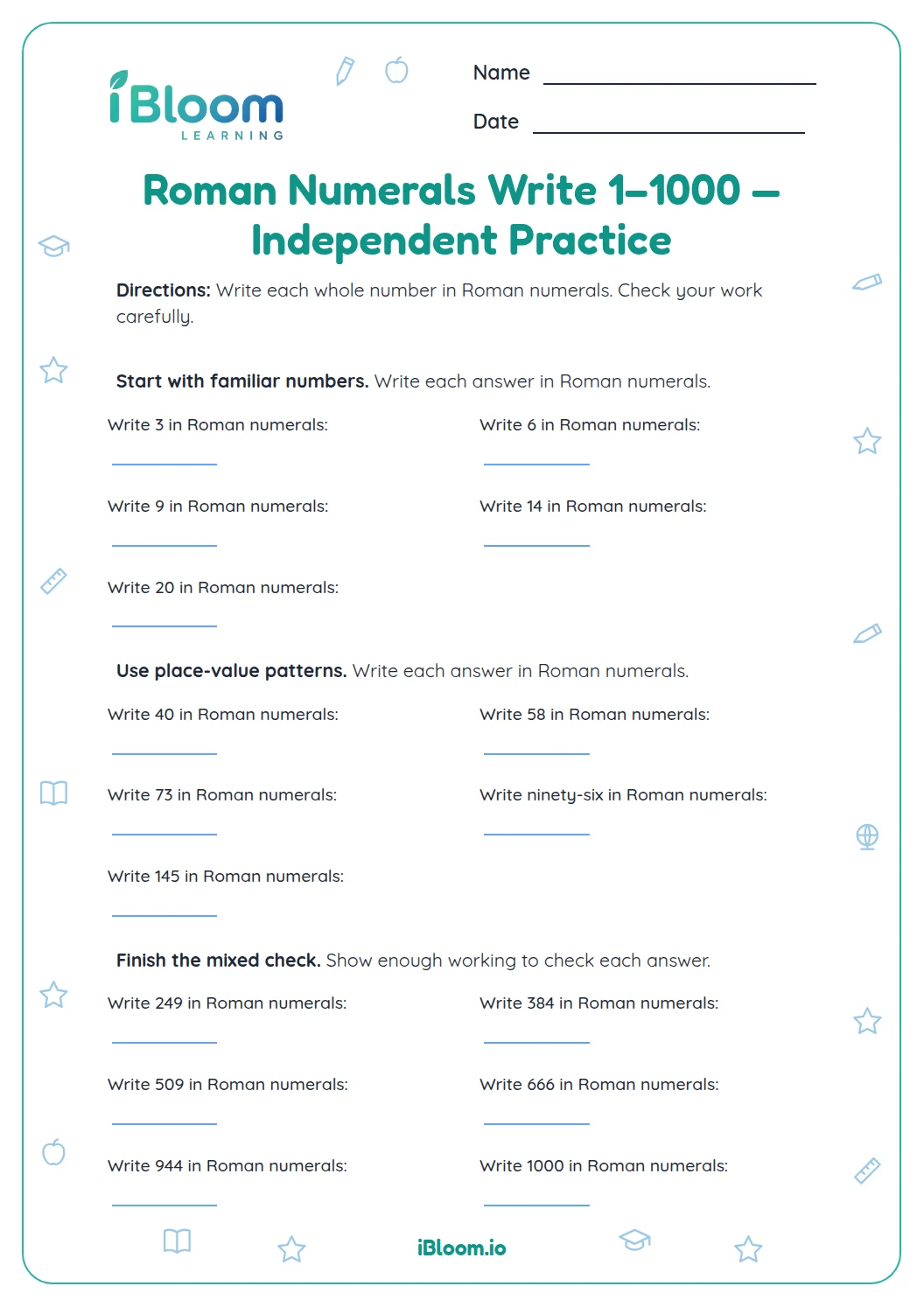
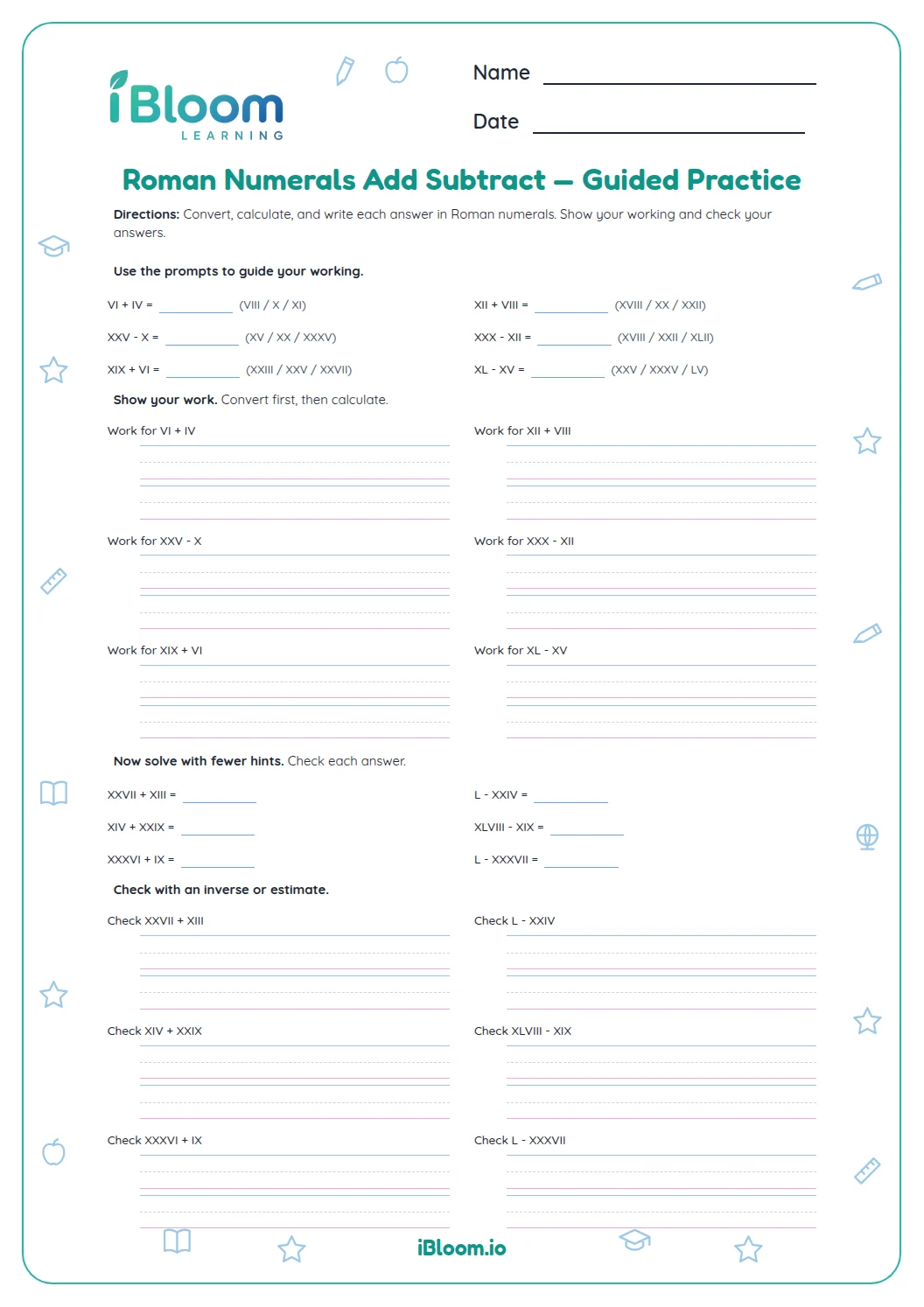
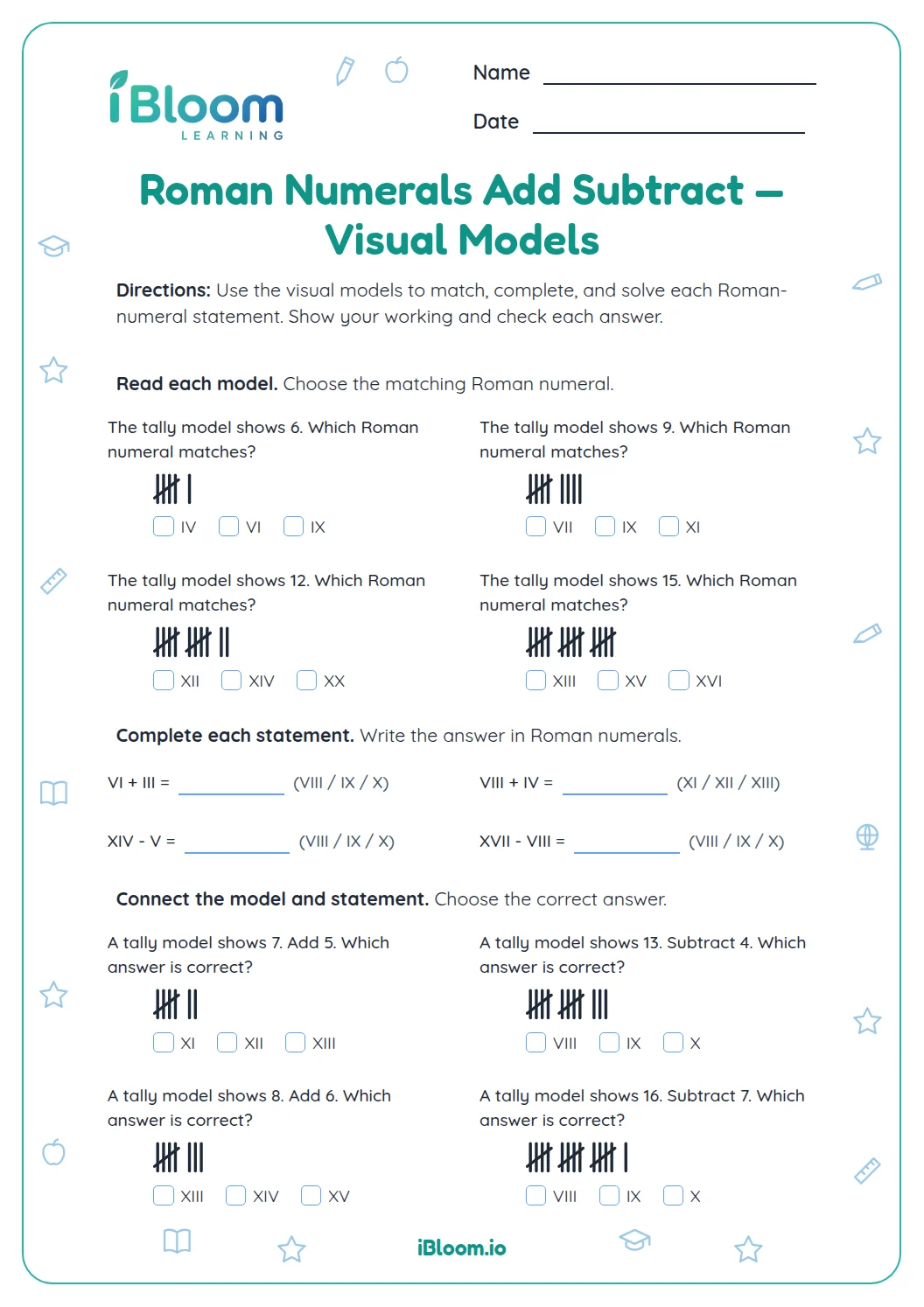
This free Grade 4 worksheet practices reading Roman numerals and using their values in everyday problems. Part A has four multiple-choice questions about an act, clock, chapter, and volume. Part B asks for ordinary numbers for eight labels, including XL, CD, CM, and M. Part C adds the extra step of using decoded numbers: add distances, subtract read pages, and total tickets or museum items. The 16 questions sample values from 1 to 1000 and use all seven symbols and six common subtractive pairs. A separate key supplies every answer.
Which symbol values help children read the labels?
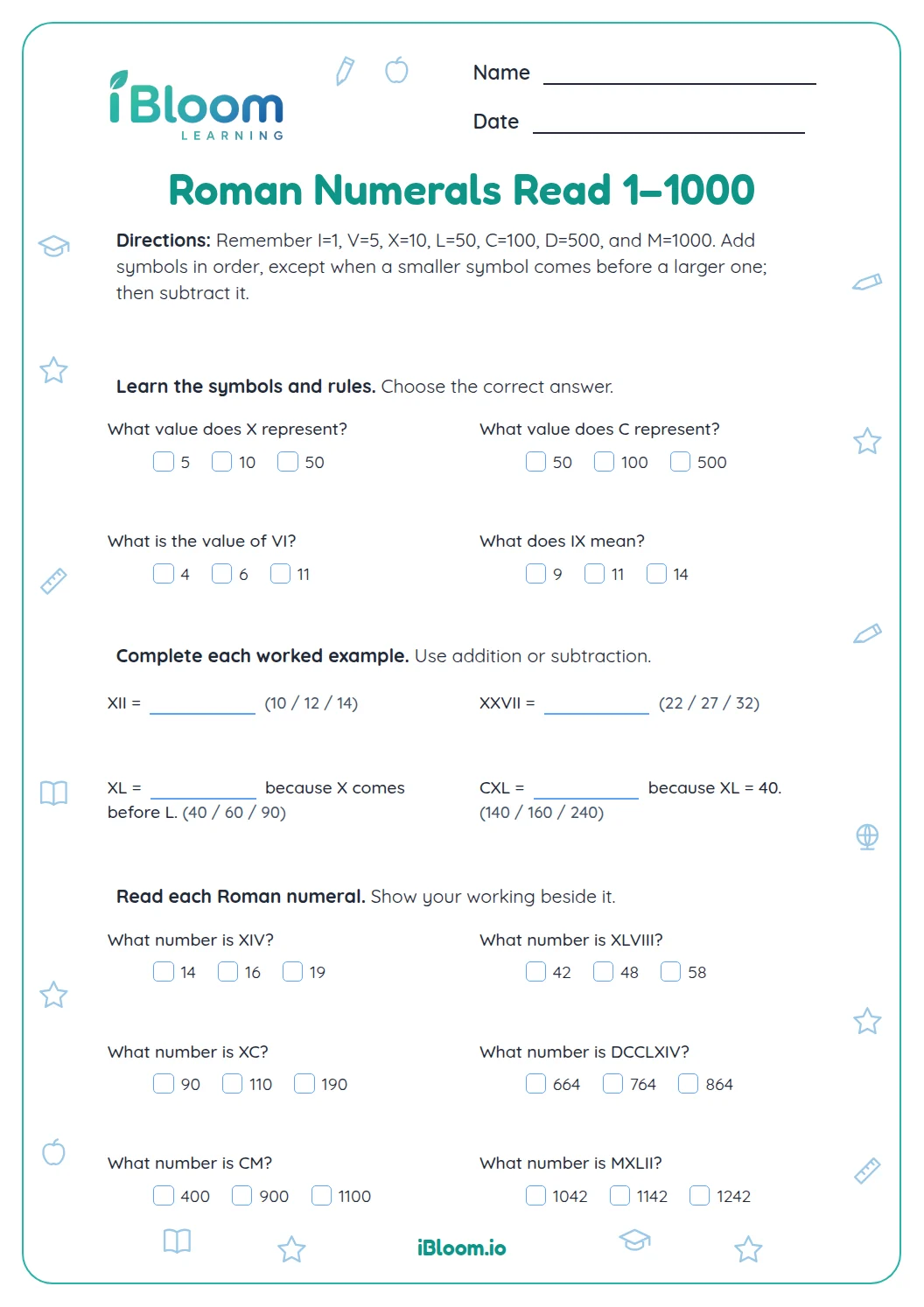
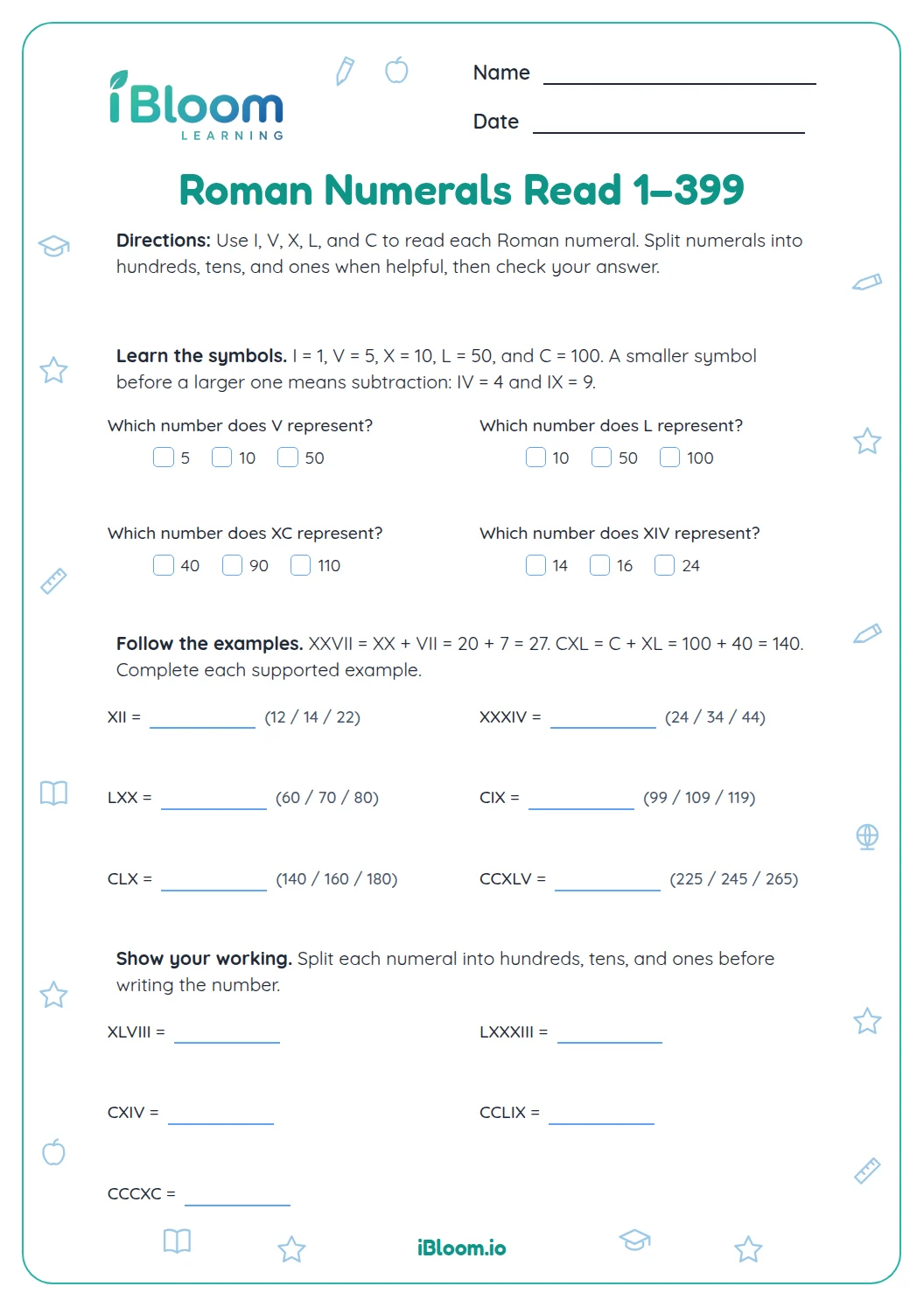
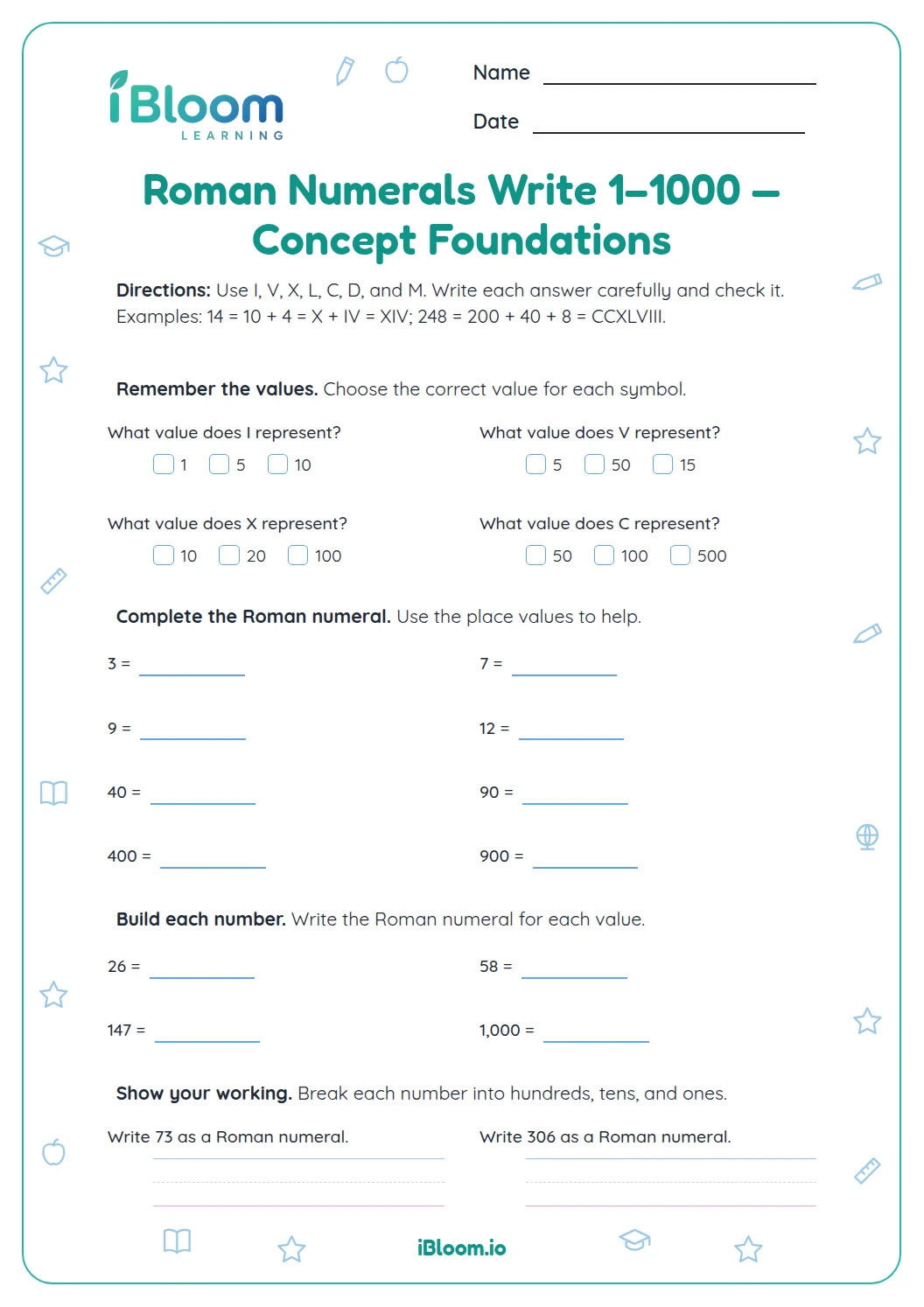
The seven symbols are I for 1, V for 5, X for 10, L for 50, C for 100, D for 500, and M for 1000. Review these values aloud before starting. When a group is written from larger values to smaller ones, add the values.
The volume XII in question 4 is 10 + 1 + 1, or 12. The art-print label M in question 12 means 1000. Part C uses longer combinations in stories that ask children to add or subtract after reading the numerals.
How do subtractive pairs work in a longer numeral?
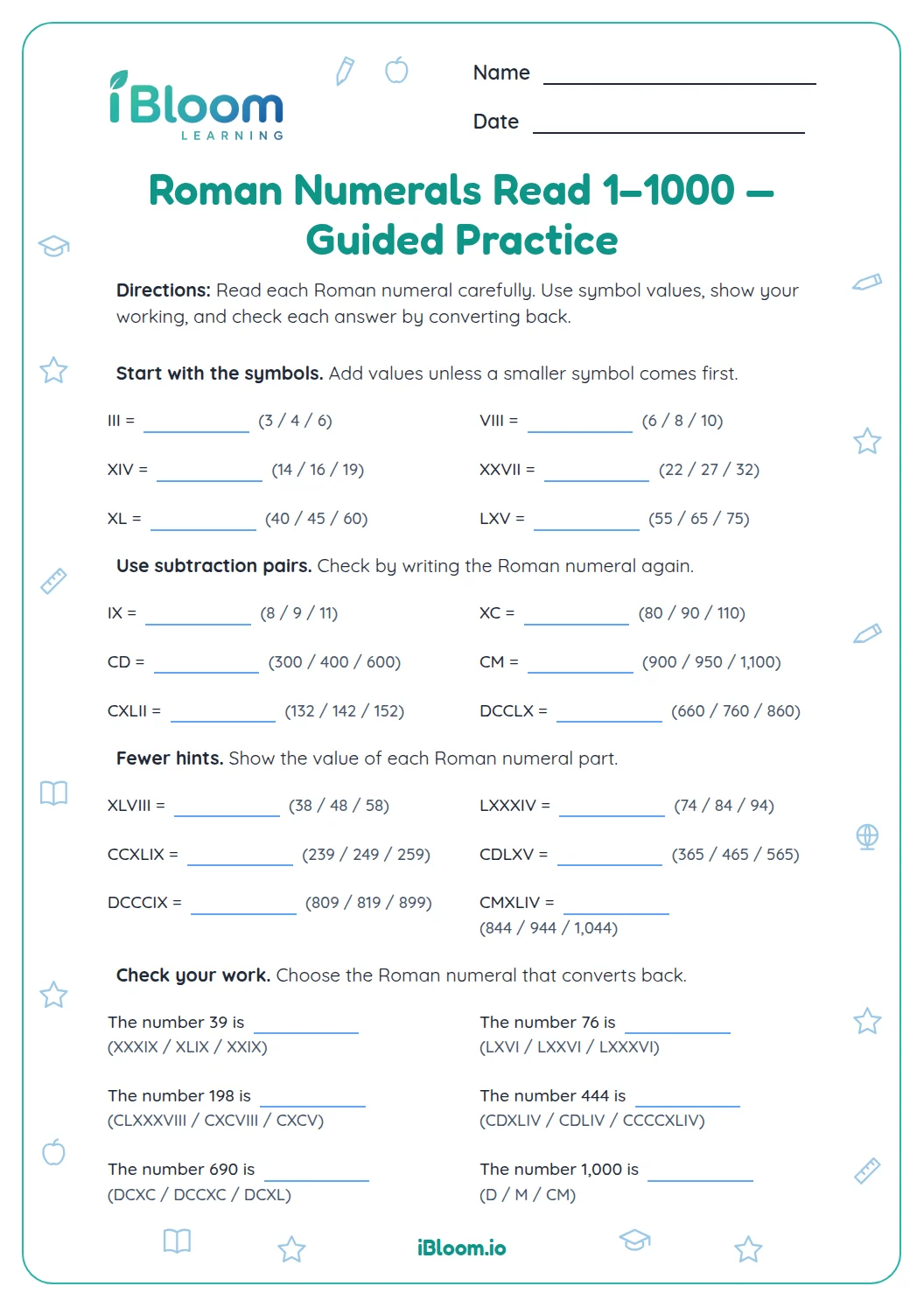
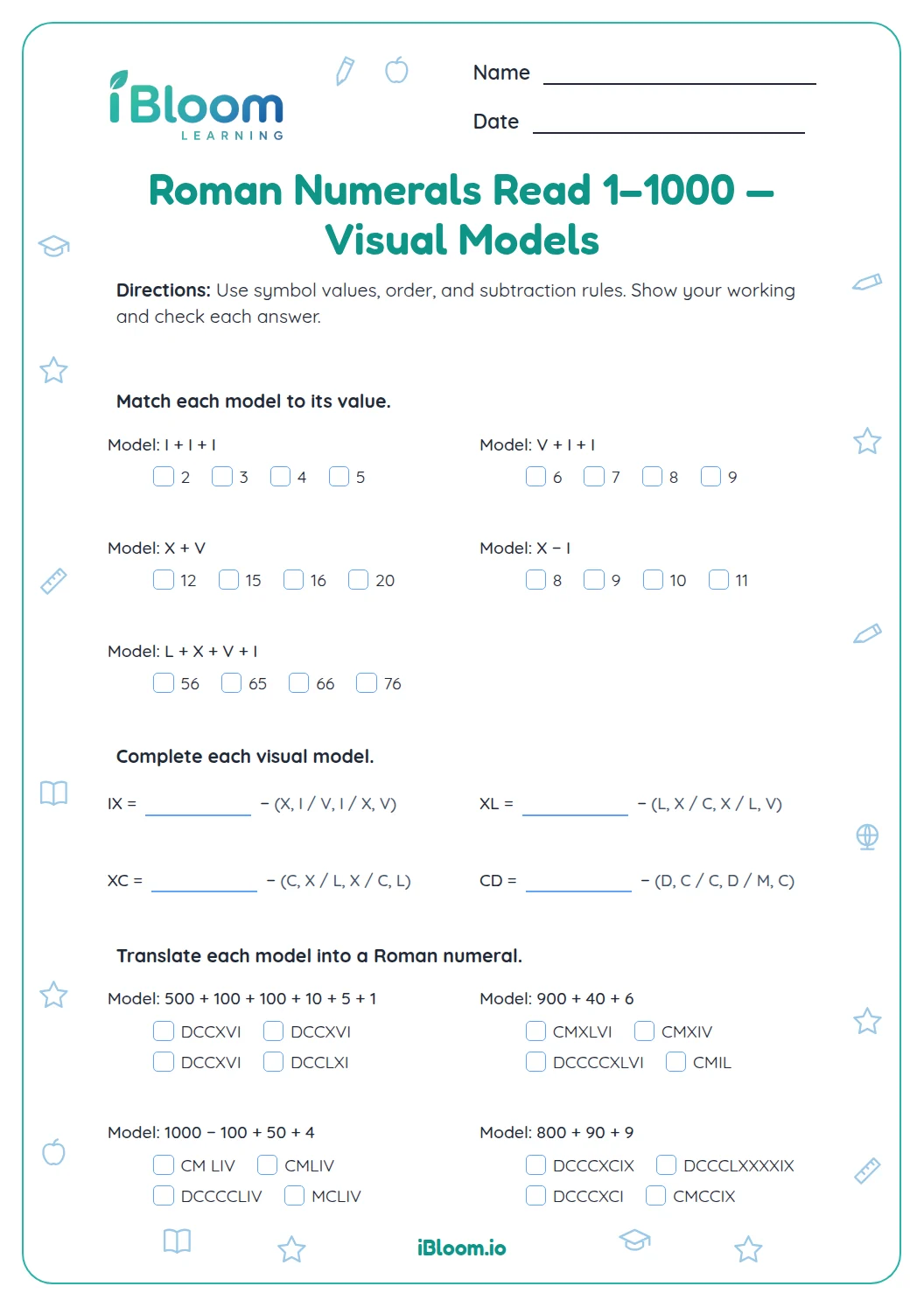
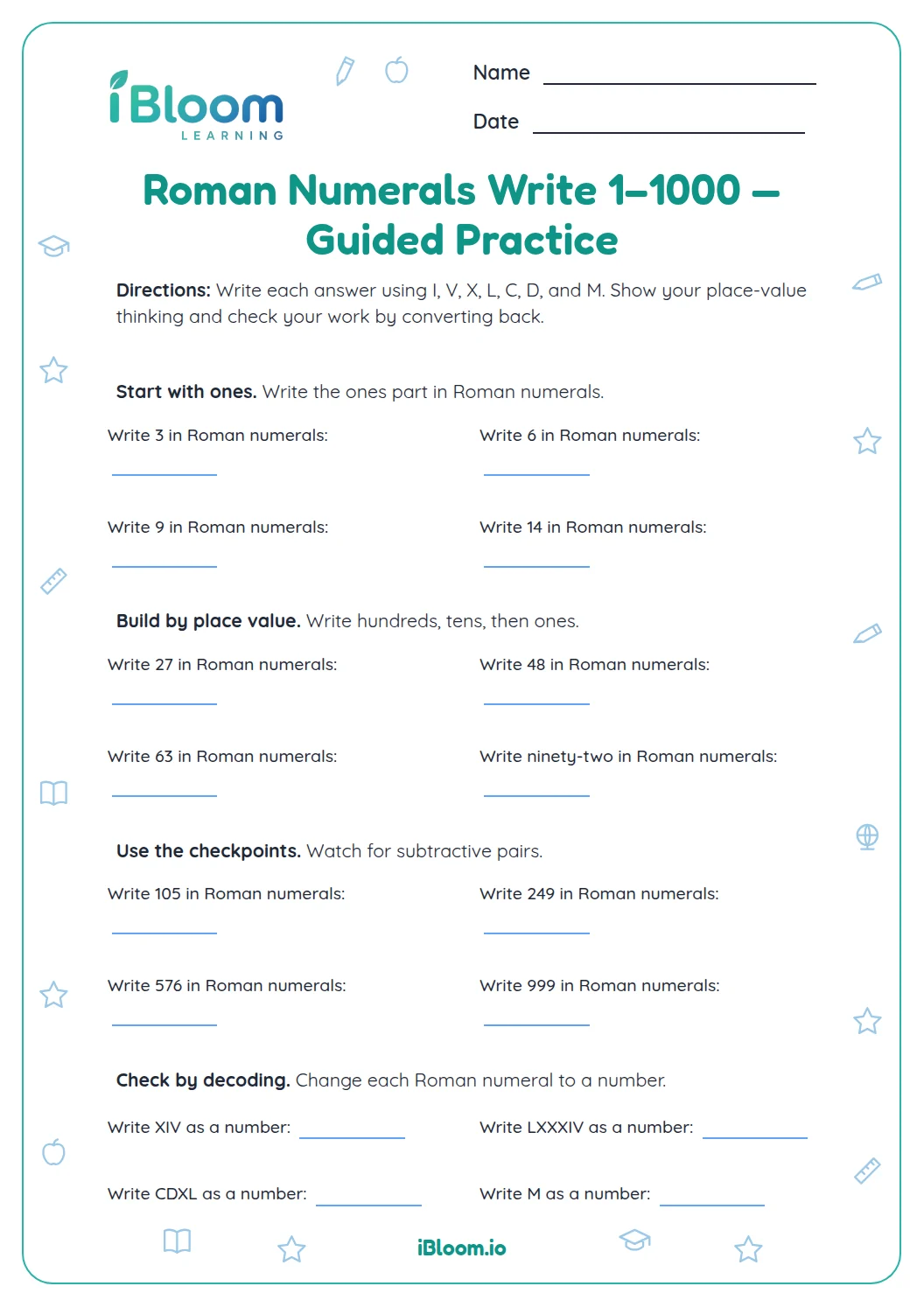
The pairs practiced here are IV = 4, IX = 9, XL = 40, XC = 90, CD = 400, and CM = 900. Read a pair together before adding it to the rest of the numeral.
Question 15 begins with CDXLIV, which combines three subtractive pairs. Read the groups as 400, 40, and 4 to get 444. Then read LVI as 56 and add it to find the total tickets sold.
- 1First tickets: CDXLIV = CD + XL + IV = 400 + 40 + 4 = 444
- 2More tickets: LVI = 50 + 5 + 1 = 56
- 3Total: 444 + 56 = 500 tickets
What do the real-world situations ask children to do?
Parts A and B ask for the ordinary number represented by a Roman numeral. Part C asks children to use those numbers in a calculation: combine two distances, find unread pages, and total tickets or museum items.
For question 14, CC is 200 and XL is 40. Because Ava has already read 40 of the 200 pages, subtract: 200 − 40 = 160 pages remain. The words in each story determine what to do after conversion.
Read the numeral in meaningful groups
- 1Review I, V, X, L, C, D, and M before starting.
- 2Complete Part A and explain why IV and IX use subtraction.
- 3In Part B, read each subtractive pair together before adding other symbols.
- 4In Part C, convert both numerals and decide whether to add or subtract.
- 5Write the equation, label the answer, and check it against the story.
Mistakes to catch and correct
The mistake
Reading IV as 6 by adding I and V.
The fix
I before V makes the pair 4; read the pair before combining it with any other symbols.
The mistake
Reading XL as 60.
The fix
X before L gives 50 − 10 = 40; LX would be 60.
The mistake
Reading CDXLIV one symbol at a time and losing a subtraction.
The fix
Group it as CD, XL, IV, then add 400 + 40 + 4.
What to practice next
Make more practice
Questions parents and teachers ask
Which numbers and symbols appear on the sheet?
The questions use all seven symbols: I, V, X, L, C, D, and M. Selected numerals range from I, meaning 1, to M, meaning 1000. The final stories include CDXLIV and CMXCIX; children decode these longer numerals before using their values in an addition problem.
Should children answer with Roman numerals or ordinary numbers?
Children answer with ordinary numbers throughout the sheet. Part A offers choices, and Part B asks them to fill in values for labels. Part C also requires a calculation: in the theater story, CDXLIV means 444 and LVI means 56, so the answer is 500 tickets.
What background knowledge should children have?
Children should know the seven symbol values and the six common subtractive pairs: IV, IX, XL, XC, CD, and CM. They also need whole-number addition and subtraction for the four final stories. Review a short numeral first, then practice converting both numerals before choosing the operation.
How can a child decode CMXCIX without guessing?
Separate it into CM, XC, and IX: 900, 90, and 9. Add those values to get 999. In the final question, the museum then adds I, meaning one more item, so its new total is 1000. Keep conversion and the story calculation as two separate steps.
Does the worksheet have an answer key?
Yes, a separate answer key gives the correct choice or number for all sixteen questions. For the four word problems, also check the child’s equation and unit. The train answer counts miles, the book answer counts unread pages, and the last two answers count tickets and museum items.