



About this worksheet
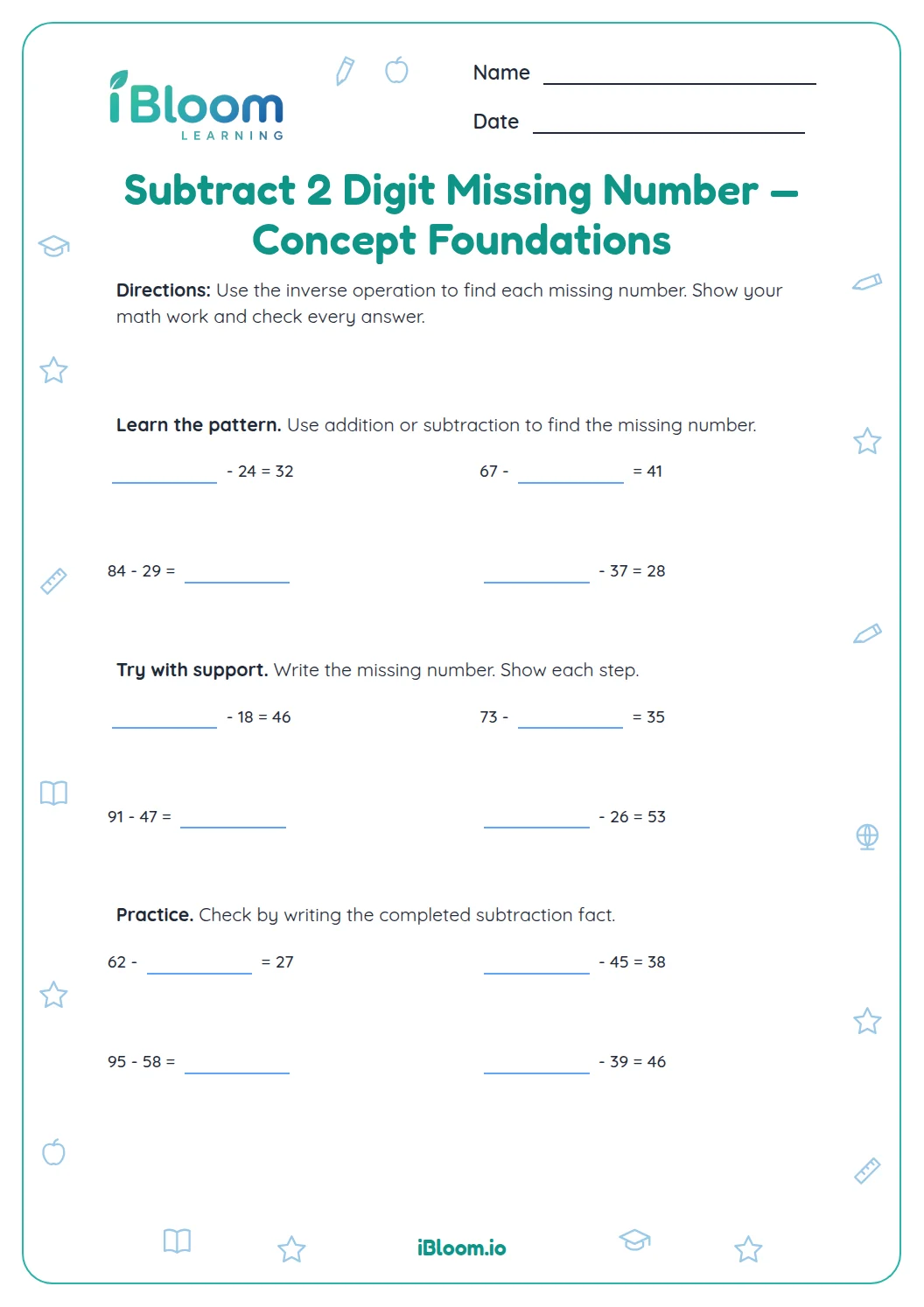
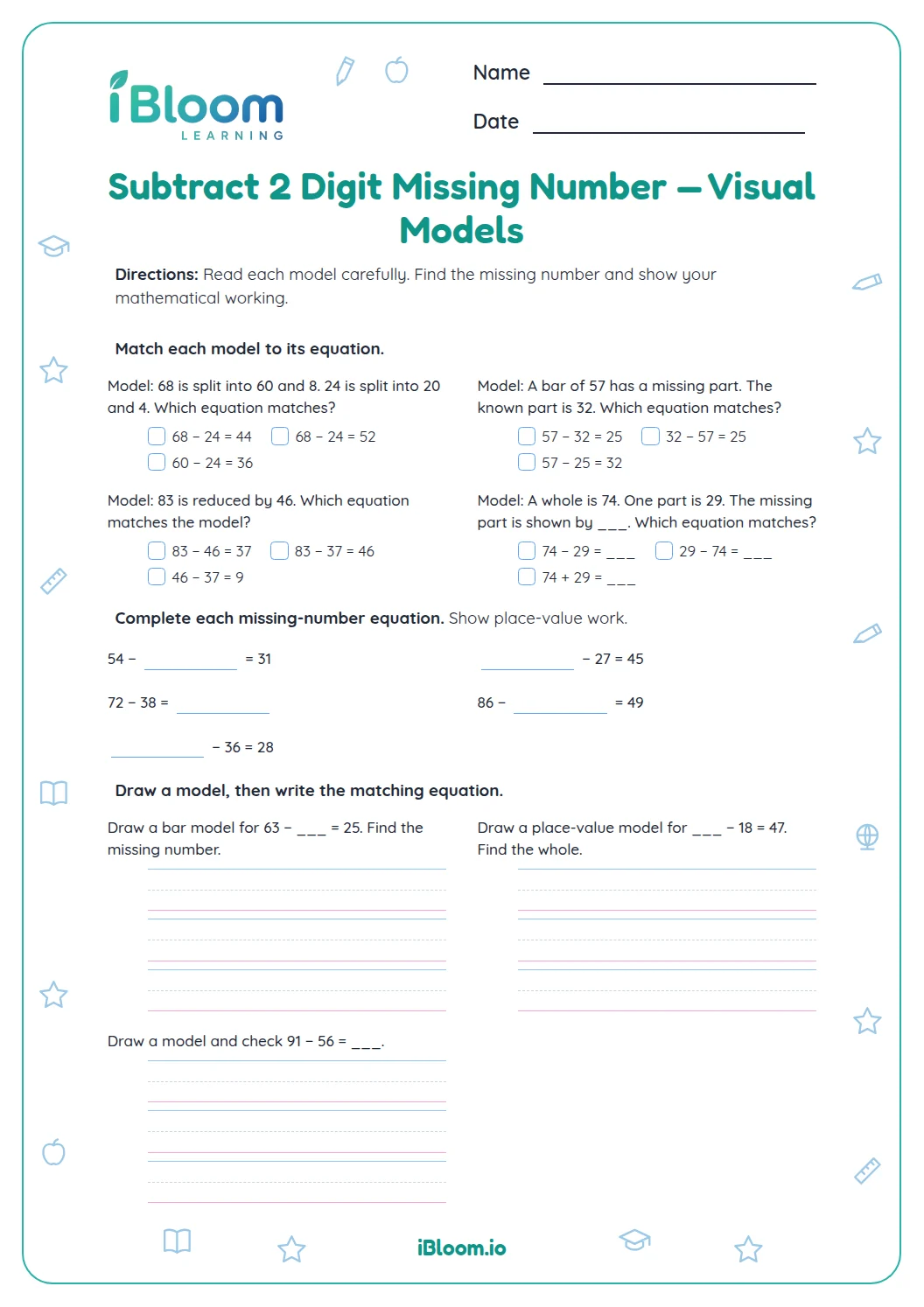
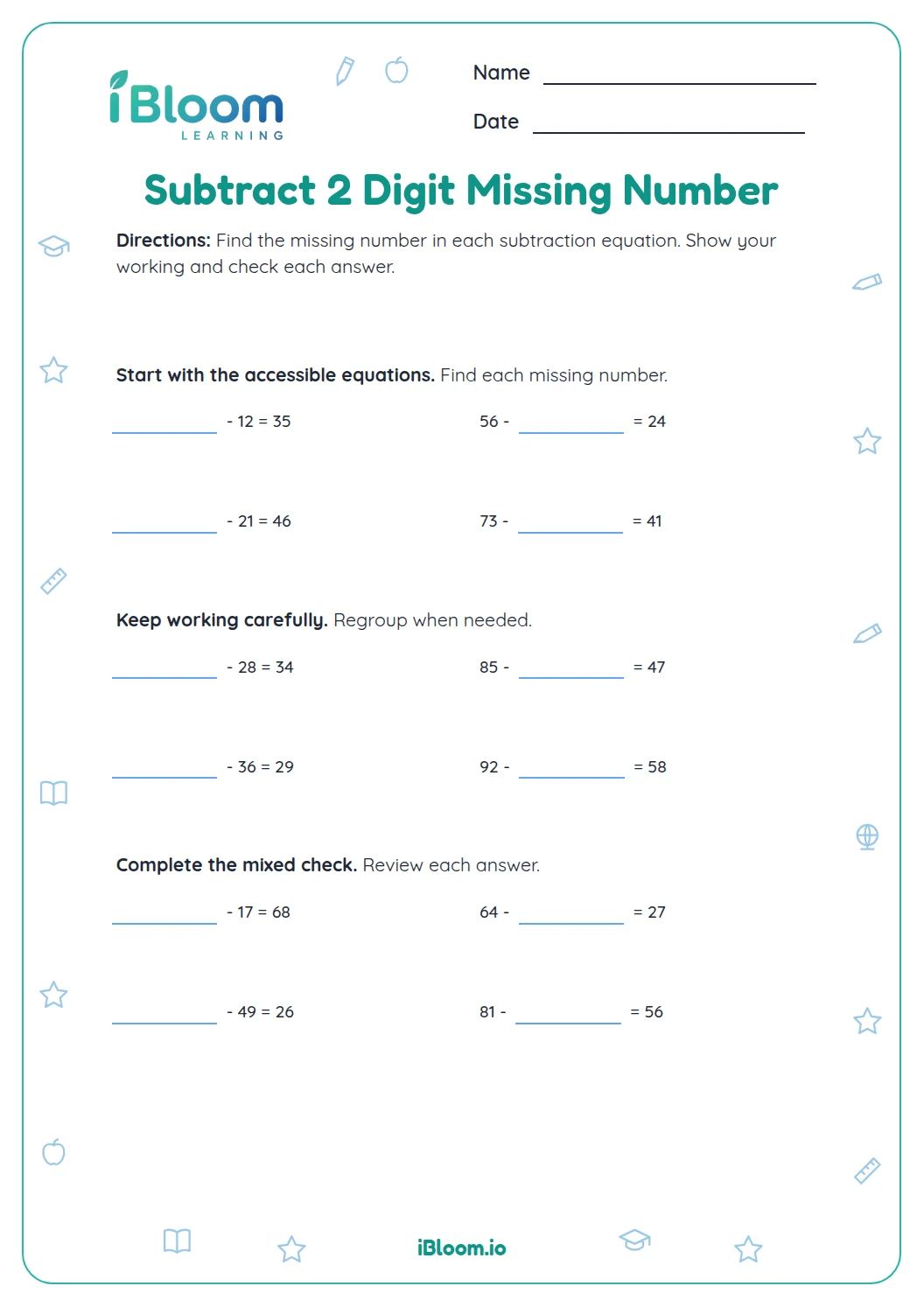
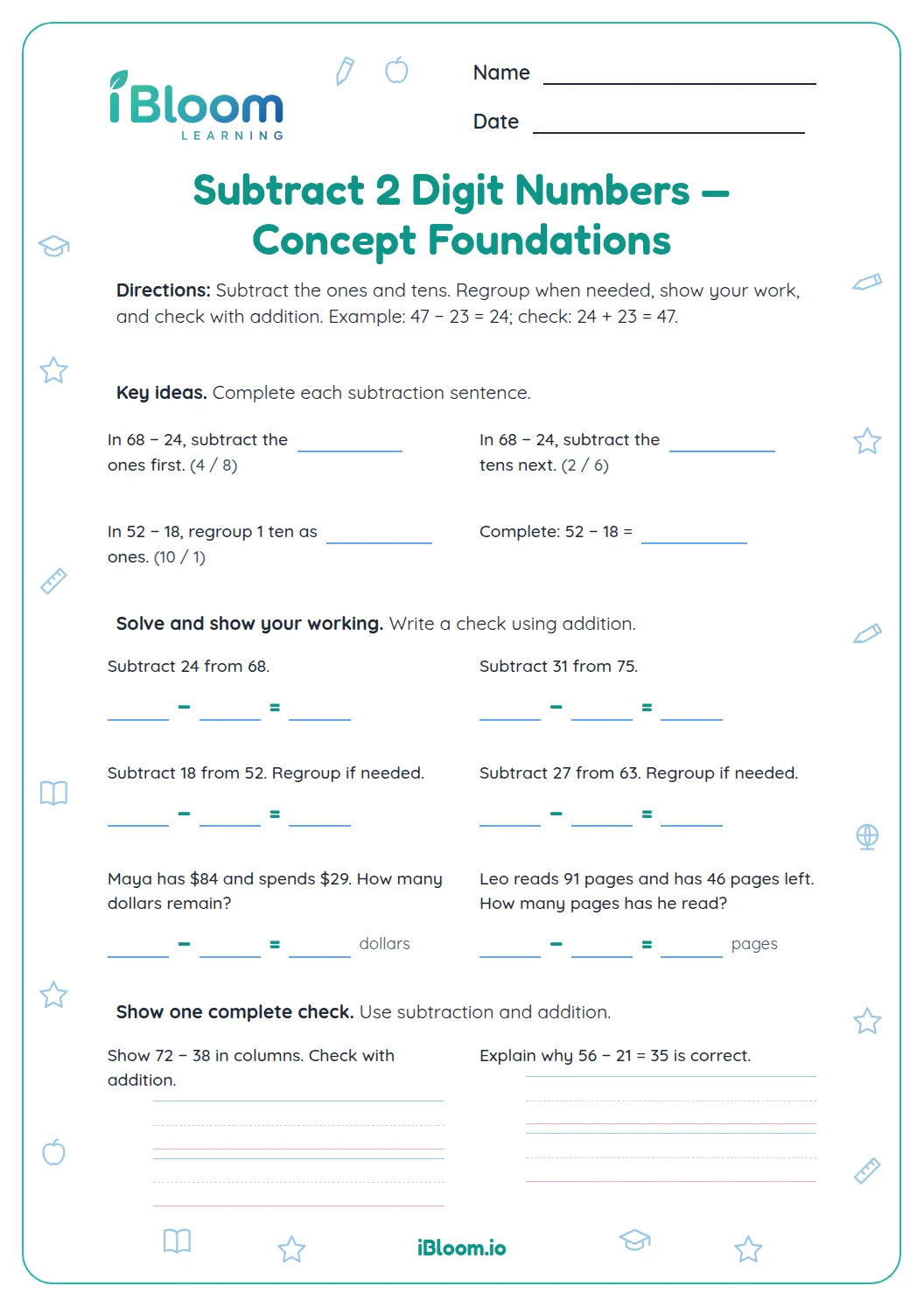
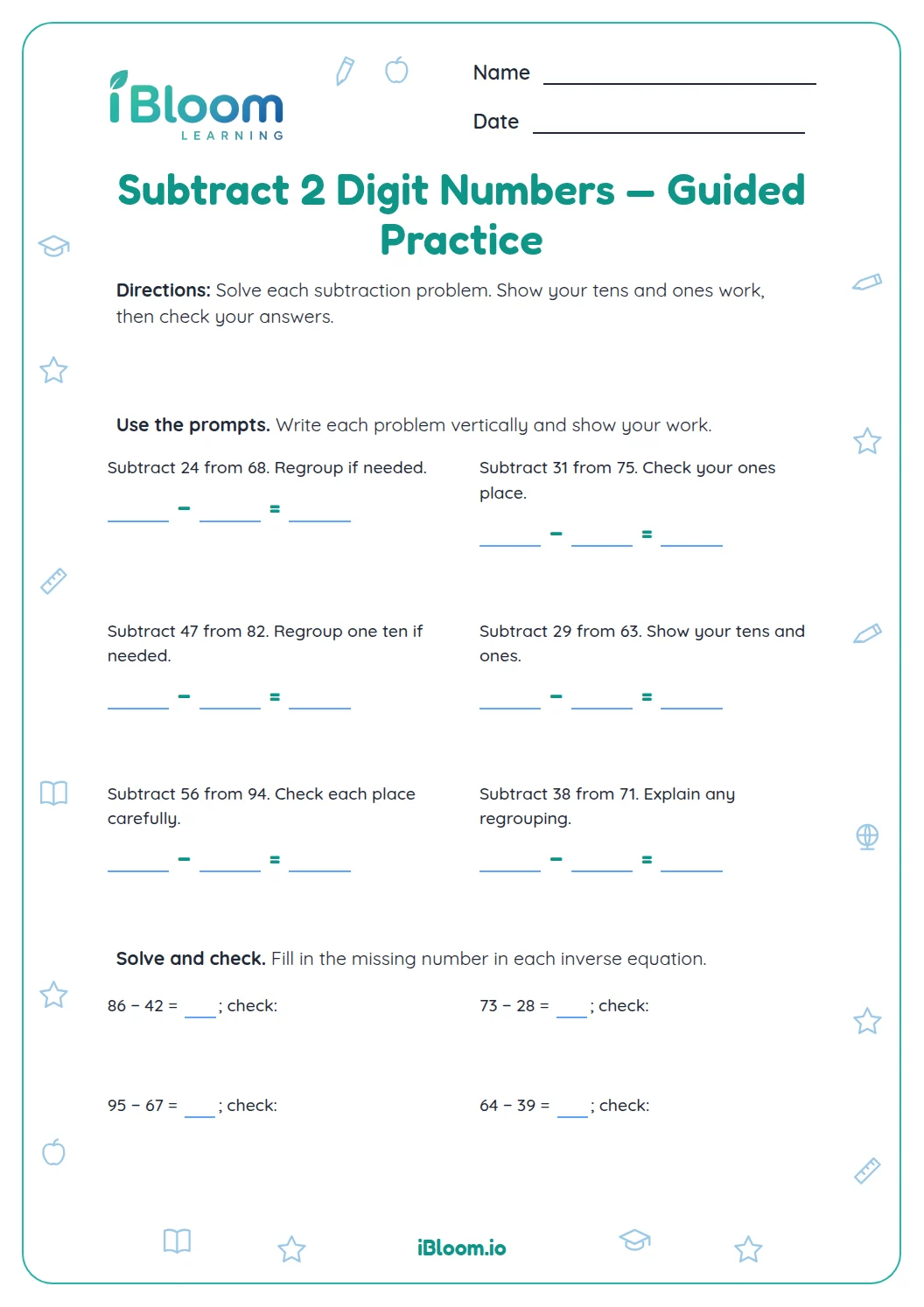
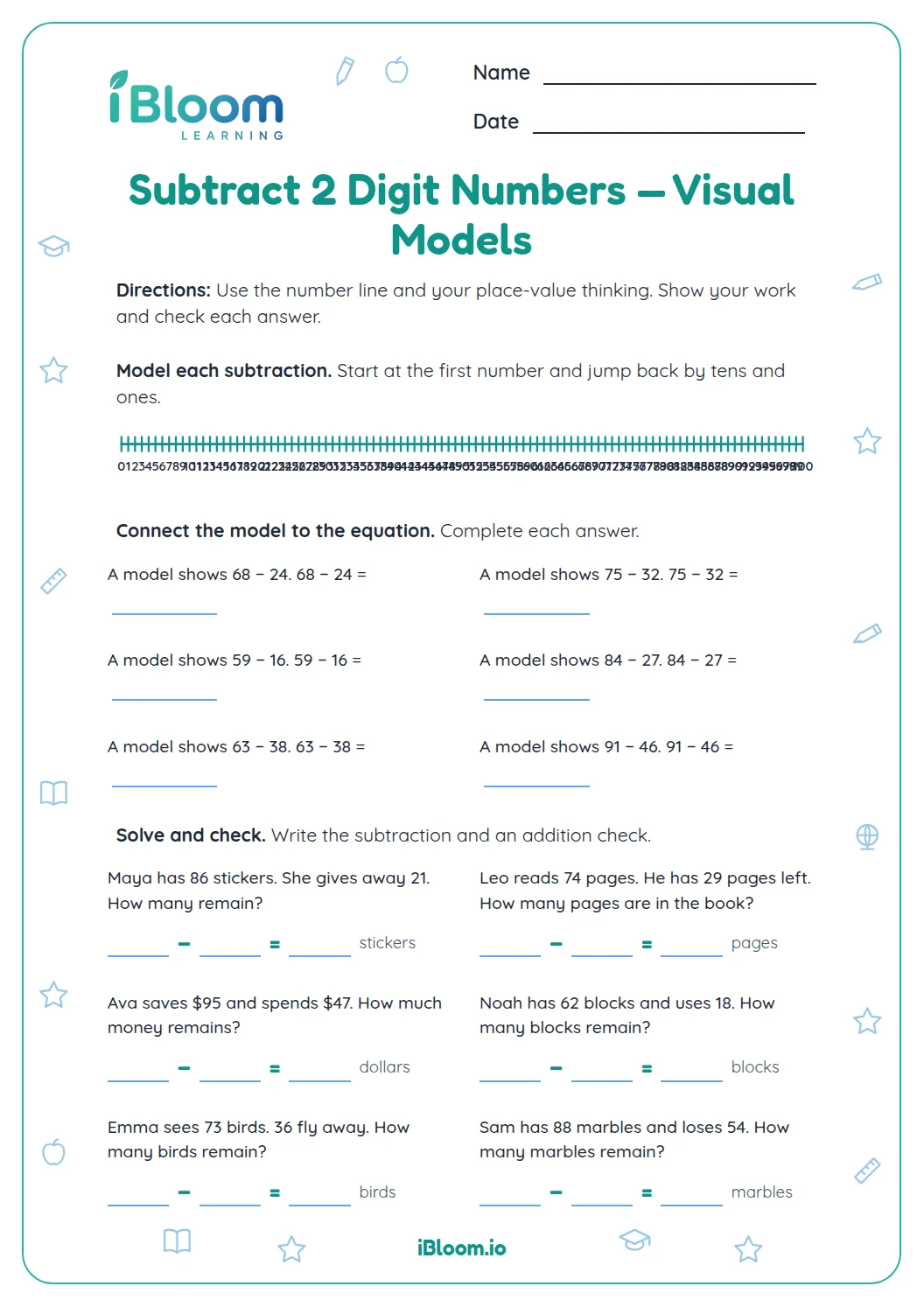
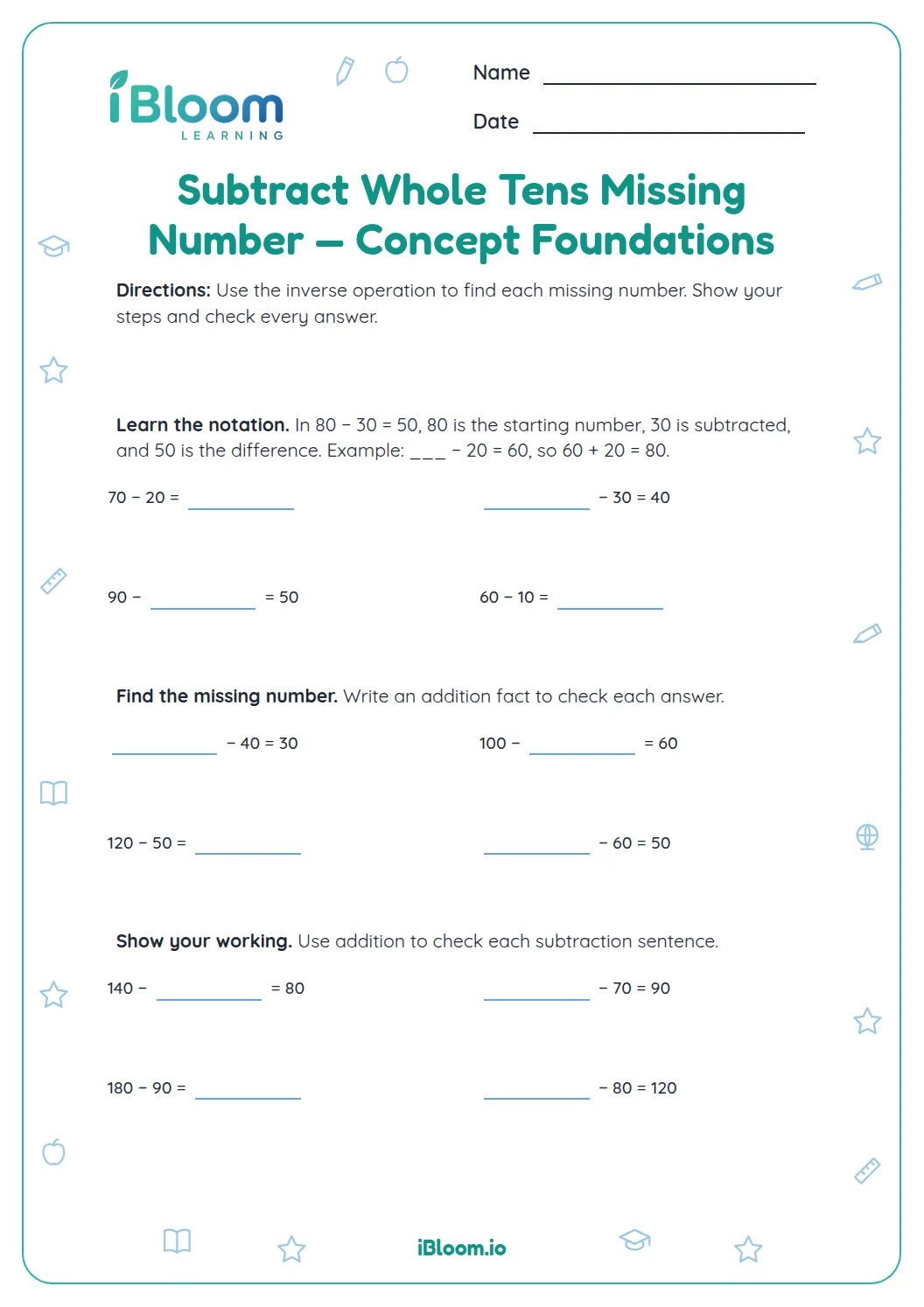
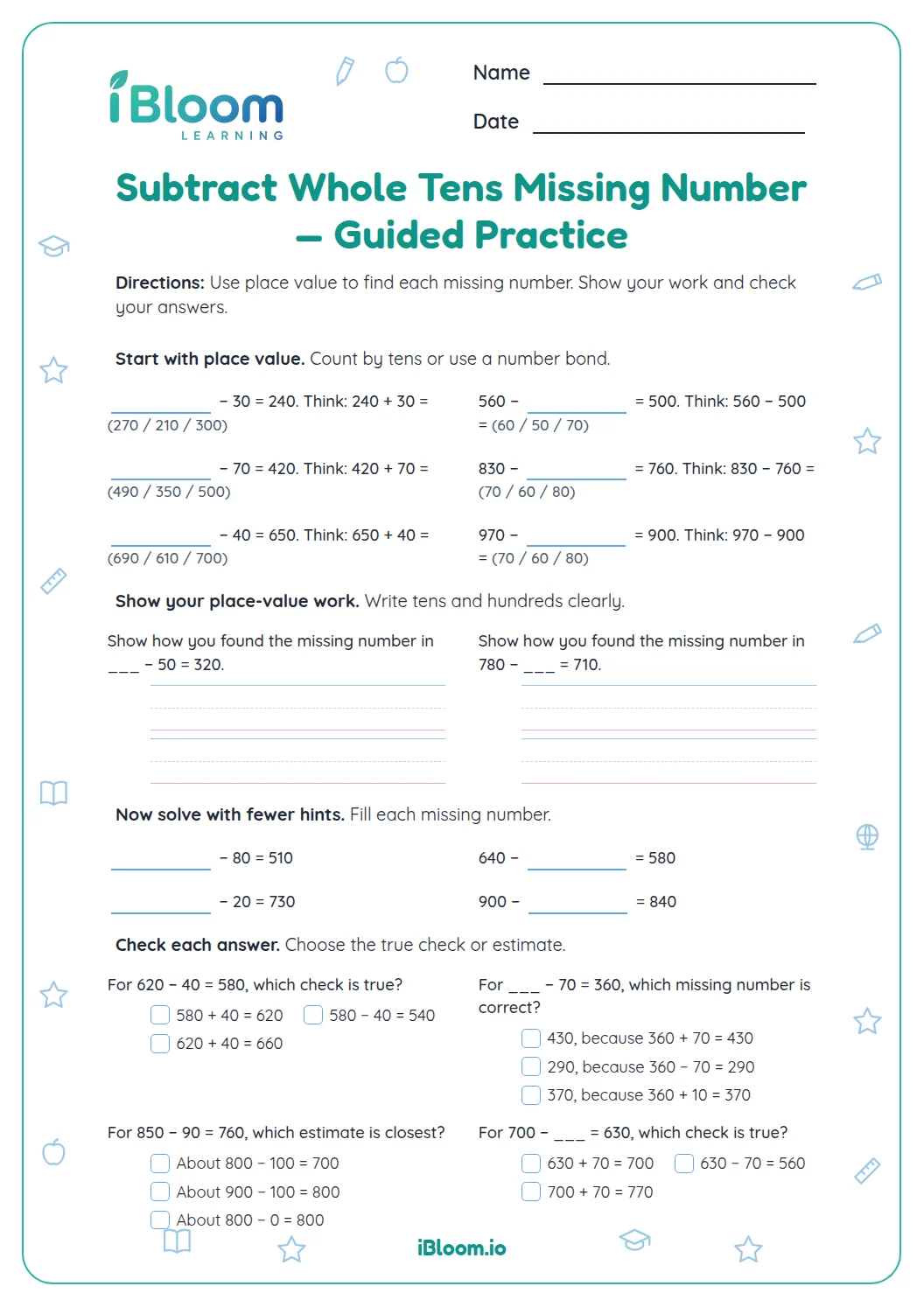
This free Grade 4 worksheet asks children to find missing numbers in two-digit subtraction equations and justify how they found them. The blank can stand for the starting number, the amount removed, or the difference. Six equations lead into four multiple-choice questions about operations and checking, followed by four written challenges, including two ways to solve and an equation to create. Children use column addition and subtraction, explain regrouping, and compare two equations that contain the same numbers in different positions. This practices Common Core 4.NBT.B.4. A separate answer key supplies all missing values and model explanations for the reasoning questions.
Aligned to 4.NBT.B.4
Why does the position of the blank matter?
A subtraction equation describes a starting amount, an amount removed, and an amount left. If the starting amount is missing, put the two known parts together. If either part is missing, subtract the known part from the start.
Question 2 hides the starting amount. Children can add in columns, then put the result back into the original subtraction equation to verify it.
- 1___ − 28 = 45
- 228 + 45 = 73
- 3Check: 73 − 28 = 45
- 4The missing starting number is 73.
How does regrouping help check a claim?
Question 11 shows a plausible error: Ava writes 92 − 56 = 46. She may have made twelve ones without reducing the tens. Rename 92 as 8 tens and 12 ones, then subtract 5 tens and 6 ones to get 36.
Ask for both the corrected number and the place-value explanation. A quick addition check, 36 + 56 = 92, confirms the correction.
Why do A and B have different values?
Question 12 uses 71 and 26 twice, but A and B have different roles. A is removed from 71 to leave 26, so A equals 45. B is the starting number from which 26 is removed to leave 71, so B equals 97.
A successful explanation connects each value to its own equation. Have children substitute both values before deciding that B is greater.
How can children solve and create equations in Part D?
Question 13 revisits 76 − ___ = 29. Subtracting 29 from 76 gives 47. Counting up reaches the same result: add 1 to reach 30, 40 to reach 70, and 6 to reach 76. The jumps total 47.
Question 14 asks children to write an equation whose missing number is 32, then fill it in and check it. For example, 68 − ___ = 36 becomes 68 − 32 = 36. The addition check is 36 + 32 = 68. Accept other correct equations.
How to use this worksheet
- 1Name the starting number, amount removed, and difference in question 1.
- 2For Part A, align tens and ones when adding or subtracting in columns.
- 3Substitute each answer into its original equation and check equality.
- 4In Part B, read the whole calculation choice, including the claimed result.
- 5For Part C, explain the tens change and the different roles of A and B.
- 6In Part D, compare the two solutions for question 13 and substitute 32 into the equation created for question 14.
Mistakes to discuss and fix
The mistake
Subtracting 28 from 45 to solve ___ − 28 = 45.
The fix
The blank is the starting number. Add the amount removed to the amount left: 28 + 45 = 73.
The mistake
Writing 46 for 92 − 56 after making twelve ones.
The fix
Cross out 9 tens and record 8 tens when exchanging one ten for ten ones.
The mistake
Using the same answer for A and B in question 12.
The fix
Read both equations aloud with the words start, remove, and left before calculating.
Common Core alignment
Use column addition and subtraction to find missing values and explain a regrouping correction.
On this sheet: Part A requests column calculations, and question 11 requires an explanation of regrouping in two-digit subtraction.
Show the official wordingHide the official wording
Fluently add and subtract multi-digit whole numbers using the standard algorithm.
What to practice next
Make more practice
Further reading
Questions parents and teachers ask
Which number can be missing on this sheet?
The blank can be the starting number, the amount removed, or the difference. Part A mixes all three positions, so children must read each equation before choosing an operation. Part B then asks them to select calculations and checks that match those different roles.
Should children use column calculations?
Yes, Part A asks children to use column addition or subtraction to find each missing value. They can work beside the equation or on scratch paper. Align the tens and ones, record any regrouping, and then substitute the answer into the original equation to check it.
Why is Ava’s answer of 46 wrong?
Ava may have kept nine tens after exchanging one ten for ten ones. In 92 − 56, the correct regrouping is eight tens and twelve ones. Subtracting gives three tens and six ones, or 36. Adding 36 and 56 returns 92 and confirms the result.
What is the answer to the A and B challenge?
A equals 45 and B equals 97, so B is greater. In 71 − A = 26, subtract 26 from 71 to find the removed part. In B − 26 = 71, add 26 to 71 to recover the starting amount. Substitute both values to check.
How should I mark the written explanations?
Accept correct mathematics with a clear reason, even when wording differs from the key. Question 11 explains regrouping; question 12 compares A = 45 and B = 97. Question 13 needs two methods giving 47. Question 14 needs a valid equation with missing number 32 and a check.