

About this worksheet
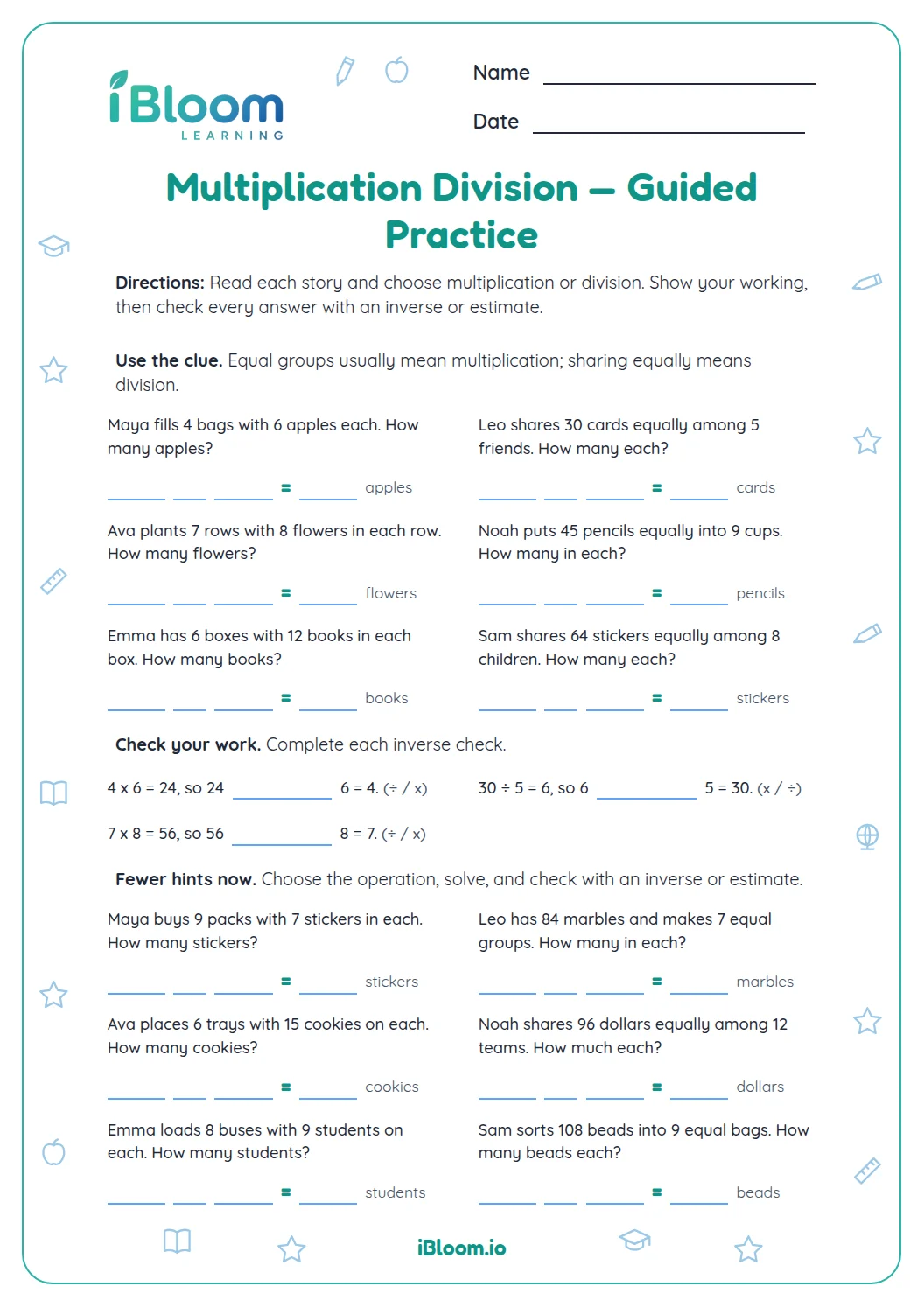
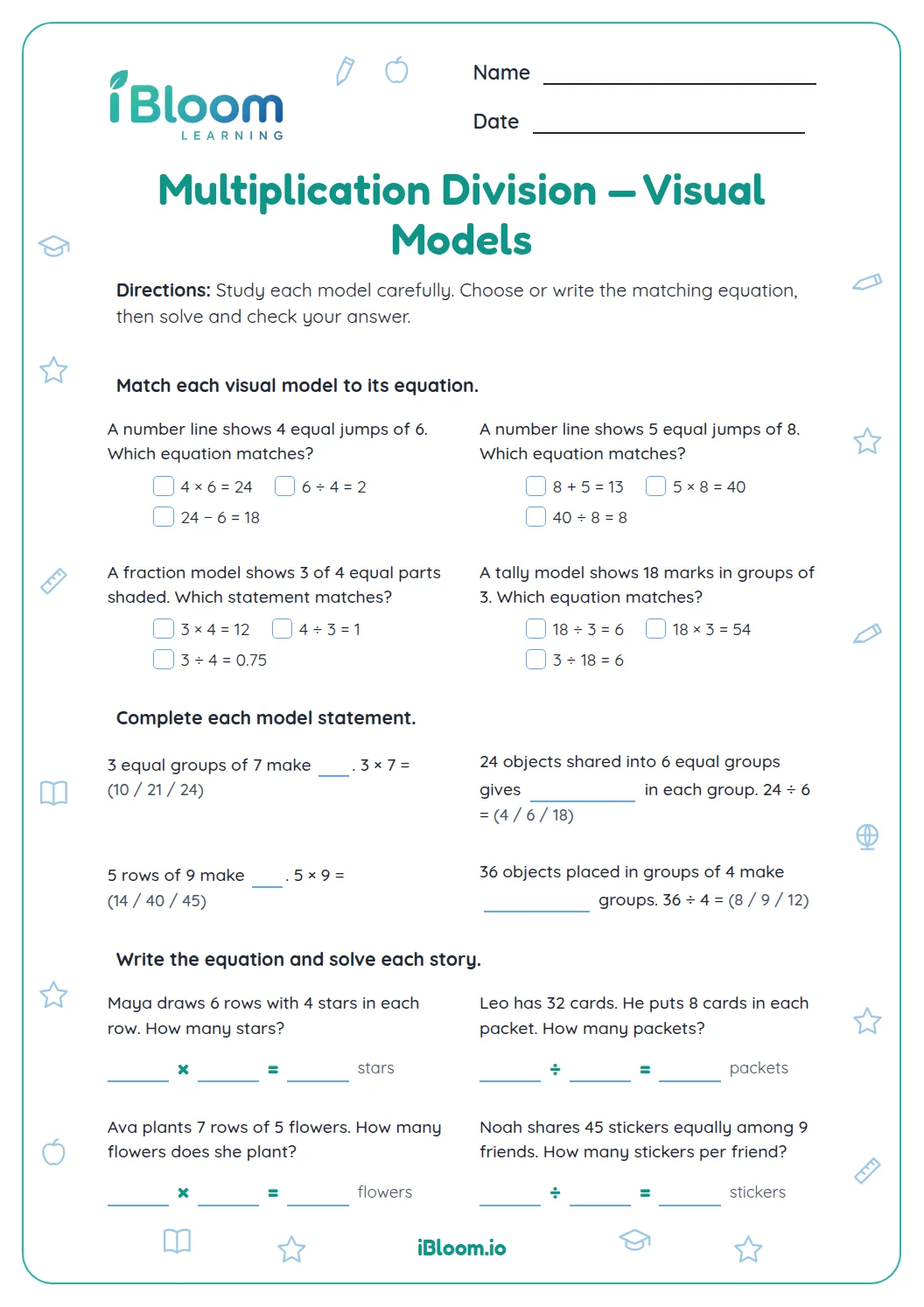
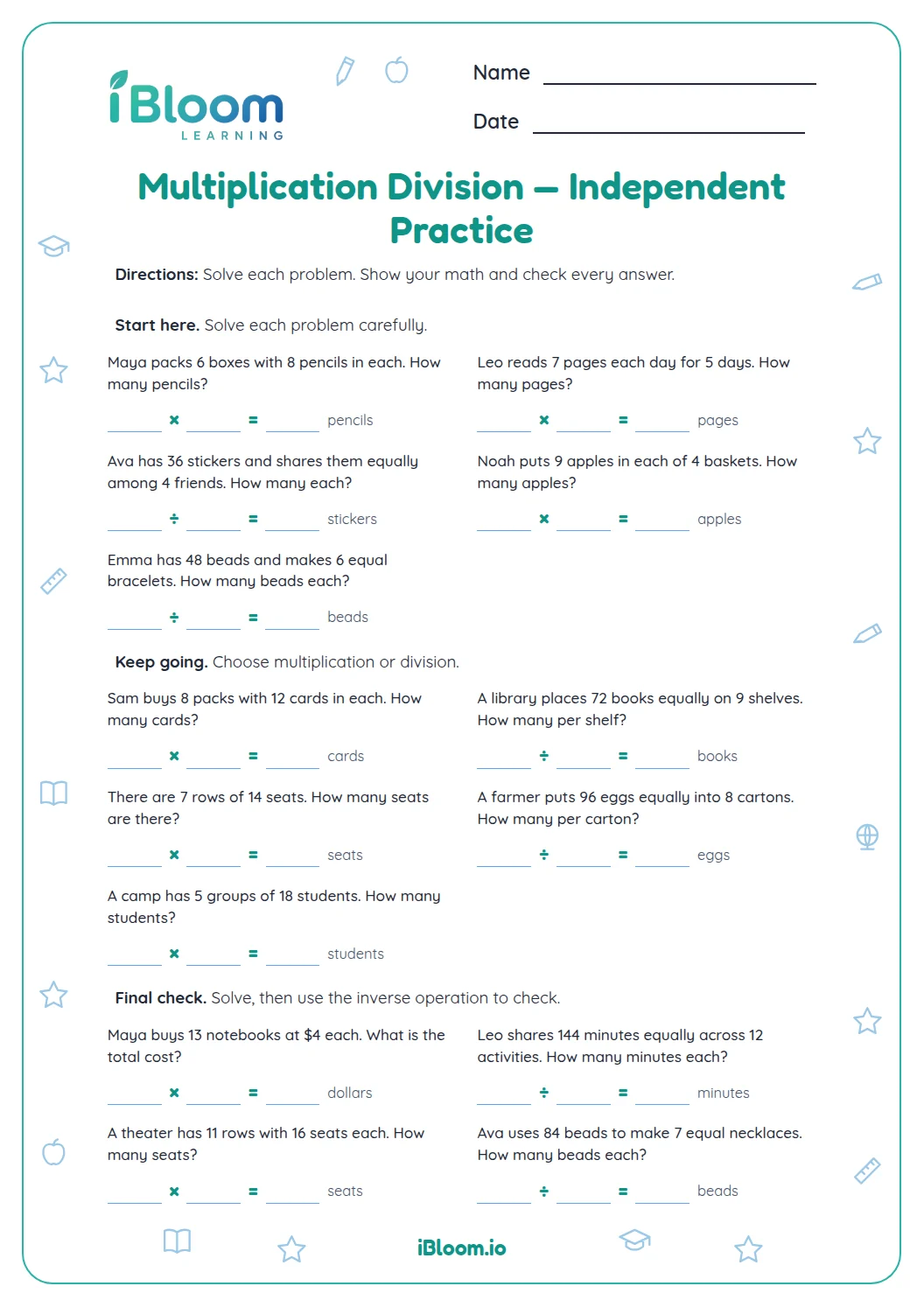
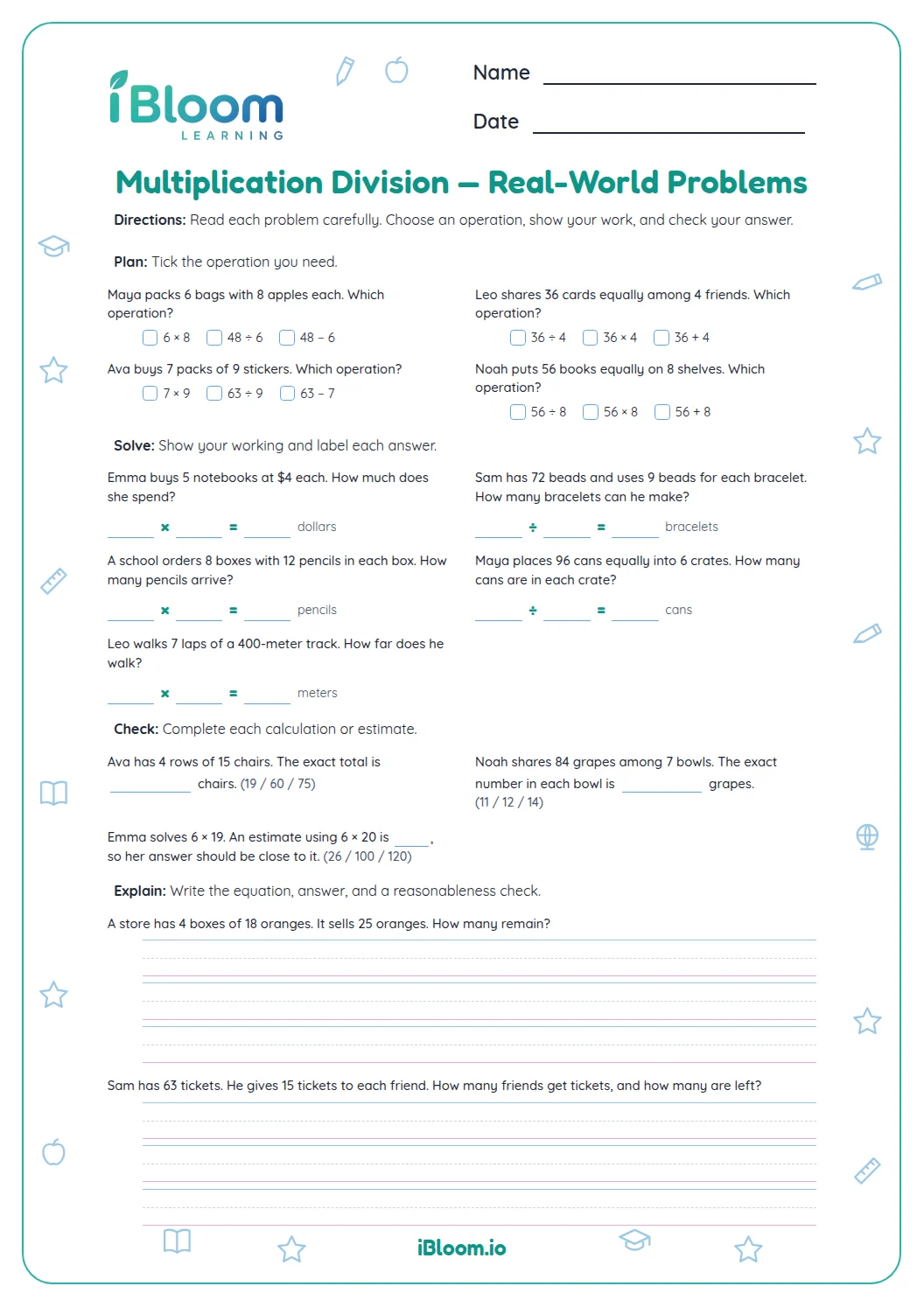
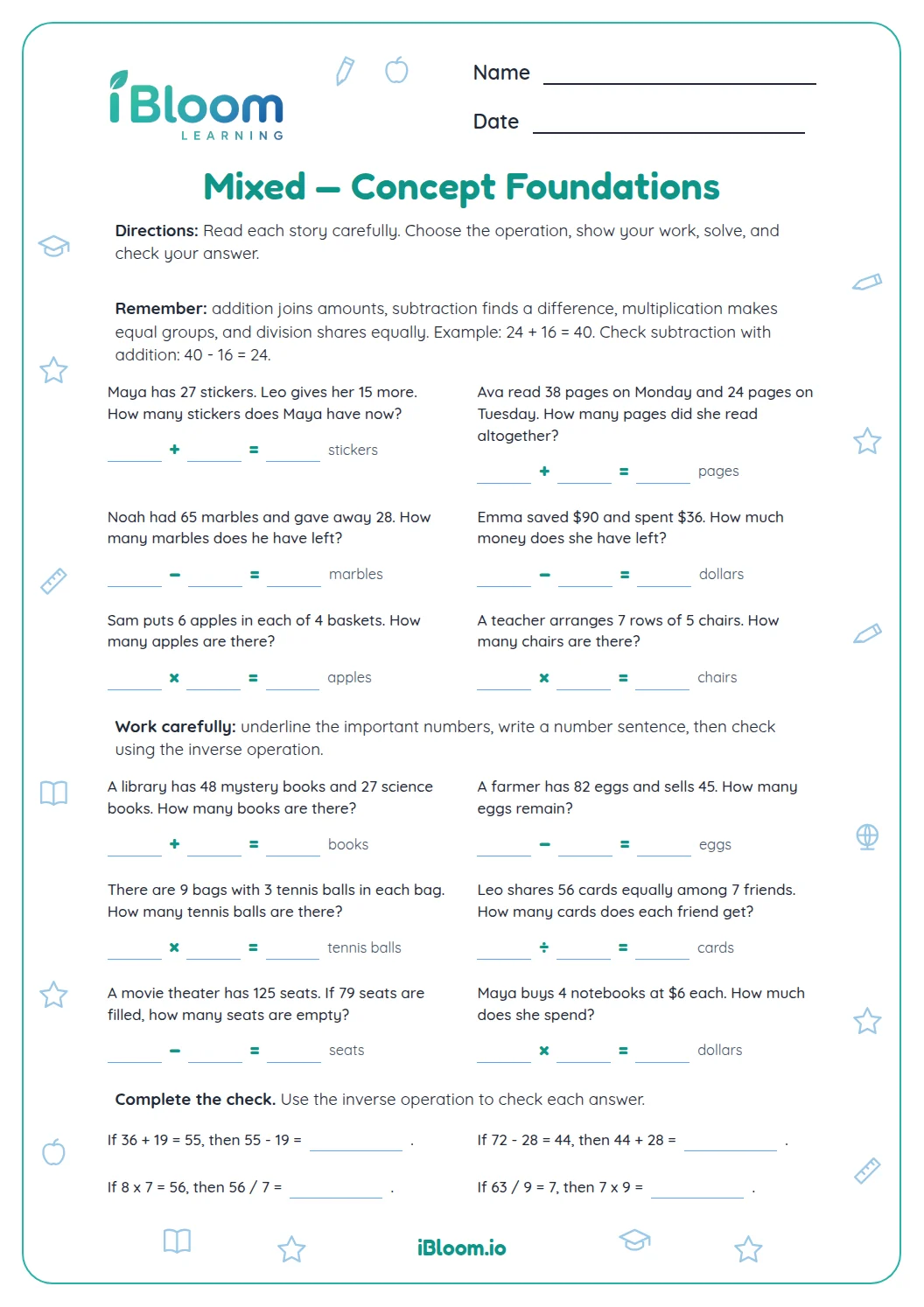
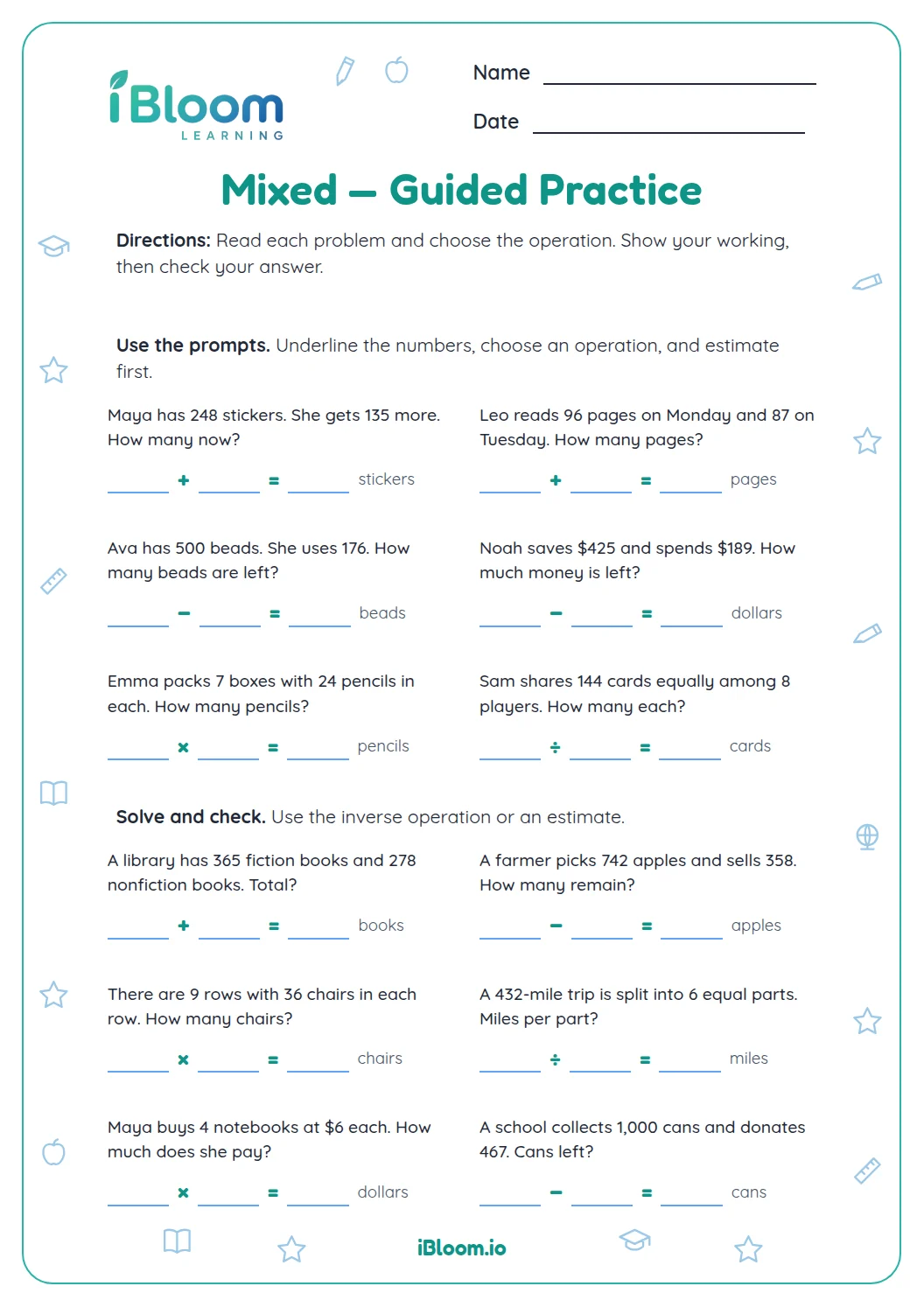
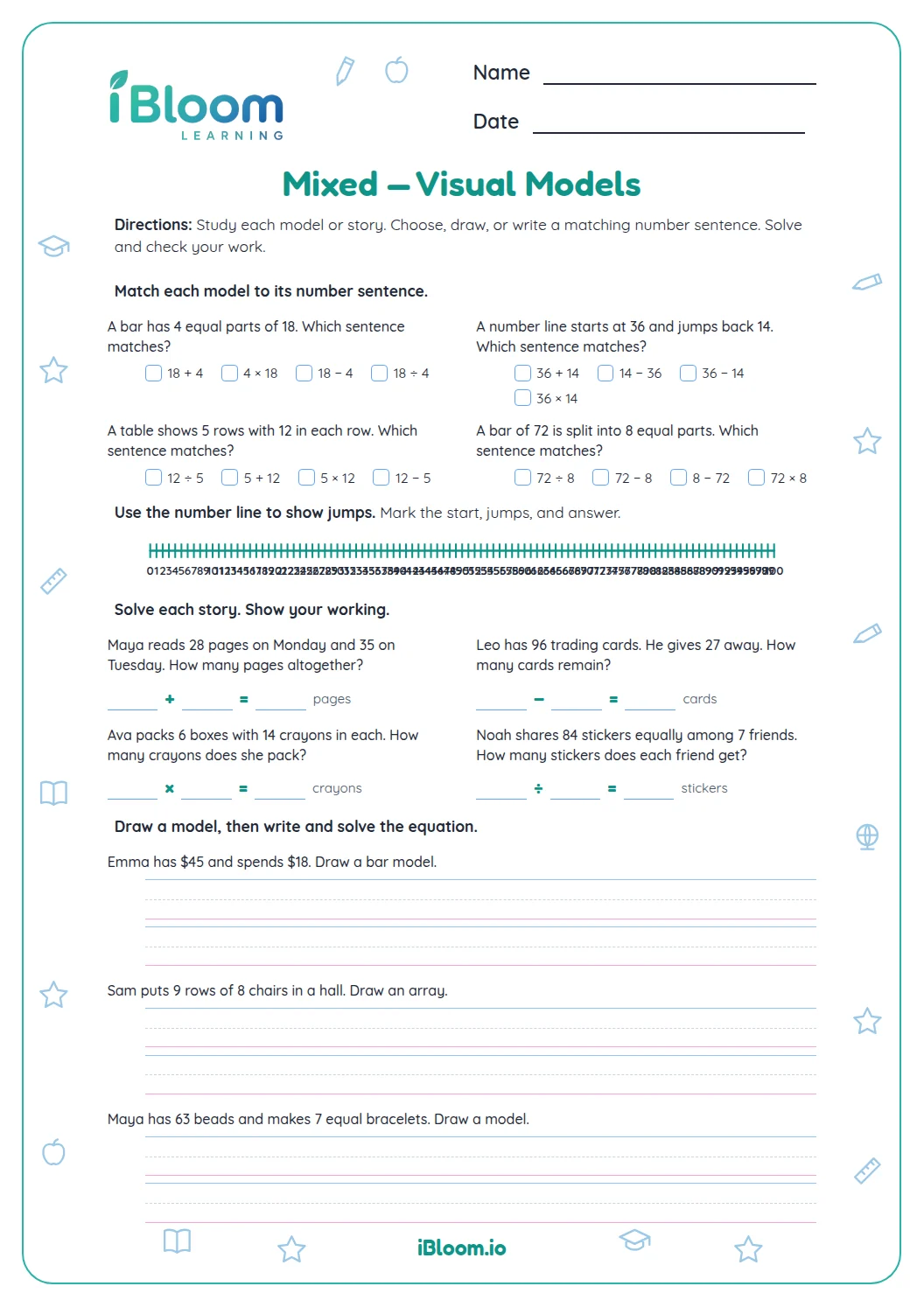
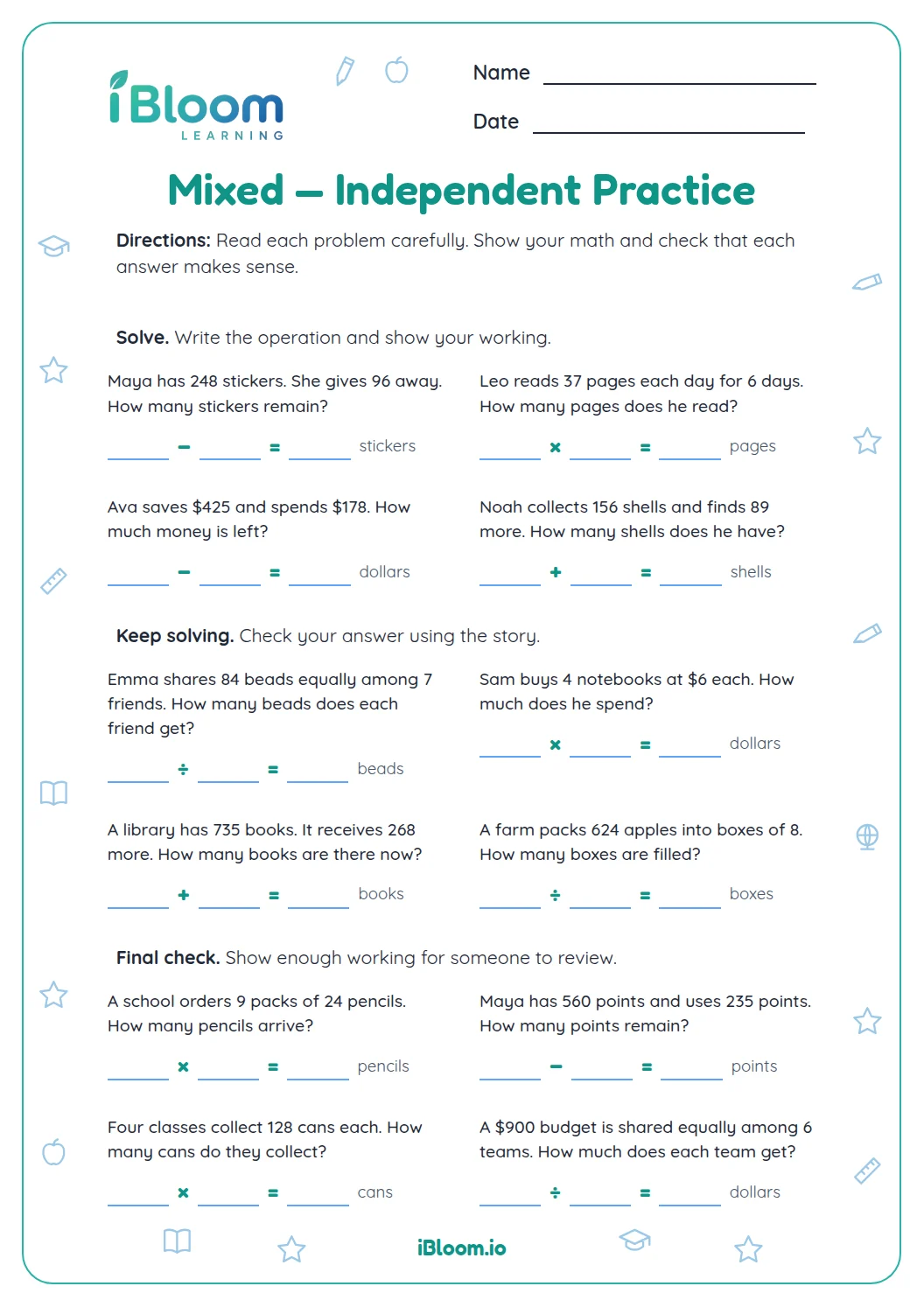
This free Grade 4 worksheet builds multiplication and division meanings before students solve multiplicative comparisons. Part A connects equal groups with multiplication or division. Part B gives four comparison stories with a missing number in an equation. Part C has four comparison equations to complete and check with the inverse operation. Part D adds two equal-group checks. These 14 items practice Common Core 4.OA.A.2.
Aligned to 4.OA.A.2
What does “times as many” mean?
Multiplication finds the total in equal groups. In question 1, four groups of six make 4 × 6 = 24. Division can find how many are in each equal group or how many groups there are.
Name the groups and the amount in each before choosing an operation. The first part asks children to connect equal-group situations with multiplication or division.
When does a comparison need division?
Use division when the larger amount is known and the smaller amount or multiplier is missing. Question 10 gives a 96-mile trail that is four times the path length, so 96 ÷ 4 finds the 24-mile path.
- 1Question 10: A trail is 96 miles, four times a path.
- 2Divide the larger distance by the comparison factor.
- 396 ÷ 4 = 24 miles.
- 4Check: 24 × 4 = 96 miles.
How do students complete and check the final equations?
Part A connects equal groups with multiplication and division. Part B uses equations to represent multiplicative comparisons. In Part C, students complete four comparison equations, then check with the inverse operation. For example, 96 ÷ 4 = 24 can be checked with 24 × 4 = 96. Part D returns to two equal-group questions.
How to use this worksheet
- 1Use question 1 to connect equal groups with multiplication.
- 2For Part A, read whether the question asks for a total or an equal share.
- 3For Part B, fill the missing number and read the equation in the story.
- 4Complete each Part C comparison equation, then check it with the inverse operation.
- 5Use the requested unit or comparison in your final answer.
Mistakes to notice and fix
The mistake
Using 7 + 3 for three times as many as seven.
The fix
Think of three equal groups of seven and write 7 × 3.
The mistake
Multiplying 32 by 4 when 32 is already the larger rope length.
The fix
Write smaller length × 4 = 32; division finds the missing length.
The mistake
Writing 5 points for the last answer.
The fix
Write 5 in the box and explain “5 times as many,” since 18 × 5 = 90.
Common Core alignment
Use multiplication and division to solve “times as many” comparison stories.
On this sheet: The unknown changes among the larger amount, smaller amount, and comparison multiplier.
Show the official wordingHide the official wording
Multiply or divide to solve word problems involving multiplicative comparison, e.g., by using drawings and equations with a symbol for the unknown number to represent the problem, distinguishing multiplicative comparison from additive comparison.
What to practice next
Make more practice
Further reading
Questions parents and teachers ask
Which kinds of unknowns appear on this worksheet?
Students find all three unknowns in a multiplicative comparison: the larger amount, the smaller amount, and the multiplier. For example, question 9 finds the larger amount from 24 cans and a factor of 3, question 10 finds the smaller distance, and question 12 finds how many times as many points Blue has.
Why does “times as many” sometimes lead to division?
The comparison describes a multiplication relationship, but a factor may be missing. In question 10, the 96-mile trail is four times the path length, so 96 ÷ 4 finds a 24-mile path. Check by multiplying 24 × 4 to get 96 miles.
How can I explain the difference between “more” and “times as many”?
Question 1 shows four equal groups of six. Four more than six would be ten, but four groups of six are 24. Ask your child to picture four groups with six in each group, then choose the multiplication equation that finds the total.
Do students need to write equations for every question?
Students choose an operation in Part A, fill comparison equations in Part B, then complete four comparison equations in Part C. Part D gives two quick equal-group checks. The sheet has no large work grids, so children can show extra steps on scrap paper and check division by multiplying.
How should I use the answer key to check the working?
Check that the operation matches the story and the number is correct. For question 10, 96 ÷ 4 = 24 gives the path length; multiply 24 × 4 to check. For question 14, 48 ÷ 6 = 8 crayons per table, and 8 × 6 returns 48.