




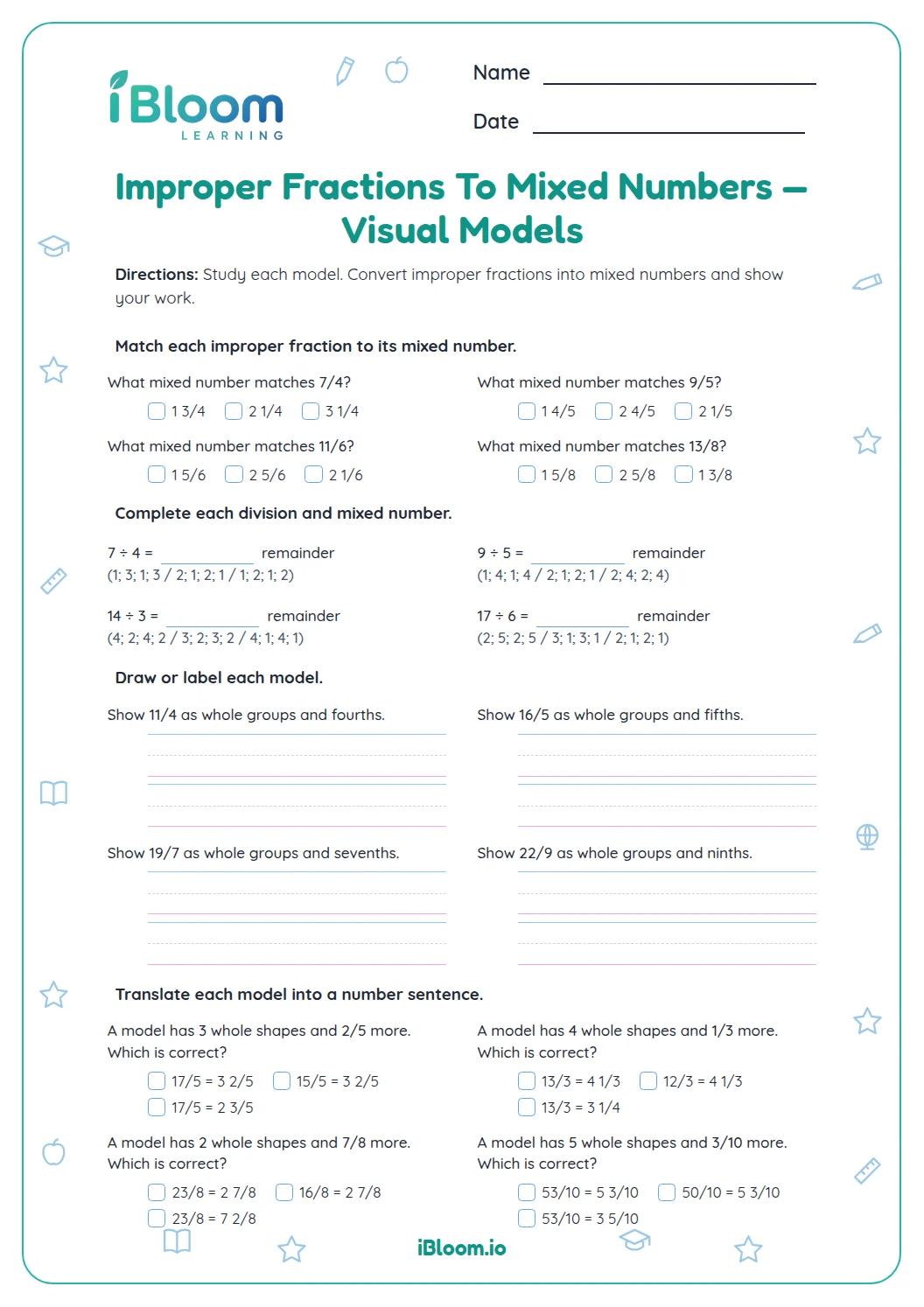

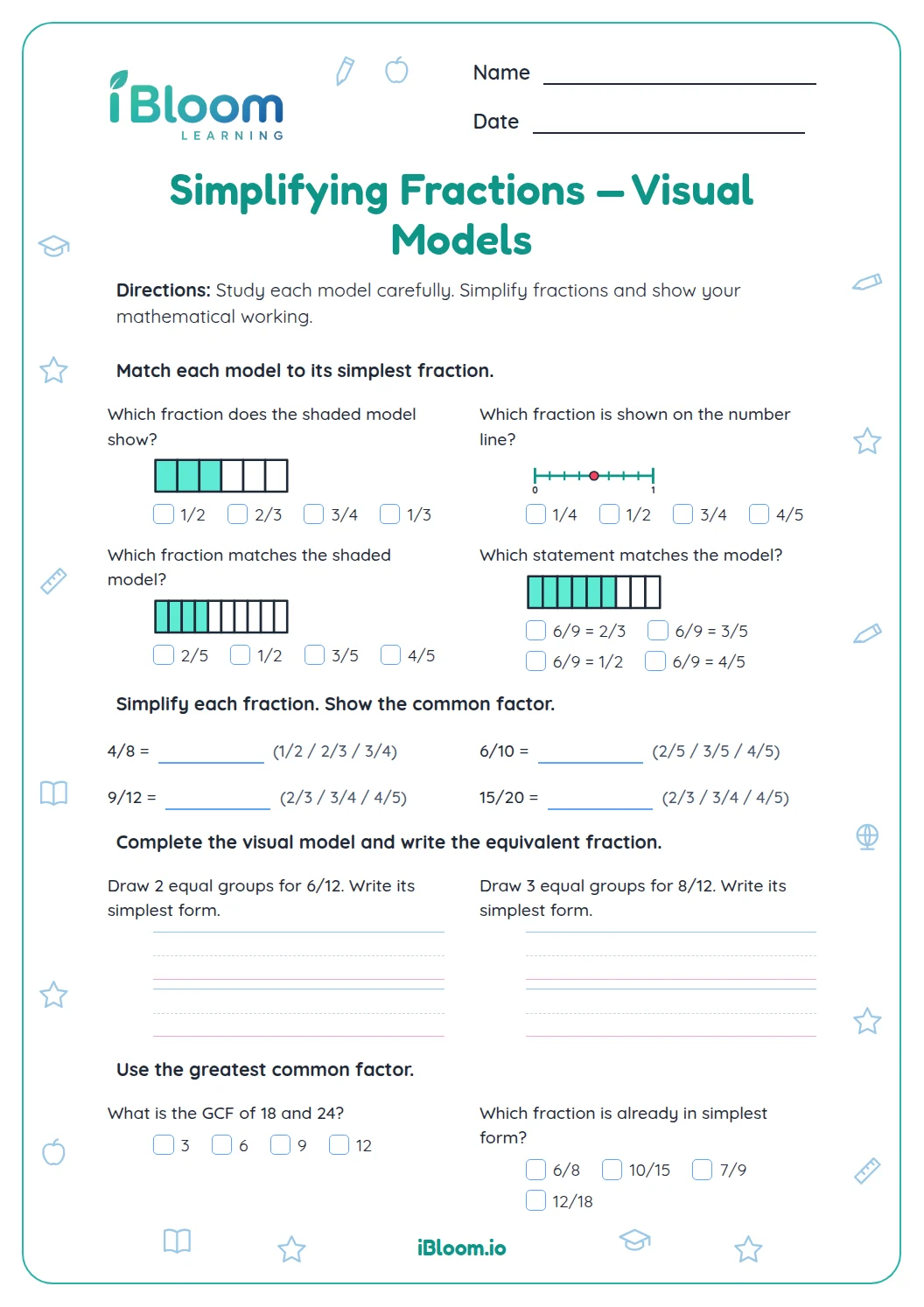
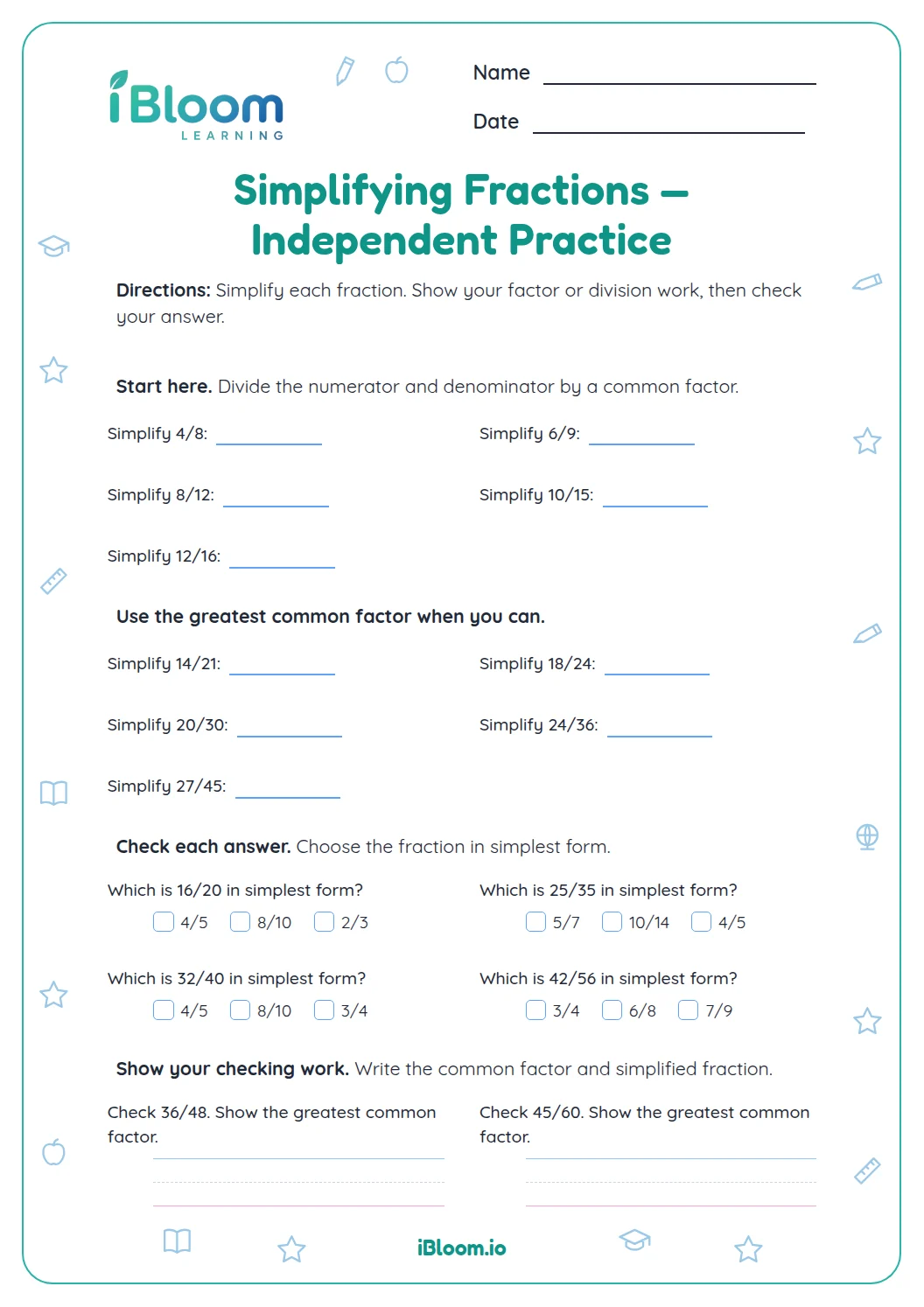
About this worksheet
This Grade 5 reasoning worksheet practices converting mixed numbers to improper fractions. Students complete eight conversions, choose equivalent improper fractions in four checks, and explain or repair four pieces of reasoning. The key provides the converted numerators and sample explanations.
How do you convert a mixed number?
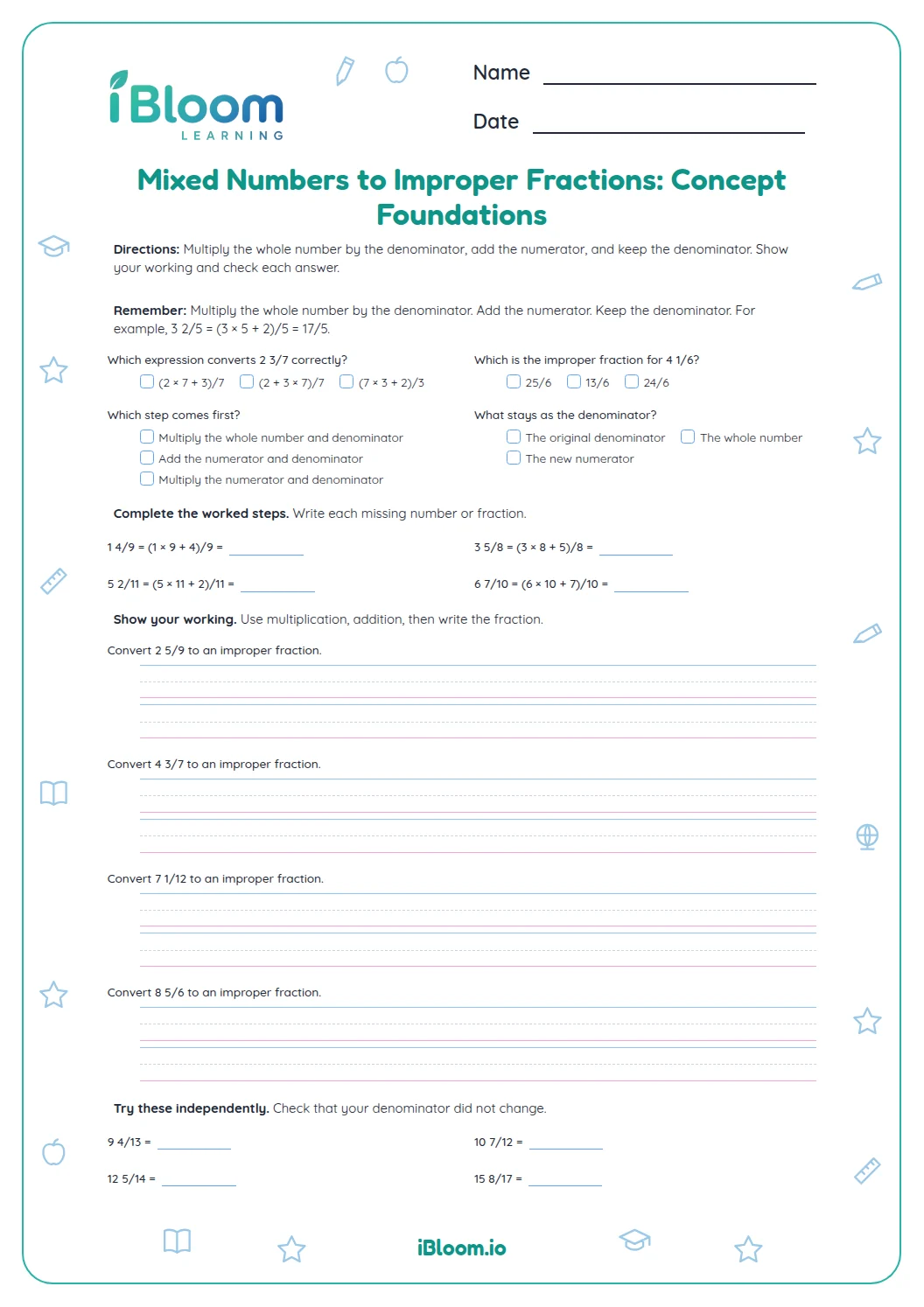
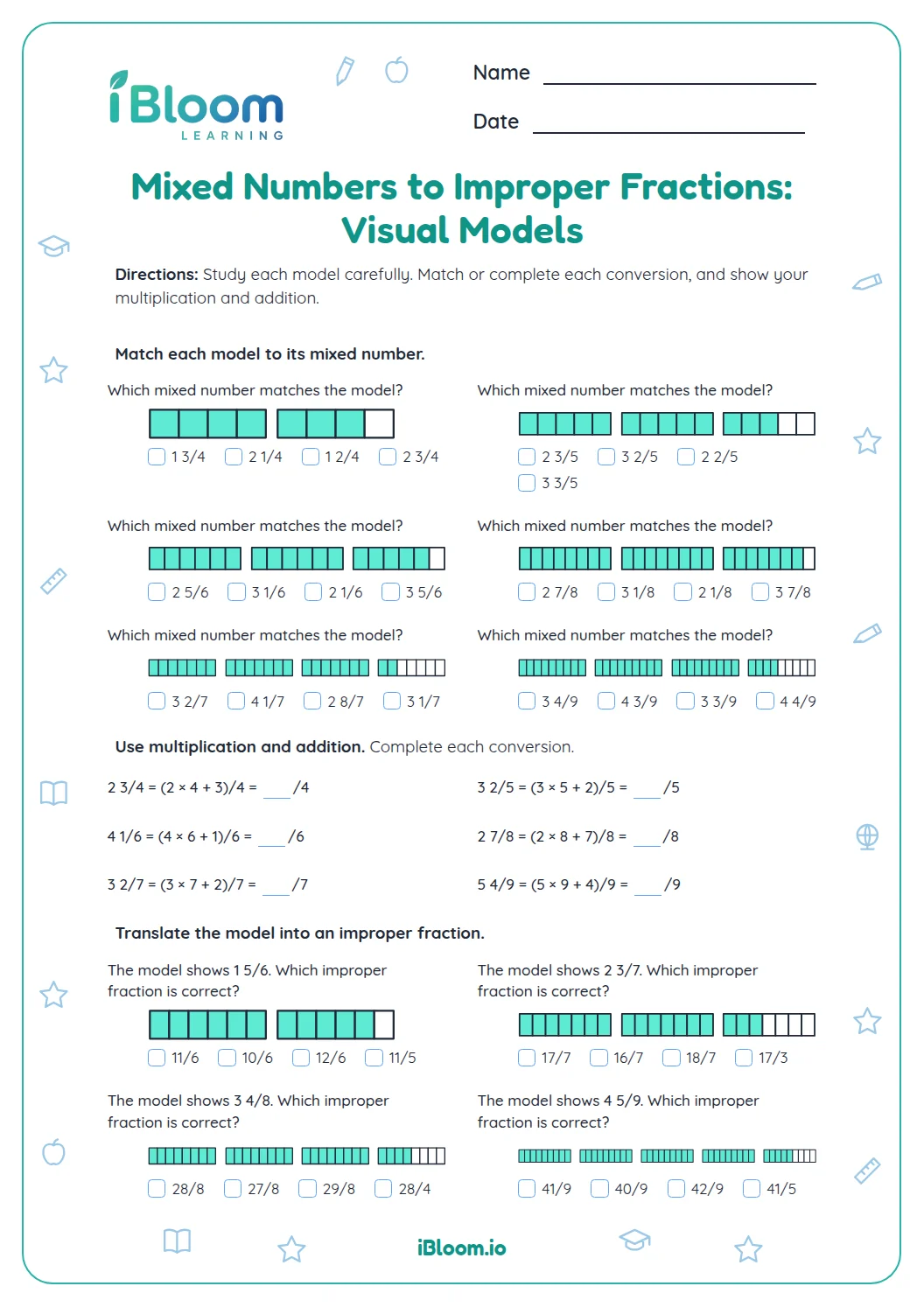
A mixed number contains whole units and a fraction of another unit. To rewrite it as an improper fraction, multiply the whole number by the denominator, then add the numerator. Keep the denominator because the size of each fractional part does not change.
For 2 3/5, two wholes are 10 fifths. Add 3 fifths to get 13/5.
- 12 3/5 = (2 × 5 + 3)/5 = 13/5.
How can you check an improper fraction?
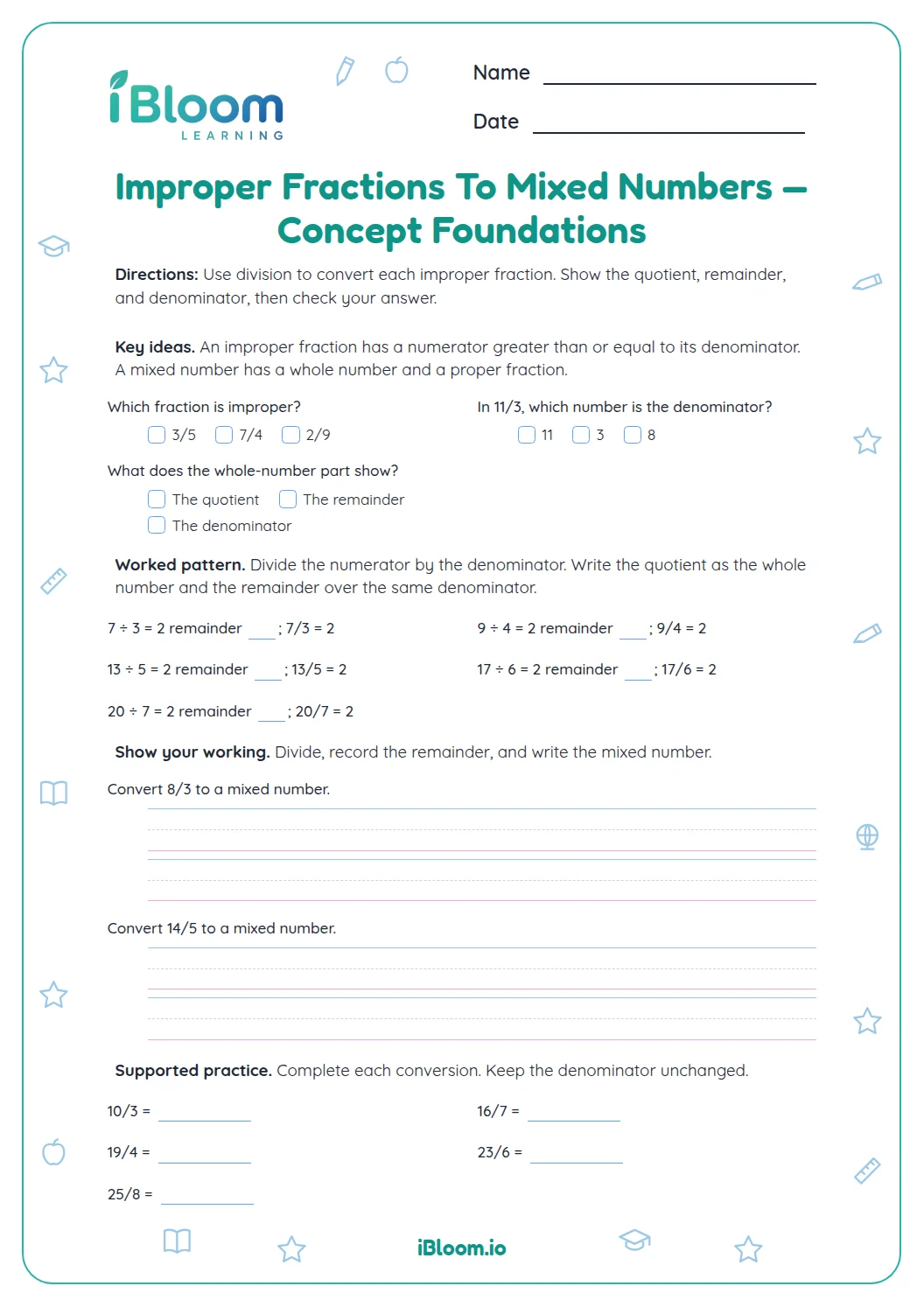
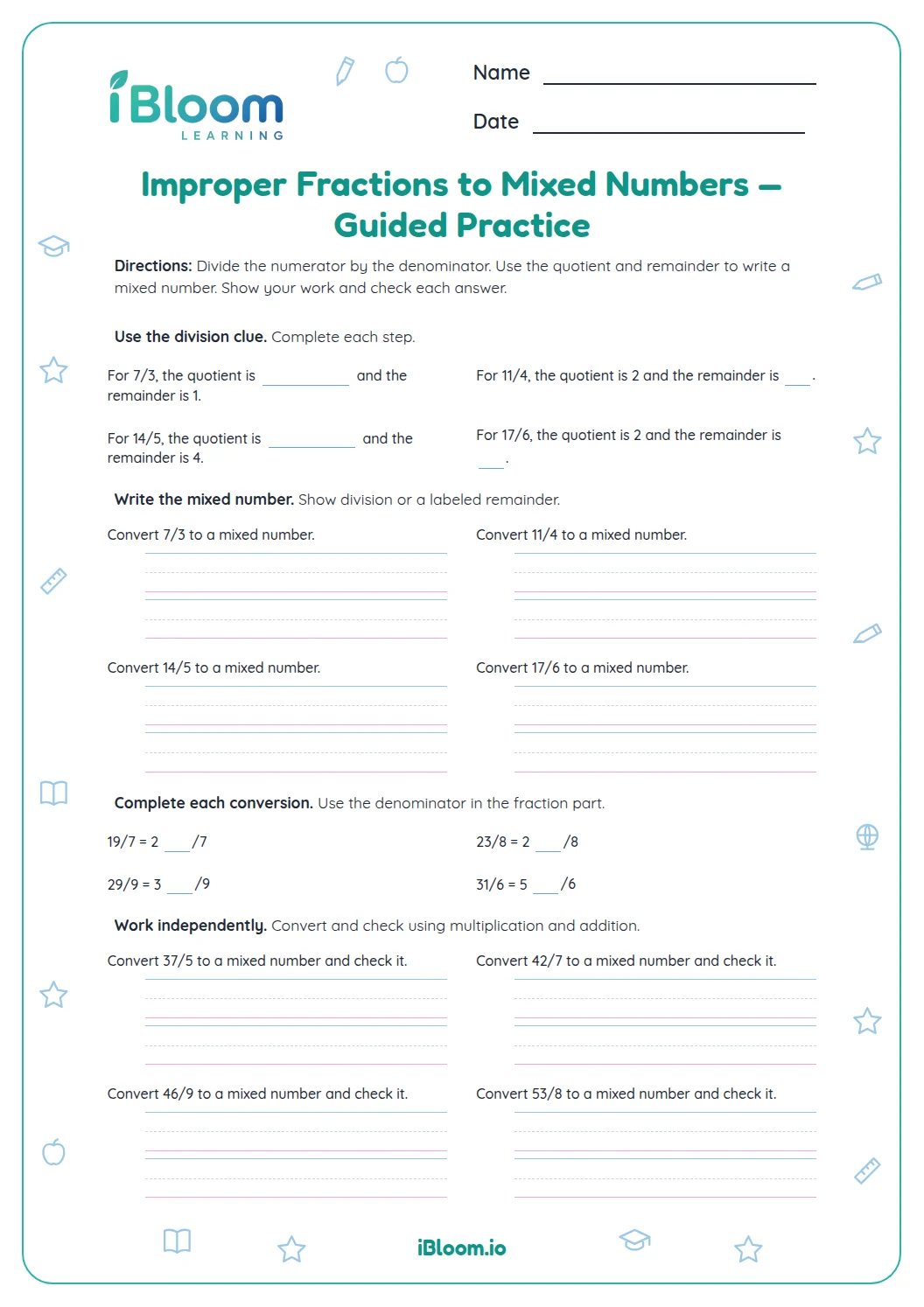
Multiply the whole-number part by the denominator and add the numerator. The result should match the improper fraction’s numerator. If the remainder is greater than or equal to the denominator when converting back, check the division again.
How do you explain a conversion error?
Check whether the calculation includes both the wholes and the leftover fraction. In 3 2/5, the three wholes make 15 fifths, but the 2/5 contributes two more fifths. A complete conversion is 17/5.
How to use this worksheet
- 1Multiply the whole number by the denominator.
- 2Add the mixed number’s numerator to that product.
- 3Keep the original denominator.
- 4For a check, divide the improper numerator by the denominator.
- 5Explain a sample error by naming the part of the calculation that was missed.
Common mistakes and quick fixes
The mistake
Adding the denominator to the whole number
The fix
The whole number must be multiplied by the denominator because each whole contains that many fractional parts.
The mistake
Changing the denominator
The fix
Keep the denominator; the size of each part stays the same.
The mistake
Forgetting the fractional remainder
The fix
After multiplying, add the numerator of the fraction to include the leftover parts.
What to practice next
Make more practice
Further reading
Questions parents and teachers ask
What is the conversion rule for mixed numbers?
Multiply the whole number by the denominator, then add the numerator. Keep the denominator. For example, 2 3/5 becomes (2 × 5 + 3)/5, or 13/5. The first eight questions practice that calculation with several denominators, and the key lists each numerator.
How many questions ask students to explain their thinking?
Questions 13 through 16 ask students to explain an error, verify a conversion, compare equal values, and convert an improper fraction to a mixed number. The key gives sample responses. Students may use different words if their calculation and conclusion are correct.
Why does the denominator stay the same?
The denominator names how many equal parts make one whole. When converting, the whole units are renamed using that same-sized part. For fifths, one whole is 5/5; for eighths, one whole is 8/8. The fractional unit stays constant throughout the conversion.
What does the reasoning section check?
The last four items ask students to notice a missing fractional remainder, check a conversion, compare equivalent forms, and convert an improper fraction back to a mixed number. These prompts help students explain how whole units and leftover parts combine.
What is a quick way to check an improper fraction?
Divide the numerator by its denominator. The quotient is the whole-number part and the remainder is the numerator of the leftover fraction. For example, 32 ÷ 5 gives 6 remainder 2, so 32/5 equals 6 2/5. This reverses the conversion rule used on the page.