





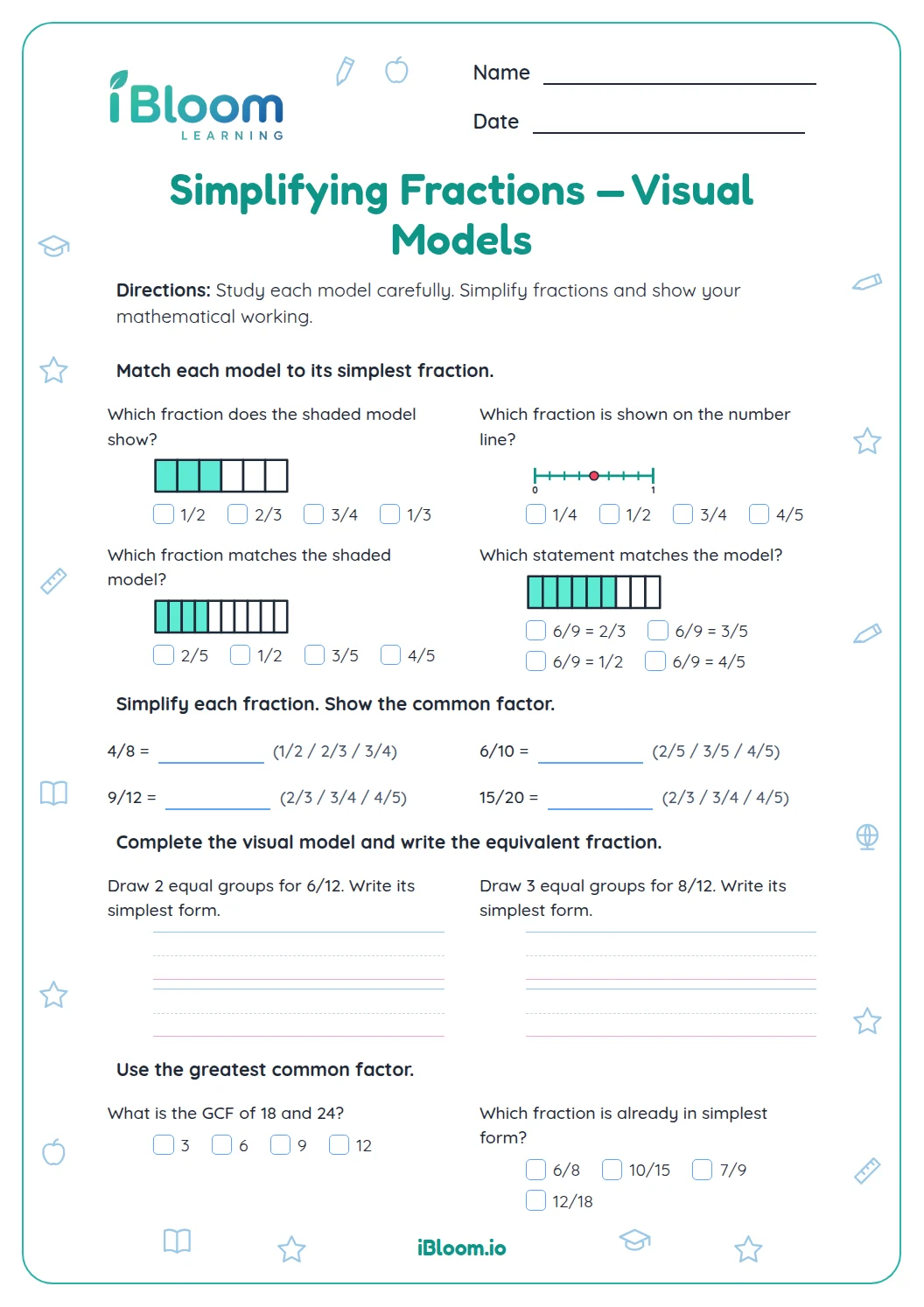
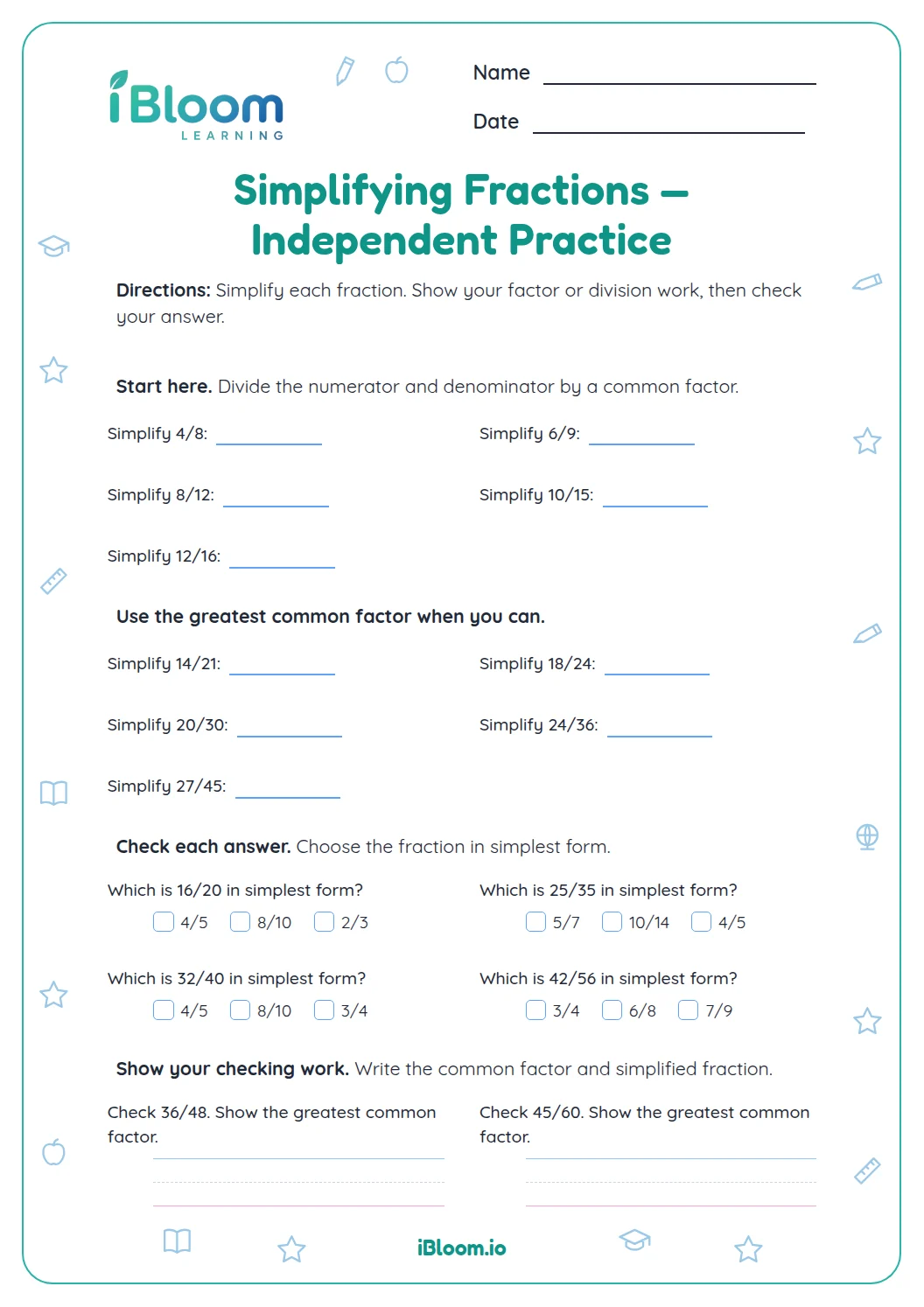
About this worksheet
This free printable Grade 5 worksheet gives learners 14 real-world mixed-number conversions. Each prompt names a measurement or recipe amount and asks for the equivalent improper fraction. A separate answer key lists each conversion, with steps for checking the numerator and keeping the denominator.
Aligned to 4.NF.A.1
How can a learner work through mixed numbers to improper fractions: word problems?
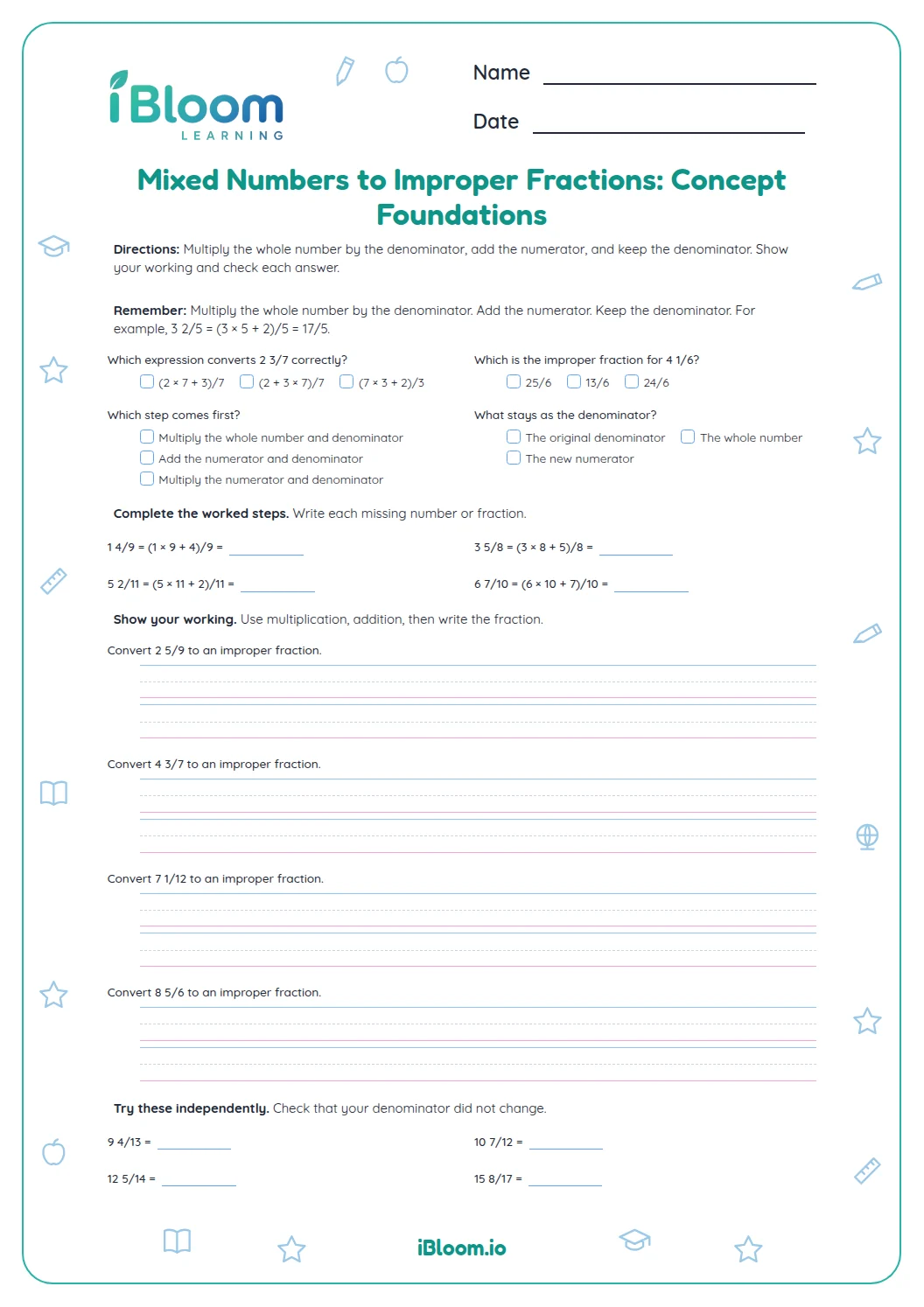
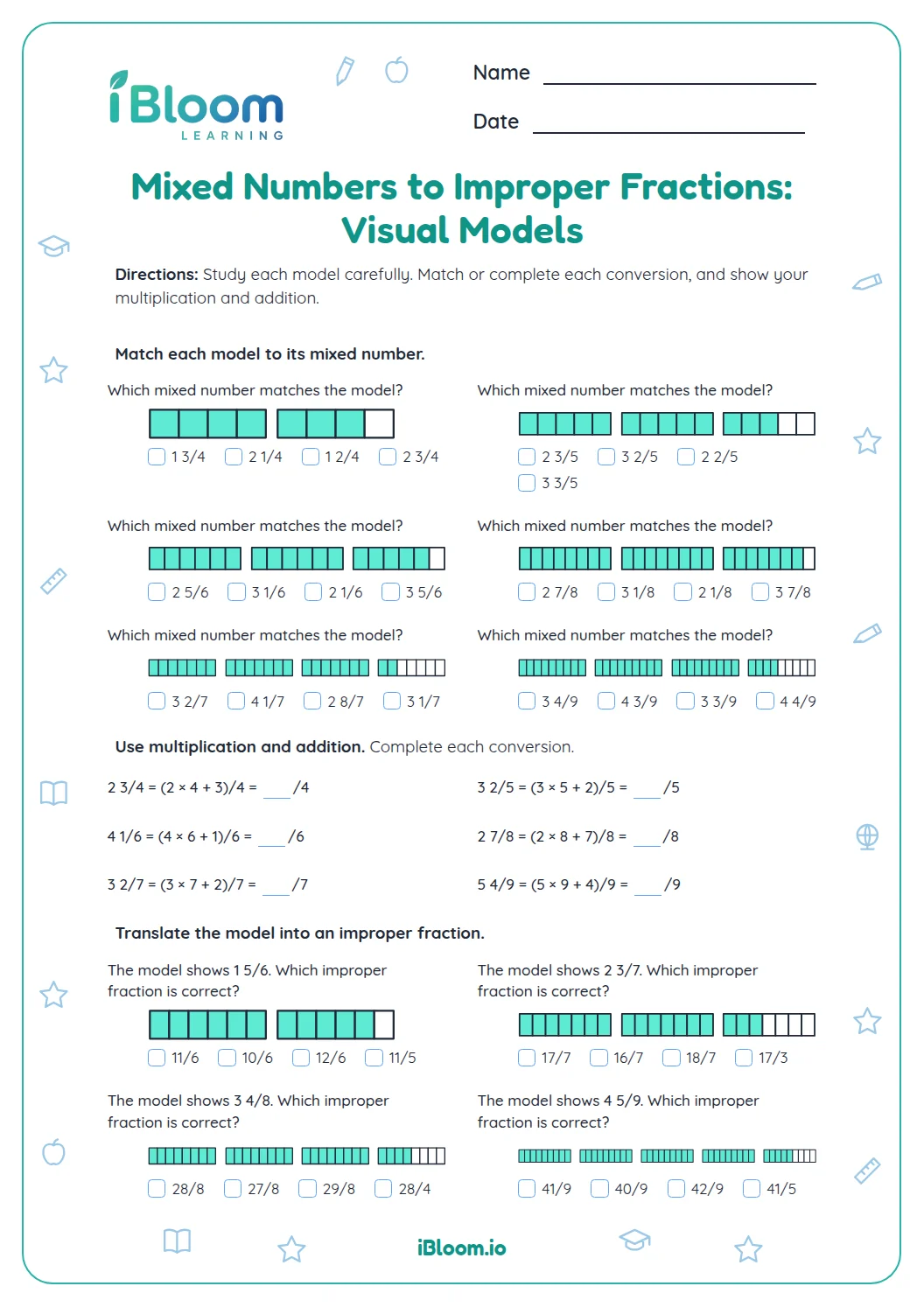
The 14 stories use mixed numbers in measurement and recipe settings. For each one, multiply the whole number by the denominator, add the numerator, and keep the denominator.
A trail is 2 3/5 miles long. Two wholes contain 2 × 5 = 10 fifths; add the extra 3 fifths. So 2 3/5 = 13/5 miles.
- 12 × 5 = 10
- 210 + 3 = 13
- 32 3/5 = 13/5
What will the worksheet ask the learner to do?
The printable has 14 questions in 1 part. Each asks for an improper fraction equal to the mixed number in its story; the separate key gives all 14 answers.
How can an adult support this practice?
Read the direction for each part, then ask the learner to explain one choice or calculation. Use the answer key to discuss the method as well as the final answer.
How to use this worksheet
- 1Find the denominator; it names the size of every part.
- 2Multiply the whole number by that denominator.
- 3Add the numerator to count all the parts.
- 4Keep the original denominator.
- 5Check that the improper fraction is greater than one whole.
Common mistakes and quick fixes
The mistake
Adding the whole number and numerator only.
The fix
Multiply the whole by the denominator first, then add the numerator.
The mistake
Changing the denominator during conversion.
The fix
Keep the denominator because the size of each part stays the same.
The mistake
Forgetting the extra fraction parts.
The fix
After counting the parts in the wholes, add the numerator.
Standards alignment
This page connects the worksheet practice to the standards listed below.
Use equivalent fractions to rename a mixed number as one fraction.
On this sheet: Learners rename the whole-number portion in denominator-sized parts and combine those parts with the fraction.
Show the official wordingHide the official wording
Explain why a fraction a/b is equivalent to a fraction (n × a)/(n × b) by using visual fraction models, with attention to how the number and size of the parts differ even though the two fractions themselves are the same size. Use this principle to recognize and generate equivalent fractions.
What to practice next
Further reading
Questions parents and teachers ask
How do you convert 2 3/5 to an improper fraction?
Two wholes contain ten fifths because 2 × 5 = 10. Add the three fifths already shown, giving 13/5. The worksheet uses this same reasoning in different measurement and recipe contexts. Ask the learner to name the denominator and explain how many equal parts the wholes contain before adding the extra parts.
Why does the denominator stay the same?
The denominator names the size of the pieces. Converting changes how many pieces are counted, not their size, so fifths stay fifths and eighths stay eighths. Ask the learner to name the denominator and explain how many equal parts the wholes contain before adding the extra parts.
How can a learner check a conversion?
Multiply the whole number by the denominator and add the numerator. Then verify that the denominator is unchanged and that the resulting fraction is greater than one whole. Ask the learner to name the denominator and explain how many equal parts the wholes contain before adding the extra parts.
Are the story contexts needed to solve each item?
The stories make the quantities meaningful, but the conversion uses the mixed number stated in each question. Learners can focus on the numerical relationship and include the named unit when explaining their result. Ask the learner to name the denominator and explain how many equal parts the wholes contain before adding the extra parts.
Does this worksheet have an answer key?
Yes. The separate answer key lists all 14 improper fractions. Check that each numerator counts the parts in the whole groups plus the extra fractional parts, and that the denominator remains the same as in the mixed number. The matching units also help keep each story meaningful.