



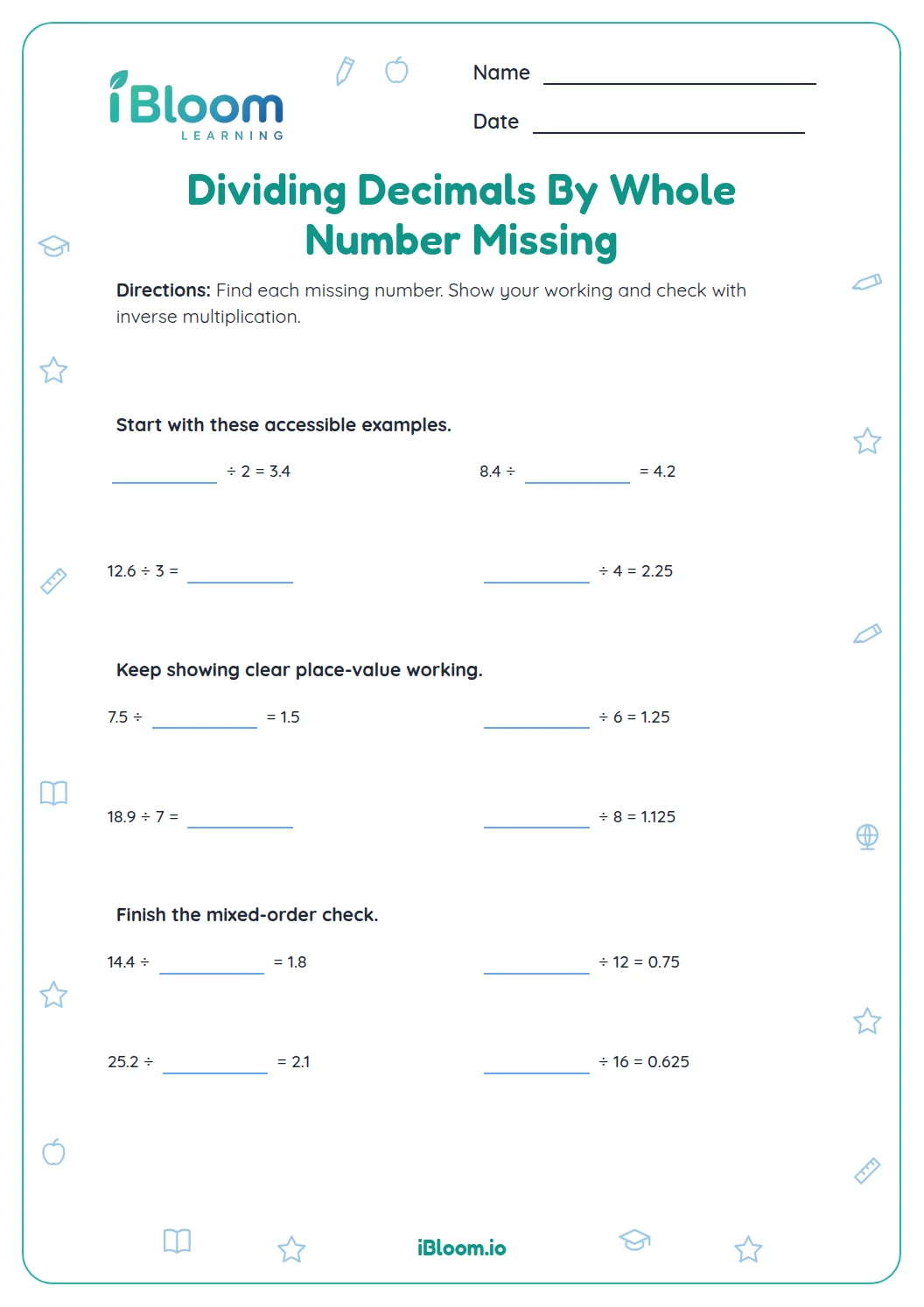
About this worksheet
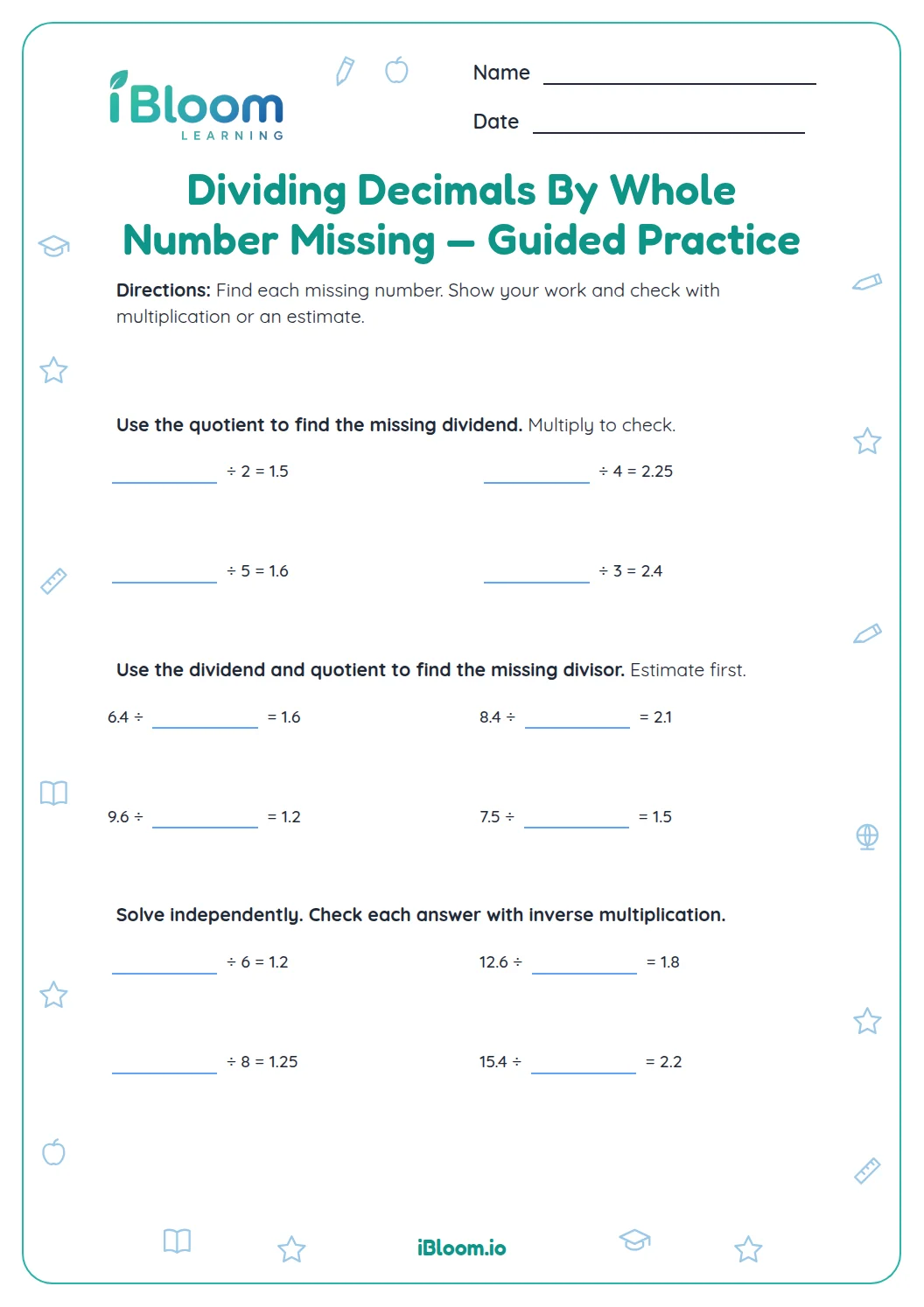
This Grade 5 worksheet gives students 16 decimal division equations with a missing divisor or dividend. Each dividend has two decimal places, and each divisor is a whole number. Students use the quotient and the inverse relationship between multiplication and division to find the missing value, then check their result. A separate answer key shows the value for every equation.
Aligned to 5.NBT.B.7
How do you find a missing divisor?
When the dividend and quotient are known, divide the dividend by the quotient to find the divisor.
- 18.40 ÷ ___ = 2.10; 8.40 ÷ 2.10 = 4.
How do you find a missing dividend?
Multiply the divisor by the quotient. The product must equal the missing dividend.
- 1___ ÷ 3 = 2.14; 2.14 × 3 = 6.42.
How to use this worksheet
- 1Identify whether the blank is the divisor or dividend.
- 2For a missing divisor, divide the dividend by the quotient.
- 3For a missing dividend, multiply the divisor by the quotient.
- 4Write the decimal point in the correct place.
- 5Multiply the divisor by the quotient to check.
Common mistakes and quick fixes
The mistake
Using addition instead of the inverse operation.
The fix
Multiply or divide to undo the equation.
The mistake
Moving the decimal without changing both numbers.
The fix
Check the quotient by multiplication.
The mistake
Placing the answer in the wrong blank.
The fix
Identify the missing term first.
Students solve decimal division equations and check with multiplication.
Use place-value reasoning and multiplication to check decimal division equations.
On this sheet:
Show the official wordingHide the official wording
Add, subtract, multiply, and divide decimals to hundredths, using concrete models or drawings and strategies based on place value, properties of operations, and/or the relationship between addition and subtraction; relate the strategy to a written method and explain the reasoning used.
What to practice next
Questions parents and teachers ask
How do you find a missing divisor?
Divide the dividend by the quotient. For example, in 12.6 ÷ ___ = 4.2, calculate 12.6 ÷ 4.2 to get 3, then check that multiplying 3 by 4.2 gives 12.6. Use the multiplication check to confirm that the divisor and quotient produce the dividend.
How do you find a missing dividend?
Multiply the divisor by the quotient. In ___ ÷ 3 = 4.8, calculate 4.8 × 3 to find the missing dividend, 14.4. Substitute it back into the equation to verify the result. The equation gives the quotient, so divide the dividend by that value to find the divisor.
How many problems are on the page?
There are 16 equations. Six ask for a missing divisor, five ask for a missing dividend, and the final five mix the two forms. Every dividend has two decimal places, and each divisor is a whole number. The key lists each result for quick checking.
Why check division with multiplication?
Multiplication is the inverse operation of division. If the missing value is correct, multiplying the divisor by the quotient gives the dividend shown in the equation, so this check confirms the relationship. A product that matches the dividend confirms the division equation is balanced.
Does this worksheet include an answer key?
Yes. The separate answer key gives the missing number for each of the 16 equations. Students can check a solution by putting it in the blank and verifying the multiplication relationship. Equivalent decimal forms may name the same value, but the multiplication check still applies.