


About this worksheet
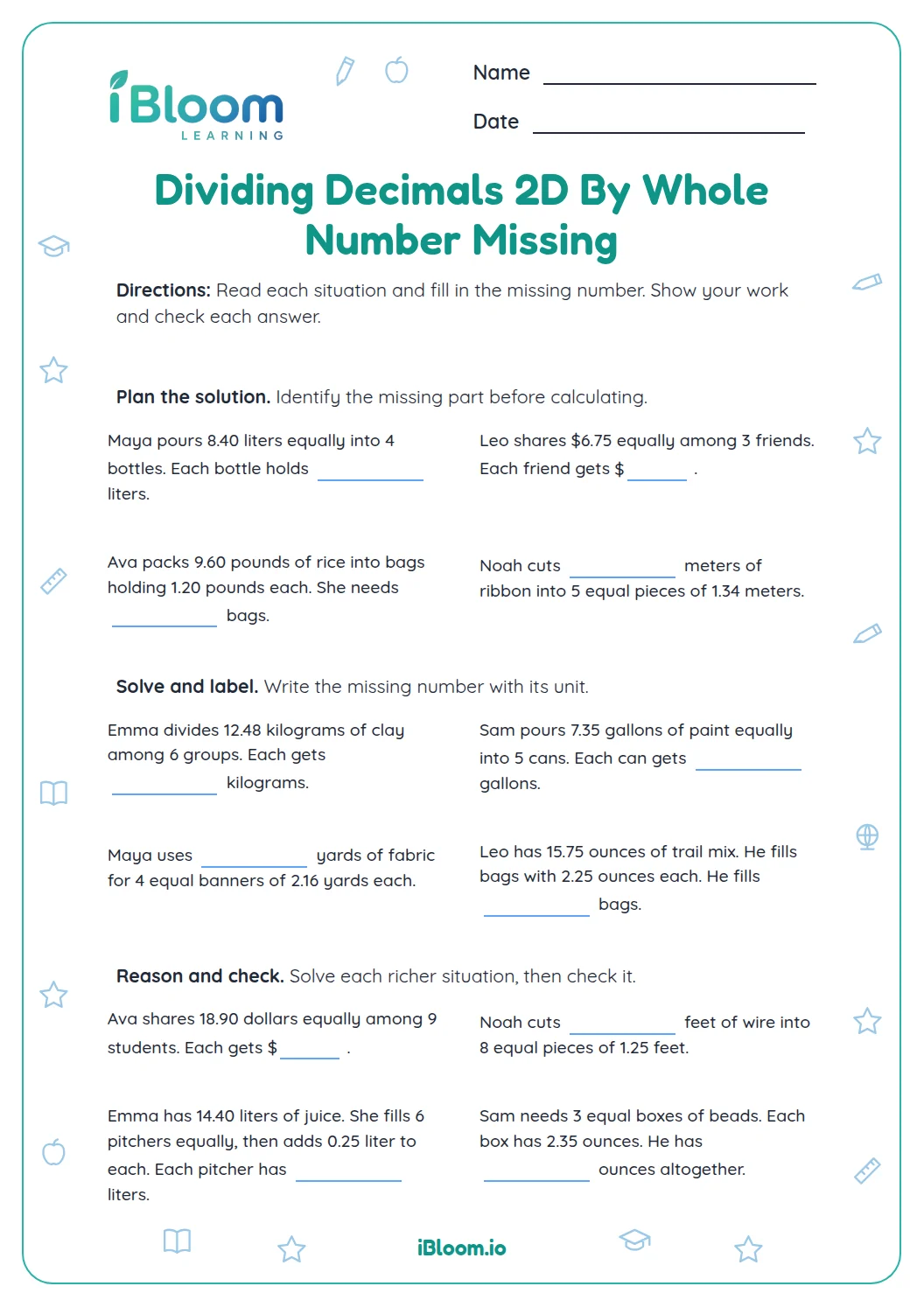
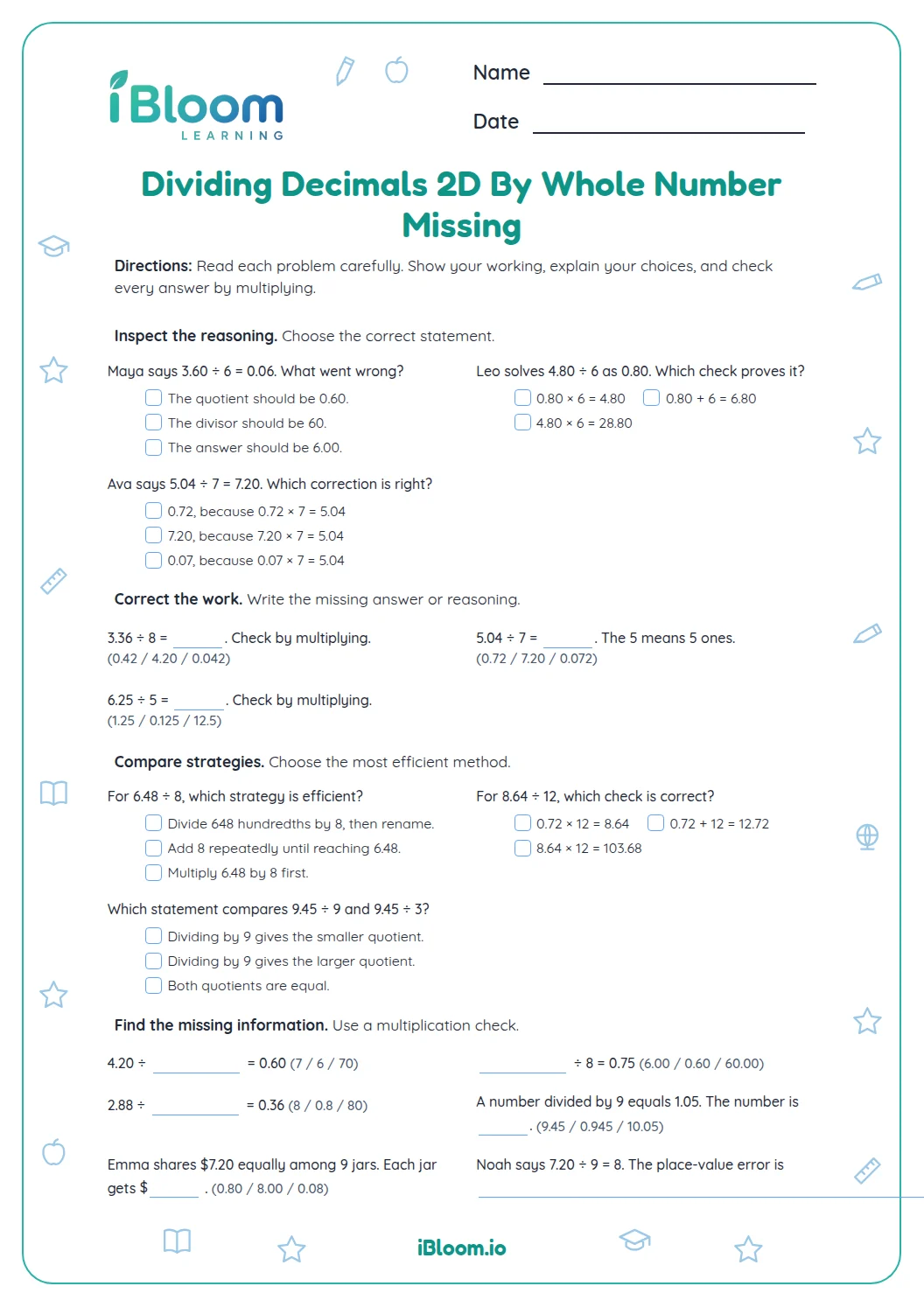
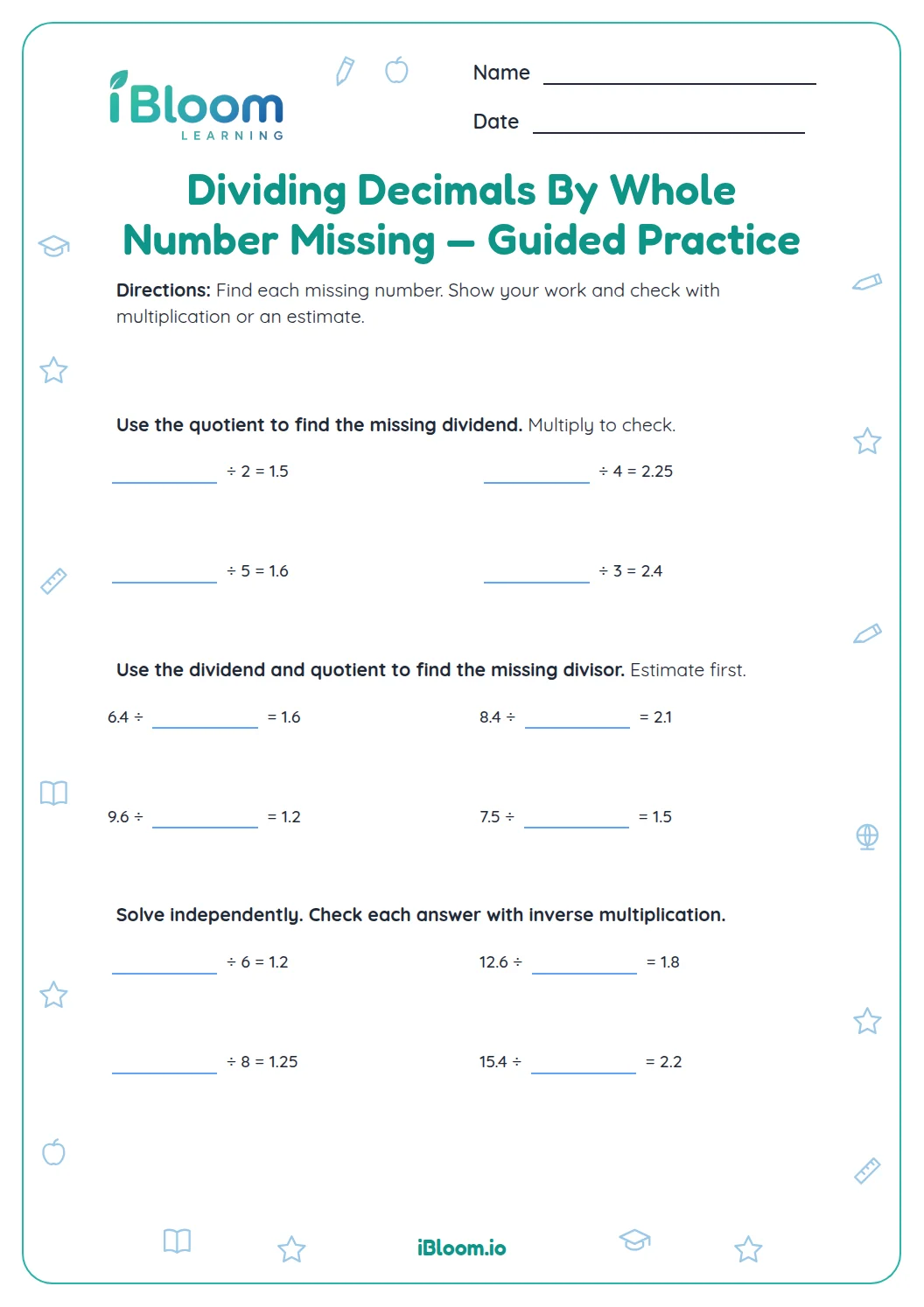
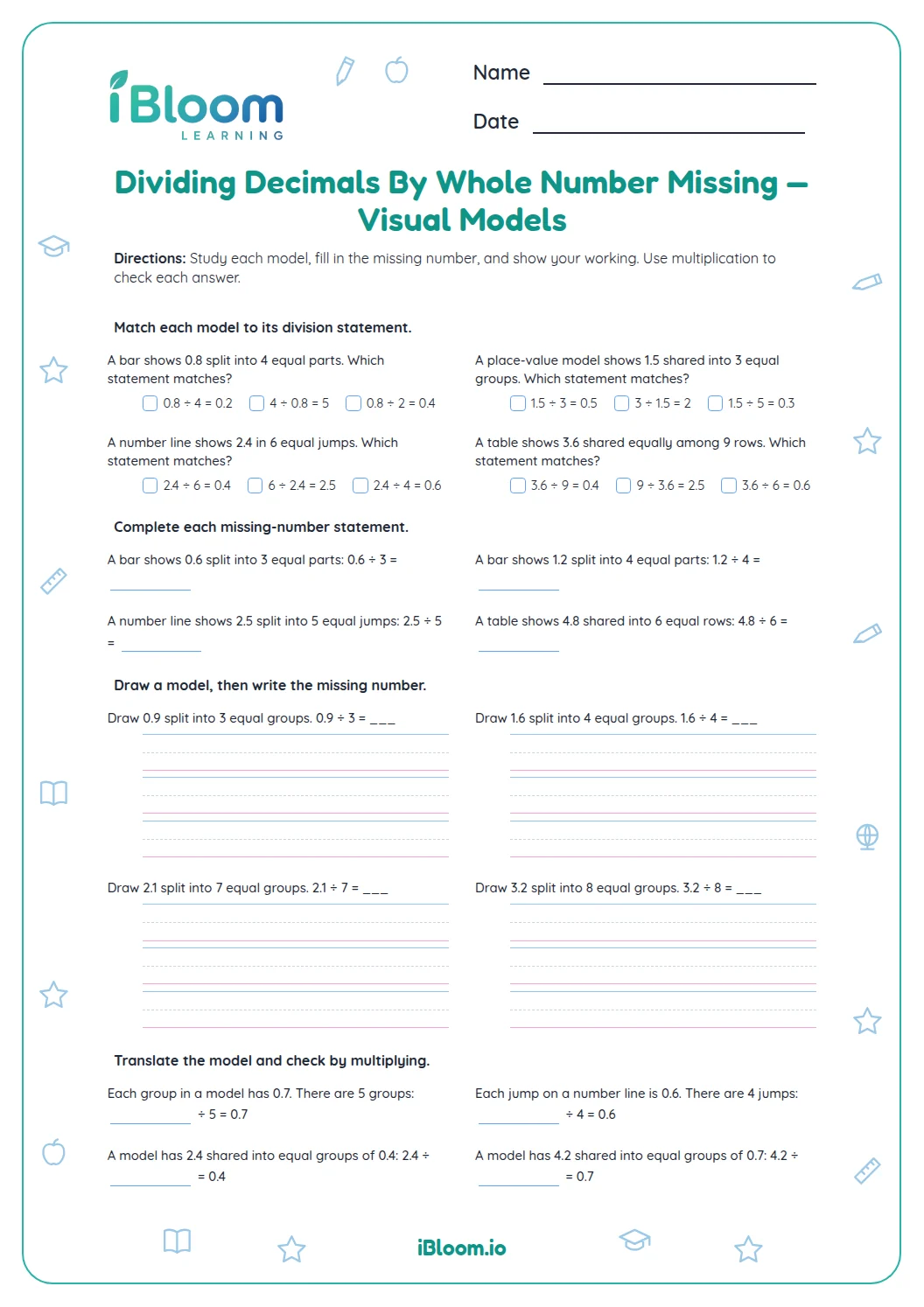
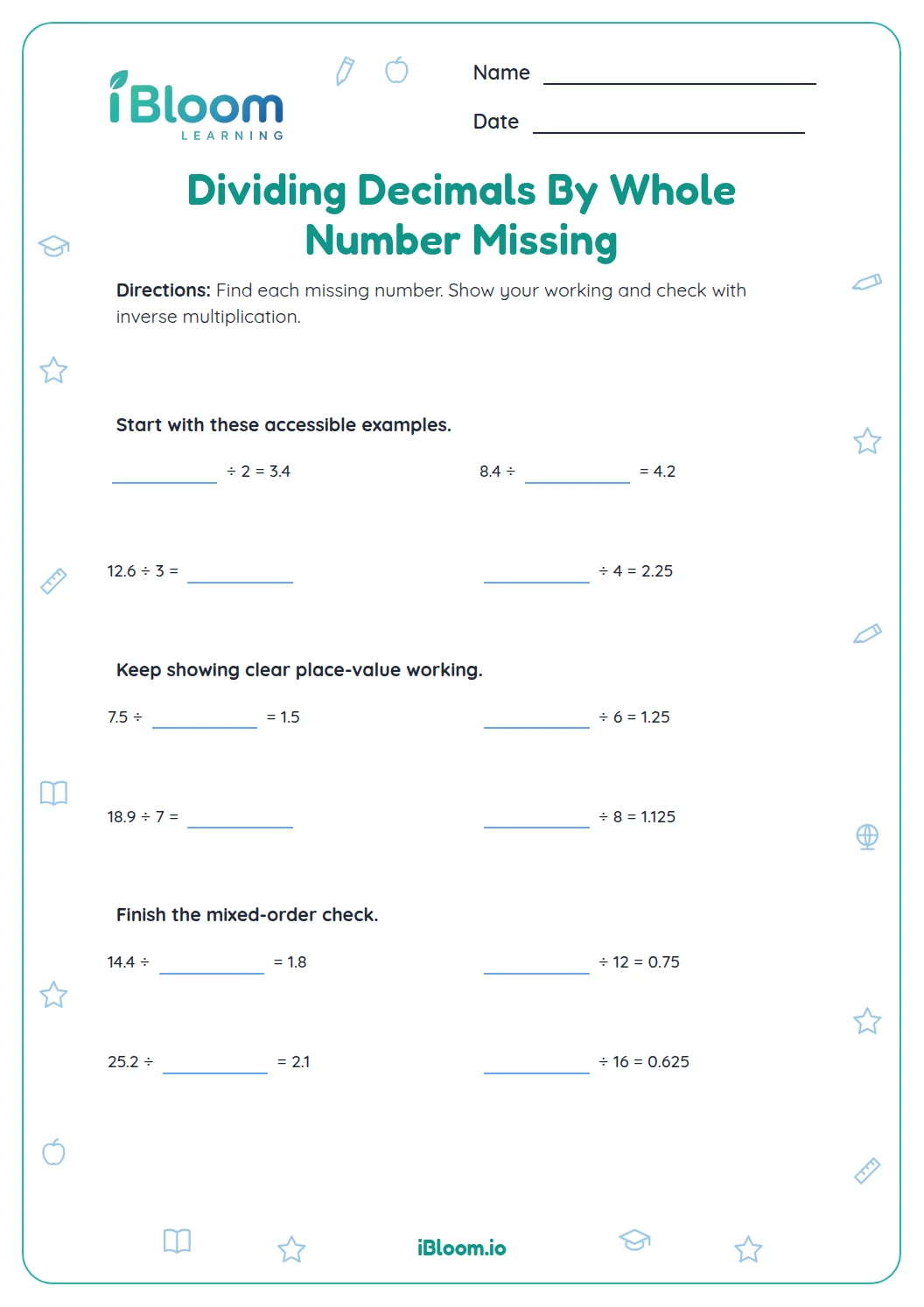
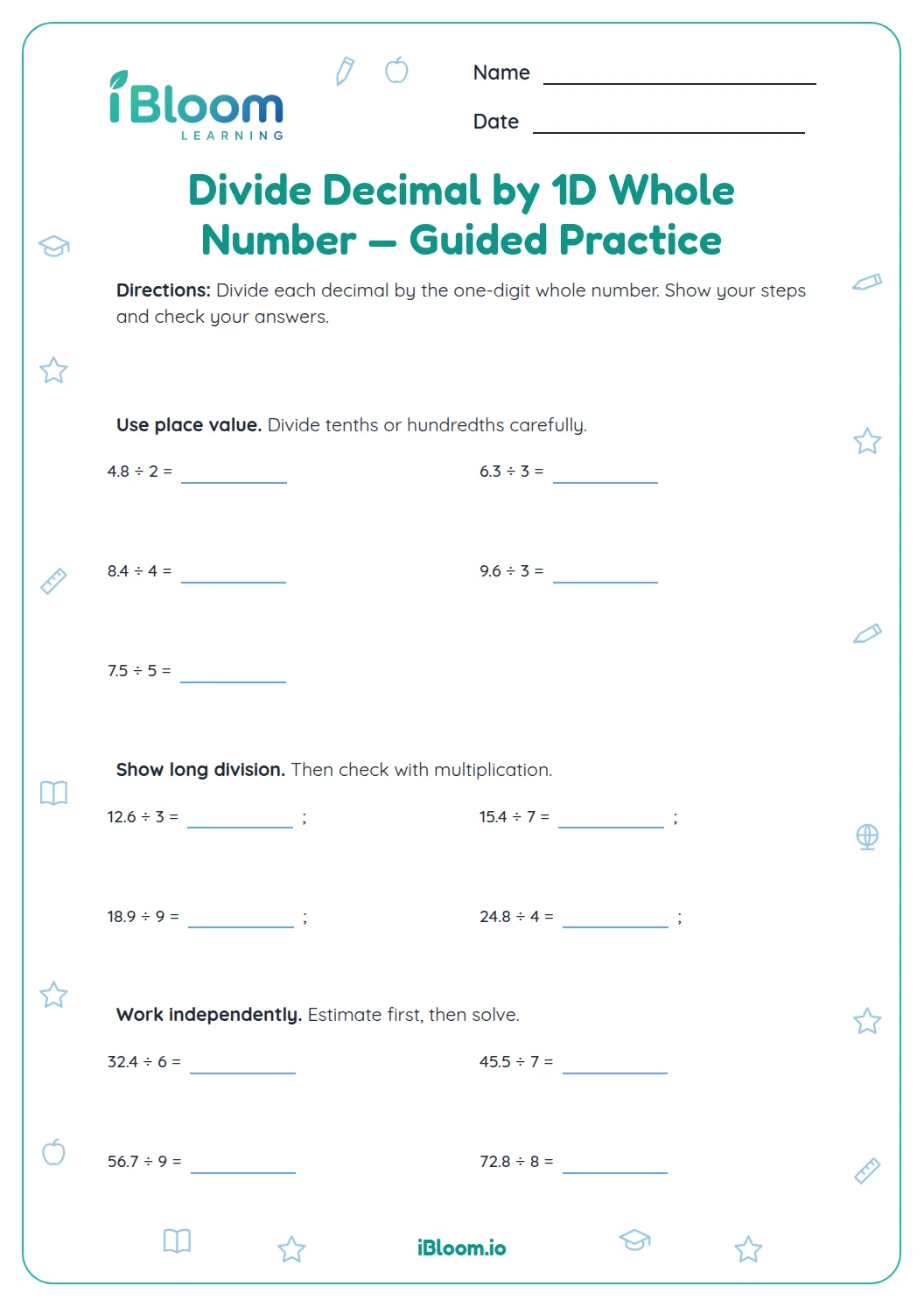
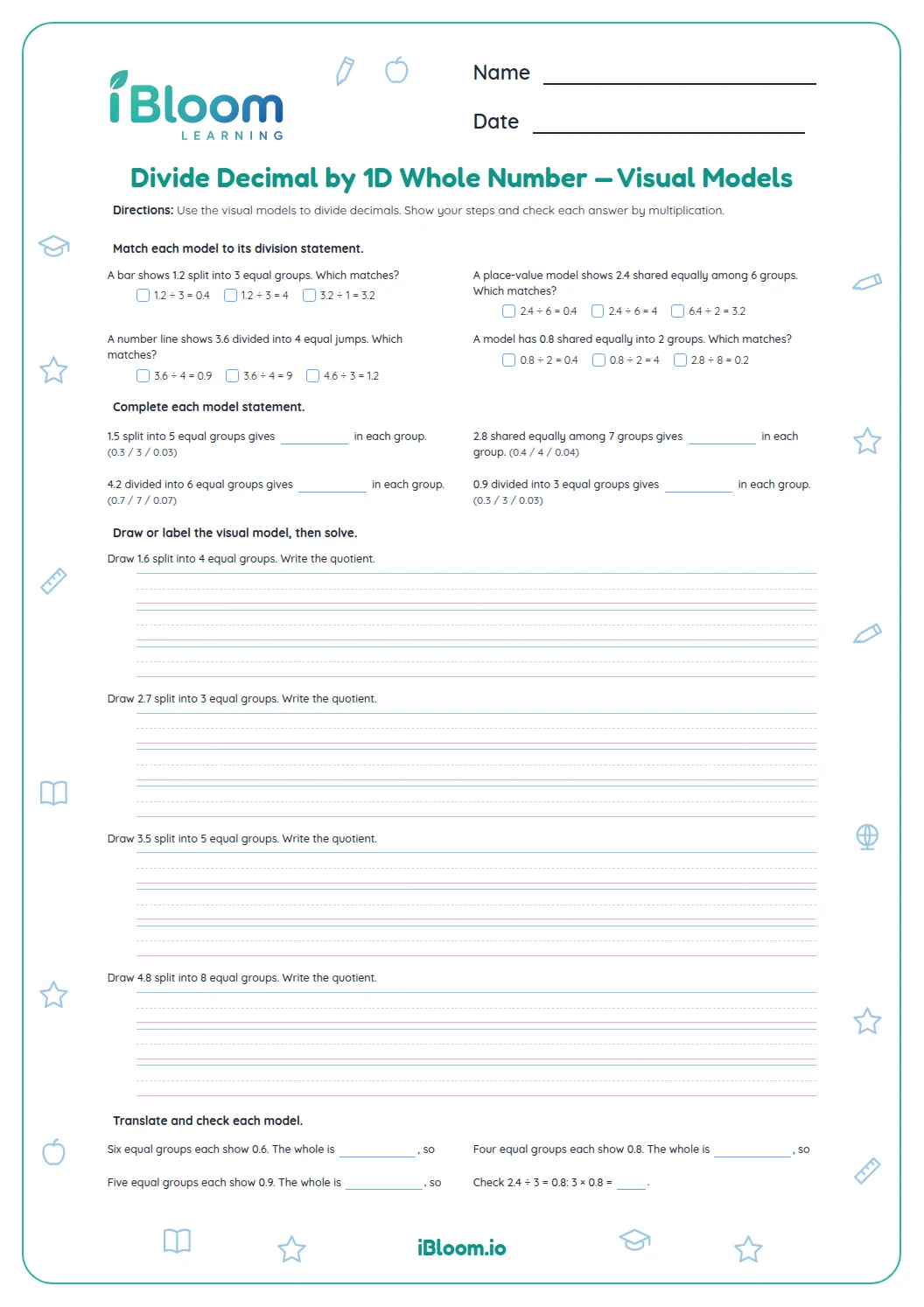
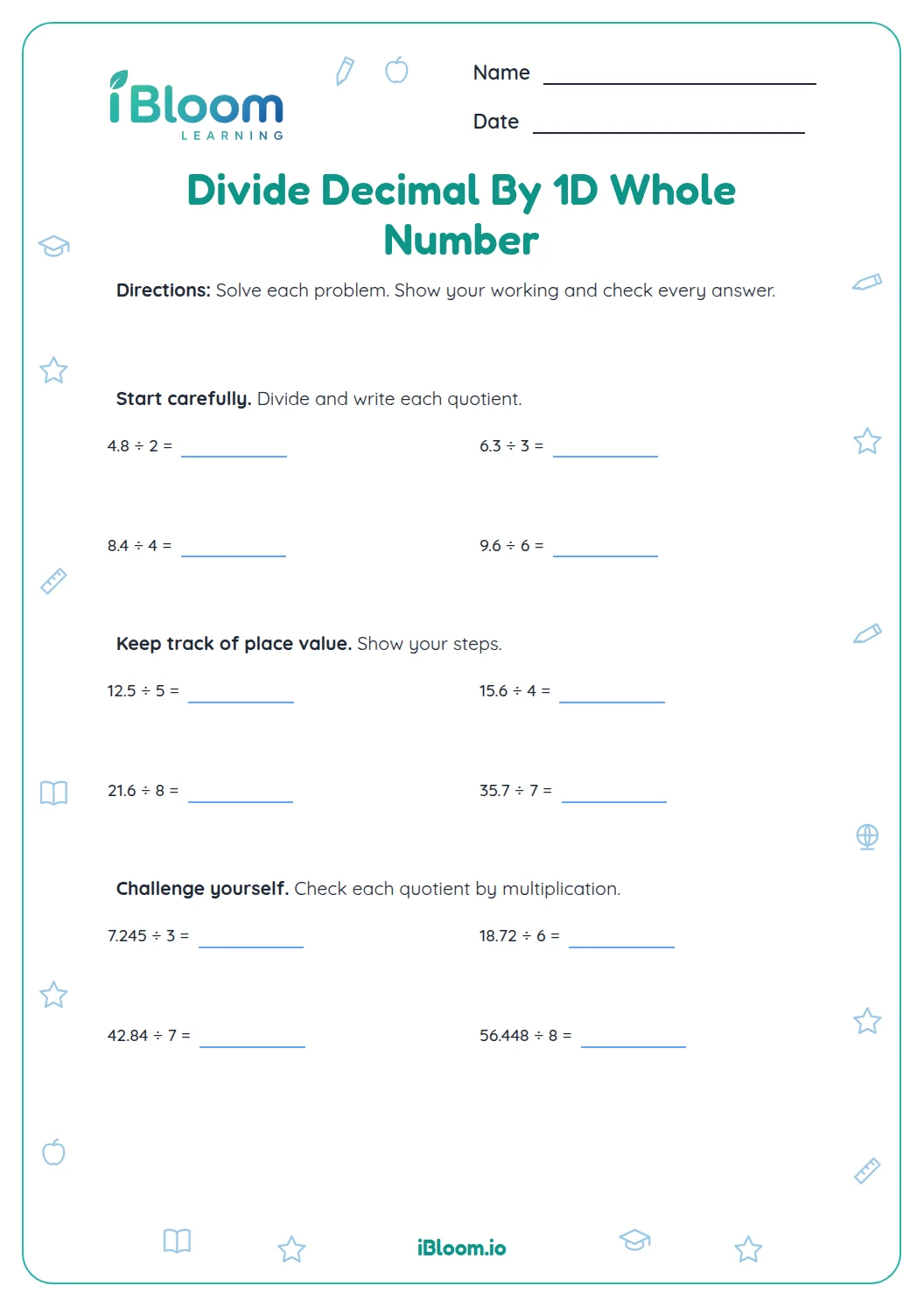
This Grade 5 concept-foundations worksheet introduces three kinds of missing values in decimal division. Children find a quotient, recover a decimal dividend by multiplying, or recover a whole-number divisor by division. Fourteen equations use hundredths and align with CCSS 5.NBT.B.7. A separate answer key supports checking.
Aligned to 5.NBT.B.7
What can be missing in a division equation?
A division equation may hide the quotient, the dividend, or the divisor. In each case, division and multiplication help uncover the missing value.
Part A asks for the quotient. Part B gives the divisor and quotient so you can find the dividend. Part C gives the dividend and quotient so you can find the divisor.
How does multiplication help find the missing number?
Use dividend ÷ divisor = quotient. If the quotient is missing, divide. If the dividend is missing, multiply divisor × quotient. If the divisor is missing, divide dividend ÷ quotient.
- 1___ ÷ 4 = 3.21
- 2Multiply the quotient by the divisor: 3.21 × 4 = 12.84.
- 3So the missing dividend is 12.84.
- 4Check: 12.84 ÷ 4 = 3.21.
How can I check a missing value?
Put your answer back into the original equation. For a missing dividend, divide the new dividend by the divisor. For a missing divisor, check that the quotient times the divisor equals the dividend.
How to use this worksheet
- 1Look at the direction: ascending or descending.
- 2Read all three numerals before writing an answer.
- 3For ascending, find the least number and continue upward.
- 4For descending, find the greatest number and continue downward.
- 5Read your finished list and check that it changes in the requested direction.
Common mistakes and quick fixes
The mistake
Multiplying when the quotient is missing.
The fix
Divide the dividend by the known divisor to find the quotient.
The mistake
Dividing when the dividend is missing.
The fix
Multiply the known divisor and quotient.
The mistake
Writing a divisor that does not make the stated quotient.
The fix
Multiply the proposed divisor by the quotient and compare with the dividend.
Common Core alignment
The equations connect decimal division with multiplication and place-value reasoning.
Use place value and written methods to divide decimals to hundredths.
On this sheet: The division items use decimal dividends and whole-number divisors, with quotient reasoning.
Show the official wordingHide the official wording
Add, subtract, multiply, and divide decimals to hundredths, using concrete models or drawings and strategies based on place value, properties of operations, and/or the relationship between addition and subtraction; relate the strategy to a written method and explain the reasoning used.
What to practice next
Make more practice
Further reading
Questions parents and teachers ask
What does missing values in decimal division mean?
A missing-value division problem leaves one number out of the equation. This sheet gives children 14 chances to practice, moving from a clear starting point to mixed examples. The separate answer key makes it easy to check each response and talk through a missed step.
What grade is this missing values in decimal division worksheet for?
This printable is written for Grade 5. The directions use short, direct language, and the problems build within the named skill. An adult can read directions aloud or work through the first example before the learner continues independently.
What is on the worksheet?
The worksheet has 14 questions in two parts. Part A begins with solving ___ ÷ 4 = 3.2; later questions ask children to apply the same idea in fresh examples. The answer key is a separate page, so you can print it only when you are ready to check the work.
How should I check a missed answer?
Ask the learner to explain the step that led to the answer, then compare it with the answer key. For this skill, use division or its inverse, multiplication, to find the unknown. A quick spoken explanation can reveal whether the issue was reading the prompt, choosing a strategy, or carrying out a step.
Does this printable include an answer key?
Yes. The answer key is included after the worksheet pages and lists a correct response for every item. For any open response, it gives a model answer or the feature to look for, so an adult can check the idea without expecting identical wording.