


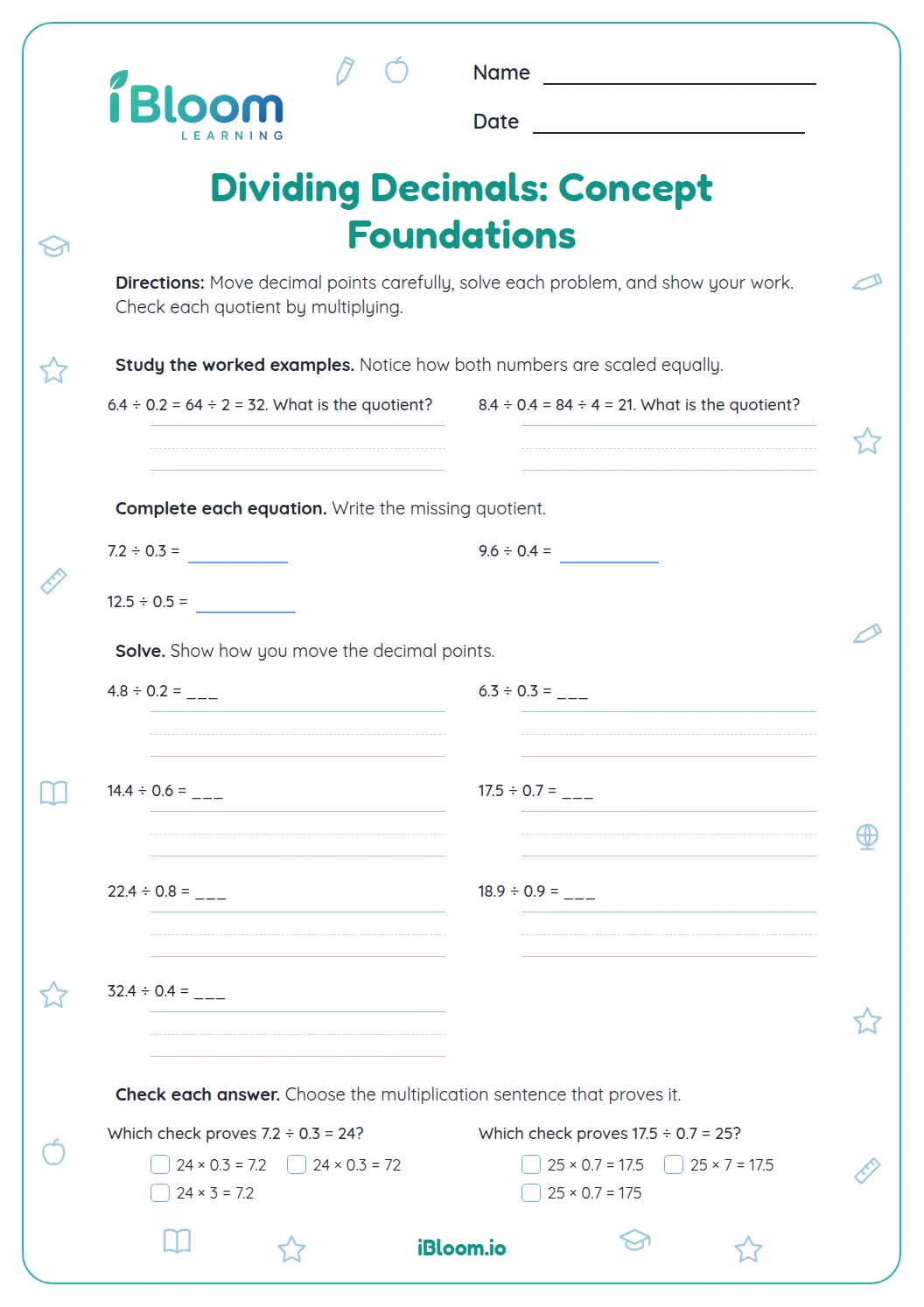
About this worksheet
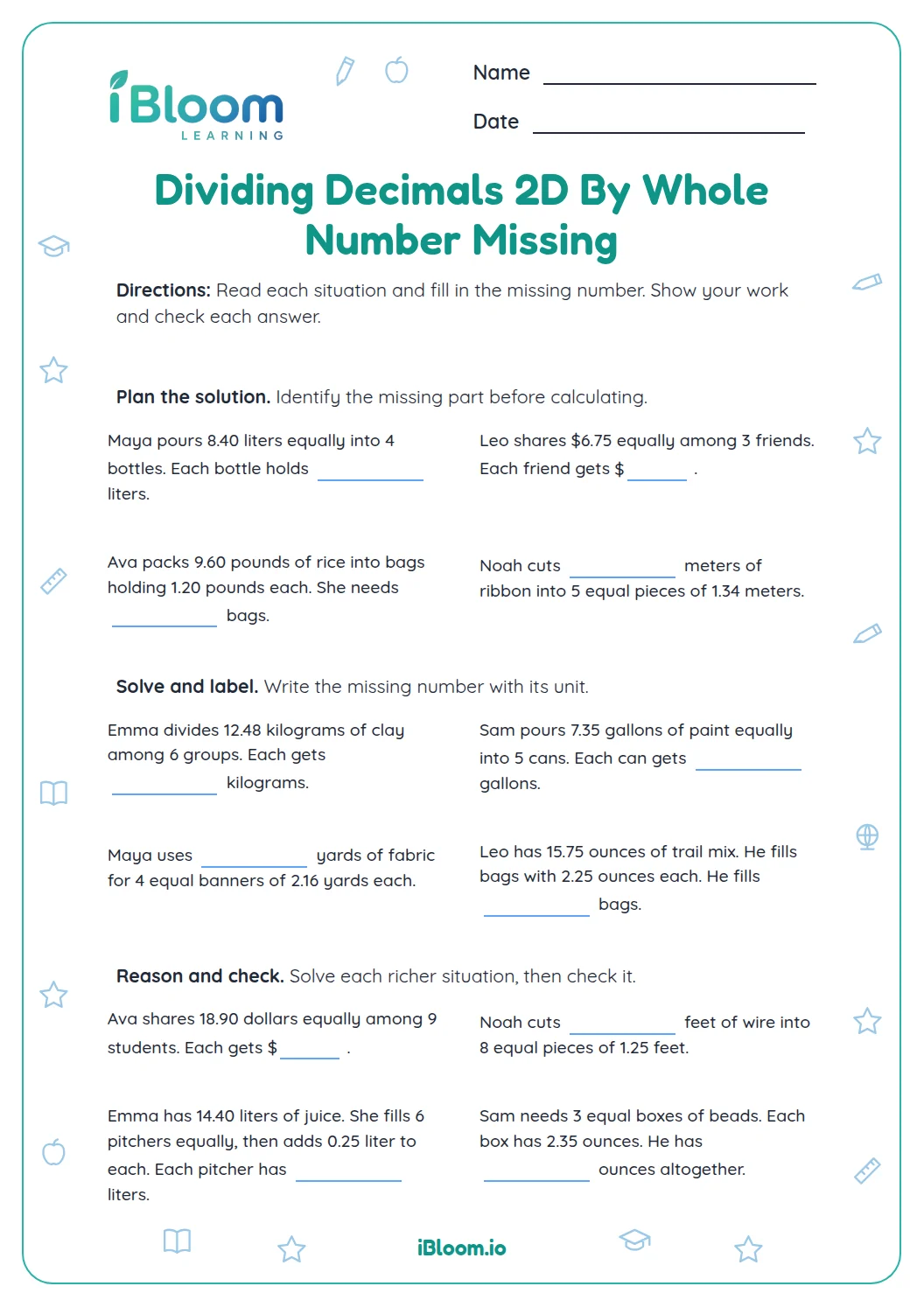
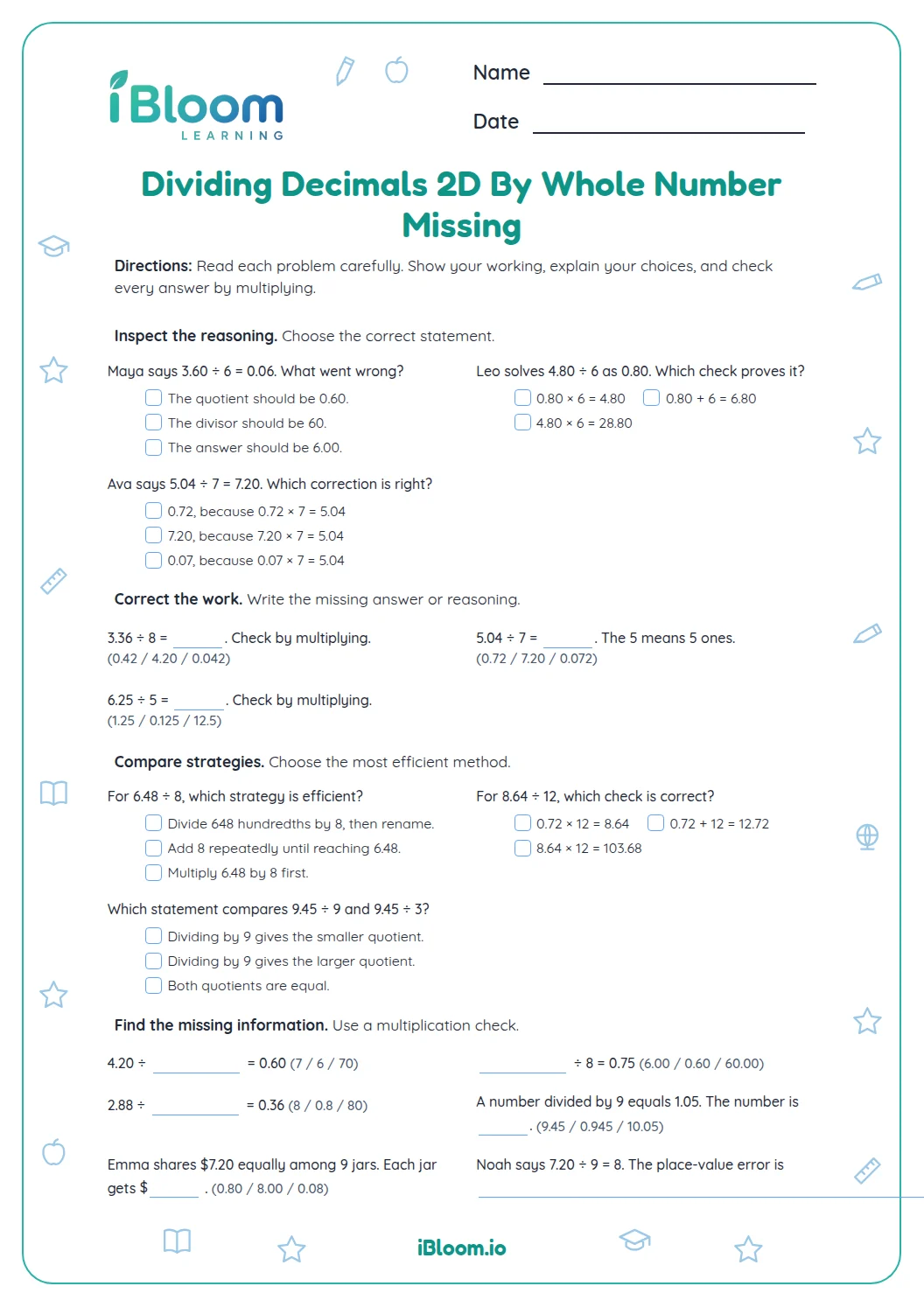
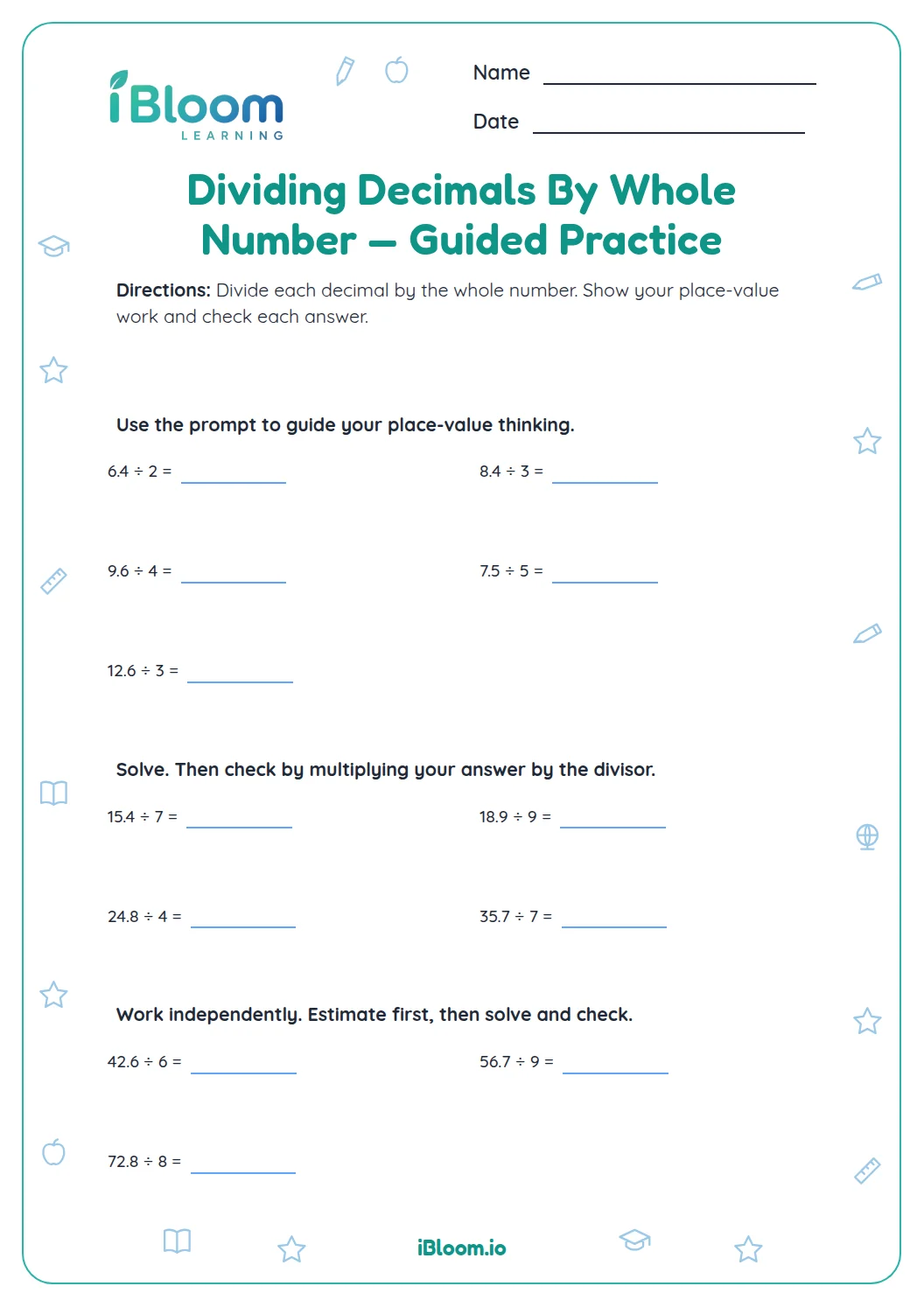
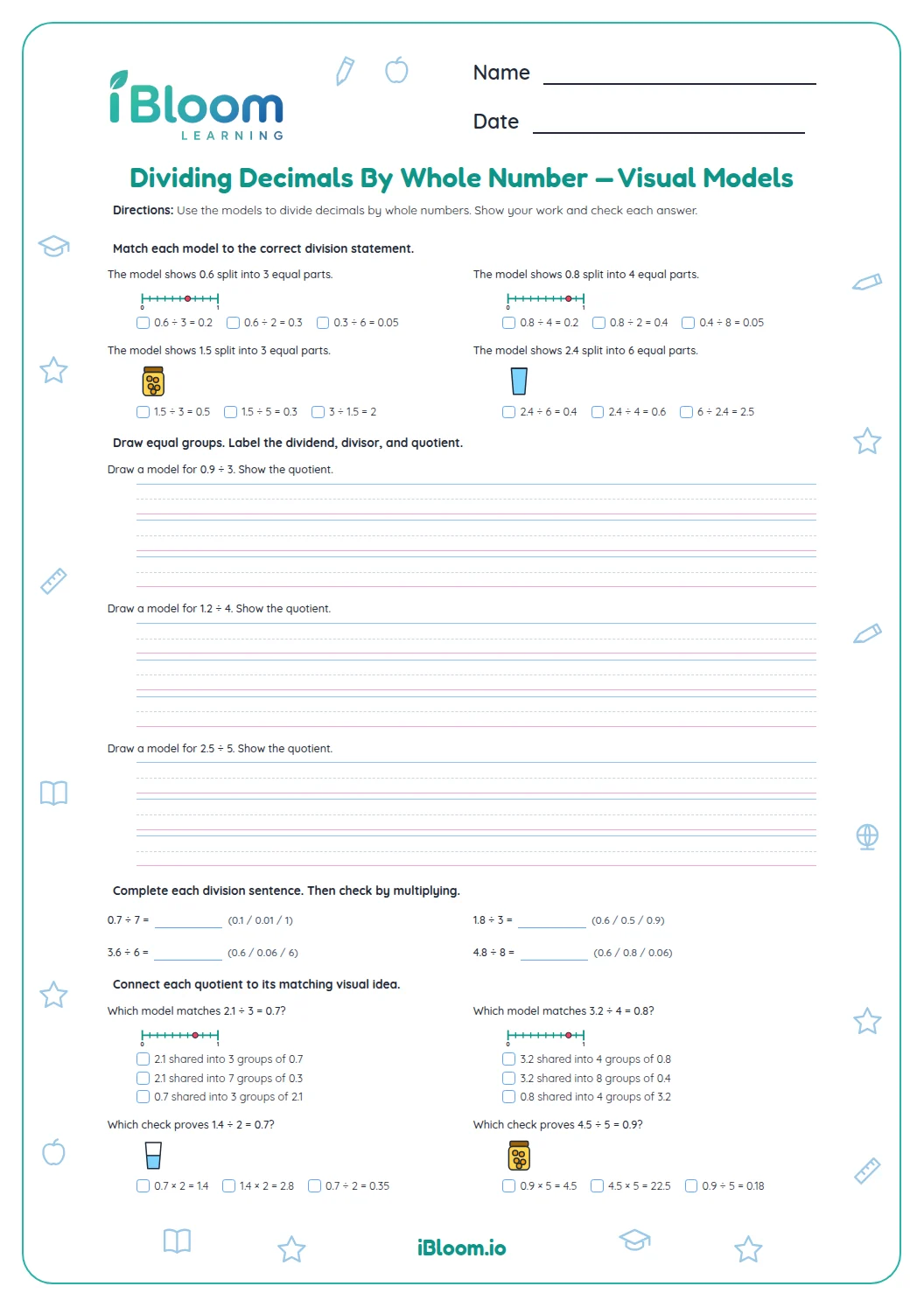
This Grade 5 guided practice sheet focuses on division with decimals to the hundredths place and a whole-number divisor. Children complete equations with a missing quotient, dividend, or divisor, then apply the same reasoning to equal-sharing stories. The work connects decimal division to CCSS 5.NBT.B.7 and encourages checking a quotient by multiplying it by the divisor. Sixteen questions and a separate answer key make it useful for classwork or home practice.
Aligned to 5.NBT.B.7
How do I find a missing quotient?
For 8.4 ÷ 2 = ___, divide 8.4 into two equal groups to get 4.2. Check: 4.2 × 2 = 8.4. Part A builds this check into each equation.
- 18.4 ÷ 2 = ___
- 28.4 divided into 2 equal groups is 4.2. Check: 4.2 × 2 = 8.4.
How do I find a missing dividend?
Use multiplication to undo division. If ___ ÷ 4 = 3.6, then the missing dividend is 3.6 × 4 = 14.4.
How do I find a missing divisor?
Think about how many groups fit. Since 18.9 ÷ 7 = 2.7, the missing divisor is 7. Part B applies equal sharing to measurement stories.
How to use this worksheet
- 1Read which number is missing.
- 2For a missing quotient, divide the dividend by the divisor.
- 3For a missing dividend, multiply divisor × quotient.
- 4For a missing divisor, find the number of equal groups.
- 5Check by multiplying and keep the decimal point in place.
Common mistakes and quick fixes
The mistake
Moving or dropping the decimal point.
The fix
Estimate first, then check with multiplication.
The mistake
Using division when the dividend is missing.
The fix
Multiply the divisor by the known quotient.
The mistake
Giving a story answer without its unit.
The fix
Copy the unit named in the question.
Common Core alignment
This worksheet practices the standard below.
Use place value to understand numbers.
On this sheet: Children read and write three-digit numbers as hundreds, tens, and ones.
Show the official wordingHide the official wording
Understand that the three digits of a three-digit number represent amounts of hundreds, tens, and ones.
What to practice next
Make more practice
Further reading
Questions parents and teachers ask
How can I check a decimal quotient?
Multiply the quotient by the divisor. For 8.4 ÷ 2 = 4.2, check that 4.2 × 2 = 8.4. If the product matches the dividend, the quotient is consistent with the original equation. This same inverse relationship helps when the worksheet asks for a missing dividend.
How do I find a missing dividend?
Multiply the quotient by the divisor. In ___ ÷ 4 = 3.6, calculate 3.6 × 4 to get 14.4. Put 14.4 in the blank, then check by dividing 14.4 by 4. The worksheet includes equations with missing quotients, dividends, and divisors.
How do I find a missing divisor?
Find how many groups of the quotient make the dividend. In 18.9 ÷ ___ = 2.7, ask how many 2.7s fit into 18.9; the answer is 7. Check with 18.9 ÷ 7 = 2.7. The final questions also use equal sharing in measurement stories.
Are word problems included?
Yes. The final four questions describe equal sharing with meters, liters, and kilograms. Divide the total amount by the number of equal pieces or groups, then include the unit in the answer. For example, 12.8 meters split into four equal lengths gives 3.2 meters each.