




About this worksheet
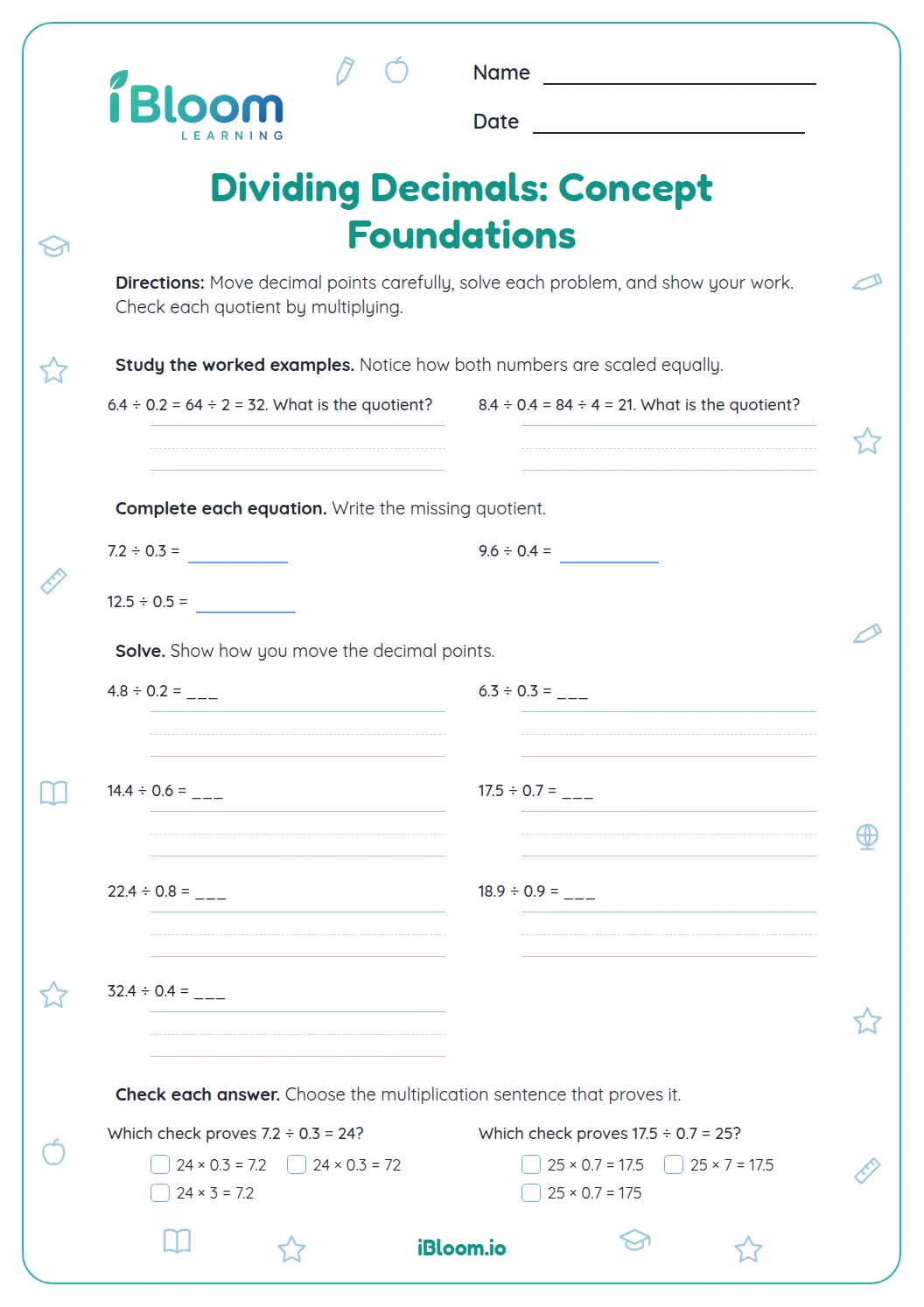
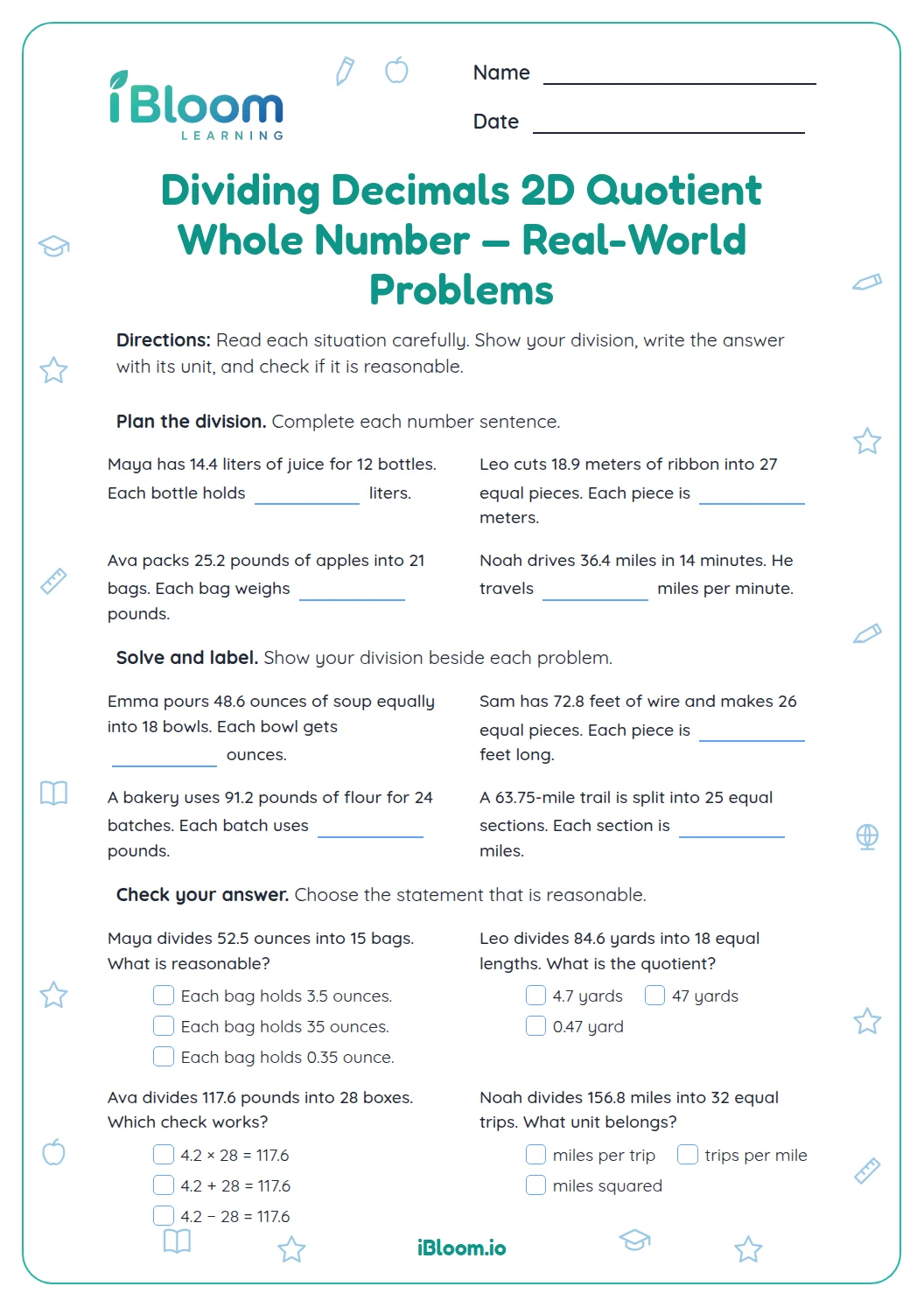
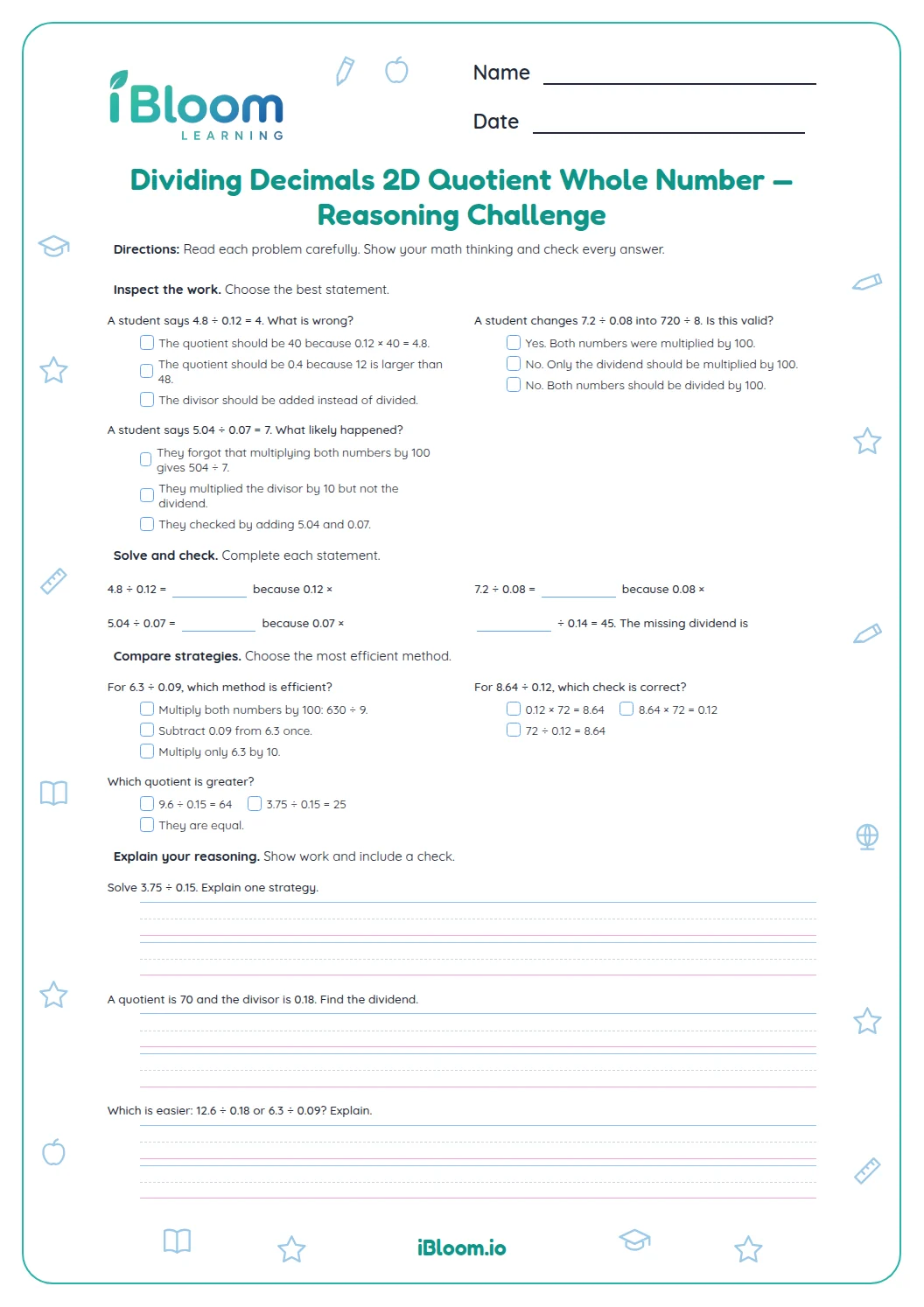
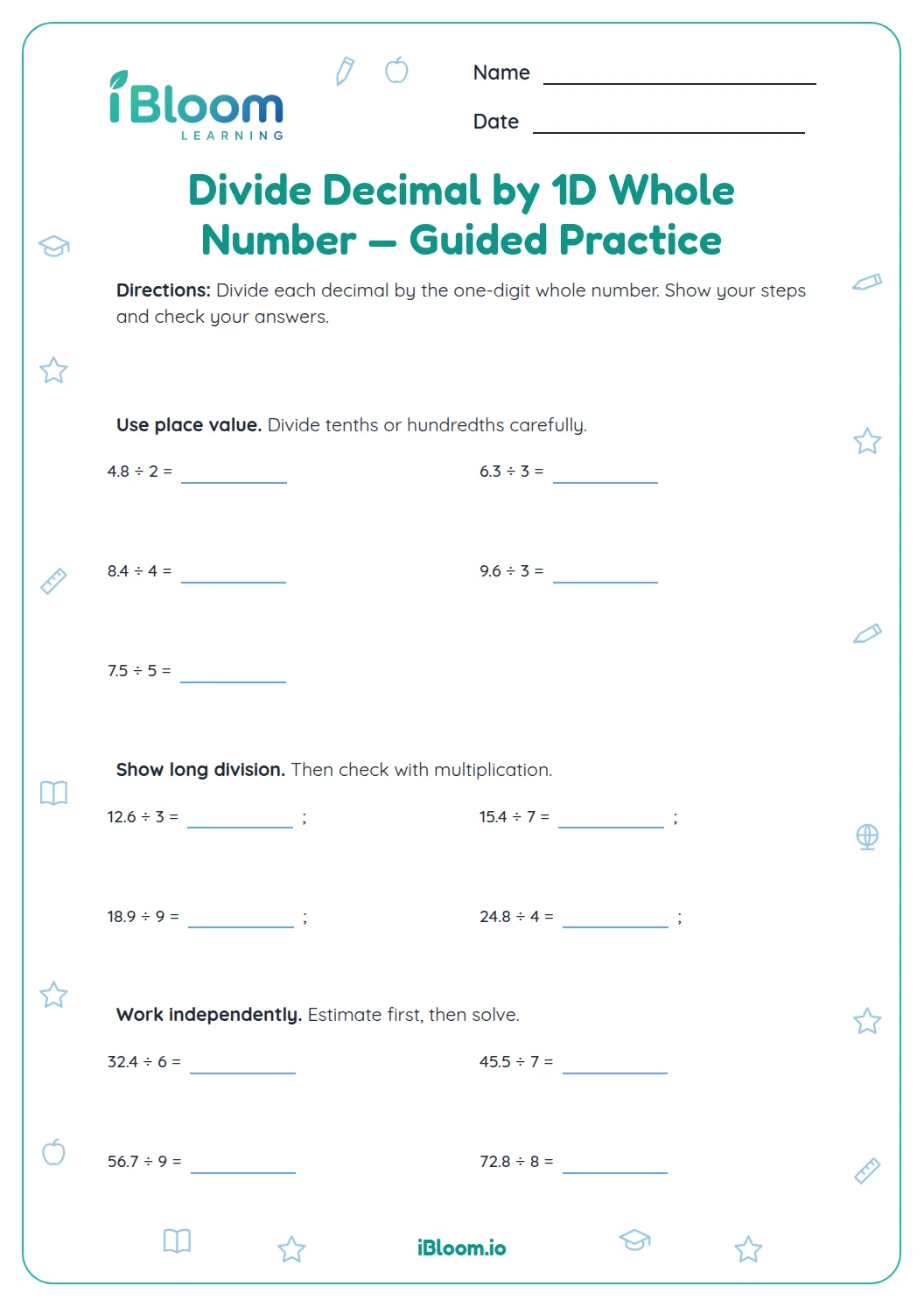
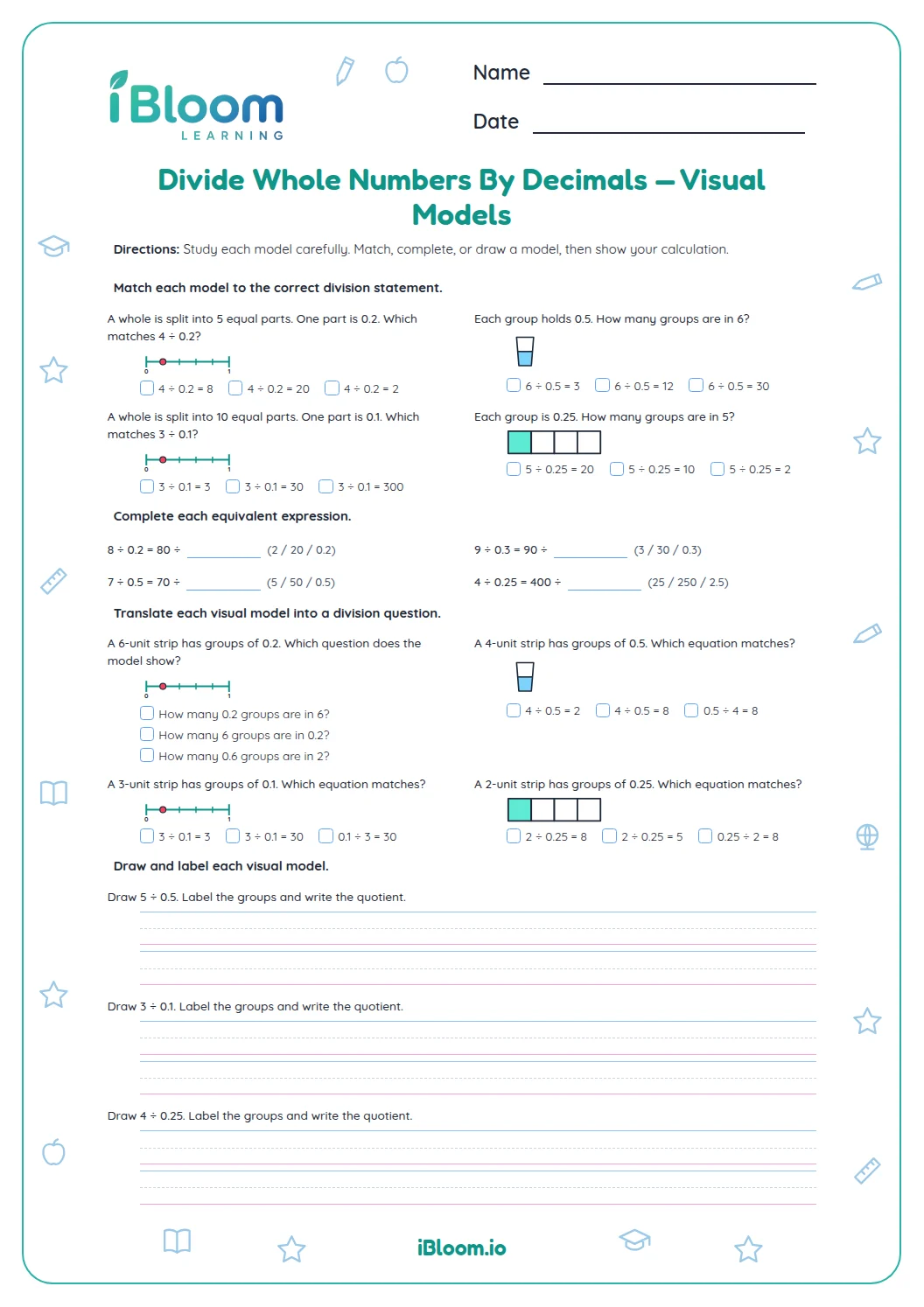
This Grade 5 printable connects decimal division to equal jumps and multiplication. Six number-line models show decimal-sized groups, followed by eight equations. All 14 quotients are whole numbers, and the answer key is included.
Aligned to 5.NBT.B.7
What models and equations are included?
Part A uses six number lines with equal decimal jumps. Part B gives eight equations for more practice. Every problem has a two-digit whole-number quotient.
How do equal jumps show a quotient?
The total distance is the dividend, and the size of each jump is the divisor. Count the jumps needed to reach the endpoint.
- 12.4 ÷ 0.2
- 2Count the 0.2 jumps from 0 to 2.4.
- 3The quotient is 12.
How do the equations connect to the models?
Each number line represents repeated addition of the divisor. Twelve jumps of 0.2 make 2.4, just as twelve groups of 0.2 total 2.4. The equation records the same group count more briefly.
How can an adult support this practice?
Have the student point to each interval while counting jumps, then say what the endpoint and step size represent. For the equation-only parts, invite them to sketch equal groups or use the same repeated-addition idea.
How to use this worksheet
- 1Read the dividend and divisor in the equation.
- 2On a model, identify the endpoint and jump size.
- 3Count each equal jump until it reaches the endpoint.
- 4Write the jump count as the quotient.
- 5For an equation alone, use an equivalent equal-groups strategy.
Mistakes to watch for
The mistake
Counting the tick marks instead of the spaces between them.
The fix
Count each interval as one group.
The mistake
Using the dividend as the jump size.
The fix
The divisor is the size of each jump; the dividend is the endpoint.
The mistake
Stopping before the endpoint.
The fix
Check that the last jump lands exactly on the dividend.
Common Core alignment
This worksheet practices the following Common Core skill.
Model decimal division with equal jumps and solve related equations to hundredths.
On this sheet:
Show the official wordingHide the official wording
Add, subtract, multiply, and divide decimals to hundredths, using concrete models or drawings and strategies based on place value, properties of operations, and/or the relationship between addition and subtraction; relate the strategy to a written method and explain the reasoning used.
What to practice next
Make more practice
Further reading
Questions parents and teachers ask
What is on this decimal division worksheet?
The 14 questions include six number-line models and eight equations. The models show decimal-sized jumps, and every question has a two-digit whole-number quotient. A separate answer key follows the two worksheet pages. Ask the student to point to the exact clue in the question before checking the key.
How do the number lines show division?
The endpoint is the dividend, and each equal interval represents one group the size of the divisor. Count the intervals from zero to the endpoint. For question 1, twelve jumps of 0.2 reach 2.4, so 2.4 ÷ 0.2 = 12. Multiplication checks the quotient.
Does the worksheet include answers?
Yes. The separate two-page key lists answers for all 14 problems. Students can try the six number-line models and eight equations first, then check their jump counts and quotients. Encourage them to use multiplication to confirm that each quotient multiplied by the divisor returns the dividend.
Do the problems have whole-number quotients?
Yes. Each dividend is an exact multiple of its divisor, and every quotient is a two-digit whole number. Students do not need to round; they can focus on the meaning of the divisor and the number of groups.
How can I help if my child is unsure?
Return to the first four number lines and connect each interval to one group. Ask what the total endpoint represents and what one jump represents. Then use those meanings to interpret the equations in the later parts. The quotients are all two-digit numbers.