




About this worksheet
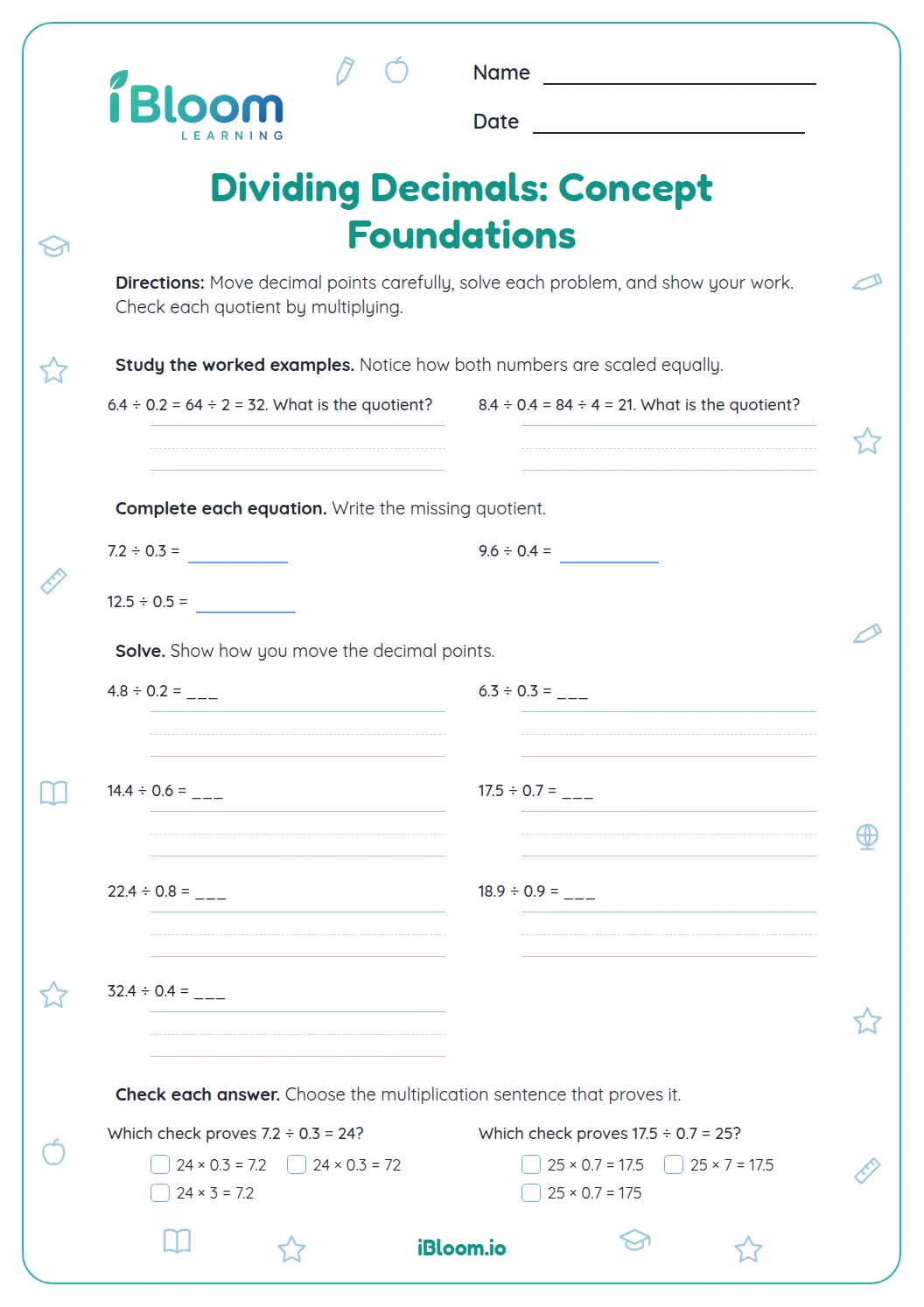
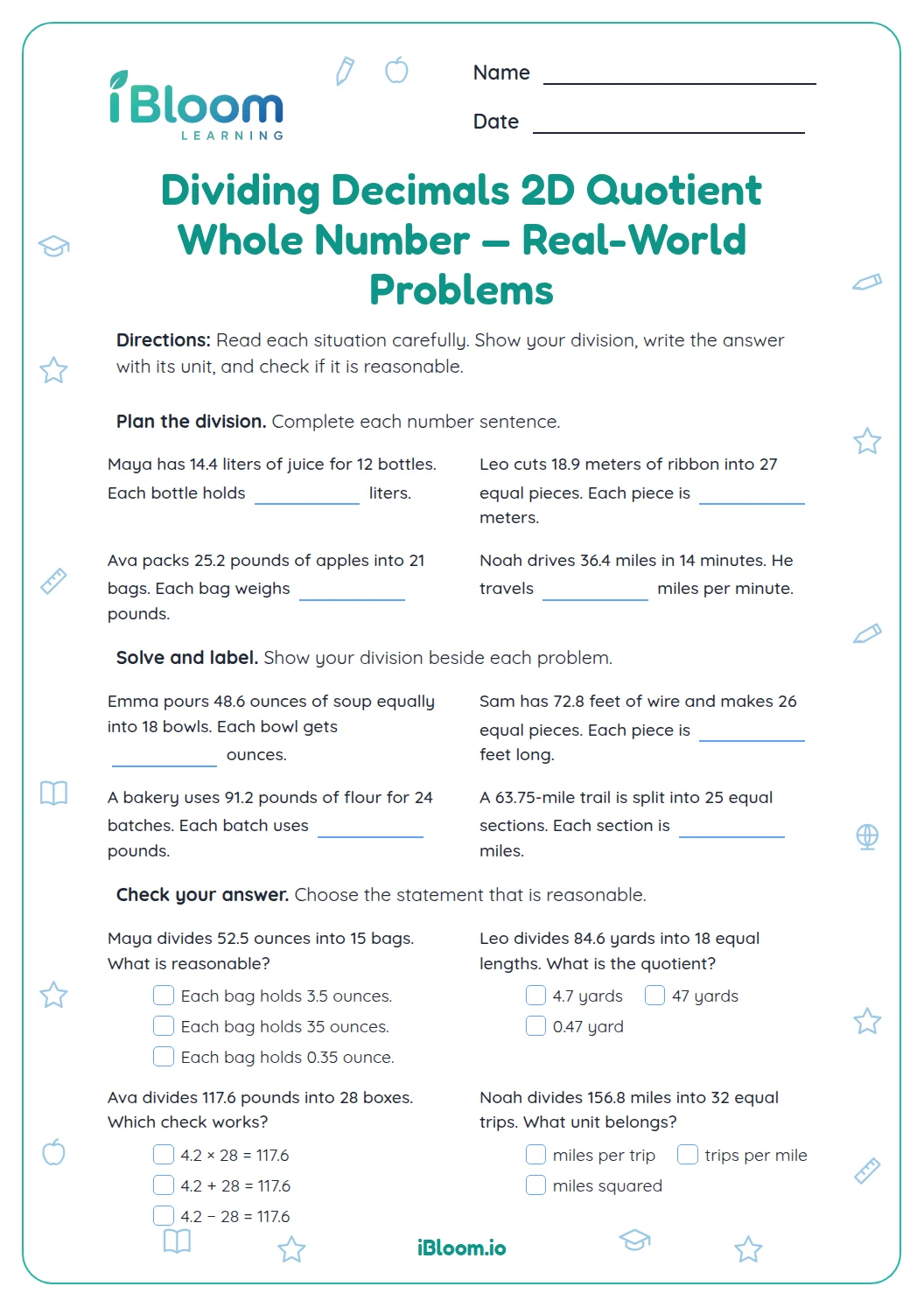
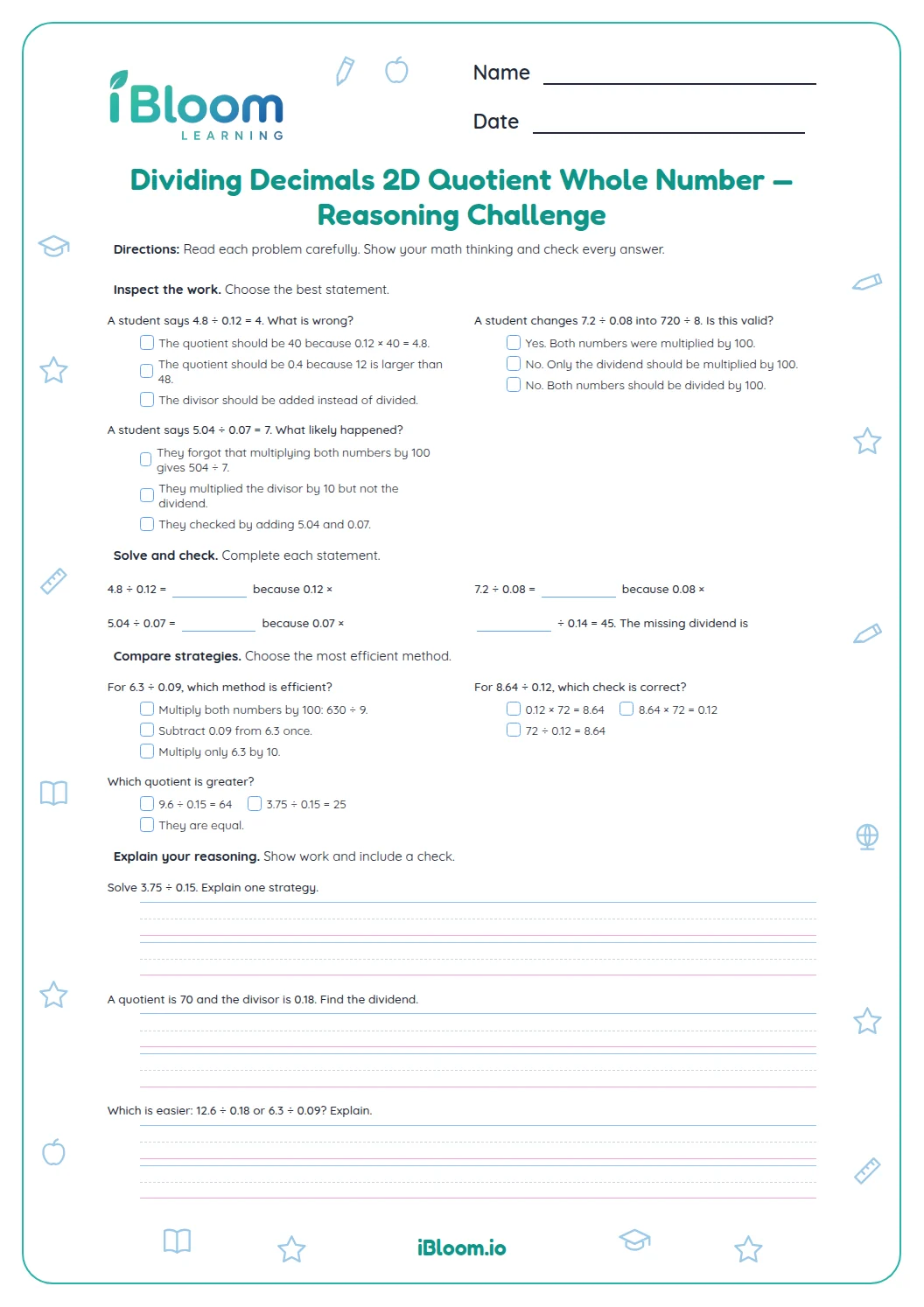
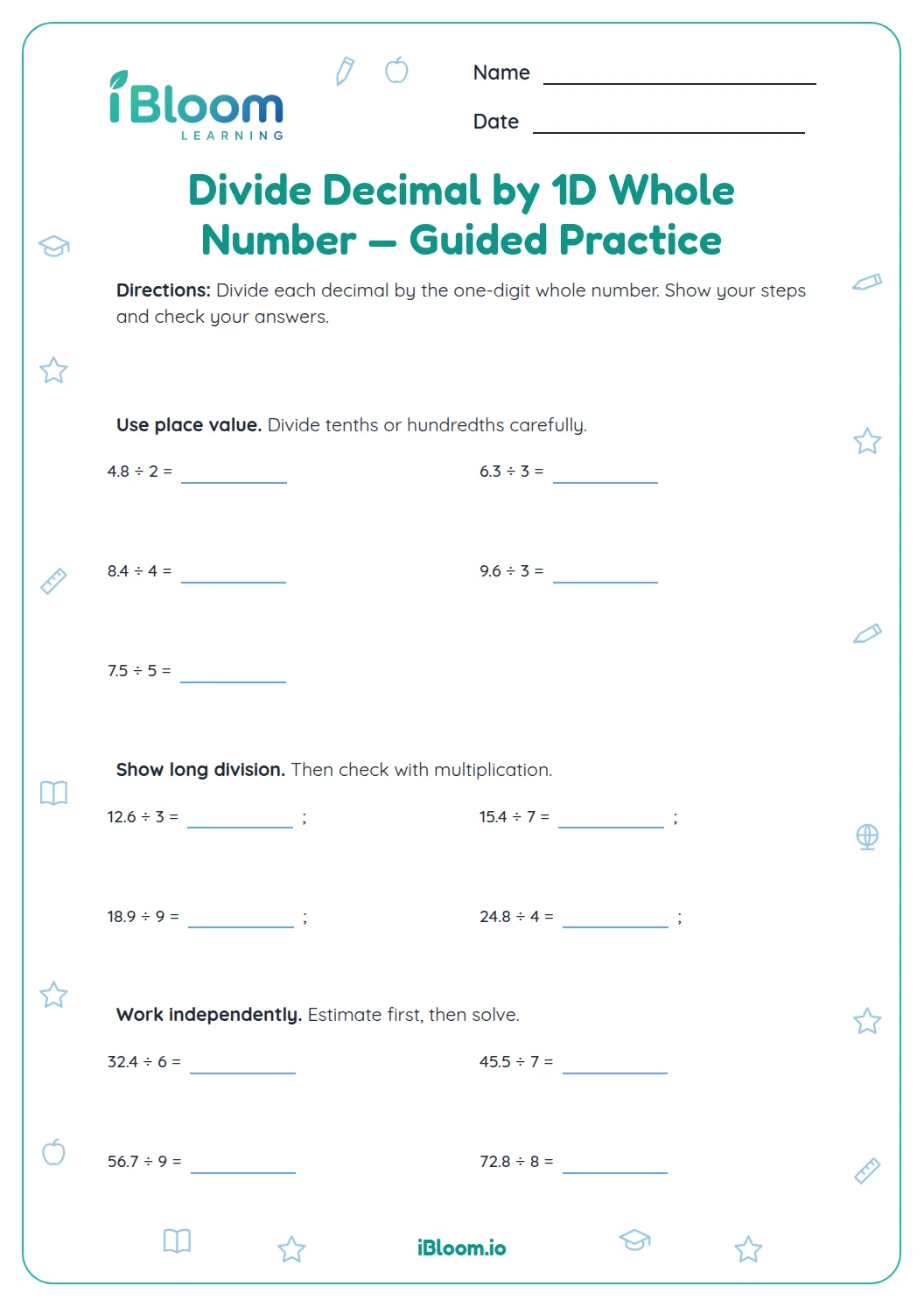
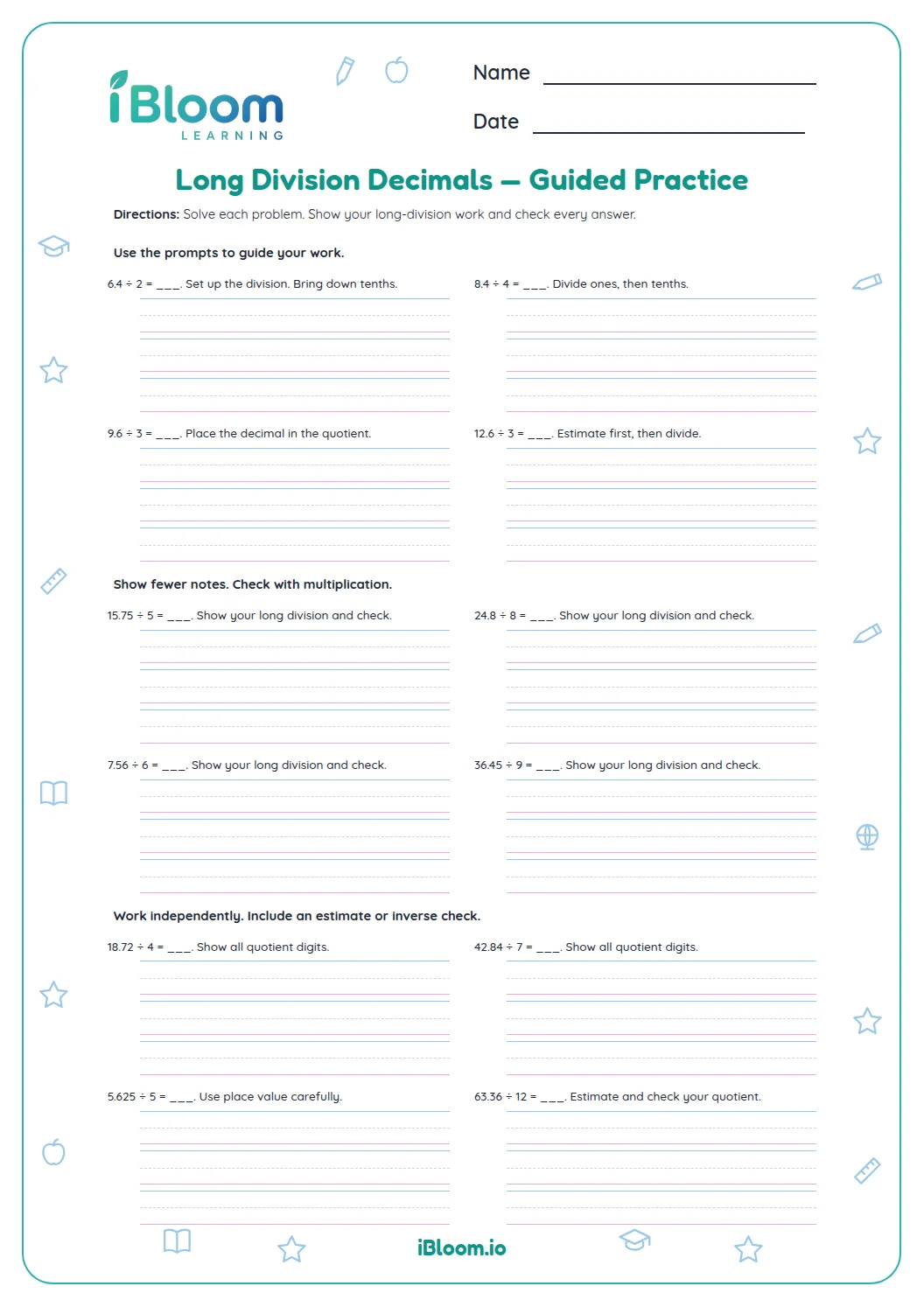
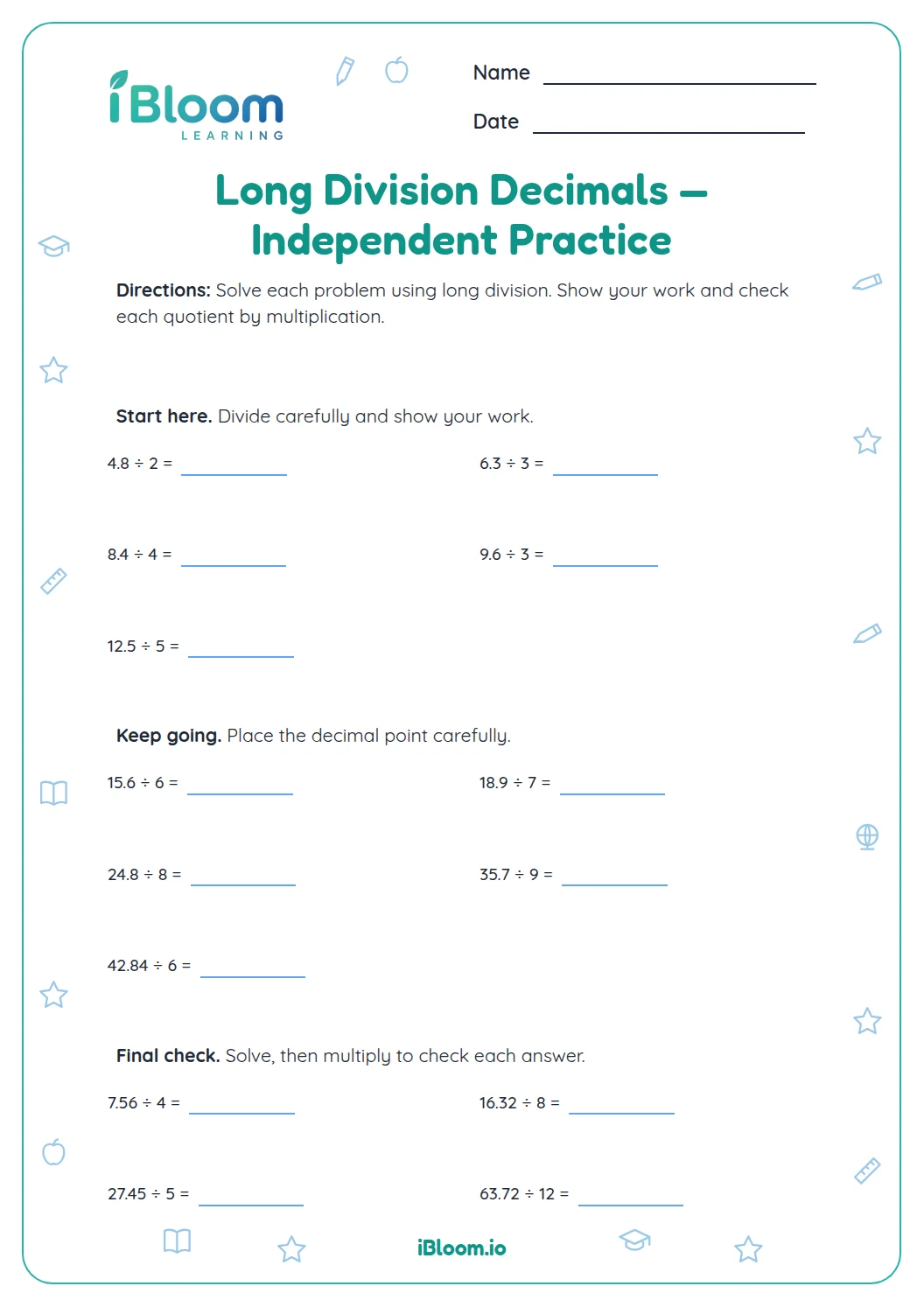
This Grade 5 printable gives students focused practice dividing decimals by decimals when the quotient is a whole number. Across two worksheet pages, Part A builds the decimal-shift routine and Part B asks students to solve and check with multiplication. The 16 calculations practice decimal division to hundredths and connect the written method to place value, as described in Common Core 5.NBT.B.7. A separate two-page answer key is included.
Aligned to 5.NBT.B.7
What does the quotient tell us?
A quotient is the answer to a division problem. In this practice, each decimal dividend is divided by a decimal divisor, and each quotient is a whole number. The paired decimals are selected so there is no remainder.
The main decision is how far to move each decimal point. Moving both the same number of places creates an equivalent division problem with a whole-number divisor.
How can you turn the divisor into a whole number?
Move the decimal point in both numbers one or two places as needed. Keep the movement equal so the ratio does not change. Then divide and check by multiplication.
- 126.4 ÷ 1.2
- 2Move both decimals one place: 264 ÷ 12
- 3264 ÷ 12 = 22
- 4Check: 22 × 1.2 = 26.4
What is on the two practice pages?
Part A builds the quotient with eight calculations. Part B has eight more decimal divisions and asks students to multiply back to check. All 16 answers are whole numbers.
How to use this decimal division worksheet
- 1Look at the divisor and decide how many places it needs to move to become a whole number.
- 2Move the dividend decimal the same distance.
- 3Rewrite the equivalent division with a whole-number divisor.
- 4Divide using a fact, place-value strategy, or written method.
- 5Multiply the quotient by the original divisor to check the dividend.
Common mistakes and quick fixes
The mistake
Moving the divisor point but leaving the dividend unchanged.
The fix
Move both decimal points the same number of places; the quotient depends on their ratio.
The mistake
Moving the decimal different distances.
The fix
Count the places in both numbers and make the same shift in each.
The mistake
Stopping before checking the quotient.
The fix
Multiply the answer by the original divisor and see whether it returns the original dividend.
Common Core alignment
This worksheet practices a specific Common Core skill through short, grade-level tasks.
Divide decimals to hundredths by using place-value strategies and written methods.
On this sheet: Every item divides decimals by decimals and yields a whole-number quotient.
Show the official wordingHide the official wording
Add, subtract, multiply, and divide decimals to hundredths, using concrete models or drawings and strategies based on place value, properties of operations, and/or the relationship between addition and subtraction; relate the strategy to a written method and explain the reasoning used.
What to practice next
Make more practice
Further reading
Questions parents and teachers ask
What does a whole-number quotient mean here?
Each answer is a whole number, such as 22 or 36. The numbers being divided still have decimal points, so students practice how place value changes when both the dividend and divisor are multiplied by the same power of ten.
How do I divide when both numbers have decimals?
Move each decimal point the same number of places until the divisor is a whole number. For 26.4 ÷ 1.2, move both one place to get 264 ÷ 12, which equals 22. The value of the quotient stays the same because both numbers changed equally.
Why does the sheet use two-digit answers?
The practice focuses on quotients from 22 to 42, so students can concentrate on decimal placement and division reasoning instead of very small basic quotients. Each dividend and divisor pair is chosen to divide evenly. For instance, 39.6 divided by 1.8 equals 22.
Is there room to show work?
Yes. The worksheet uses equation and working-space items. Students can rewrite each expression with a whole-number divisor, solve it, and multiply the quotient by the original divisor to check. Students can use the equation lines to record a quotient.
What is included with the printable?
The printable has two pages of guided decimal-division practice and a separate two-page answer key. It contains 16 problems, moving from one decimal shift to a second set for solving and checking. The key shows the quotient for every printed calculation.
How long should this practice take?
Plan for about 20 minutes. Students who are new to decimal division may want to work through the first few slowly and explain why moving both decimal points the same distance preserves the quotient. A multiplication check should return the original dividend.