




About this worksheet
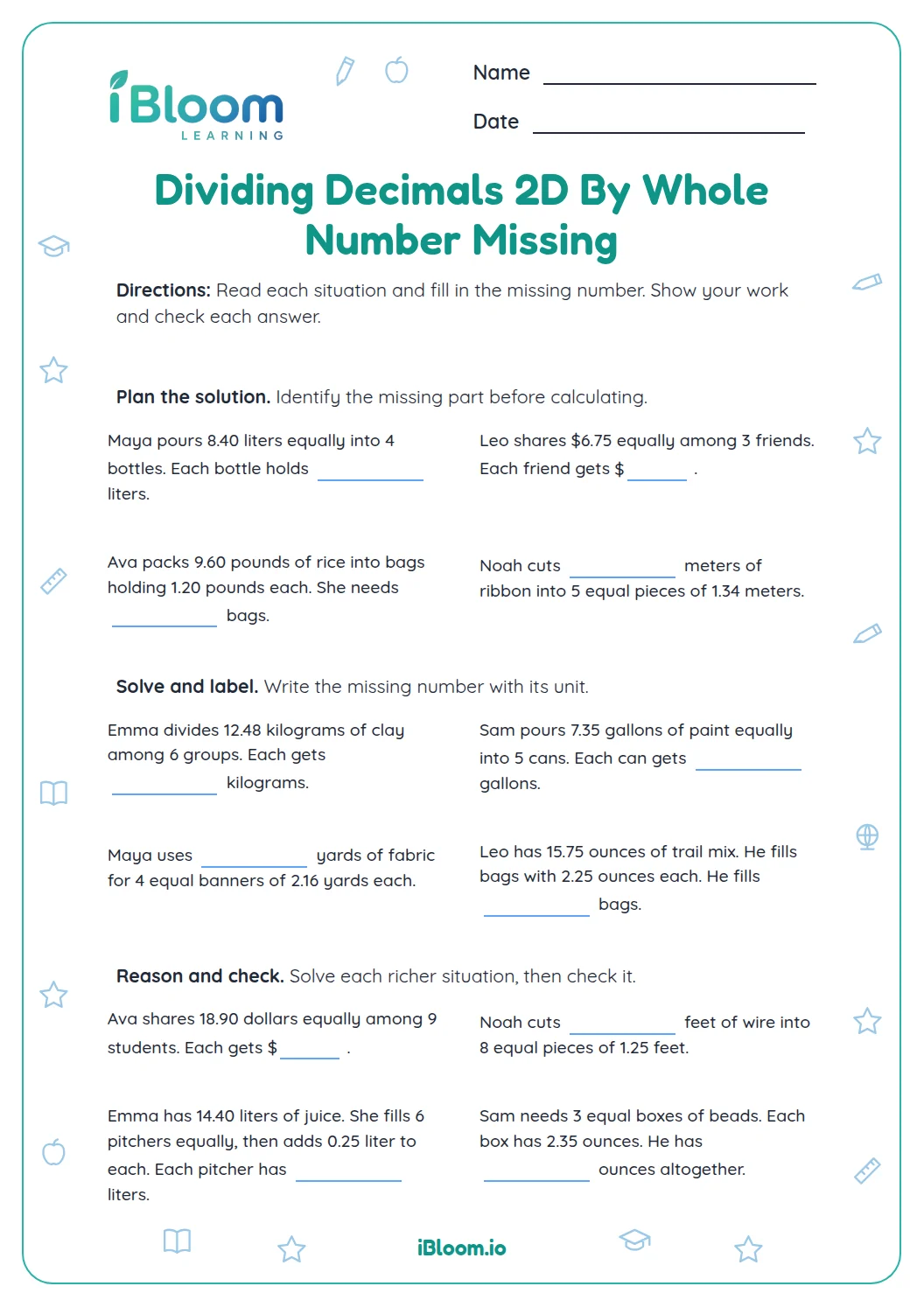
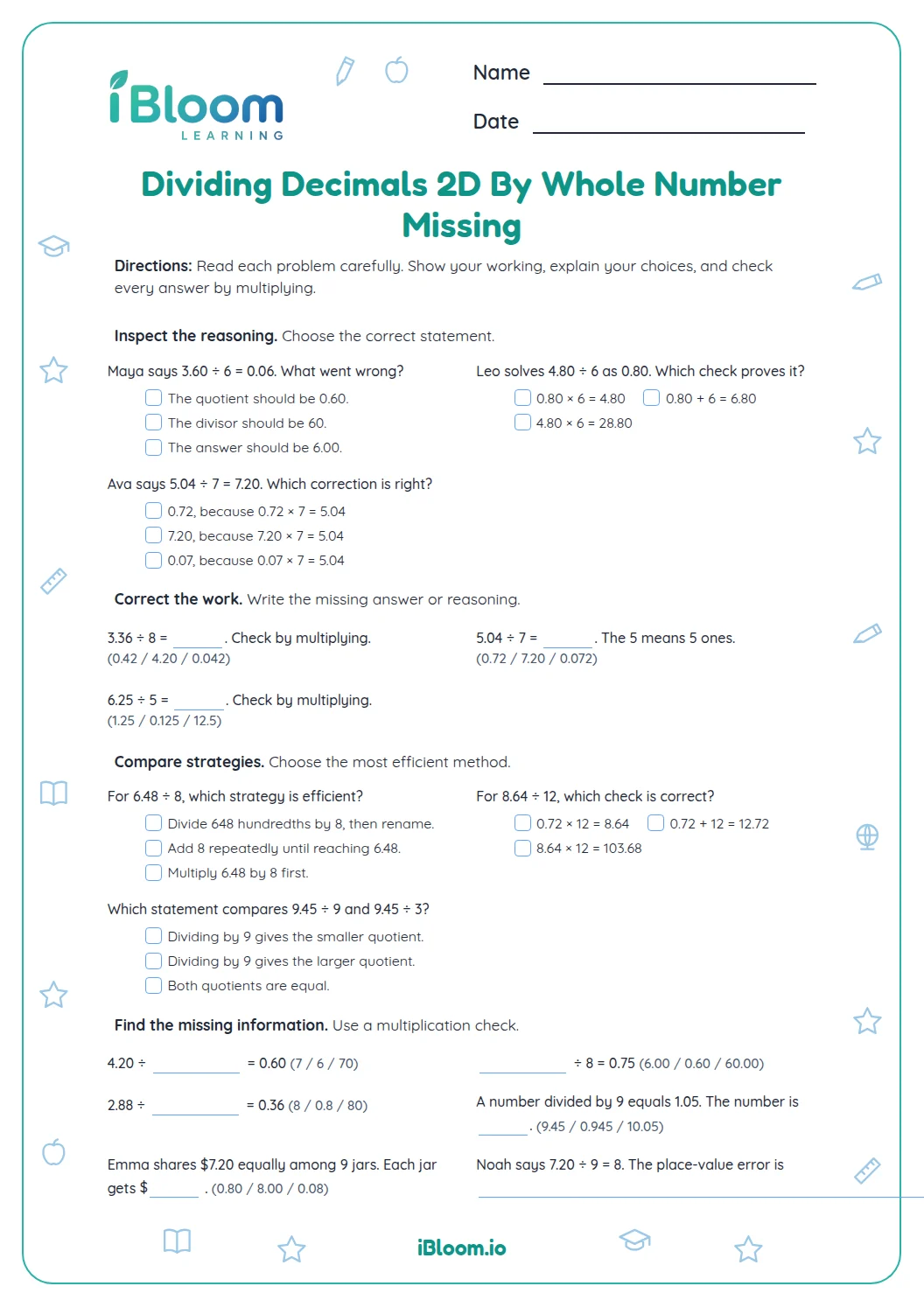
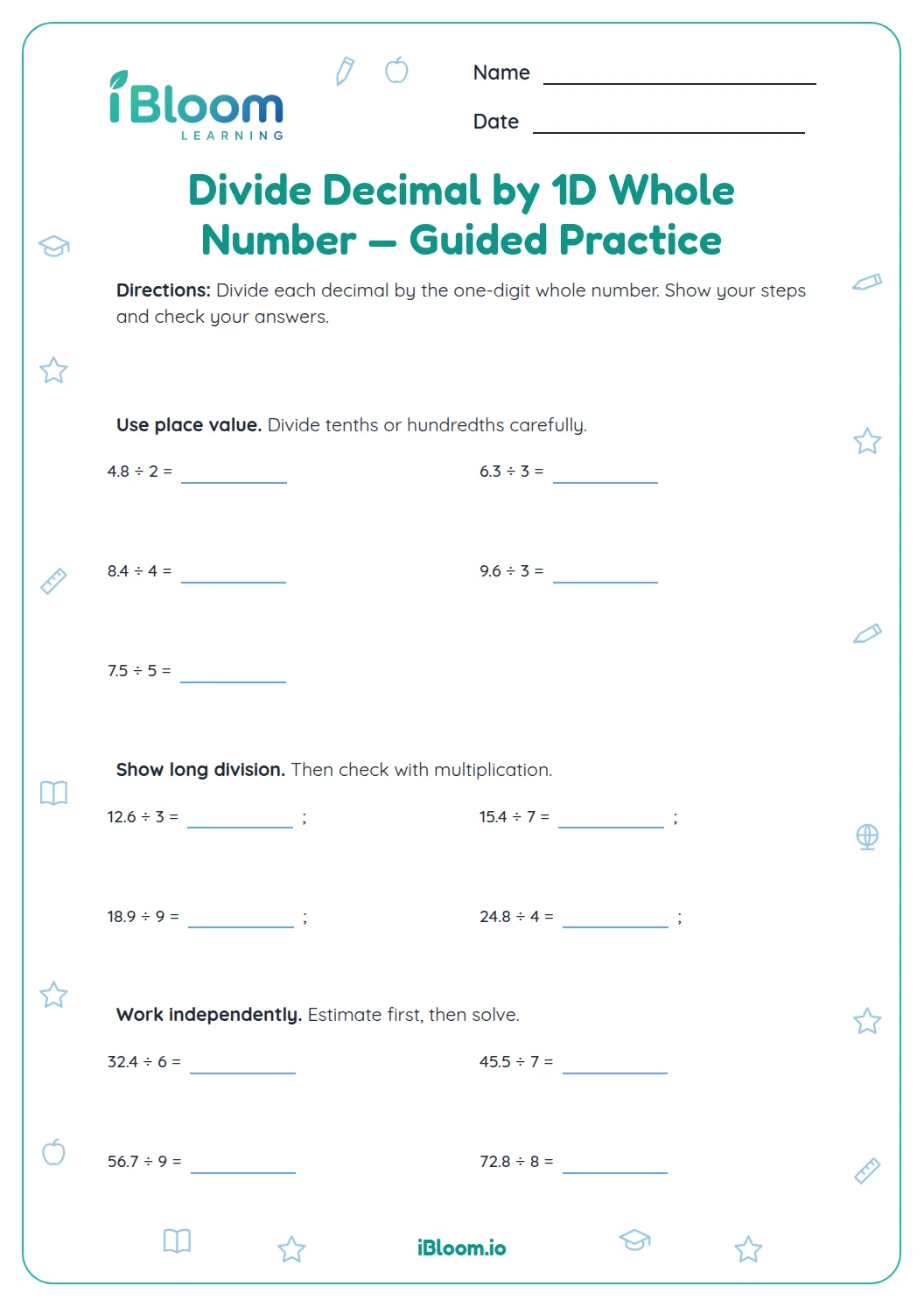
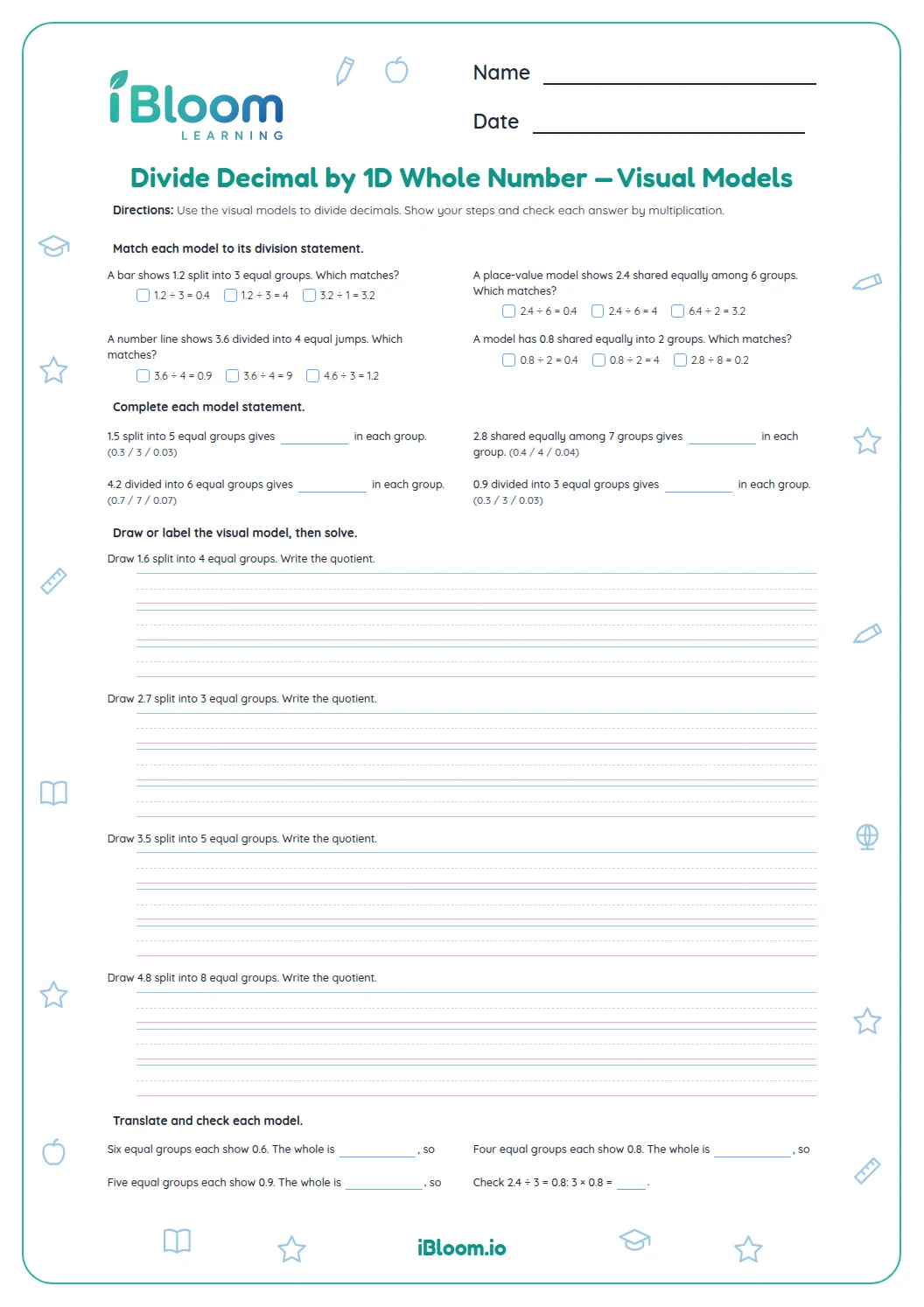
This Grade 5 worksheet connects decimal division with multiplication. Learners begin with tenths-strip models, then solve missing-factor equations and two equal-sharing problems. The opening model represents 2.4 repeated four times to make 9.6, so the missing factor is 2.4. The 15 questions practice decimal division and multiplication checks described by Common Core 5.NBT.B.7. A separate answer key is included.
Aligned to 5.NBT.B.7
How does a tenths model show a quotient?
The first model shows two whole tenths strips and four tenths, or 2.4. Four groups of 2.4 make 9.6, so 9.6 ÷ 4 = 2.4.
How can you solve a missing-factor equation?
In ___ × 3 = 6.9, split 6.9 into three equal groups or divide by 3. Each group is 2.3.
How do you check the quotient?
Question 13 shares 9.6 liters among 6 bottles. Calculate 9.6 ÷ 6 = 1.6, then check 1.6 × 6 = 9.6.
- 19.6 ÷ 6 = 1.6
- 2Check: 1.6 × 6 = 9.6
- 3Answer: 1.6 L per bottle
How to use this worksheet
- 1Read the dividend and number of equal groups.
- 2Use a model or division to find one group’s amount.
- 3Write the quotient as the missing factor.
- 4Multiply to check the equation.
- 5Add units to each real-world answer.
- 6Compare your work with the answer key.
Common mistakes and quick fixes
The mistake
Reading the model as 2.1 instead of 2.4.
The fix
Count the shaded tenths in the second strip; four tenths make 0.4.
The mistake
Multiplying the dividend by the divisor.
The fix
Divide the total into the stated number of equal groups.
The mistake
Skipping the multiplication check.
The fix
Multiply quotient by divisor; it should equal the dividend.
Curriculum alignment
Use place-value reasoning and models to solve decimal division problems.
On this sheet: Models and missing-factor equations represent decimal division, and learners check quotients with multiplication.
Show the official wordingHide the official wording
Add, subtract, multiply, and divide decimals to hundredths, using concrete models or drawings and strategies based on place value, properties of operations, and/or the relationship between addition and subtraction; relate the strategy to a written method and explain the reasoning used.
What to practice next
Make more practice
Further reading
Questions parents and teachers ask
What does “missing divisor” mean here?
Each equation gives a product and one factor, and learners find the other factor. That missing factor is also the quotient when the product is divided by the known factor, as in ___ × 4 = 9.6. The model uses two whole strips and four tenths to show 2.4.
What does the first model show?
It shows 2.4: two complete strips and four tenths in a third. Four groups of 2.4 total 9.6, so the missing number is 2.4. The answer key shows the matching equation. The first model and its equation connect a visual amount with a quotient.
How many questions are included?
There are 15 questions: three model-based equations, nine more missing-factor equations, two real-world division problems, and one multiplication-check explanation. Each equation has one missing factor; use division to find it and multiplication to check. Completing these steps together reinforces the connection between division and multiplication.
How can a child check a quotient?
Multiply the quotient by the divisor. For example, 9.6 ÷ 6 = 1.6 checks because 1.6 × 6 = 9.6. The final question asks learners to explain this inverse relationship. Learners can use the same inverse relationship for each decimal dividend on the page.
Is there an answer key?
Yes. The separate key includes answers for all 15 items, with units for the jug and ribbon problems and a sample response for the final explanation. For the open response, the key gives one correct way to explain the check.