






About this worksheet
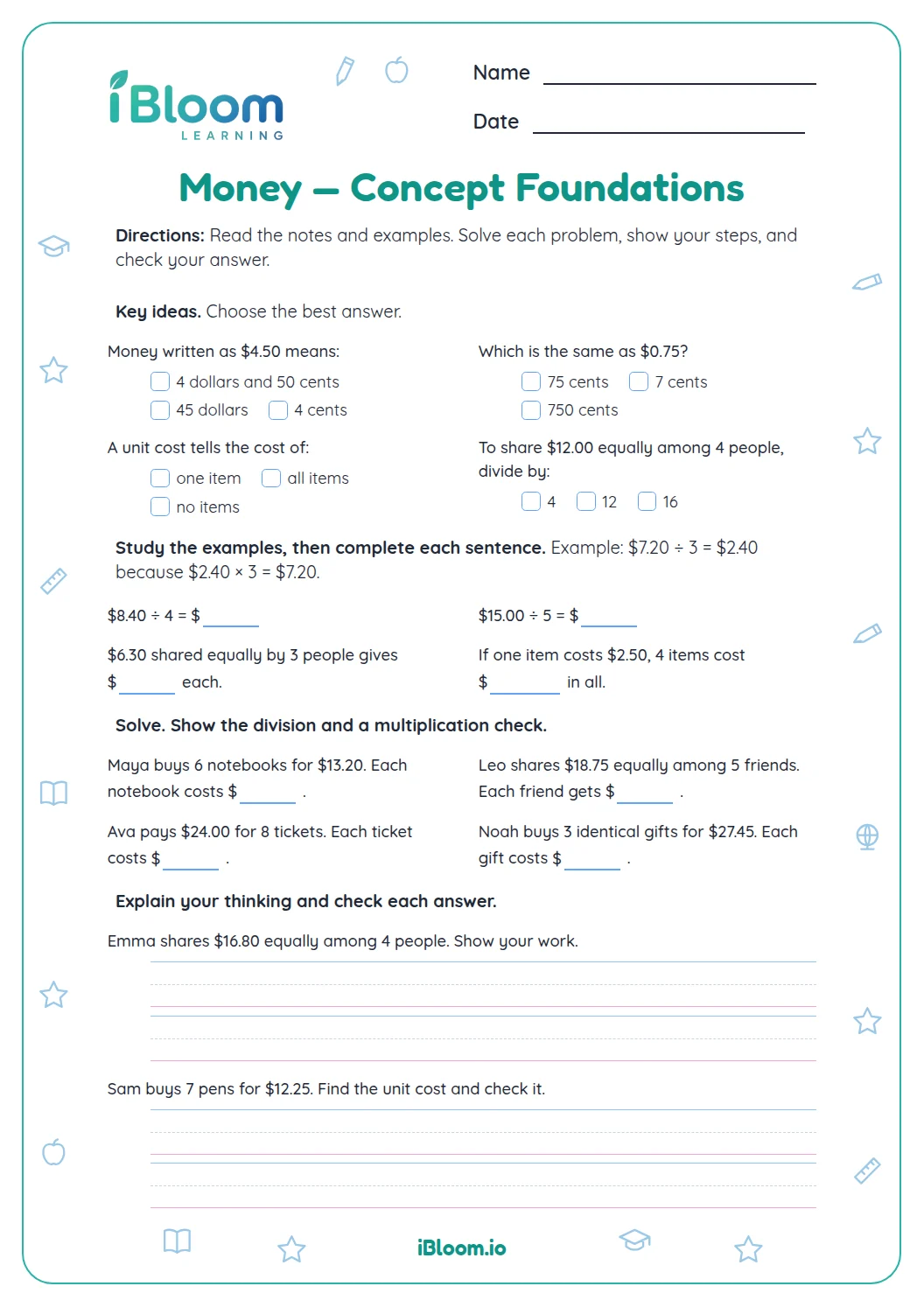
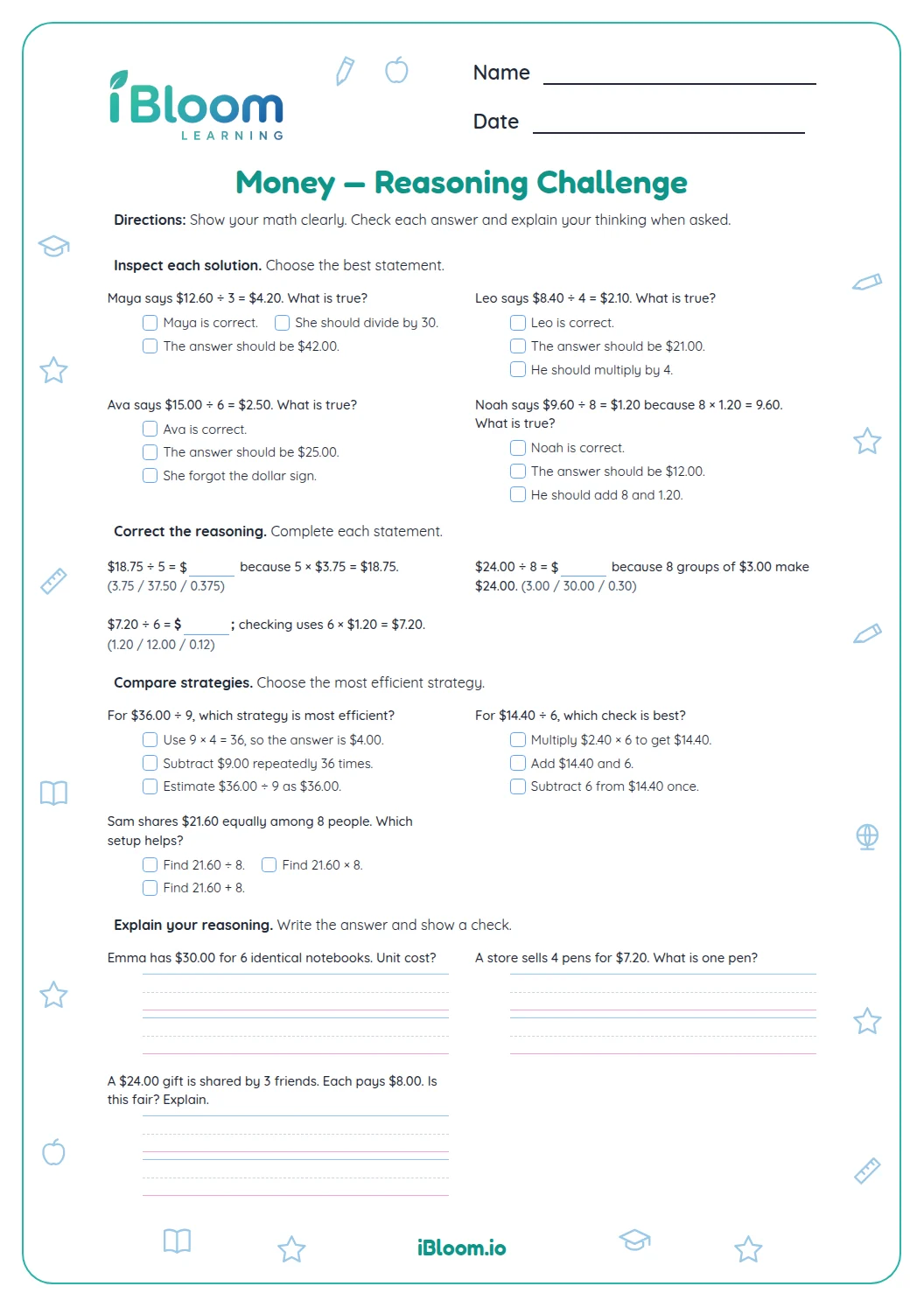
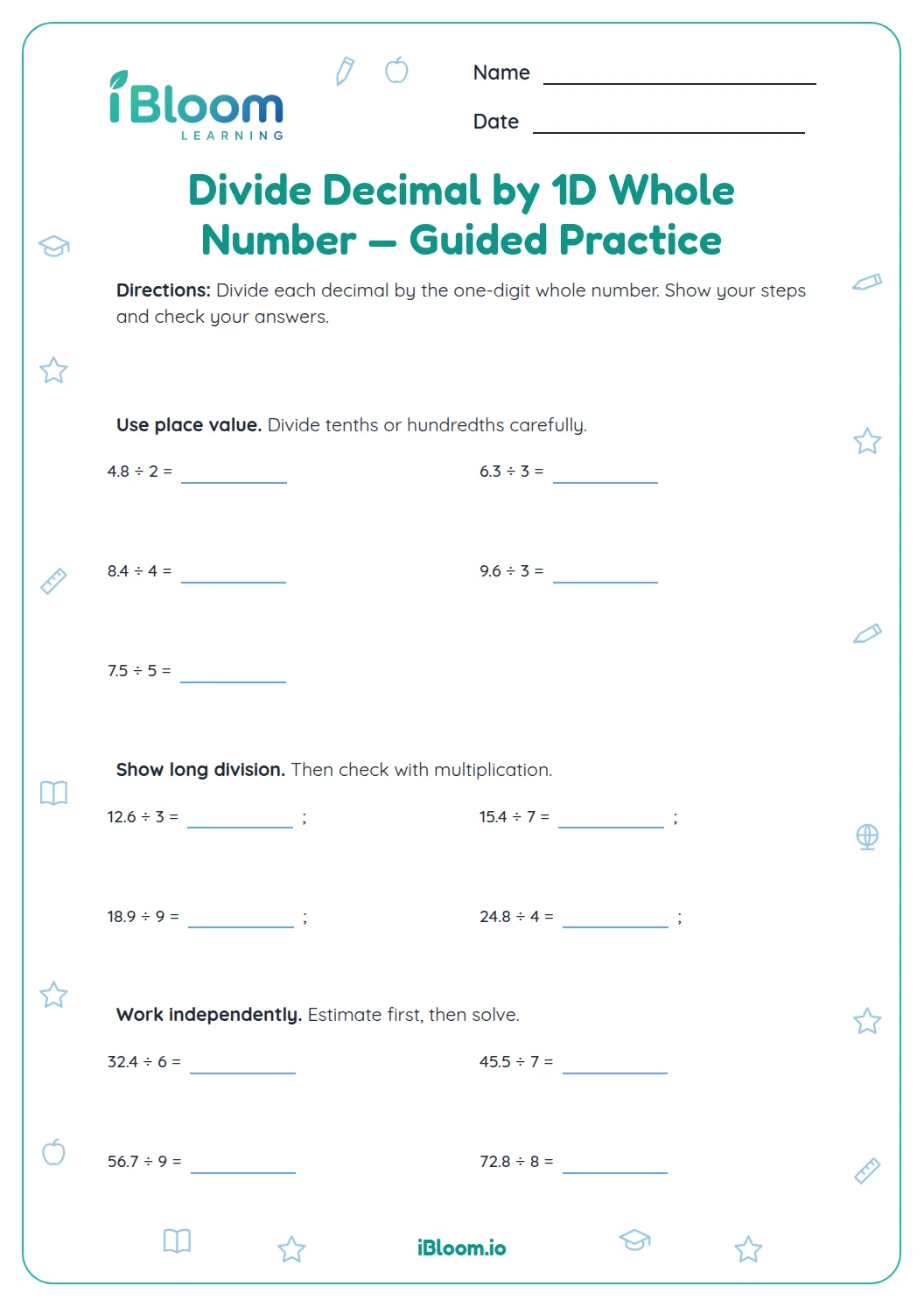
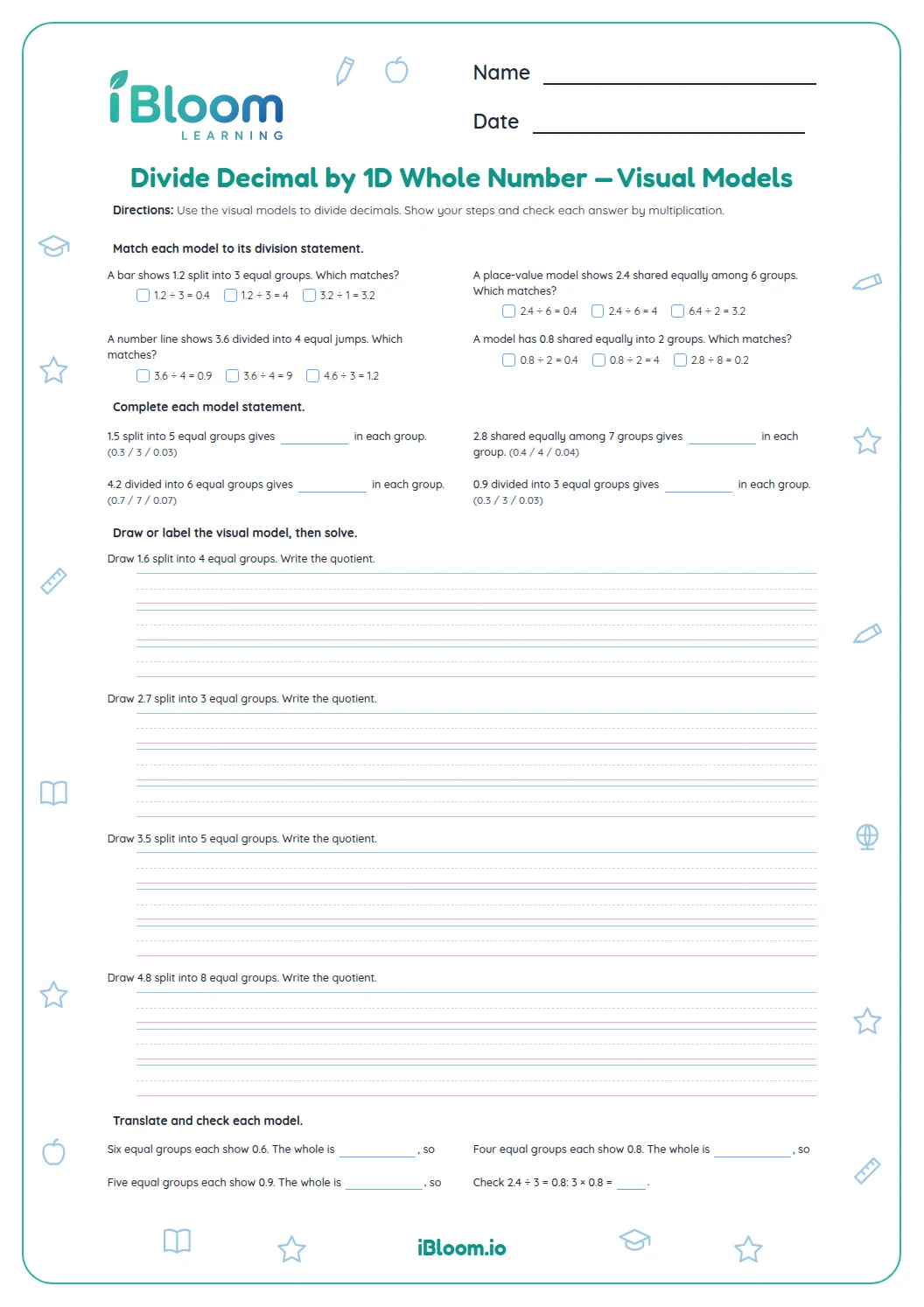
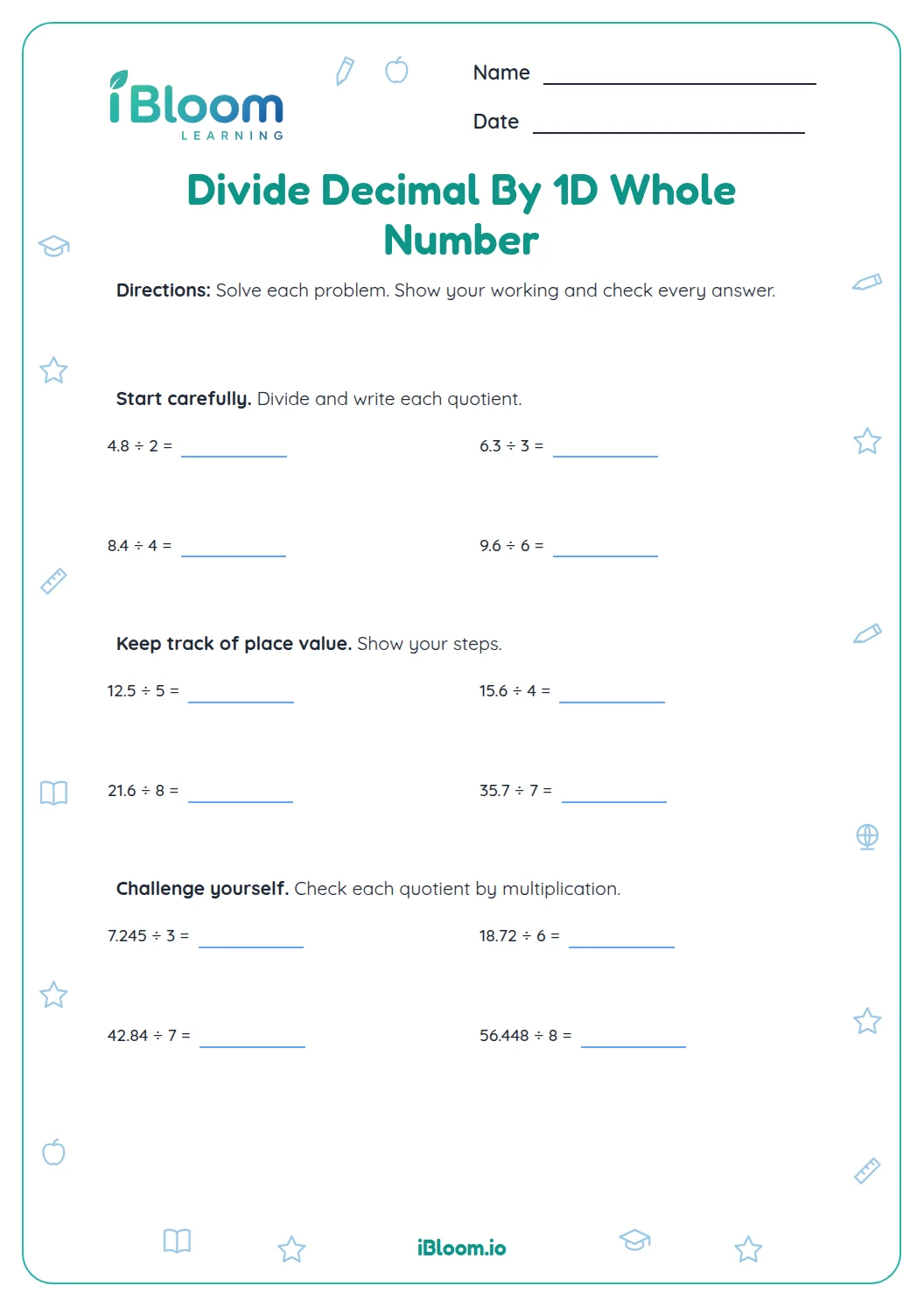
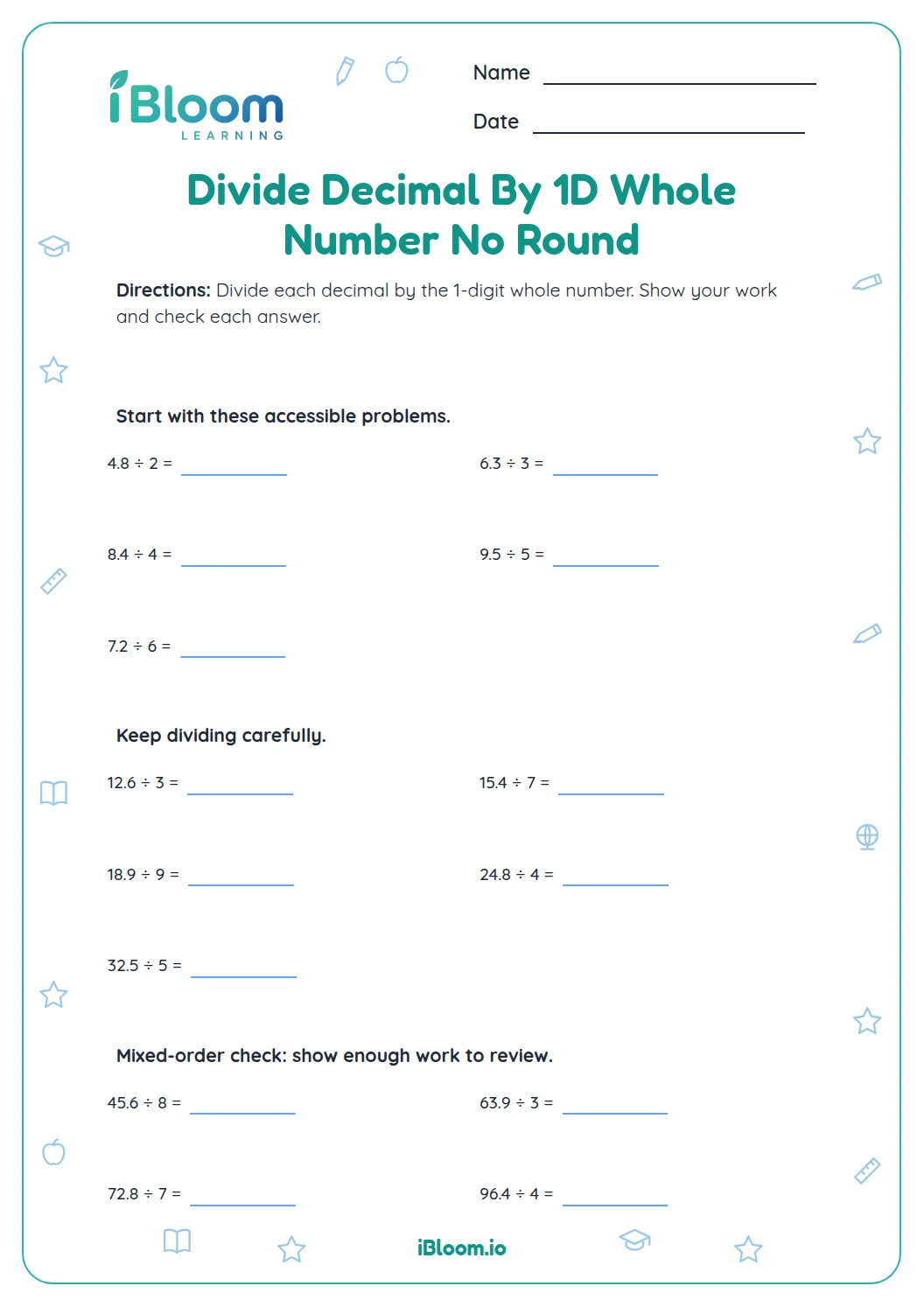
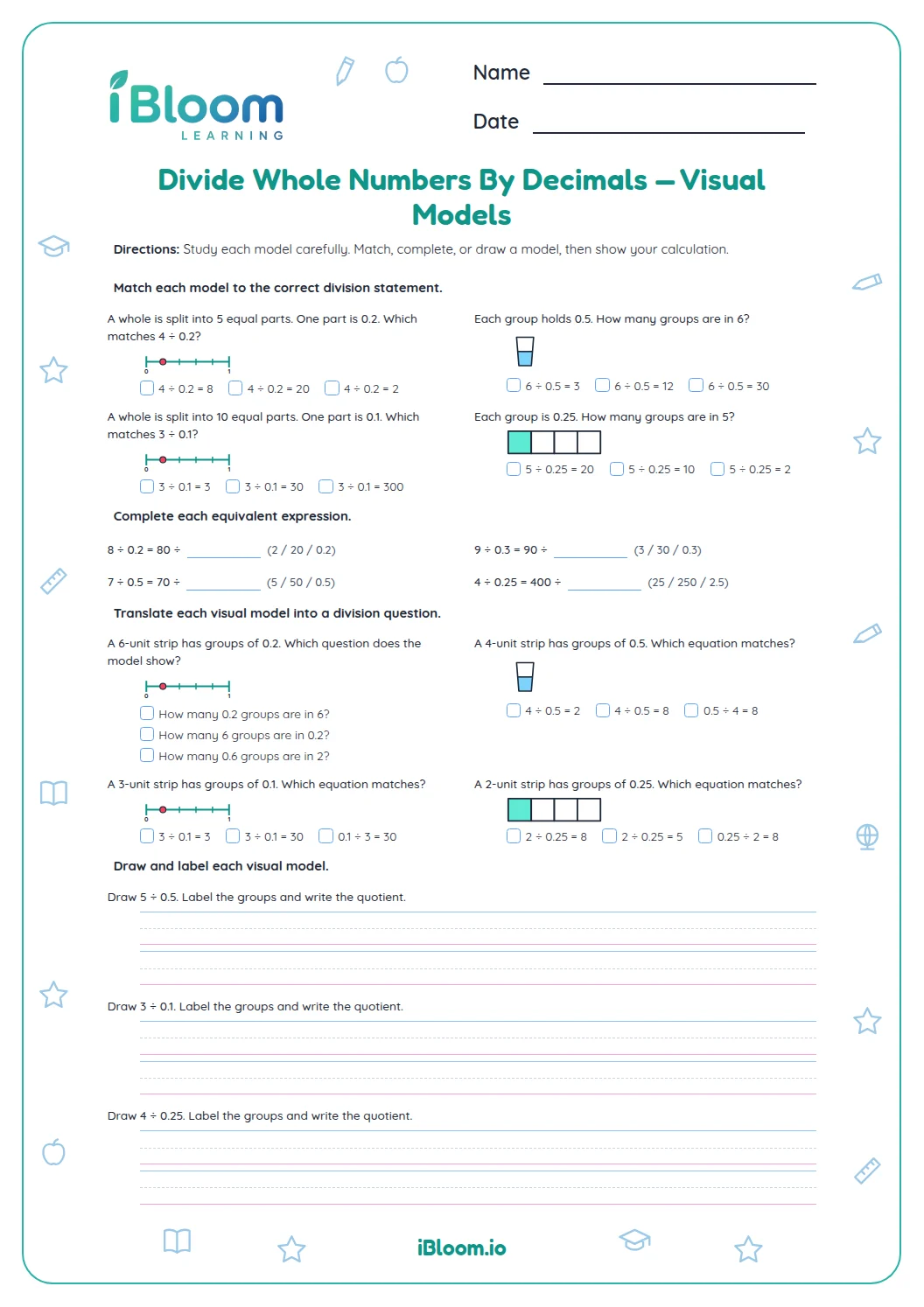
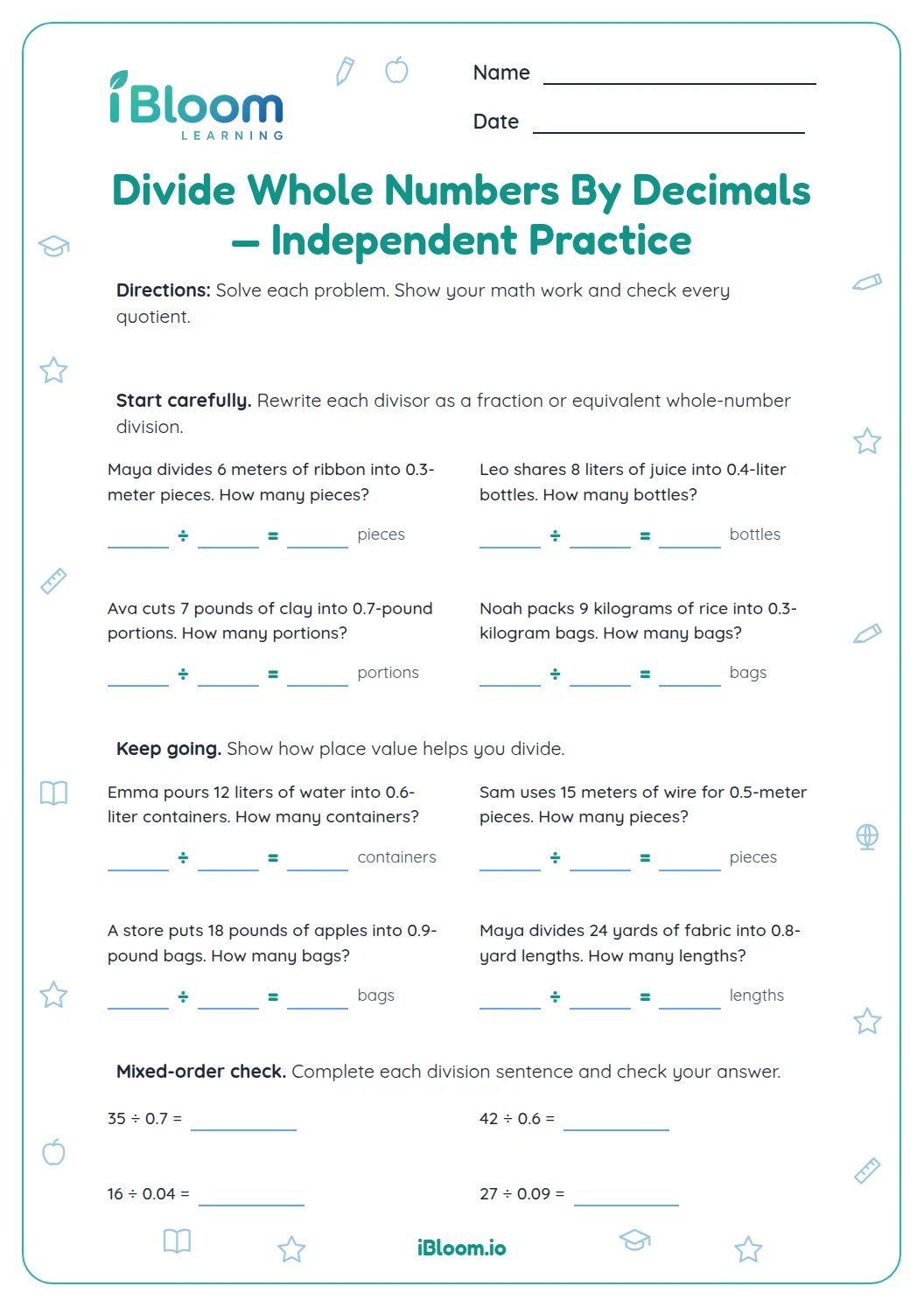
This free printable Grade 5 worksheet practices decimal division in money contexts. Its 16 problems begin with dollar amounts divided by whole numbers, then use equal-share and unit-cost situations, including quotients with cents. Students write answers in dollars and can check them by multiplying the quotient by the number of shares or items. The practice aligns with Common Core 5.NBT.B.7, which includes dividing decimals to hundredths using strategies based on place value and operations.
Aligned to 5.NBT.B.7
How does division find a unit price?
Divide the total cost by the number of equal items or shares. In question 1, $12.00 ÷ 3 = $4.00, so each share is four dollars. The quotient keeps the same money unit as the amount being shared.
Some answers include cents. For example, dividing $25.00 among 10 markers gives $2.50 per marker.
- 1$12.00 ÷ 3 = $4.00
- 2Check: $4.00 × 3 = $12.00
- 3Each share is $4.00.
How should a student read a money story?
Identify the total amount and how many equal groups, people, or items share it. Divide the total by that count, then attach the context: dollars per friend, notebook, ticket, or item.
When do answers need cents?
Use dollars and cents when the quotient is not a whole number of dollars. The worksheet directions ask for each answer in dollars, and the key accepts equivalent money notation when the value is the same.
How to use this worksheet
- 1Read the directions and scan the whole part.
- 2Underline or name the information that matters.
- 3Choose a strategy and show the calculation.
- 4Write a complete answer with its unit when needed.
- 5Check the answer key and correct any missed step.
Common mistakes and quick fixes
The mistake
Starting to calculate before identifying what the prompt asks.
The fix
Say the unknown aloud, then choose the operation that finds it.
The mistake
Leaving off a unit or context label.
The fix
Reread the question and include the requested unit in the answer.
The mistake
Accepting an answer without checking it.
The fix
Use the inverse operation or estimate to see whether the result makes sense.
Common Core alignment
This worksheet practices the following Common Core skill.
Divide decimal amounts to hundredths and connect a strategy to a written method.
On this sheet:
Show the official wordingHide the official wording
Add, subtract, multiply, and divide decimals to hundredths, using concrete models or drawings and strategies based on place value, properties of operations, and/or the relationship between addition and subtraction; relate the strategy to a written method and explain the reasoning used.
What to practice next
Make more practice
Further reading
Questions parents and teachers ask
How many questions are on the money division sheet?
There are 16 questions: eight dollar division equations and eight short money situations. The situations ask about equal shares or the cost of one item. The answer key shows the dollar amount for each quotient. Each context names what one quotient represents.
How do I find the cost of one item?
Divide the total price by the number of items. For question 10, eight notebooks cost $40.00, so $40.00 ÷ 8 = $5.00 per notebook. Multiplying $5.00 by 8 checks the total. This check works for every equal-share question.
Why are some answers written with cents?
Some totals do not divide into whole dollar amounts. For example, $25.00 shared among 10 markers is $2.50 per marker. Writing two digits after the decimal point makes the cents clear. The quotient can be stated in dollars and cents.
Should students write a dollar sign in each answer?
Yes. The worksheet directions ask for answers in dollars, so students should include the dollar sign and cents where needed. The key accepts equivalent notation such as $1.6 and $1.60 because they have the same value. The context helps students label the quotient accurately.
What standard does this worksheet practice?
The sheet practices CCSS 5.NBT.B.7, including dividing decimals to hundredths. Students divide money amounts and interpret the quotient as a cost or share, then can use multiplication to check the written division. The cited standard covers decimal operations to hundredths.