






About this worksheet
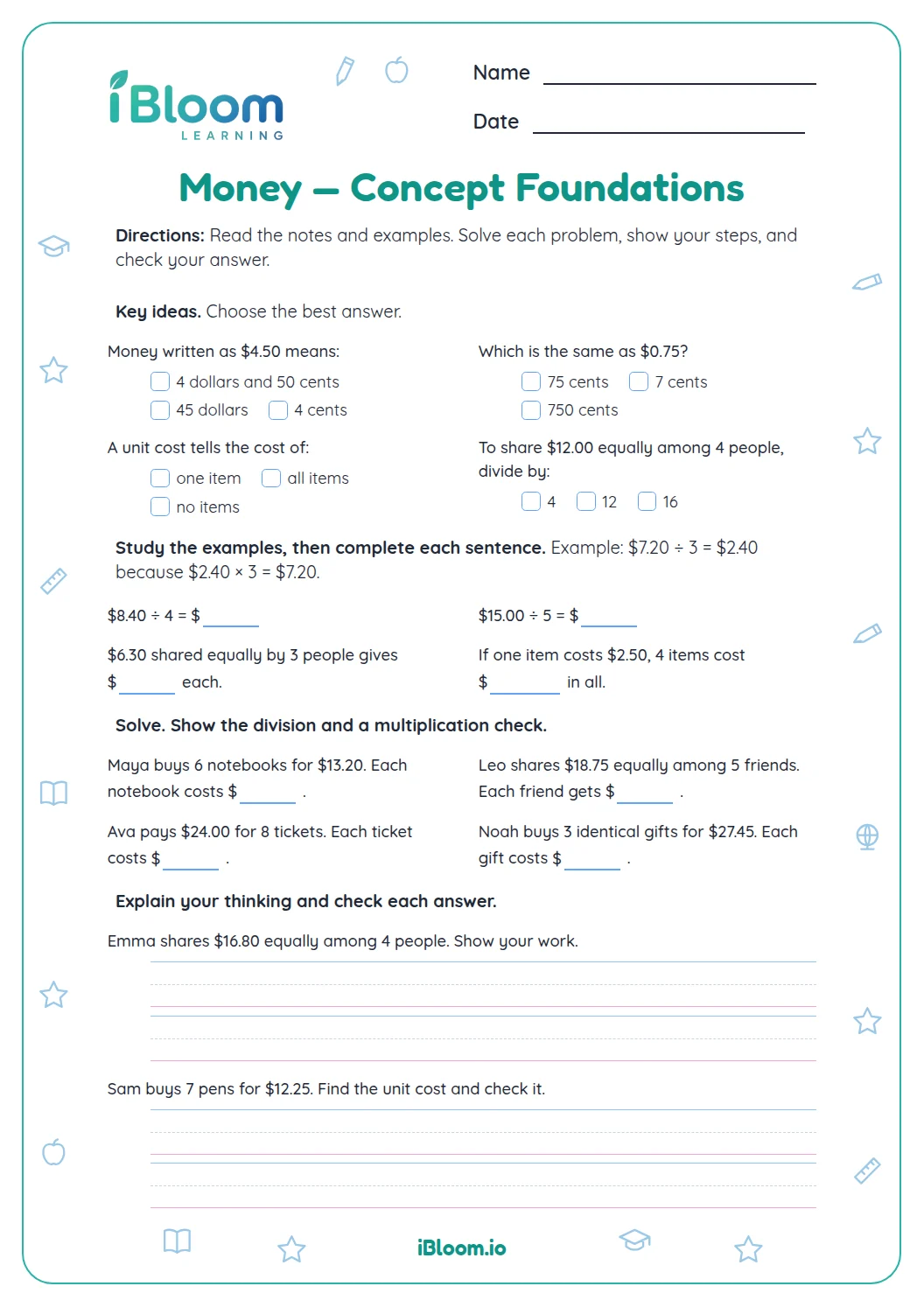
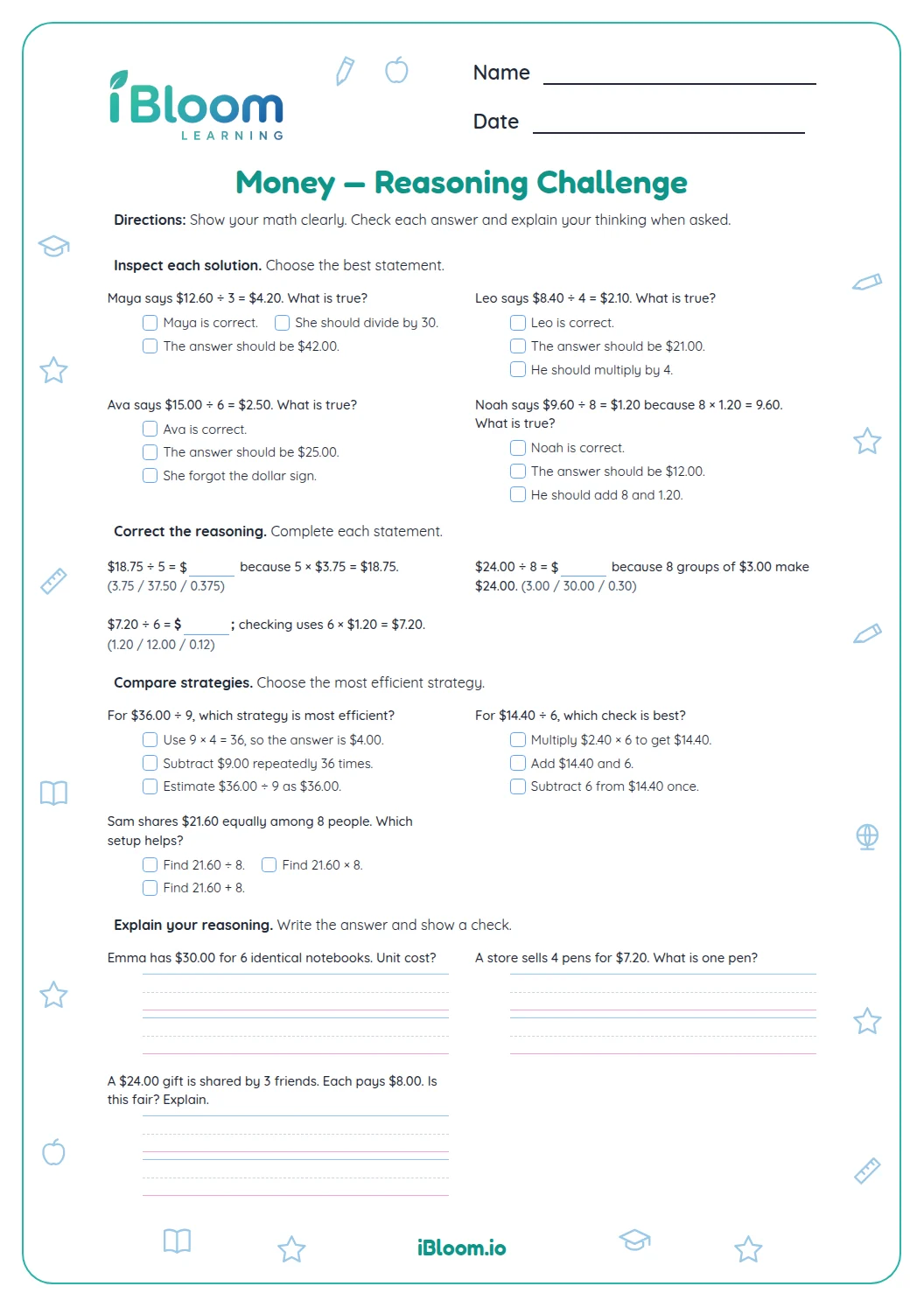
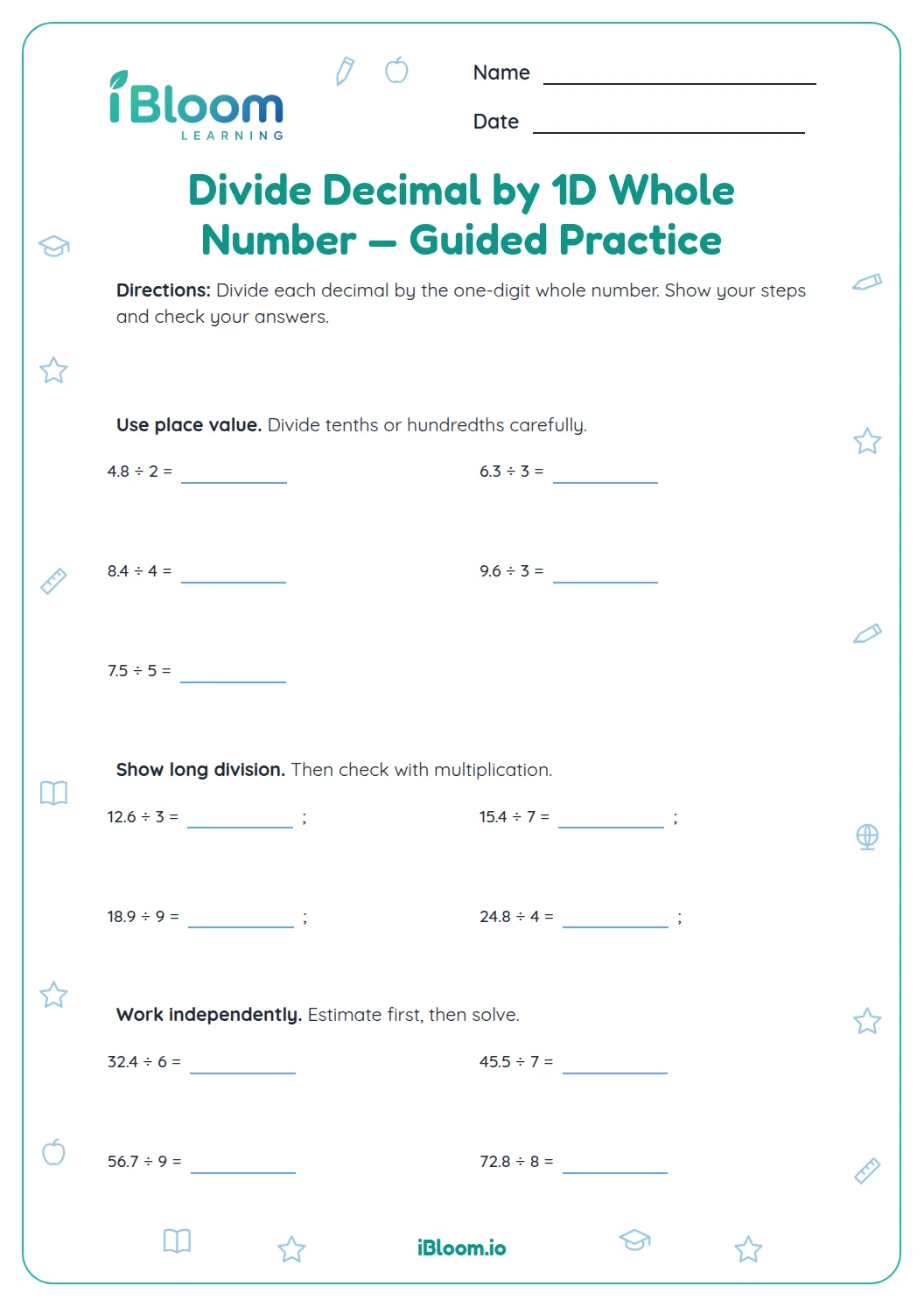
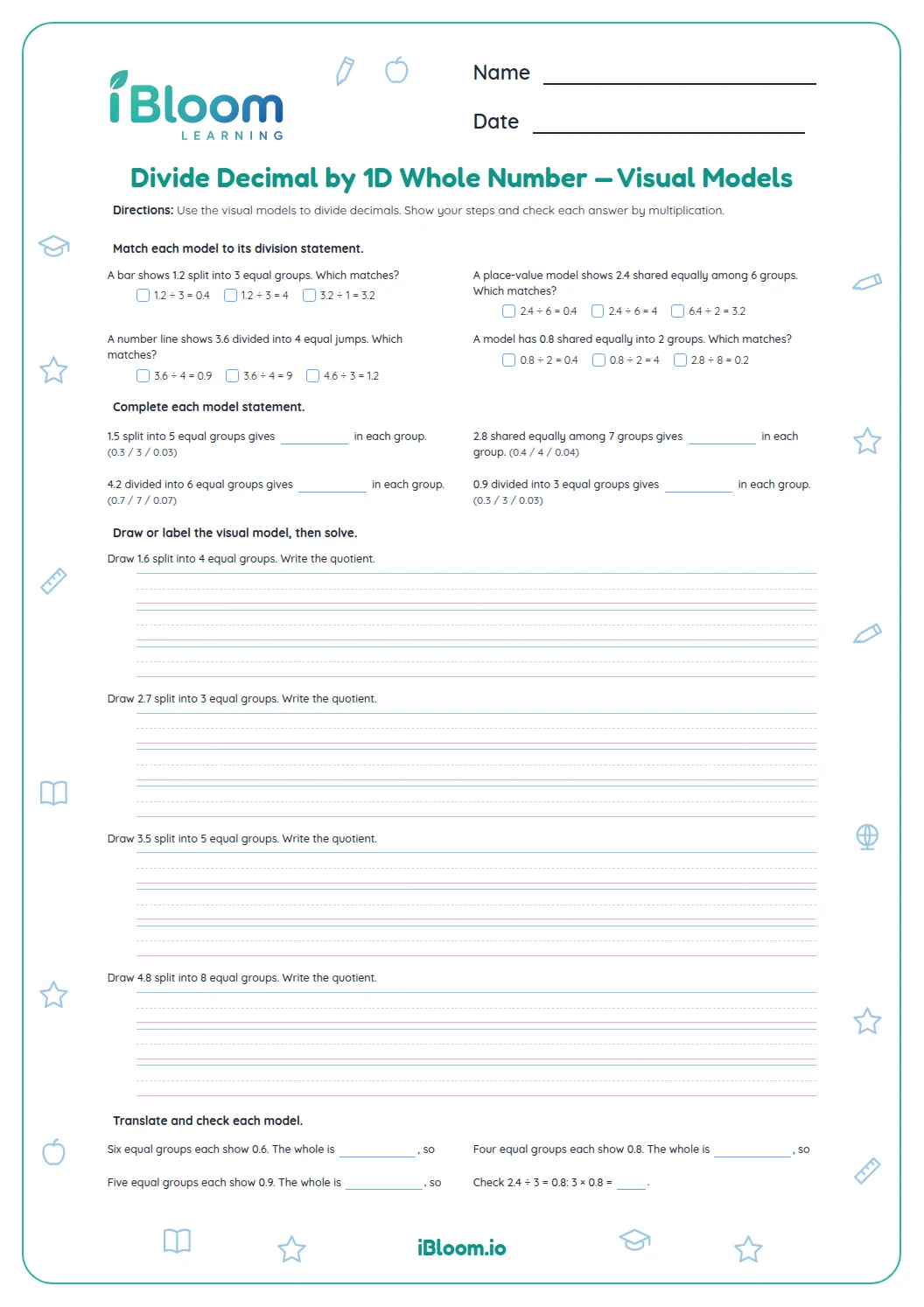
This Grade 5 worksheet uses decimal division in shopping, measuring, and equal-share situations. Four problems ask learners to write a division equation; twelve more ask for the money quotient. All answers are exact to the cent, so students can check each quotient by multiplying it by the number of equal units or shares.
Aligned to 5.NBT.B.7
How does division help find a unit price?
A unit price tells the cost for one unit. Divide the total cost by the number of equal units, then check that multiplying the unit price by the number of units gives the total.
- 1Four notebooks cost $9.00.
- 2Equation: $9.00 ÷ 4 = $2.25
- 3Check: $2.25 × 4 = $9.00.
How do you divide a bill fairly?
When several people share a cost equally, divide the total by the number of people. Keep money in dollars and cents and check the equal shares add back to the original total.
What should you check in a decimal quotient?
The amounts are chosen to produce exact money quotients. Estimate whether a quotient is reasonable, write it to the cent, and multiply by the number of units or people to check the total.
How to use this worksheet
- 1Identify the total amount and the number of equal units or shares.
- 2Divide the total by the number of units or people.
- 3Write the quotient in dollars and cents.
- 4For the first four items, show the division equation.
- 5Multiply the quotient by the divisor to check the original total.
Common mistakes and quick fixes
The mistake
Dividing the number of units by the total cost.
The fix
Ask whether the question wants the cost for one unit; divide the total cost by the number of units.
The mistake
Writing 2.5 dollars as $2.5.
The fix
Show cents with two places in money answers: $2.50.
The mistake
Moving the decimal point without checking the quotient.
The fix
Estimate the unit cost and multiply back to see whether the total is recovered.
Common Core alignment
Each situation uses decimal division to find a unit price or an equal share.
Divide decimal money amounts to hundredths in practical situations.
On this sheet: Learners divide decimal money amounts by whole-number or decimal quantities in practical contexts and express exact quotients to the cent.
Show the official wordingHide the official wording
Add, subtract, multiply, and divide decimals to hundredths, using concrete models or drawings and strategies based on place value, properties of operations, and/or the relationship between addition and subtraction; relate the strategy to a written method and explain the reasoning used.
What to practice next
Make more practice
Further reading
Questions parents and teachers ask
How do you find the cost per item?
Divide the total cost by the number of equal items. For four notebooks costing $9.00, compute $9.00 ÷ 4 = $2.25 per notebook. Multiplying $2.25 by 4 returns $9.00 and checks the unit price. Write the result with a dollar sign and two decimal places.
What does “equally” mean in a money problem?
It means each person or item receives the same share of the total. If four friends share $13.60, divide $13.60 by 4 to find $3.40 each. Four equal payments of $3.40 add back to $13.60, confirming the split clearly.
Should answers include a dollar sign?
Yes. Each question asks for a cost or a share of money, so write the dollar sign and include two digits for cents. For example, two dollars and fifty cents is written $2.50, not $2.5. The dollar sign keeps units clear.
How can a student check a division answer?
Multiply the quotient by the number of equal units or people. If a 5-yard ribbon costs $8.75, the unit cost is $1.75 per yard; $1.75 × 5 equals $8.75. The product should match the original total, so the quotient is reasonable.
Do any problems require rounding?
No. The amounts are chosen so the quotients are exact money values. Write each answer to the nearest cent, then multiply it by the divisor to check the original total. If the product matches the starting amount, the quotient is reasonable and the decimal place is consistent.