





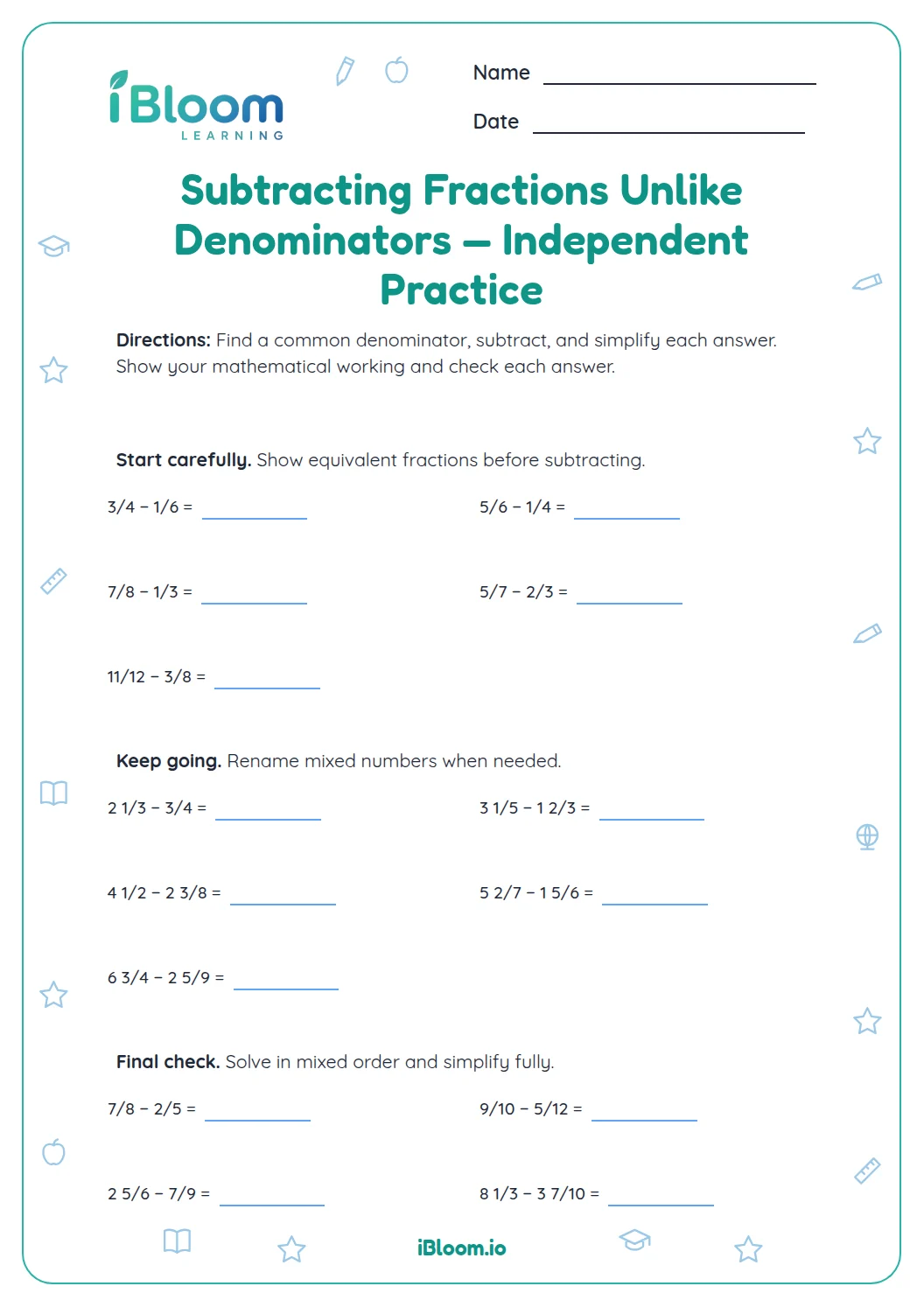
About this worksheet
This printable Grade 5 worksheet gives learners 14 real-world problems that require adding fractions with unlike denominators. Contexts include distances, recipes, time, fabric, and classroom projects. Each item gives room for an equation and work, encouraging children to rename fractions with a common denominator, add, and simplify. It replaces the earlier repeated situation patterns with varied contexts and includes a separate answer key. It practices CCSS 5.NF.A.1 and 5.NF.A.2.
Aligned to 5.NF.A.1 and 5.NF.A.2
Why find a common denominator?
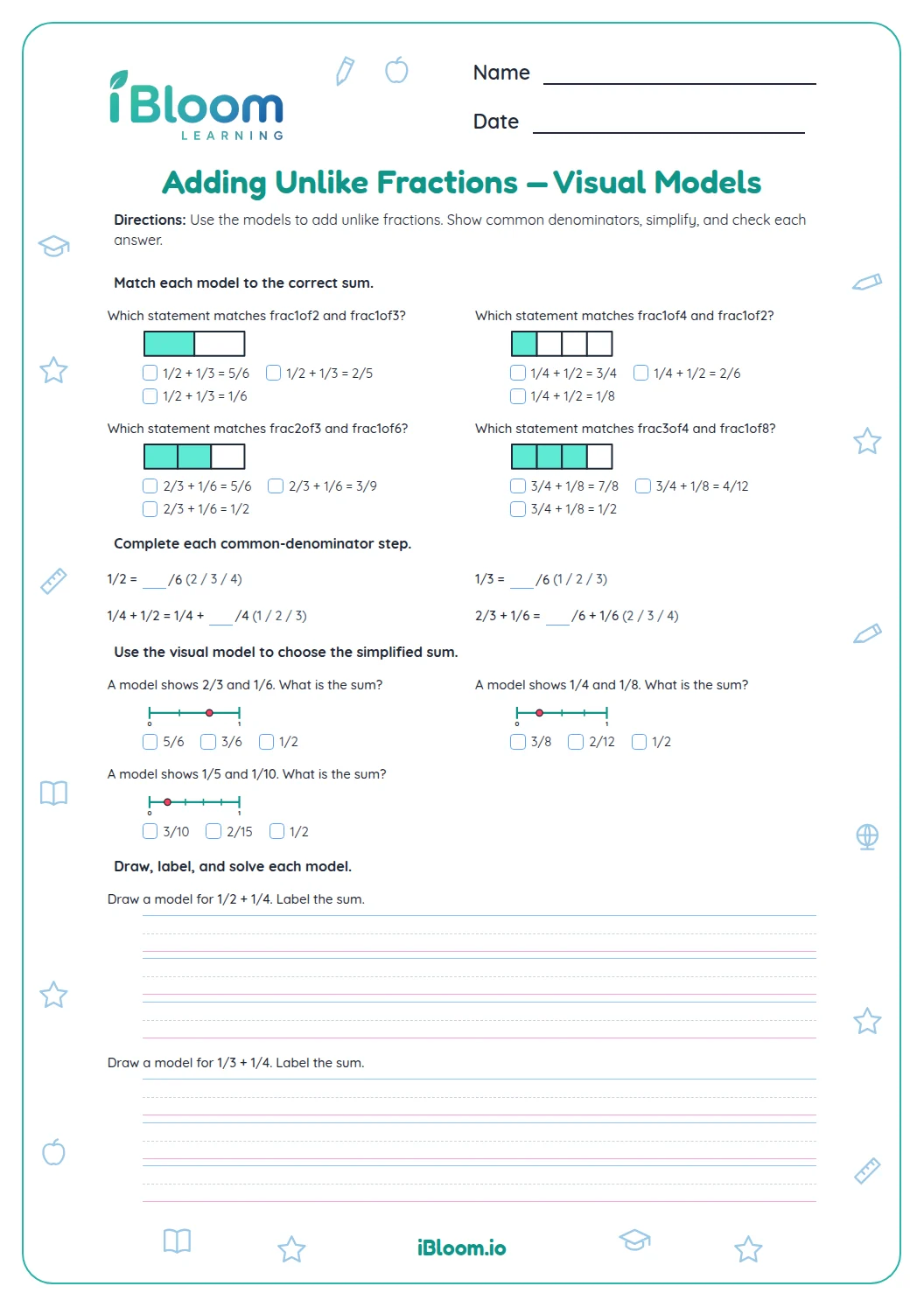
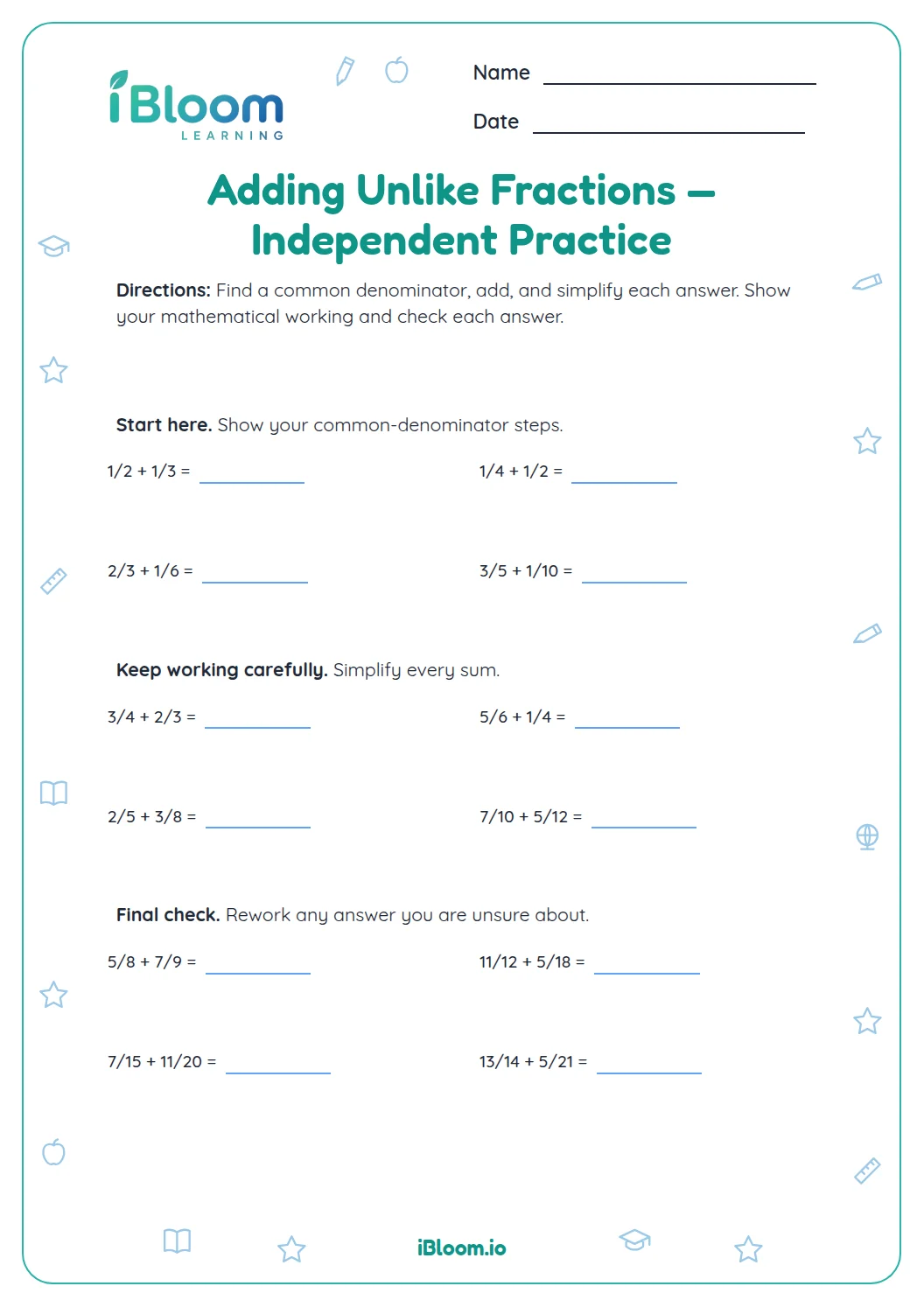
A denominator names the size of the pieces. To add unlike fractions, rewrite them as equivalent fractions with the same-sized pieces. In question 1, thirds and fourths become twelfths.
- 12/3 + 1/4
- 28/12 + 3/12
- 311/12 mile
How does the story help choose the operation?
Look for two amounts that are being combined. Question 4 gives two distances Noah biked, so addition finds the full distance: 3/8 + 5/12 = 9/24 + 10/24 = 19/24 mile.
When should a sum be simplified?
After adding, check whether the numerator and denominator have a common factor. If the total is greater than one whole, write an equivalent mixed number when it makes the amount easier to read.
How can learners estimate a sum?
Compare each fraction with familiar benchmarks such as 0, 1/2, and 1. The estimate helps catch an answer that is too small or too large, while the exact common-denominator work gives the precise total.
How can I use this page?
- 1Underline the two amounts that are being combined.
- 2Choose a common denominator that both denominators divide evenly into.
- 3Write equivalent fractions before adding numerators.
- 4Simplify or convert an improper fraction when useful.
- 5Include the unit and estimate whether the total is reasonable.
What should learners check?
The mistake
Adding denominators as well as numerators.
The fix
Make the piece sizes match first; add only the numerators.
The mistake
Changing a denominator without changing the numerator.
The fix
Multiply the numerator and denominator by the same factor.
The mistake
Dropping the unit from the final answer.
The fix
Copy the unit named in the story, such as miles, cups, or yards.
Common Core alignment
This worksheet practices the following Common Core skill.
Add fractions with unlike denominators by making equivalent fractions.
On this sheet: Each problem combines unlike fractional parts after renaming them with a shared denominator.
Show the official wordingHide the official wording
Add and subtract fractions with unlike denominators (including mixed numbers) by replacing given fractions with equivalent fractions in such a way as to produce an equivalent sum or difference of fractions with like denominators.
Solve real-world problems that require adding fractions.
On this sheet: Context problems ask learners to add fractions that describe parts of one shared whole.
Show the official wordingHide the official wording
Solve word problems involving addition and subtraction of fractions referring to the same whole, including cases of unlike denominators, e.g., by using visual fraction models or equations to represent the problem. Use benchmark fractions and number sense of fractions to estimate mentally and assess the reasonableness of answers.
What to practice next
Make more practice
Further reading
Questions parents and teachers ask
What is the first step for adding unlike fractions?
Find a common denominator so both fractions name the same-sized pieces. In question 1, thirds and fourths can be renamed as twelfths: 2/3 = 8/12 and 1/4 = 3/12. Then add the numerators to get 11/12 mile. Equivalent fractions keep the original amounts unchanged.
Why can’t I add the denominators?
The denominator tells the size of each piece. Adding the denominators would change the piece size while combining the amounts. Rename both fractions to equivalent fractions with a shared denominator, then add the numerators and keep that denominator.
How should a learner choose a common denominator?
Choose a number that both denominators divide into evenly. The least common multiple is often convenient, though another shared multiple can also work. After rewriting both fractions, check that each equivalent fraction has the same value as the original.
What does question 6 mean by a fraction of a dollar?
It describes parts of one dollar. Two fifths plus three tenths becomes four tenths plus three tenths, or seven tenths of a dollar. The key writes the amount as $7/10 to keep the money unit clear. It is less than one liter because the two parts total less than one whole.
How do you handle a sum greater than one?
Keep the improper fraction or rename it as a mixed number. For example, 5/6 + 3/10 = 17/15, which is 1 2/15. The mixed number can make a measurement larger than one whole easier to interpret. Both forms name the same amount.
Is an answer key included?
Yes. The separate key lists each total with its unit. It accepts the stated simplified form, and an equivalent mixed number is also correct when a sum is greater than one. Learners can check their answers by estimating the combined amounts.