




About this worksheet
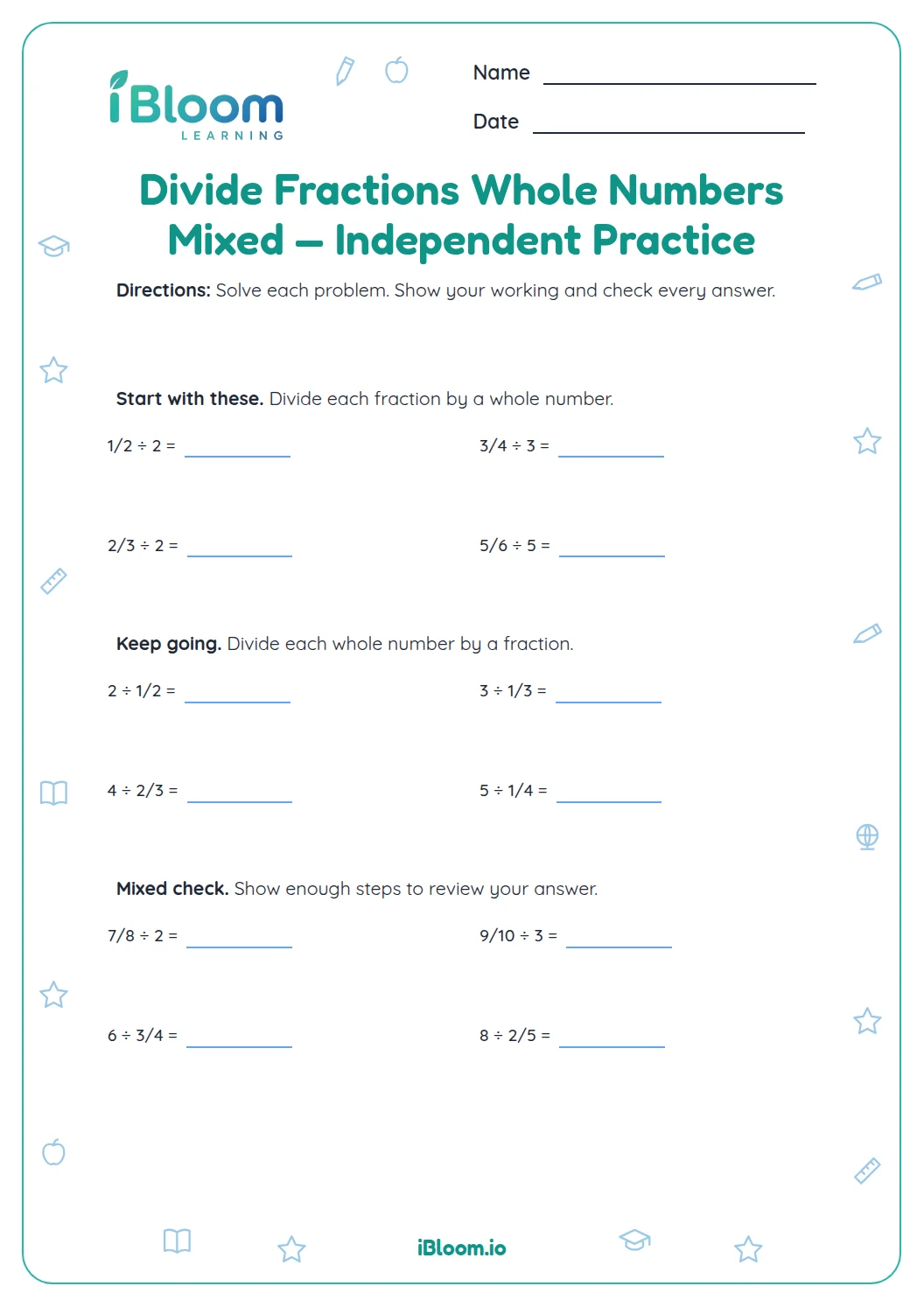
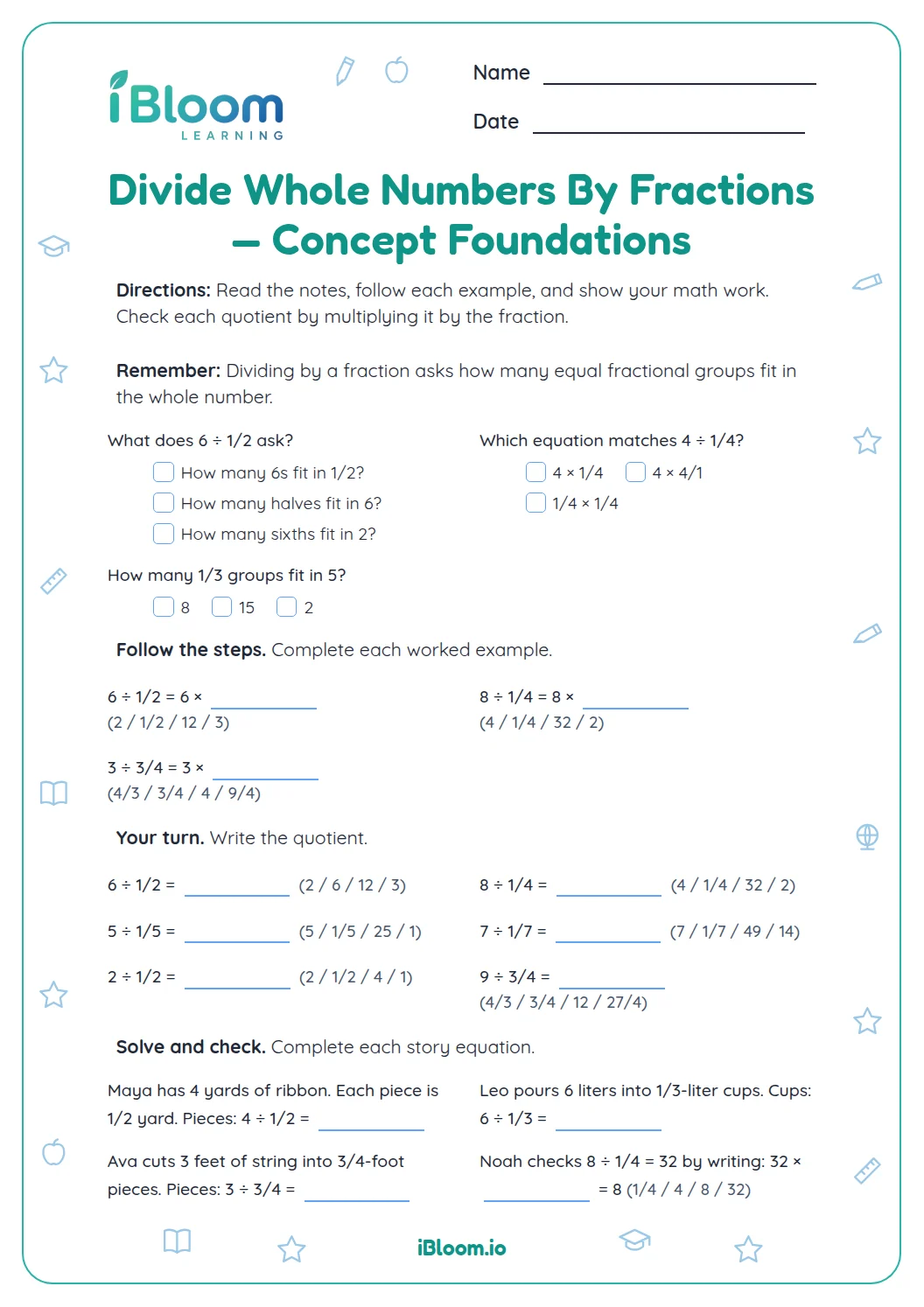
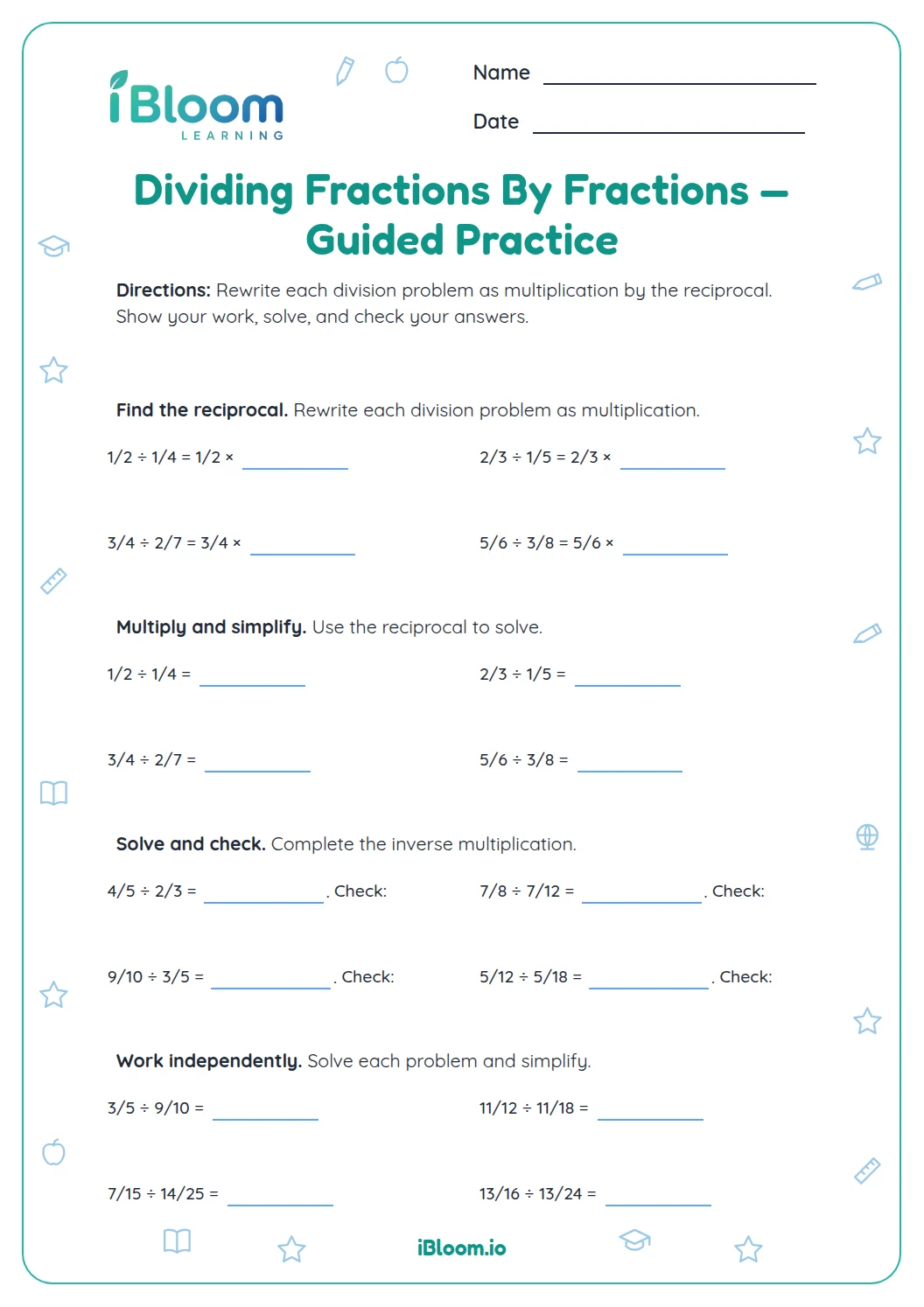
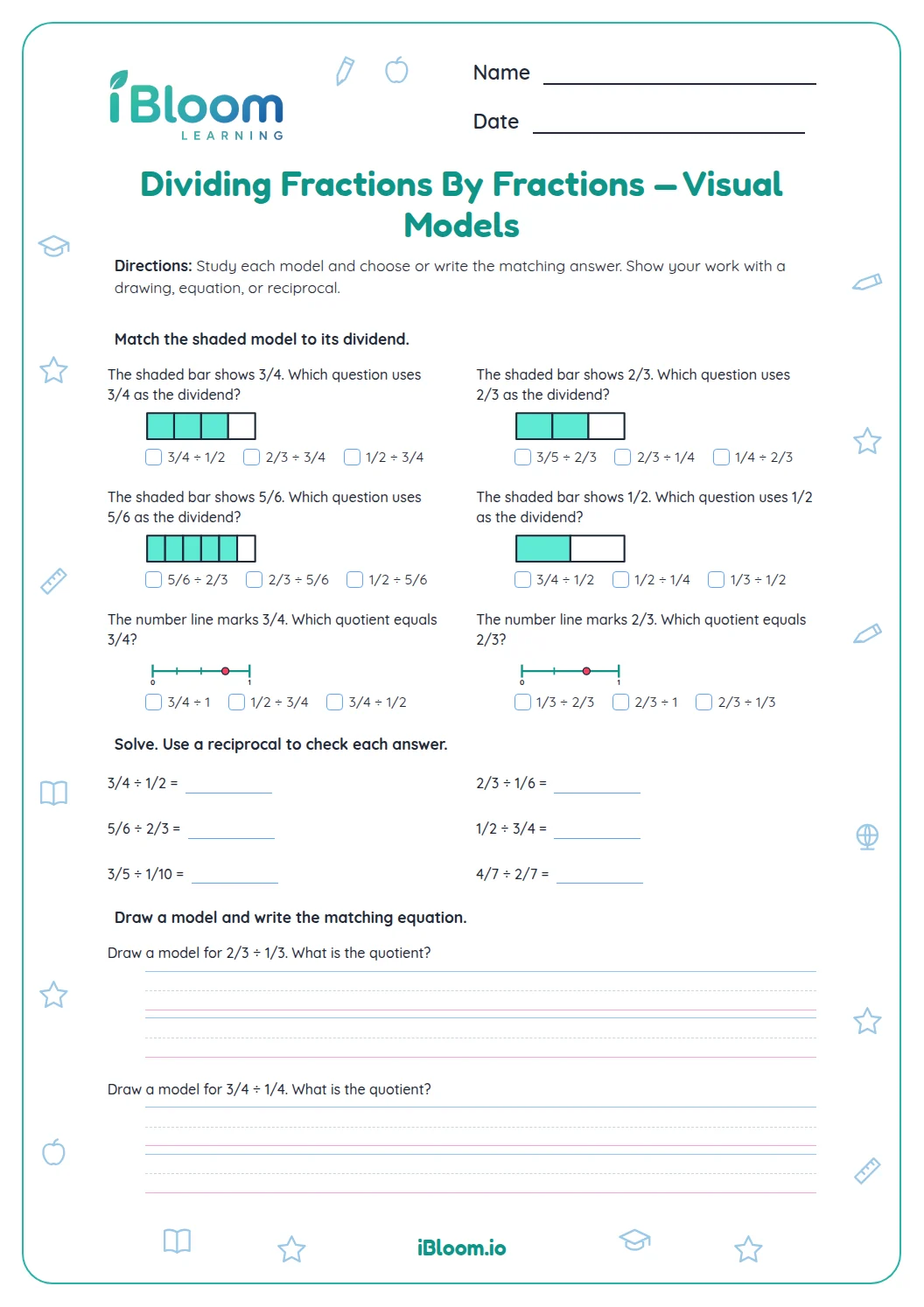
This Grade 5 worksheet practices dividing fractions by whole numbers through equal-share situations and direct quotient problems. Students first split fractional amounts such as 3/4 yard of ribbon into equal shares, then solve eight more fraction-division items with units. Three final questions ask students to compare a quotient with its starting amount, evaluate a claim, and explain a unit-fraction result. The answer key includes the fraction and unit for each share, plus model reasoning. The problems align with CCSS 5.NF.B.7.
Aligned to 5.NF.B.7
How does equal sharing show division?
The first four problems name an amount, a number of equal shares, and a unit. Divide the fraction by the number of shares, then keep the unit in the answer.
- 13/4 yard ÷ 3 = 1/4 yard
- 2Three shares of 1/4 yard use all 3/4 yard.
How do you calculate each quotient?
For a fraction divided by a whole number, multiply the denominator by that whole number, then simplify if possible. Keep the original numerator. For example, 4/5 ÷ 3 = 4/15.
How can you check a sharing answer?
Multiply the size of one share by the number of shares to recover the starting amount. Also compare the share with the original amount: dividing a positive amount into more than one equal group makes each group smaller.
- 13/4 ÷ 3 = 1/4
- 23 groups × 1/4 = 3/4
How to use this worksheet
- 1Underline the fractional amount and the number of equal shares.
- 2Write a division expression using the amount and group count.
- 3Multiply the denominator by the whole-number divisor.
- 4Keep the measurement or food unit in the answer.
- 5Check by multiplying one share by the number of shares.
Common mistakes and quick fixes
The mistake
Multiplying the numerator by the divisor.
The fix
Keep the numerator and multiply the denominator by the whole number.
The mistake
Dropping the unit from an equal-share answer.
The fix
Copy the unit from the amount, such as yard, gallon, or cup.
The mistake
Thinking division makes the starting amount larger.
The fix
If a positive amount is split into multiple equal groups, each share is smaller.
Common Core alignment
This worksheet practices the listed Common Core skill through its questions.
Apply division to unit fractions and whole numbers.
On this sheet: The problems divide fractional amounts equally among whole-number groups.
Show the official wordingHide the official wording
Apply and extend previous understandings of division to divide unit fractions by whole numbers and whole numbers by unit fractions.
What to practice next
Make more practice
Further reading
Questions parents and teachers ask
How many questions are included?
There are 15 questions: four equal-sharing stories, eight quotient calculations, and three reasoning checks. The first stories include ribbon, juice, pizza, and oats. A separate two-page key lists the share with its unit and gives sample explanations for the reasoning items.
What happens to the denominator when a fraction is divided by a whole number?
Keep the numerator and multiply the denominator by the whole-number divisor. For example, 4/5 ÷ 3 = 4/15. On a story problem, attach the original unit to the quotient so the answer says what one share measures. The key shows each quotient in simplest form.
Why should the answer include a unit?
A fraction alone gives a number, but the unit tells what that number measures. Question 1 asks for a share of 3/4 yard of ribbon, so each share is 1/4 yard. Writing “1/4” without “yard” leaves out part of the real-world answer.
How can a student check an equal-share answer?
Multiply one share by the number of shares. If 3/4 yard is divided among 3 shares, 1/4 yard × 3 = 3/4 yard. The product should return to the original amount, including its unit. Keep the unit with the product to check the full measurement.
What does the final reasoning section ask students to do?
The final three questions ask students to compare 5/6 ÷ 2 with 5/6, assess Sam’s equation for 4/5 ÷ 2, and explain why 3/4 ÷ 3 equals 1/4. They connect the calculation to the size of each share and equivalent fractions.