


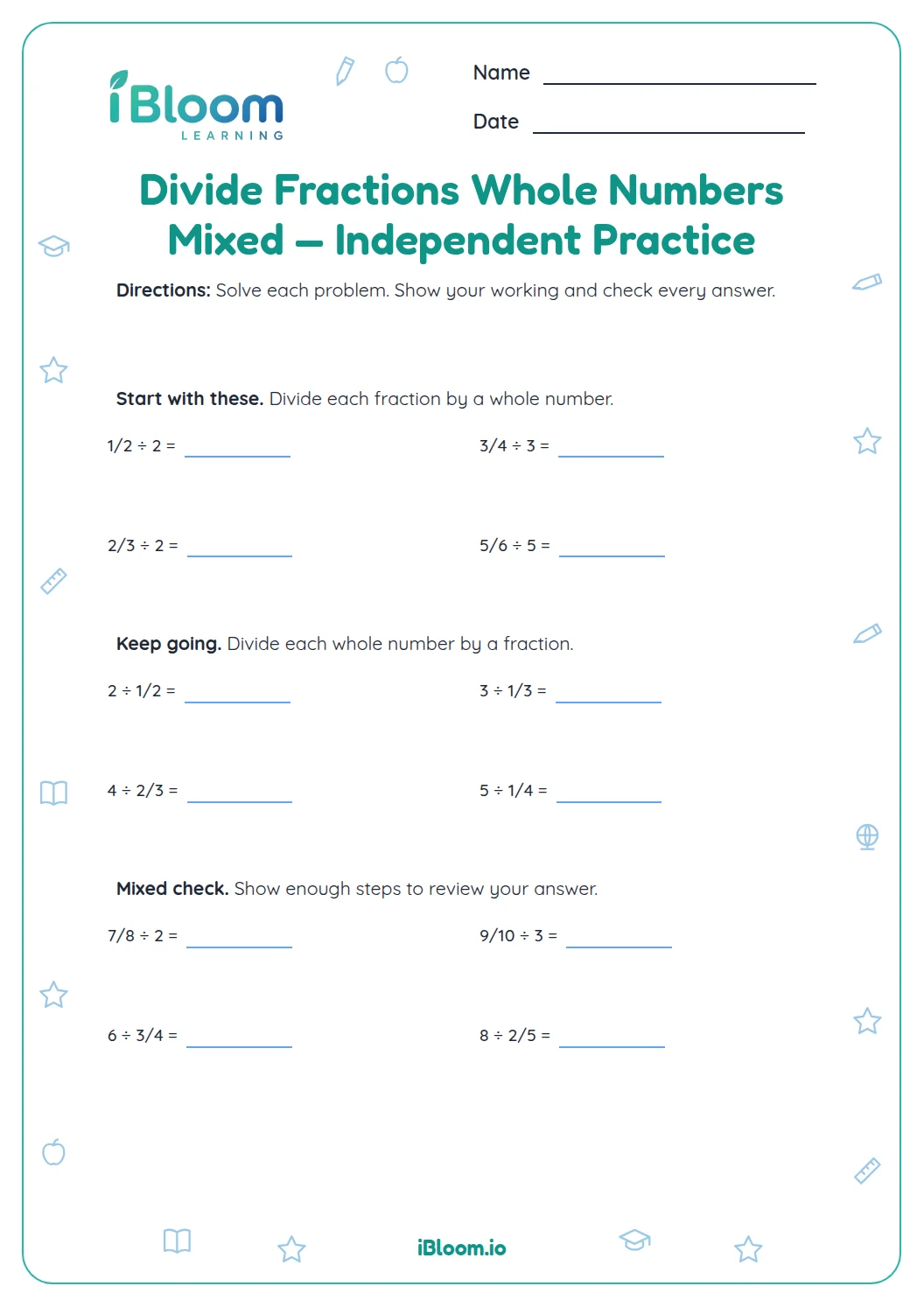
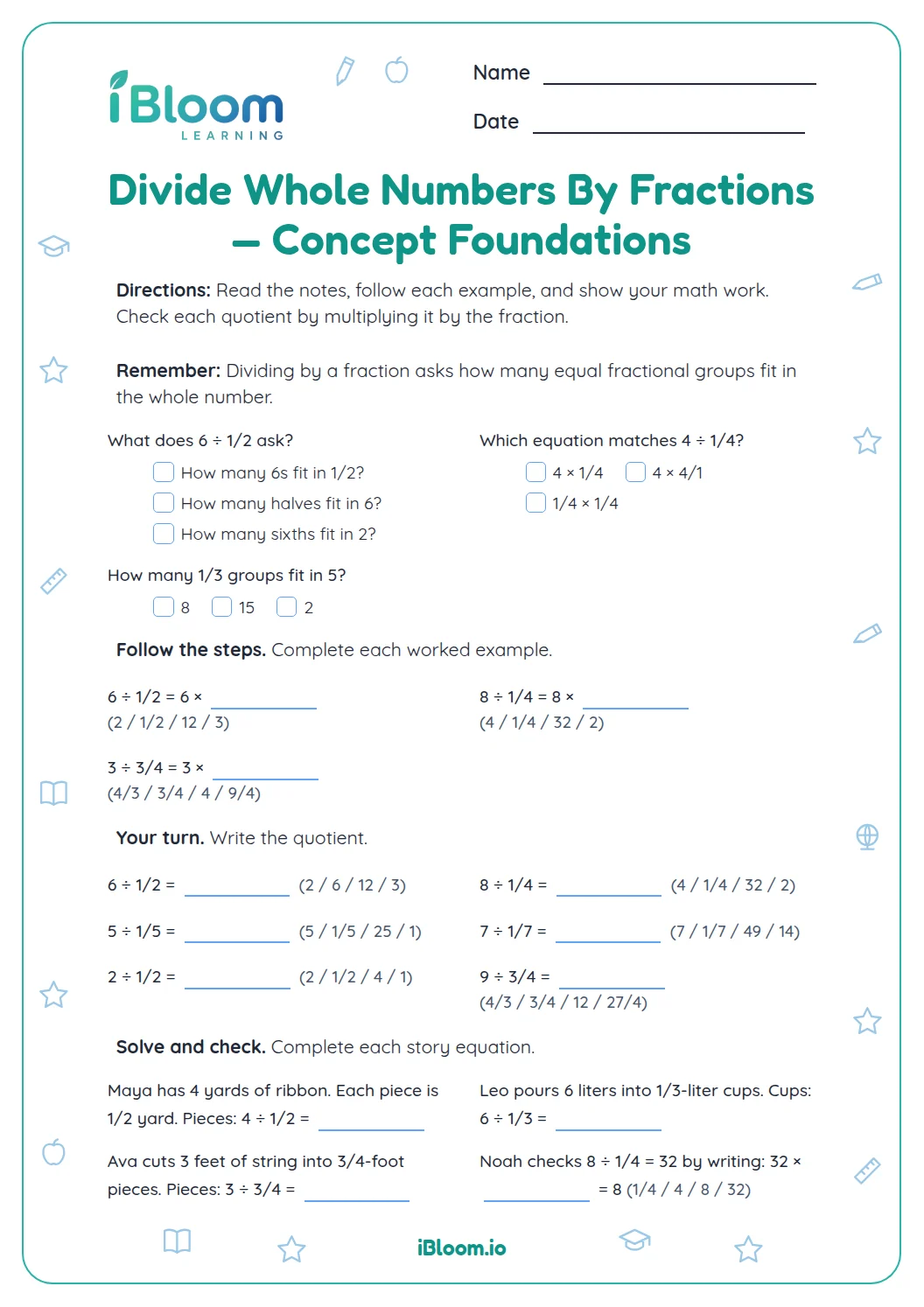


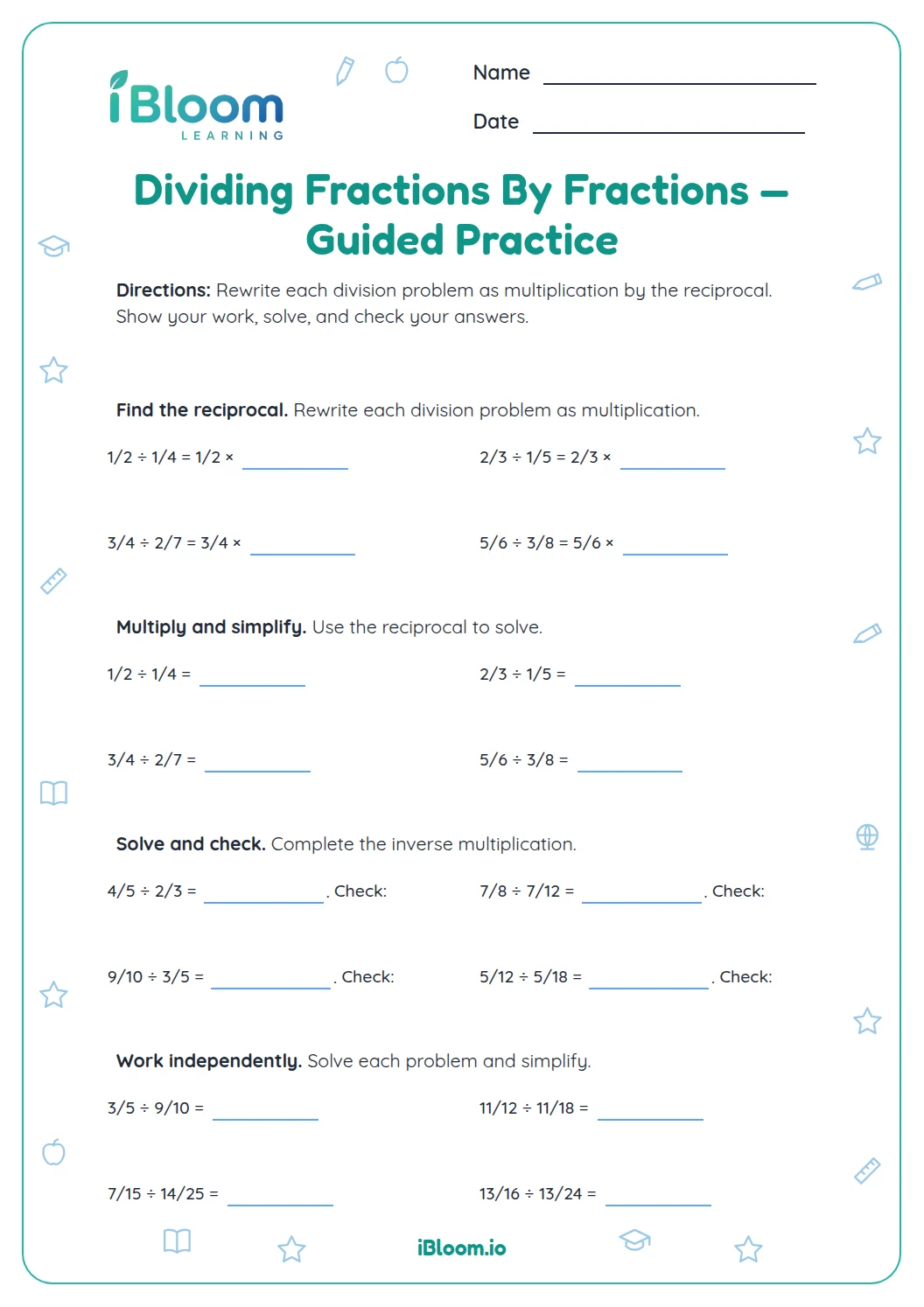
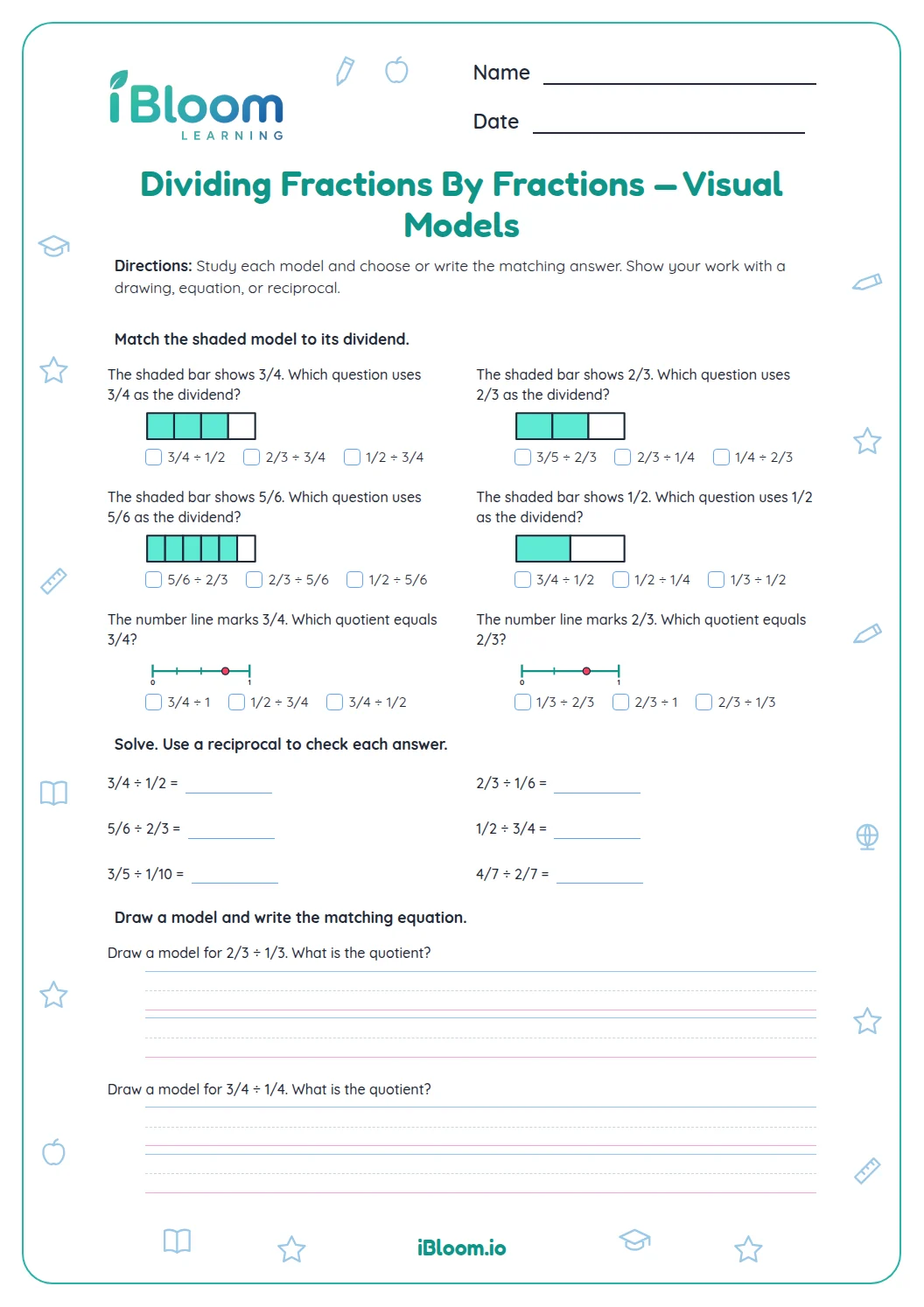
About this worksheet
This Grade 5 printable builds the equal-sharing meaning of dividing a unit fraction by a whole number. Students solve six quotients, apply division to four sharing situations, then work backward, check a quotient claim and compare results. Fourteen questions move from direct calculations to reasoning. The separate answer key shows each result.
Aligned to 5.NF.B.7
What does dividing a fraction mean?
Division can describe sharing one amount equally. If 1/2 meter is split into two equal pieces, each piece is 1/4 meter. The quotient is smaller because the same amount is shared among several groups.
Multiply the quotient by the number of groups to check it: two groups of 1/4 make 1/2.
- 11/2 ÷ 2 = 1/4
- 2Check: 1/4 × 2 = 2/4 = 1/2
How can multiplication check a quotient?
The first six items build fluency with unit-fraction quotients. Later items use sharing contexts, ask for a missing value, test a claim and compare two quotients. For a missing divisor, ask how many equal shares of the quotient make the starting fraction.
The claim in question 13 is false: four shares of 1/32 make 1/8, while 1/2 is larger than the amount being shared.
What will students practice?
Part A has six quotient calculations. Part B applies division to four equal-sharing questions. Part C asks for a missing value, checks Nico’s quotient claim and compares two quotients. The answer key is separate.
How to use this worksheet
- 1Read the unit fraction and identify how many equal groups are made.
- 2Divide the denominator by the number of groups to find the size of one share.
- 3Keep the unit with each measurement answer.
- 4Check a quotient by multiplying it by the number of groups.
- 5Use the key to revisit any result that does not multiply back to the starting fraction.
Common mistakes and quick fixes
The mistake
Multiplying the denominator by the divisor but forgetting to keep the numerator 1.
The fix
For a unit fraction, the numerator stays 1 while the denominator is multiplied by the number of equal groups.
The mistake
Making a share larger than the amount being shared.
The fix
Compare the quotient with the starting fraction, then multiply back to check.
The mistake
Using the number of groups as the quotient.
The fix
Divide the fraction among the groups; the divisor tells how many shares, not the amount in each share.
Common Core alignment
Students calculate unit-fraction quotients and apply equal sharing to short contexts.
Interpret and solve division problems with unit fractions and whole numbers.
On this sheet: Direct calculations and sharing stories divide unit fractions by whole numbers; multiplication checks those quotients.
Show the official wordingHide the official wording
Apply and extend previous understandings of division to divide unit fractions by whole numbers and whole numbers by unit fractions.
What to practice next
Make more practice
Further reading
Questions parents and teachers ask
Why is 1/2 ÷ 2 equal to 1/4?
Two equal groups of 1/4 make 1/2, so each group contains 1/4. A strip model can show one half split into two equal pieces. Multiplying 1/4 by 2 returns 1/2, which checks the quotient and shows why the answer is one fourth.
How can students check a quotient?
Multiply the quotient by the number of equal groups. For example, 1/4 × 2 = 1/2, so 1/4 is the correct value of 1/2 ÷ 2. This check connects the quotient to the amount being shared and works for the story problems too.
What kinds of questions are on this sheet?
The 14 questions include direct unit-fraction quotients, short sharing situations, missing values, a claim to evaluate and a comparison. Students move from computing a share to using multiplication as a check. The answer key is separate and lists each result.
Why does the quotient get smaller?
The same fraction is divided among more than one group, so each group receives only part of the starting amount. For instance, two shares of 1/4 make 1/2. Multiplication confirms that the smaller share still combines to the original amount.
What does the answer key show?
The answer key lists the value for each quotient and sharing problem, along with the missing values and comparison. Students can check the arithmetic and then multiply selected answers by the number of groups to verify the original fraction. Multiplying back confirms the amount in each share.