
About this worksheet
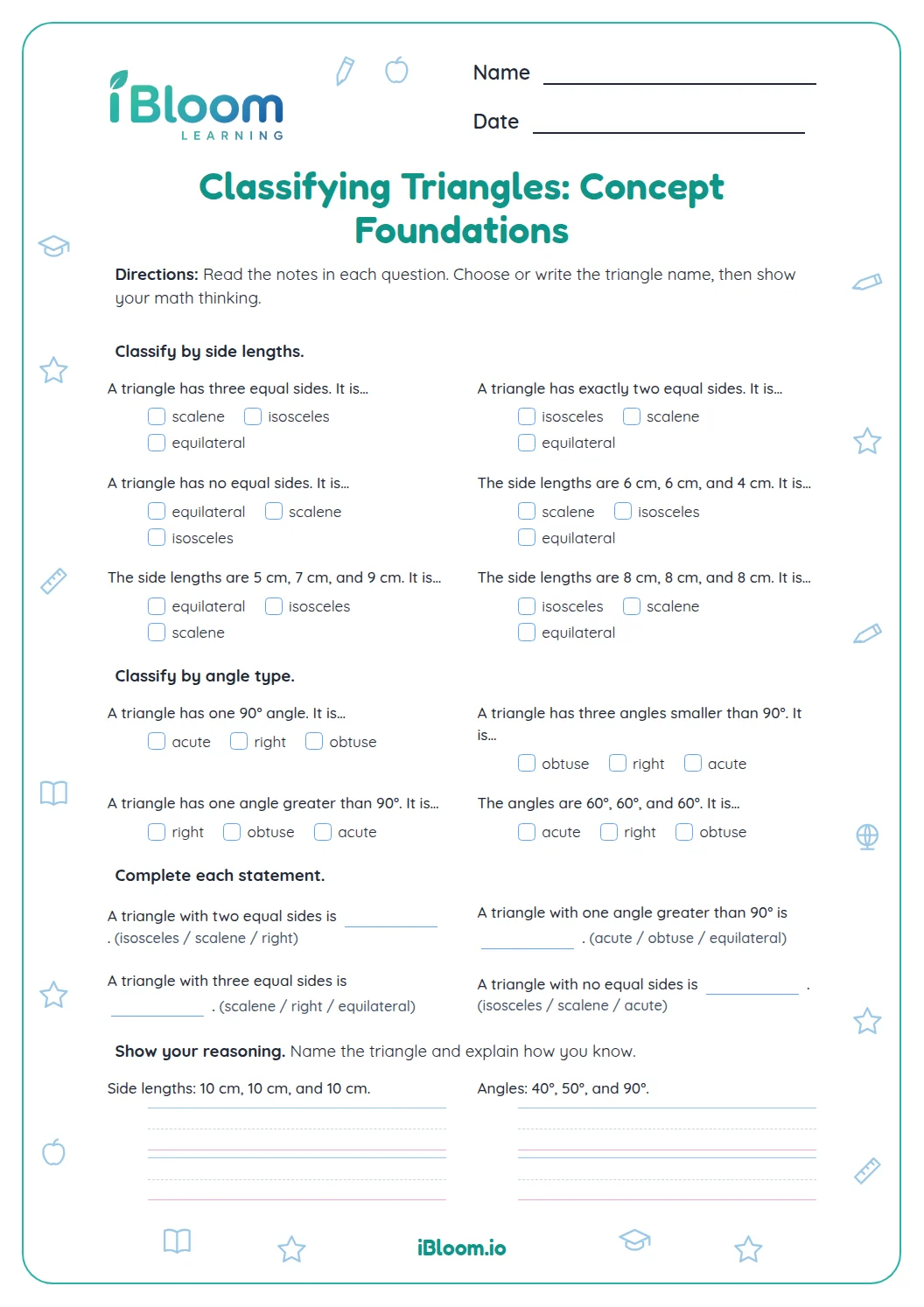
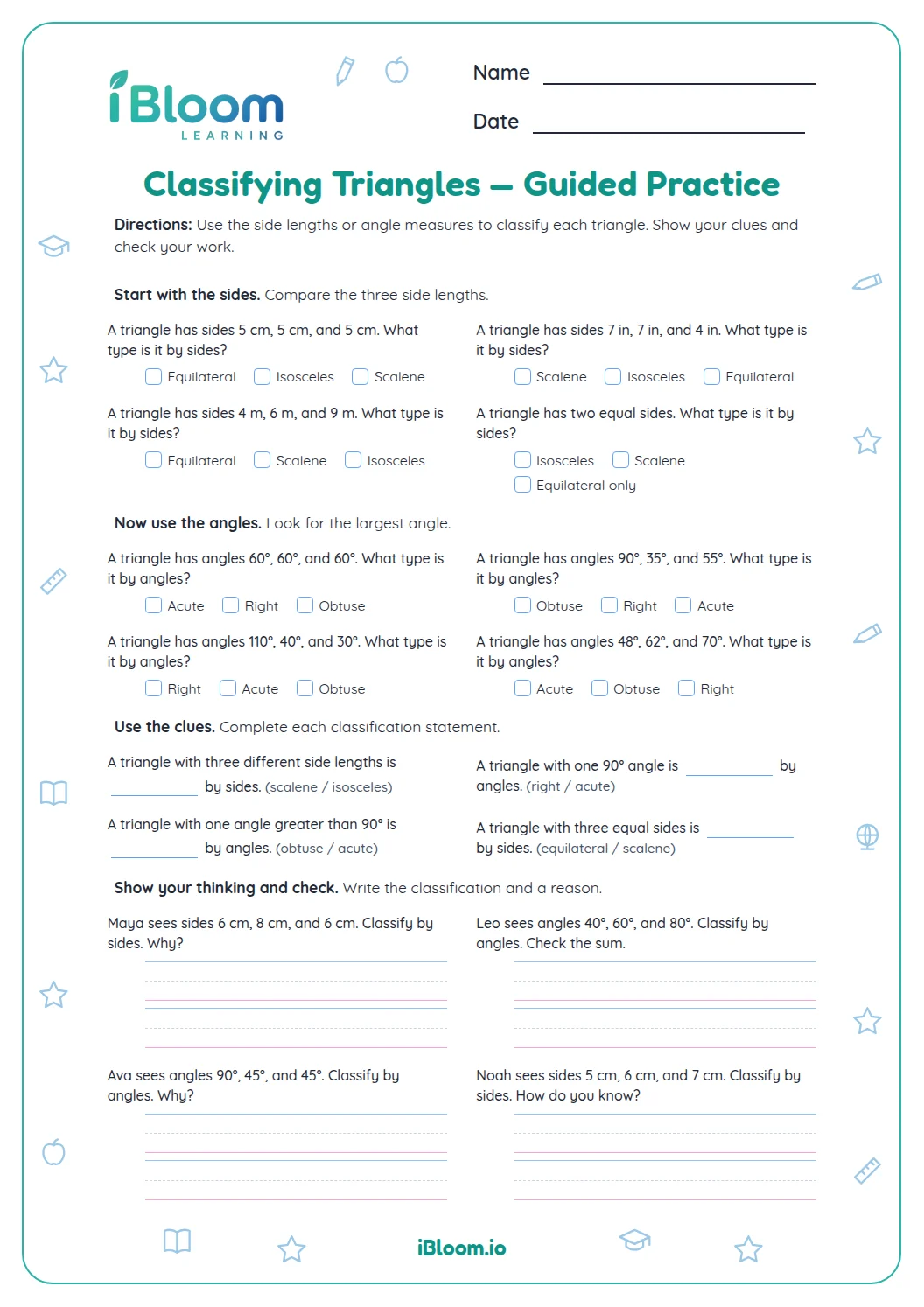
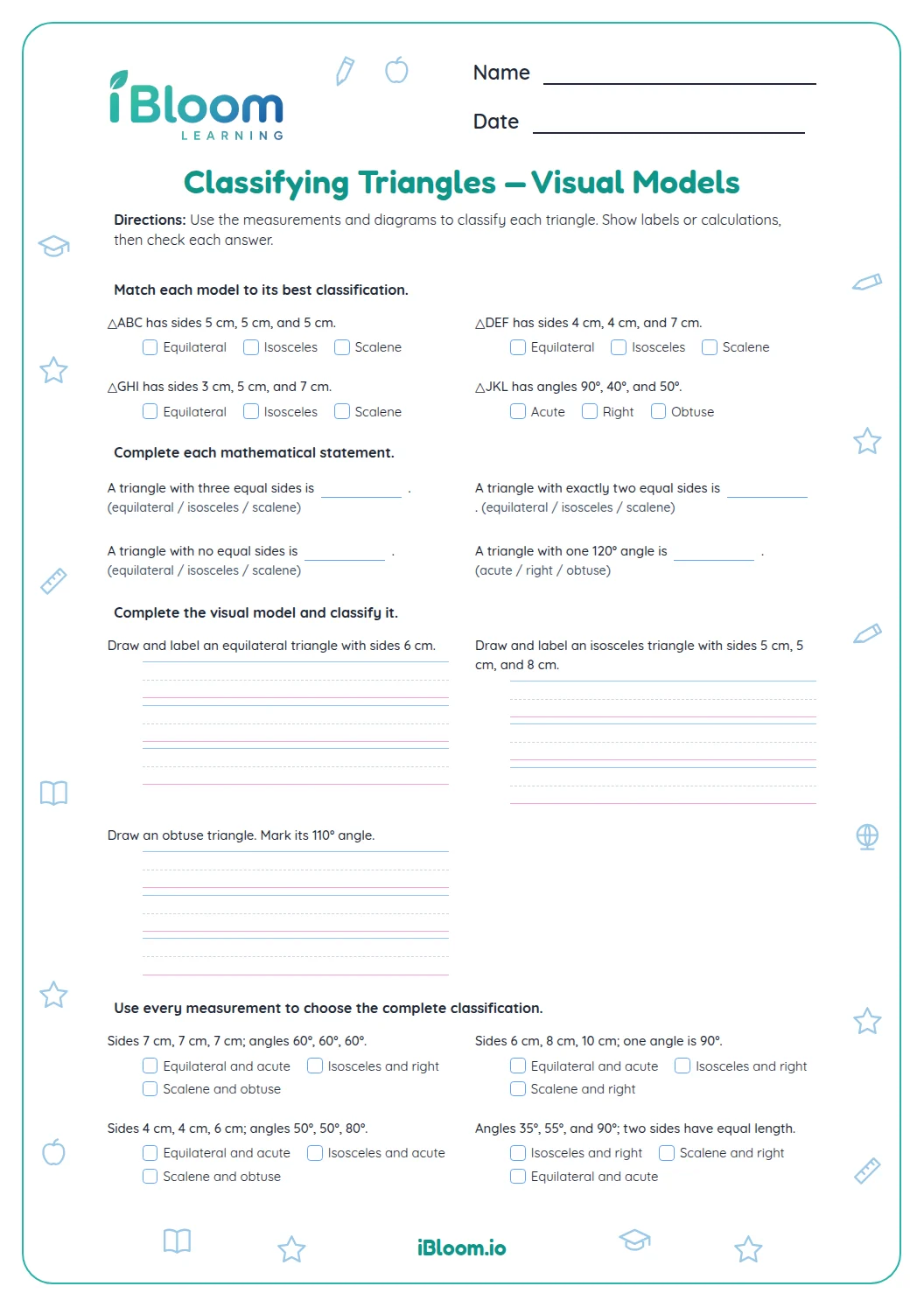
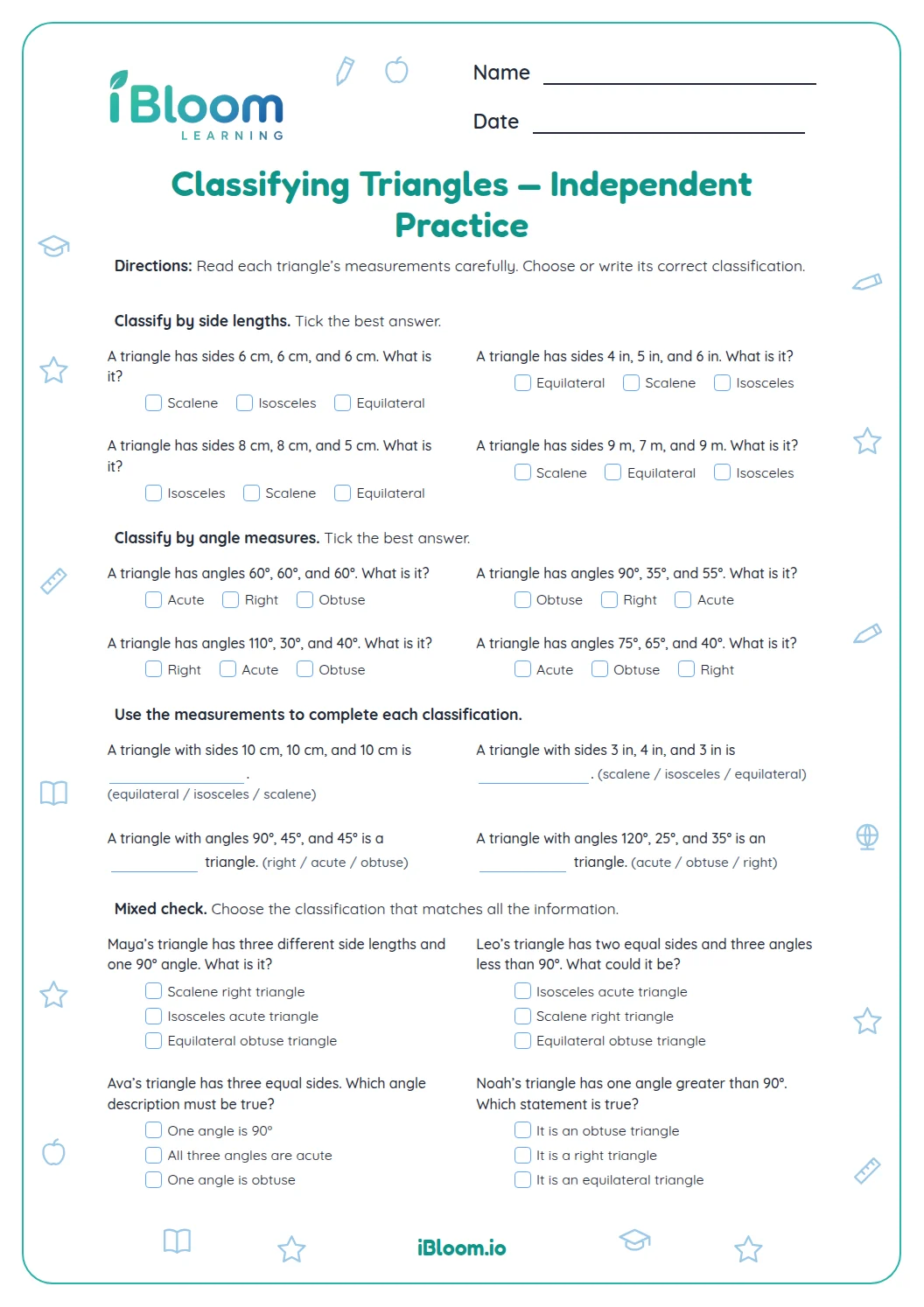
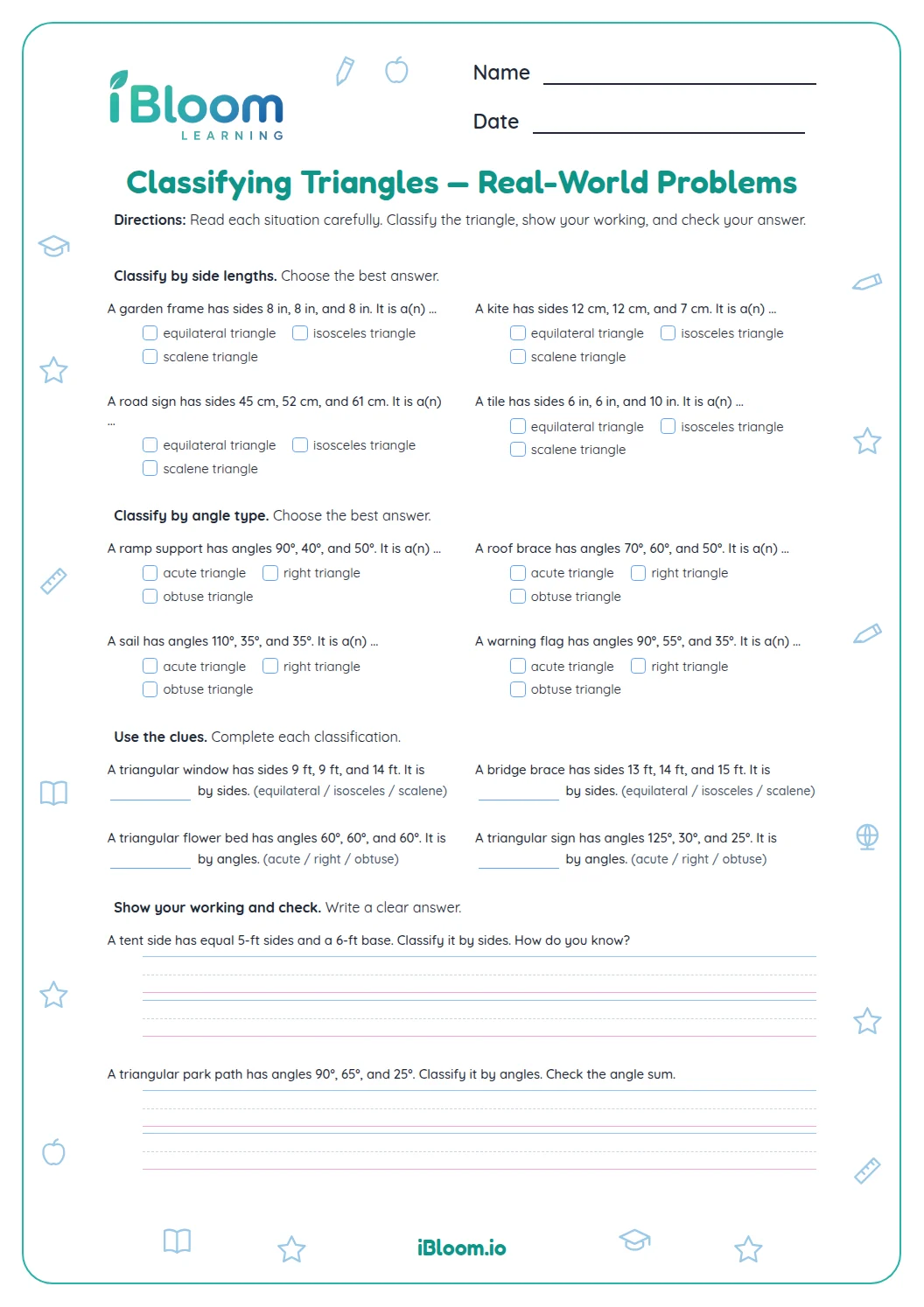
This printable Grade 5 worksheet practices classifying triangles by side lengths and angle measures. Its 15 fill-in questions move from direct classification to property reasoning and claim checks in two parts. A separate answer key is included.
Aligned to 5.G.B.3
How does classifying triangles work?
Classify triangles by side lengths (equilateral, isosceles, or scalene) and by angles (acute, right, or obtuse). A triangle can have one classification from each group.
Part A gives side lengths or angle measures; Part B asks learners to combine classifications and check claims.
- 1Sides 5 cm, 5 cm, and 8 cm: ___ by sides.
- 2Two sides match, so the missing classification is isosceles.
What will learners practice on this sheet?
The 15 prompts ask learners to classify triangles from clues, combine side and angle properties, and check claims by completing a key term.
How can a learner check the answers?
After finishing a part, use the answer key to check it. For a missed item, name the relationship or operation, solve it again, and compare.
How to use this worksheet
- 1Read the whole prompt and underline the quantity, unit, or feature it names.
- 2Complete Part A, showing the relationship used for each answer.
- 3Continue through the remaining parts and write units where they belong.
- 4Check each response with the answer key after finishing the sheet.
- 5Redo missed items and explain the step that changed the result.
Common mistakes and quick fixes
The mistake
Treating “isosceles” and “acute” as competing labels.
The fix
Use one side classification and one angle classification when asked.
The mistake
Calling a triangle equilateral because two sides match.
The fix
Check all three sides; equilateral means all three are equal.
The mistake
Assuming a triangle’s appearance proves a property.
The fix
Use the stated side lengths or angle measures when the prompt gives them.
Common Core alignment
This worksheet practices the following Common Core skill.
Recognize that shapes can share properties and belong to categories.
On this sheet: Learners use triangle definitions and recognize that one triangle may fit more than one category.
Show the official wordingHide the official wording
Understand that attributes belonging to a category of two-dimensional figures also belong to all subcategories of that category.
What to practice next
Make more practice
Further reading
Questions parents and teachers ask
What triangle classifications does the worksheet practice?
It practices side classifications (equilateral, isosceles, and scalene) and angle classifications (acute, right, and obtuse). Some questions ask learners to apply both kinds of labels to the same triangle. Ask the learner to point to the clue in the prompt and explain how it supports the answer.
Are triangle pictures included?
The questions give side lengths and angle measures in words. Learners use those clues to classify triangles, then apply definitions and explain a claim. This format keeps attention on the evidence instead of estimating from a drawing. The key lists every result.
How many questions are on the worksheet?
There are 15 fill-in questions in two parts: classifying triangles from side-length or angle clues, then reasoning about properties and claims. The answer key gives the missing word or phrase for every item. Learners can use the written clues to explain each choice.
Can a triangle be both right and isosceles?
Yes. A right isosceles triangle has one 90-degree angle and two equal side lengths. This worksheet asks learners to combine side and angle classifications, so one triangle can have both labels at the same time. Learners can use the written clues to explain each choice.
How should a learner explain a classification?
Look for the evidence in the clue: compare side lengths or check an angle against 90 degrees. For instance, a 110-degree angle is obtuse, and three equal sides make a triangle equilateral. Have learners compare each clue with the triangle definition before selecting.