





About this worksheet
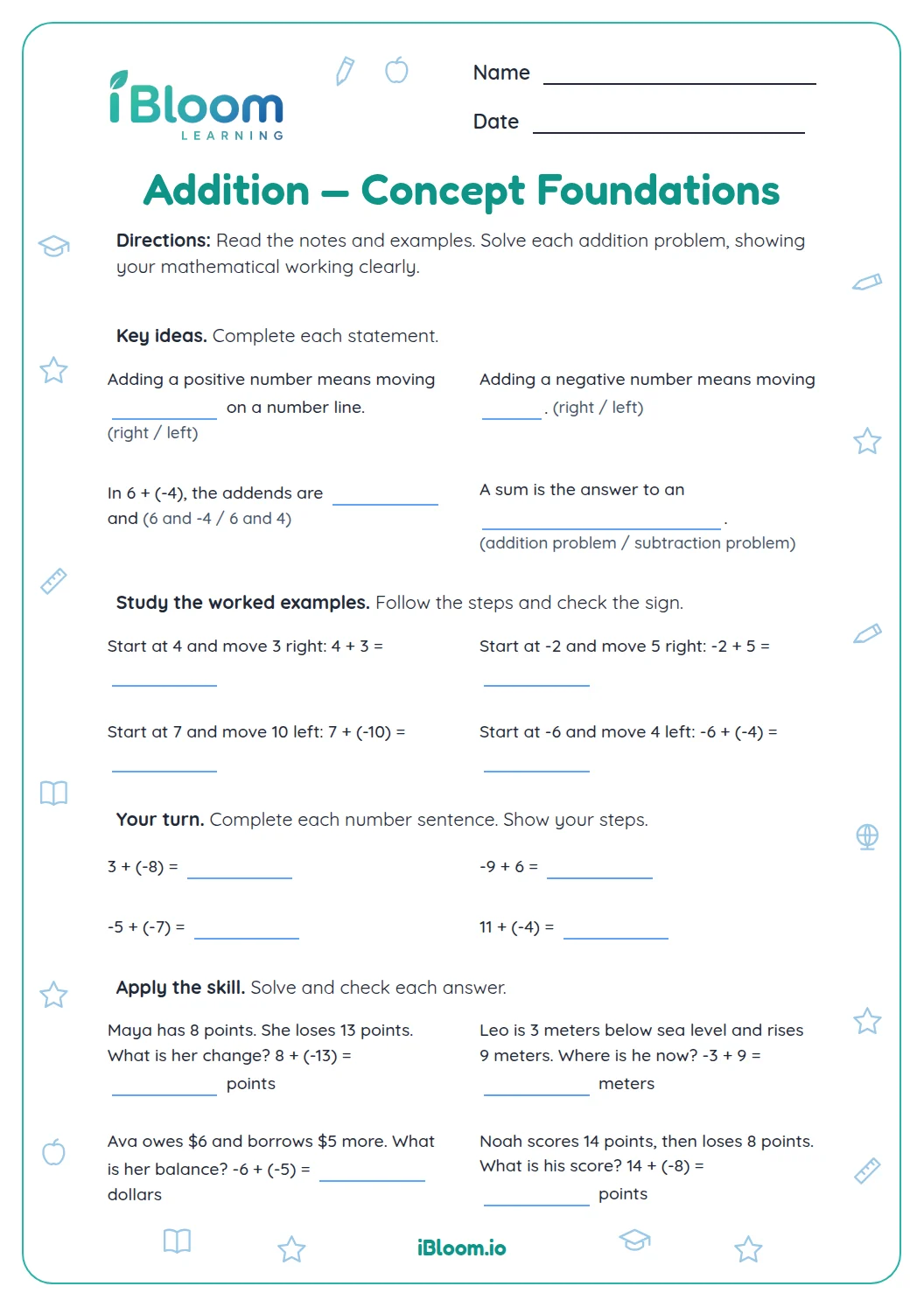
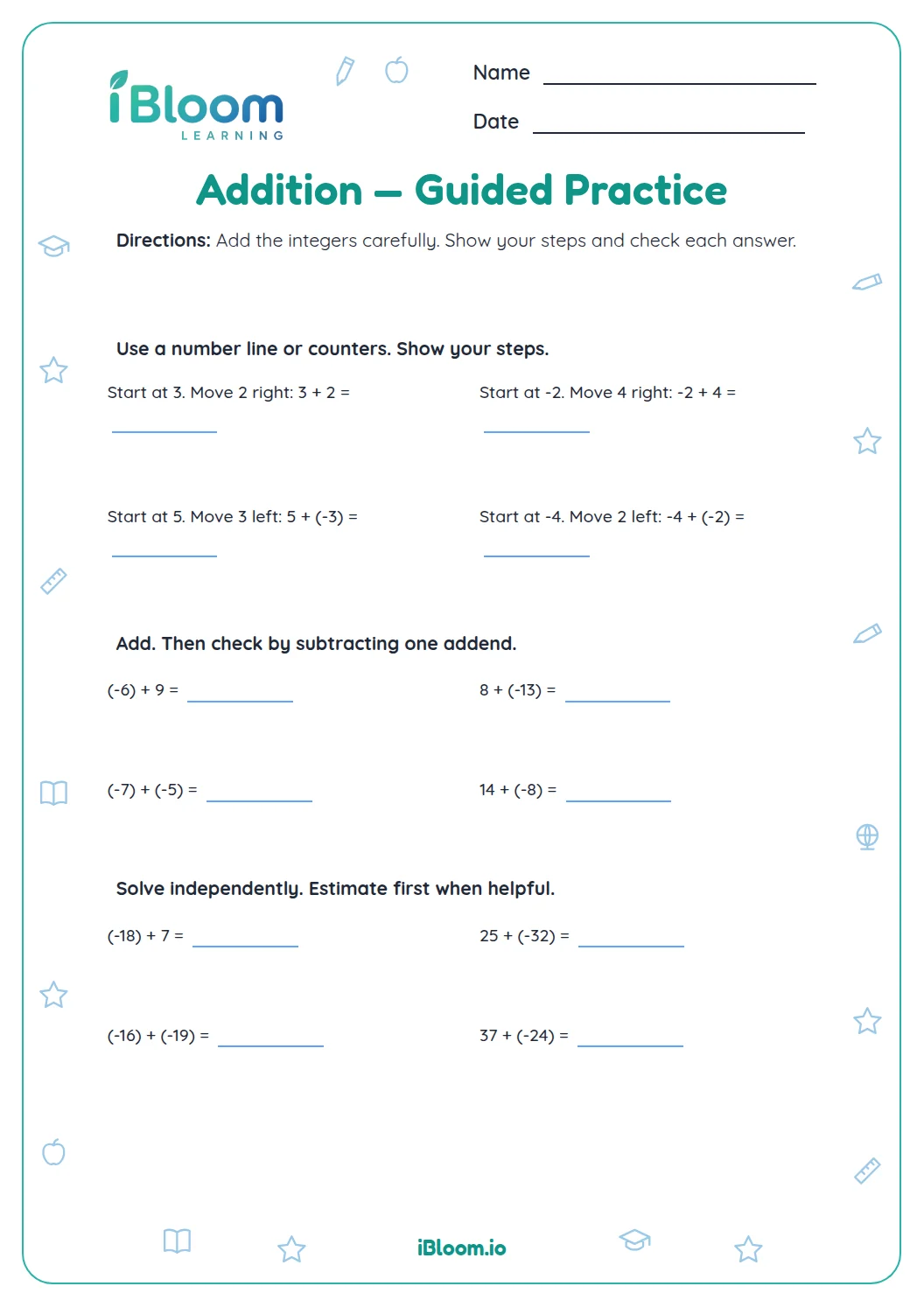
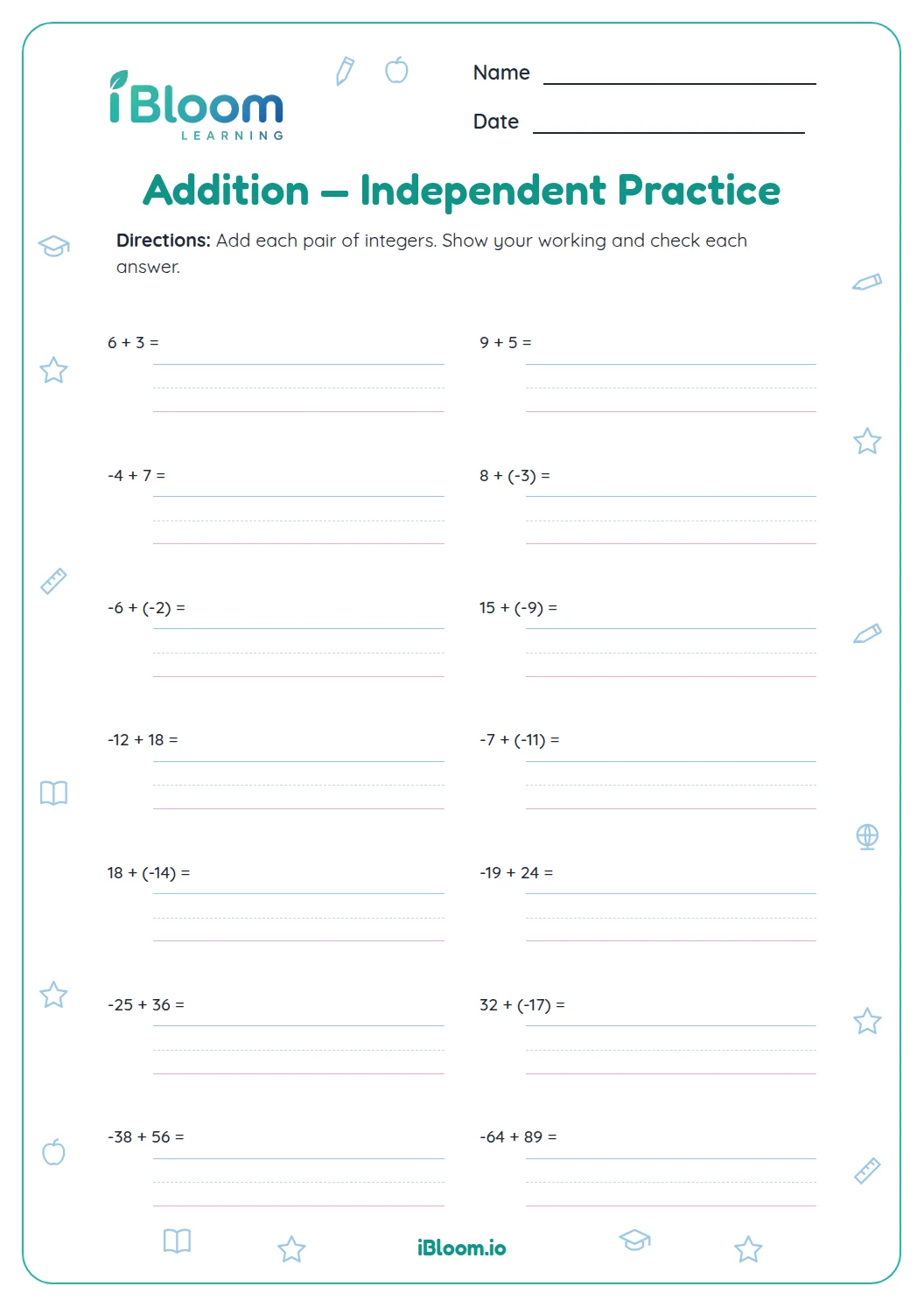
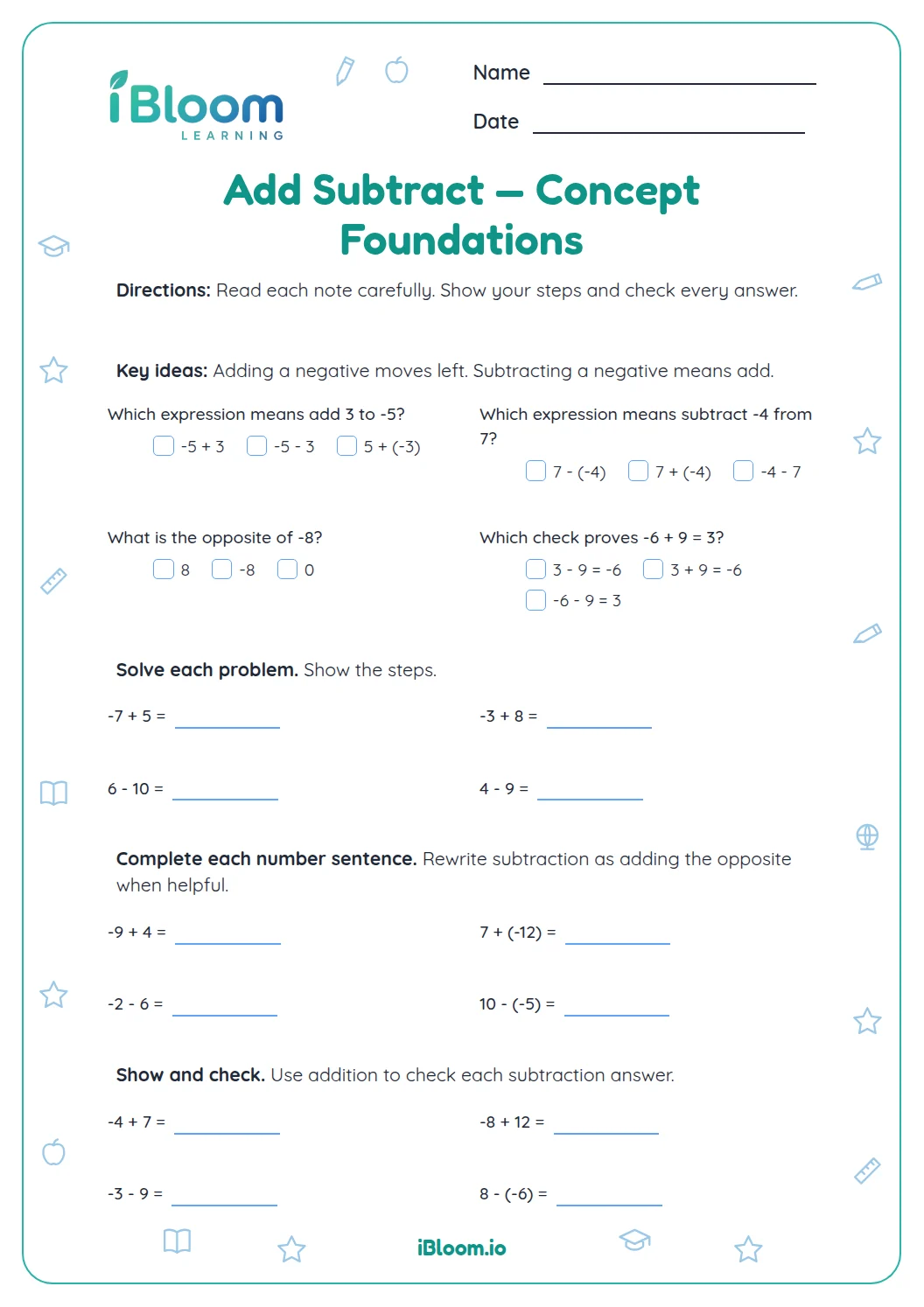
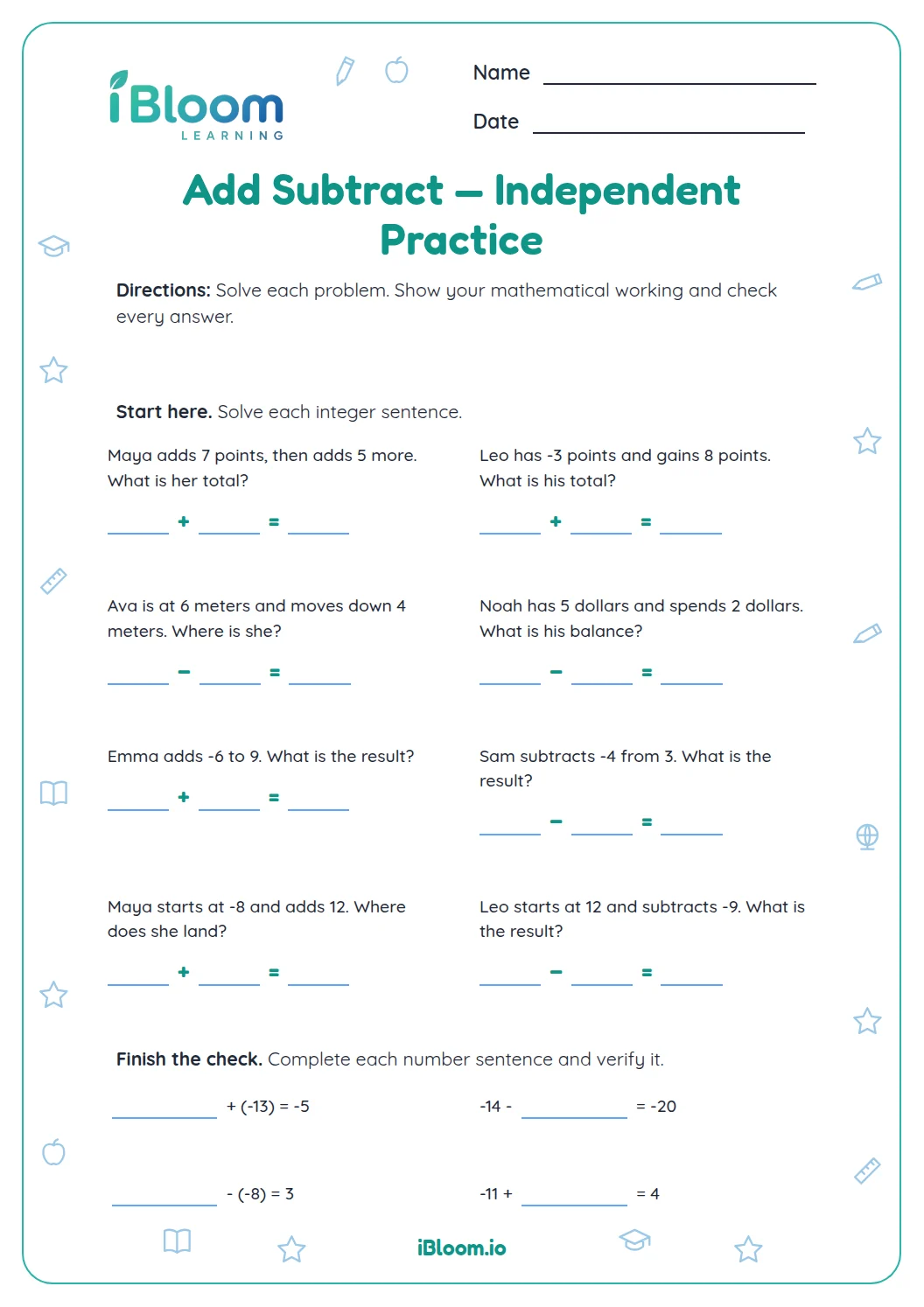
This Grade 5 printable practices addition of positive and negative integers in short equations and familiar situations. Learners solve six signed sums, then model gains and losses, elevations, temperature changes, and score changes as addition. The answer key gives each result with its context unit.
How do positive and negative integers combine?
Think of a positive integer as a gain or movement up and a negative integer as a loss or movement down. The six number sentences include both signs and sums on either side of zero.
- 1−12 + 5
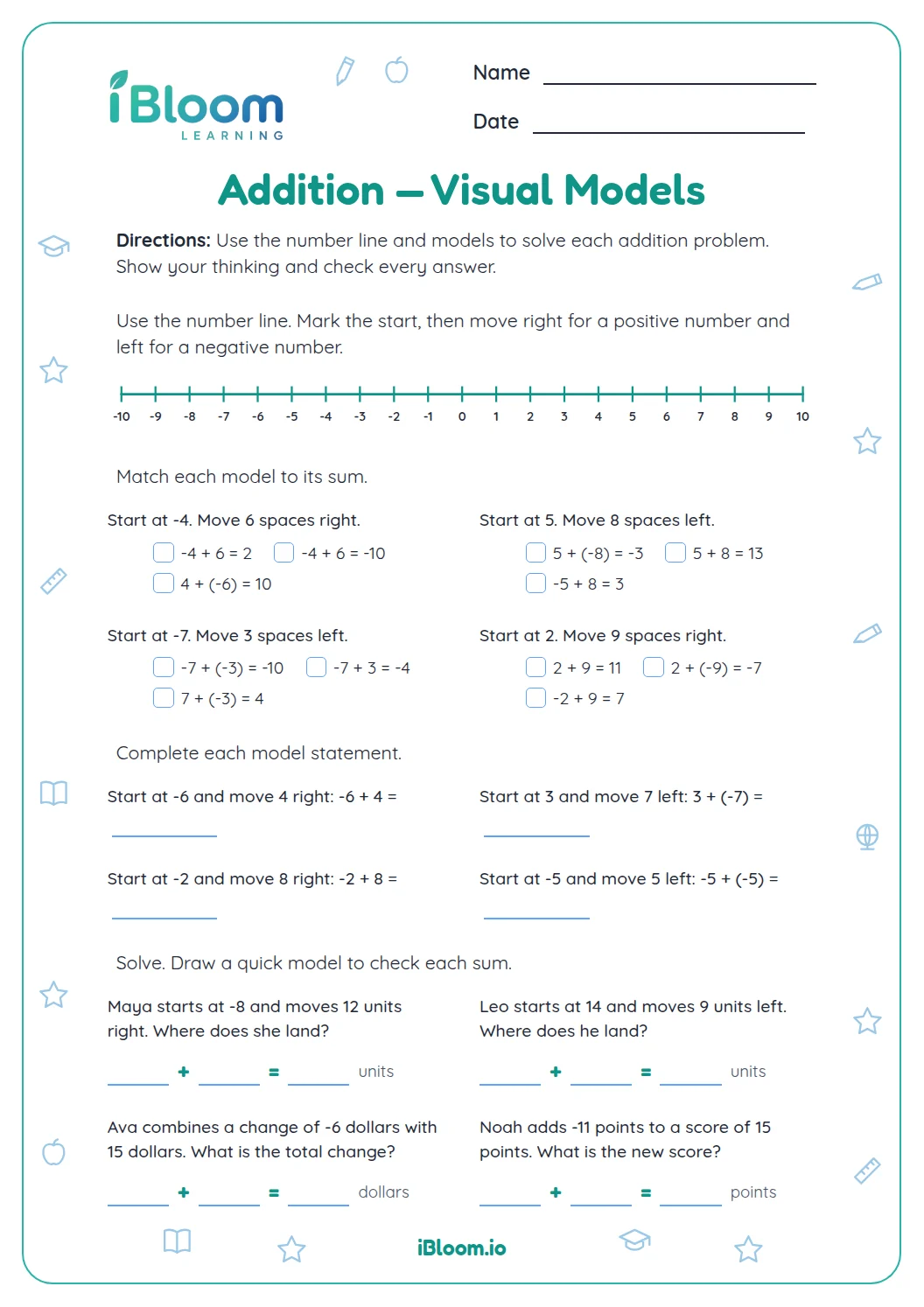
- 2Start at −12 and move 5 units right.
- 3The sum is −7.
How do the situations show integer addition?
Each story describes two signed changes. Write each change with its sign, then add; keep the unit from the story in the final answer.
How can a learner check a sum?
Use the number line for a negative starting value, or compare the sizes of the positive and negative changes. The larger absolute value determines the sign when the signs differ.
How to use this worksheet
- 1Read the change in the situation.
- 2Write positive for an increase and negative for a decrease.
- 3Combine the signed numbers or move on the number line.
- 4Check that the answer fits the story and its units.
Common mistakes and quick fixes
The mistake
Treating a decrease as positive
The fix
Write a minus sign for a loss, drop, or move backward.
The mistake
Moving left when adding a positive number
The fix
On the number line, a positive addend moves right.
The mistake
Reporting the change with the wrong unit
The fix
Keep the context unit, such as feet, degrees, or points.
What to practice next
Make more practice
Questions parents and teachers ask
How do positive and negative integers combine?
Think about what each sign means in the situation. An increase of 9 is positive and a decrease of 6 is negative, so −6 + 9 = 3. The result is positive because the increase is greater than the decrease.
How can the number line help with −12 + 5?
Start at −12 on the number line and move five spaces to the right for +5. You land at −7, so the diver’s position becomes −7 feet. Moving right represents adding a positive amount. Each answer keeps the unit named in its situation.
What kinds of real-world situations appear?
The questions use changes in game scores, bank balances, elevation, temperature, yardage, and a token’s movement. Read each increase or decrease as a signed number, then choose the sum that matches the situation. A number line can make the direction and distance easier to track.
Why is the answer sometimes still negative?
A result stays negative when the total decrease is greater than the total increase. For example, a team that gains 12 points and then loses 17 has a net change of −5 points. The story problems apply the same signed addition in varied settings.
Is an answer key included?
Yes. A separate answer key gives the six signed sums and the results for all eight real-world problems. Use it to check the direction of each change as well as the final integer. Learners can check whether the sign matches the direction of change.