


About this worksheet
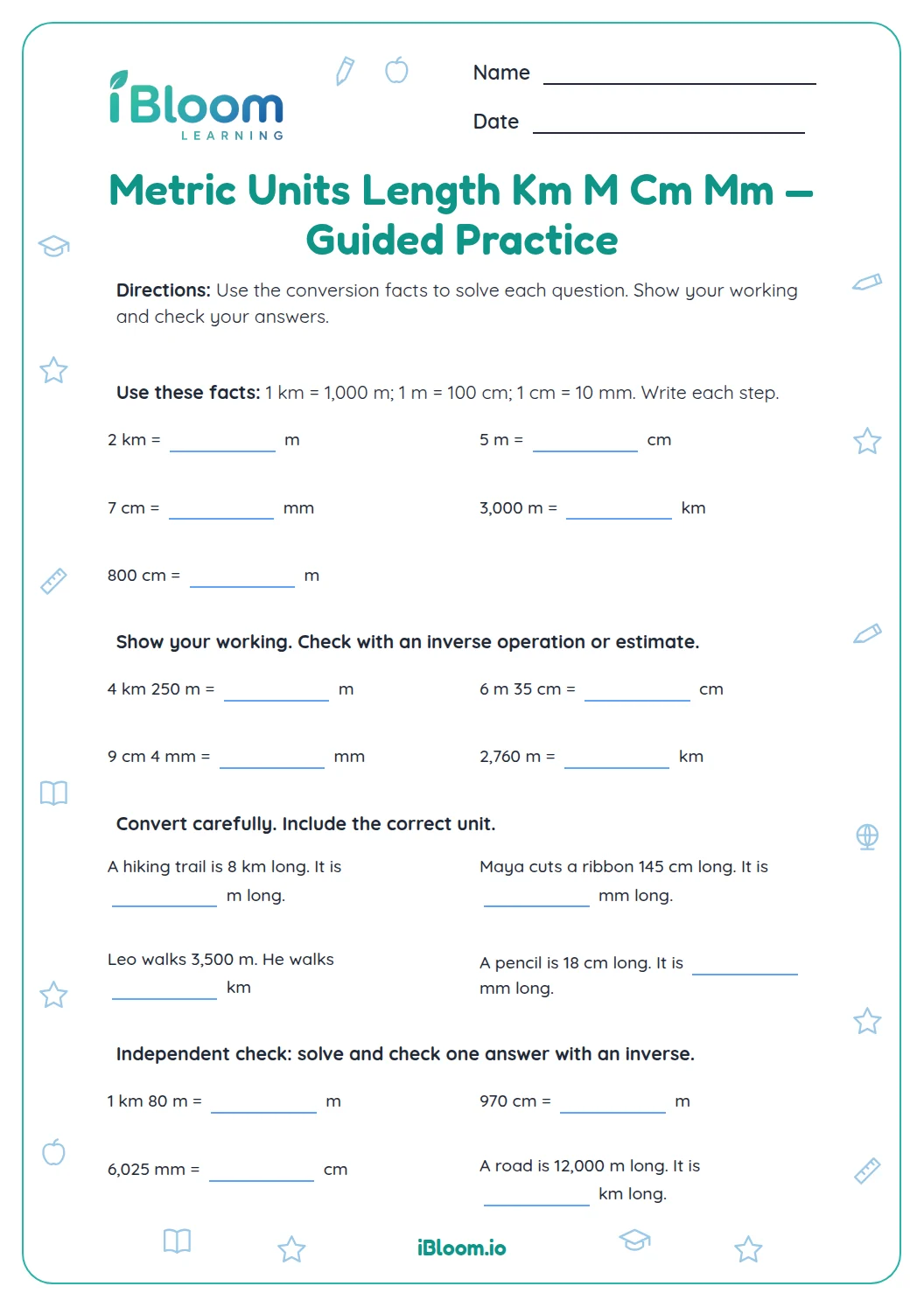
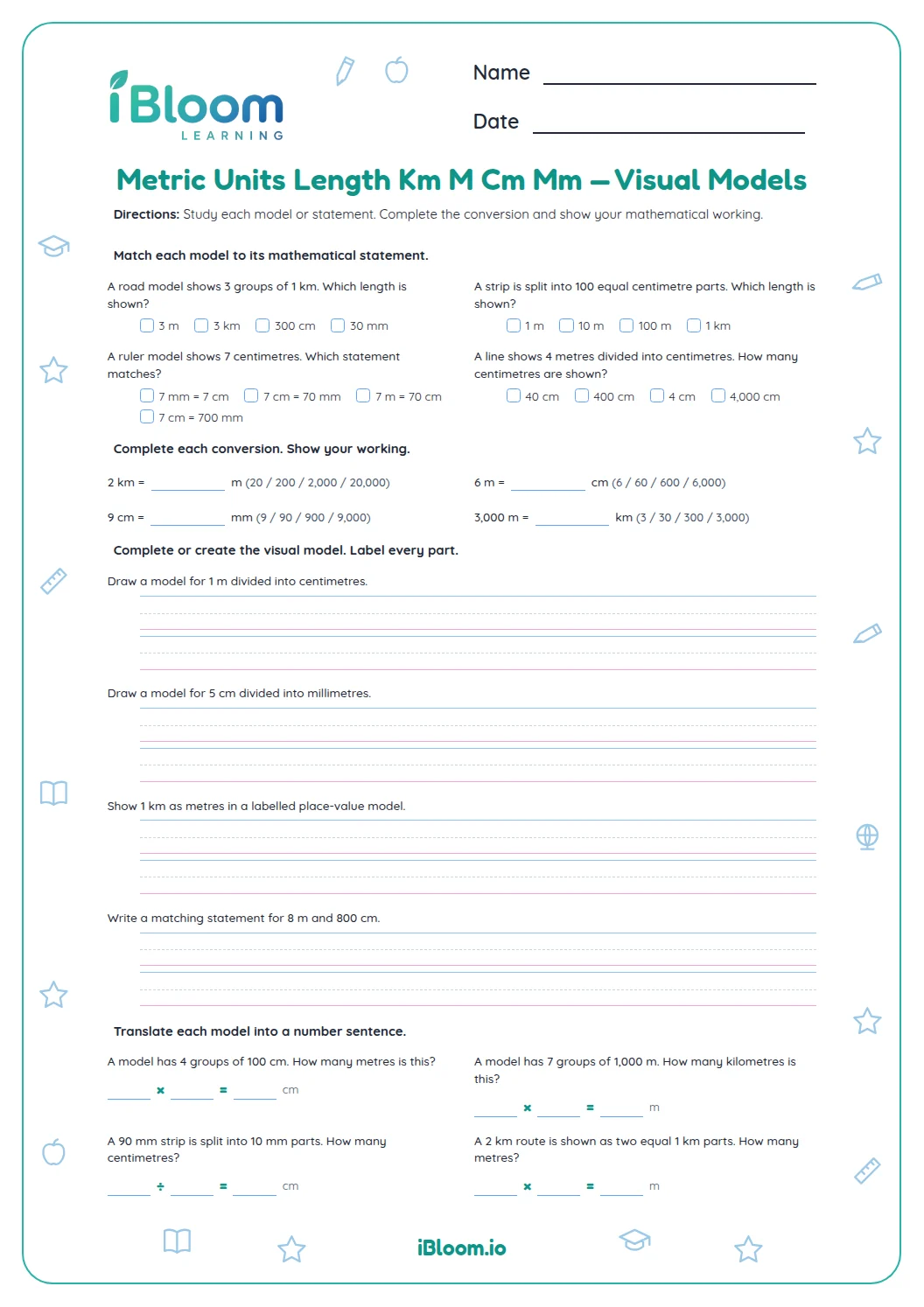
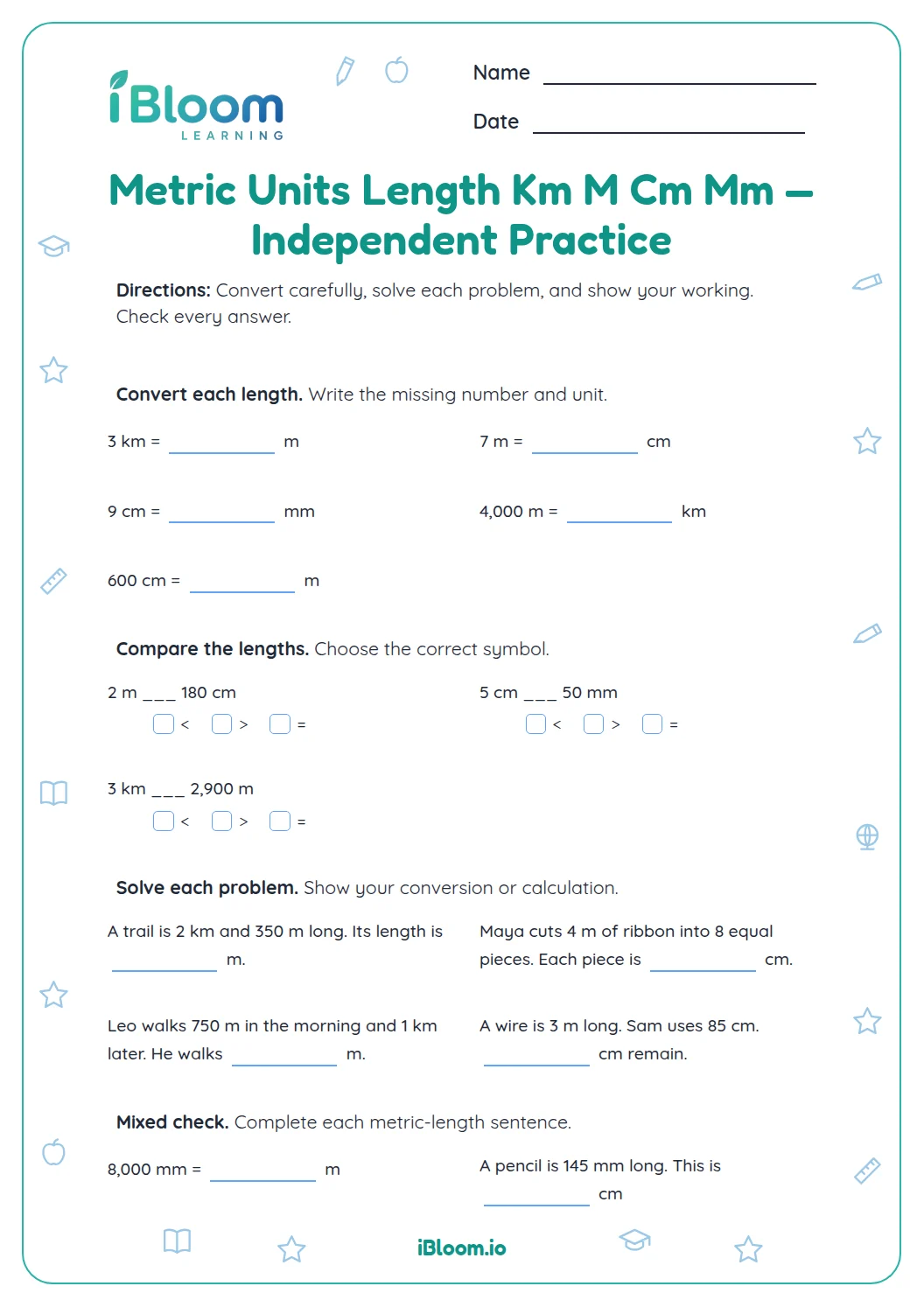
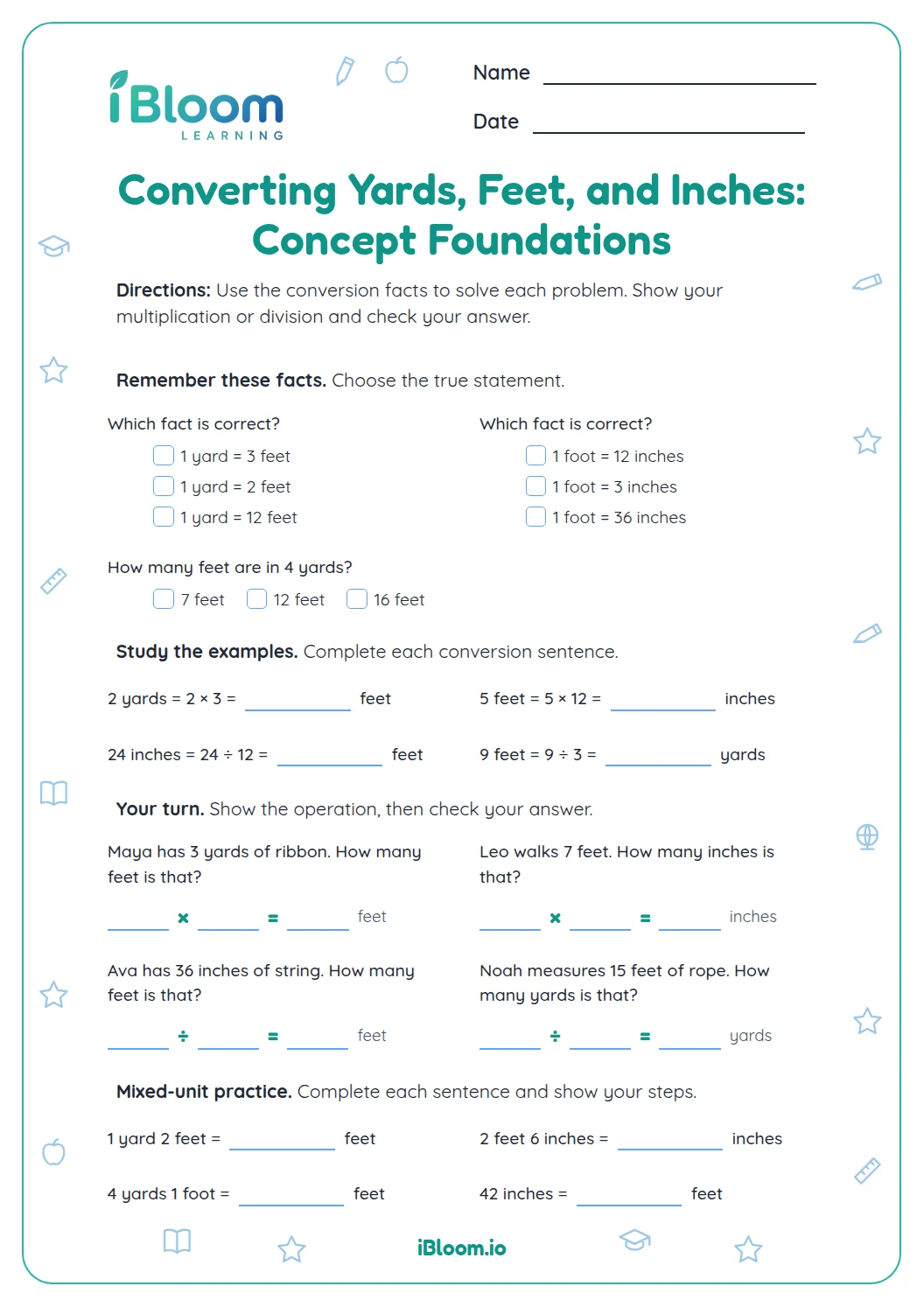
This Grade 5 guided-practice sheet covers customary and metric length conversions. Students use stated conversion facts for miles, yards, feet, inches, kilometers, meters, centimeters and millimeters, then apply them in short situations. Two inch-centimeter questions add decimal multiplication and division. The separate answer key gives the converted lengths with units.
Aligned to 5.MD.A.1
How does a conversion fact act as a scale?
A conversion fact tells how many smaller units make one larger unit. Since 1 yard equals 3 feet, 14 yards equals 14 groups of 3 feet, or 42 feet. Multiplication makes more smaller units.
When converting smaller units to larger units, divide by the number of smaller units in one larger unit. Keep the requested unit beside the answer.
- 114 yd × 3 ft per yd = 42 ft
- 2The yards cancel, leaving feet.
How can an estimate check a decimal conversion?
For 12.5 inches at 2.54 centimeters per inch, 12.5 × 2.54 = 31.75 centimeters. Since one inch is a little more than 2 centimeters, an answer a little above 25 centimeters is reasonable.
The cross-system facts are printed in the questions. Students use those rates to focus on scaling and unit labels.
What conversions are on the worksheet?
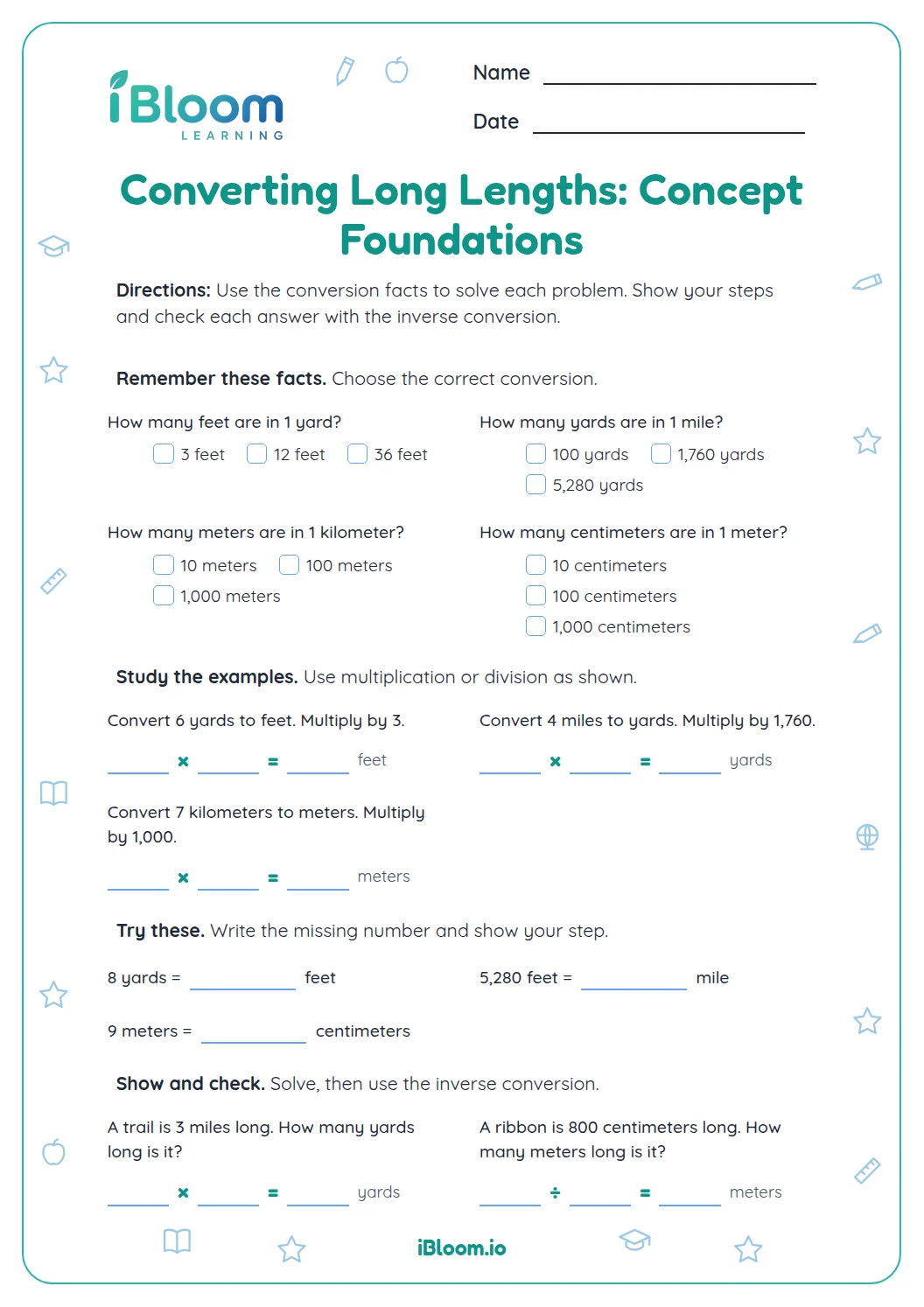
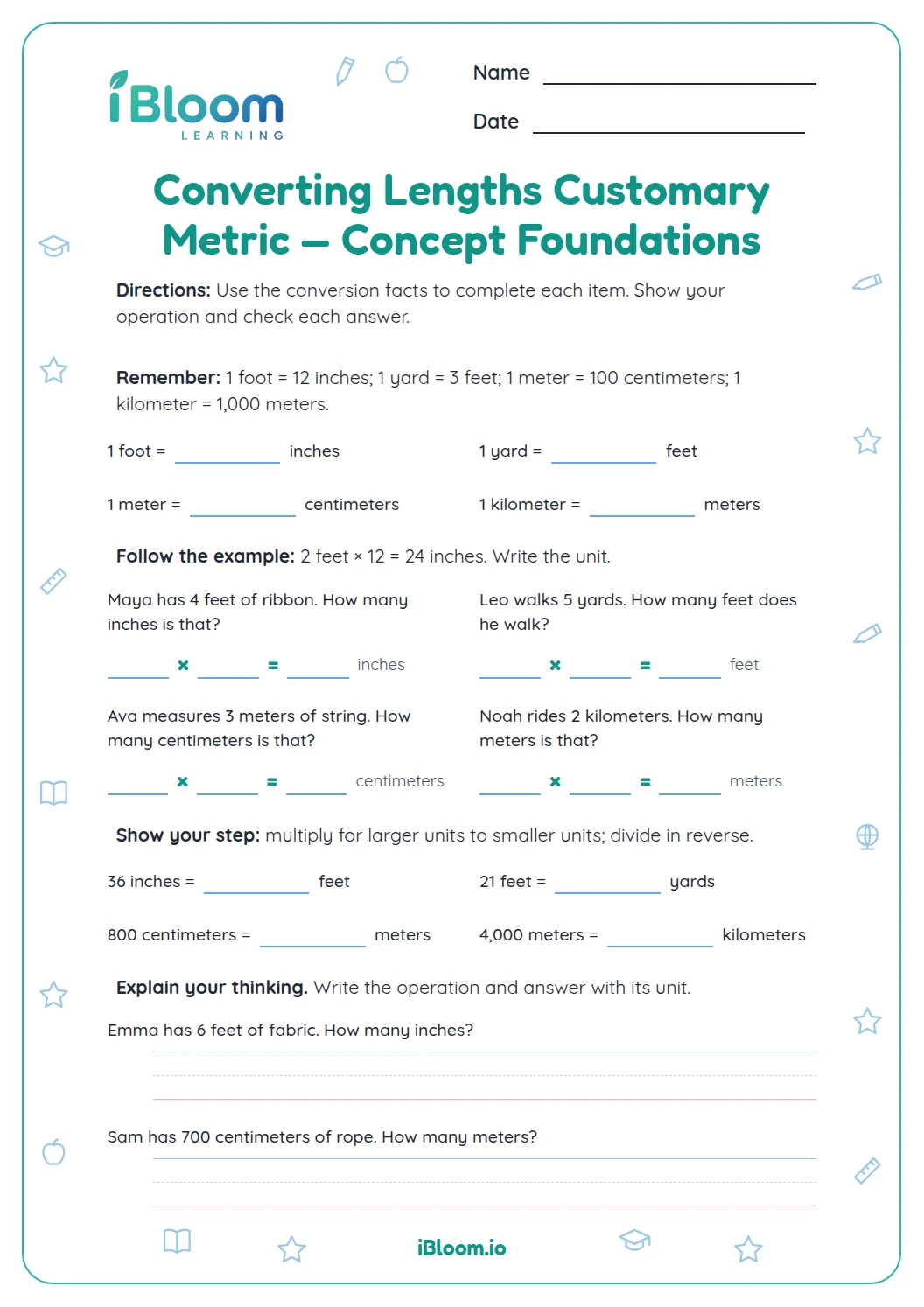
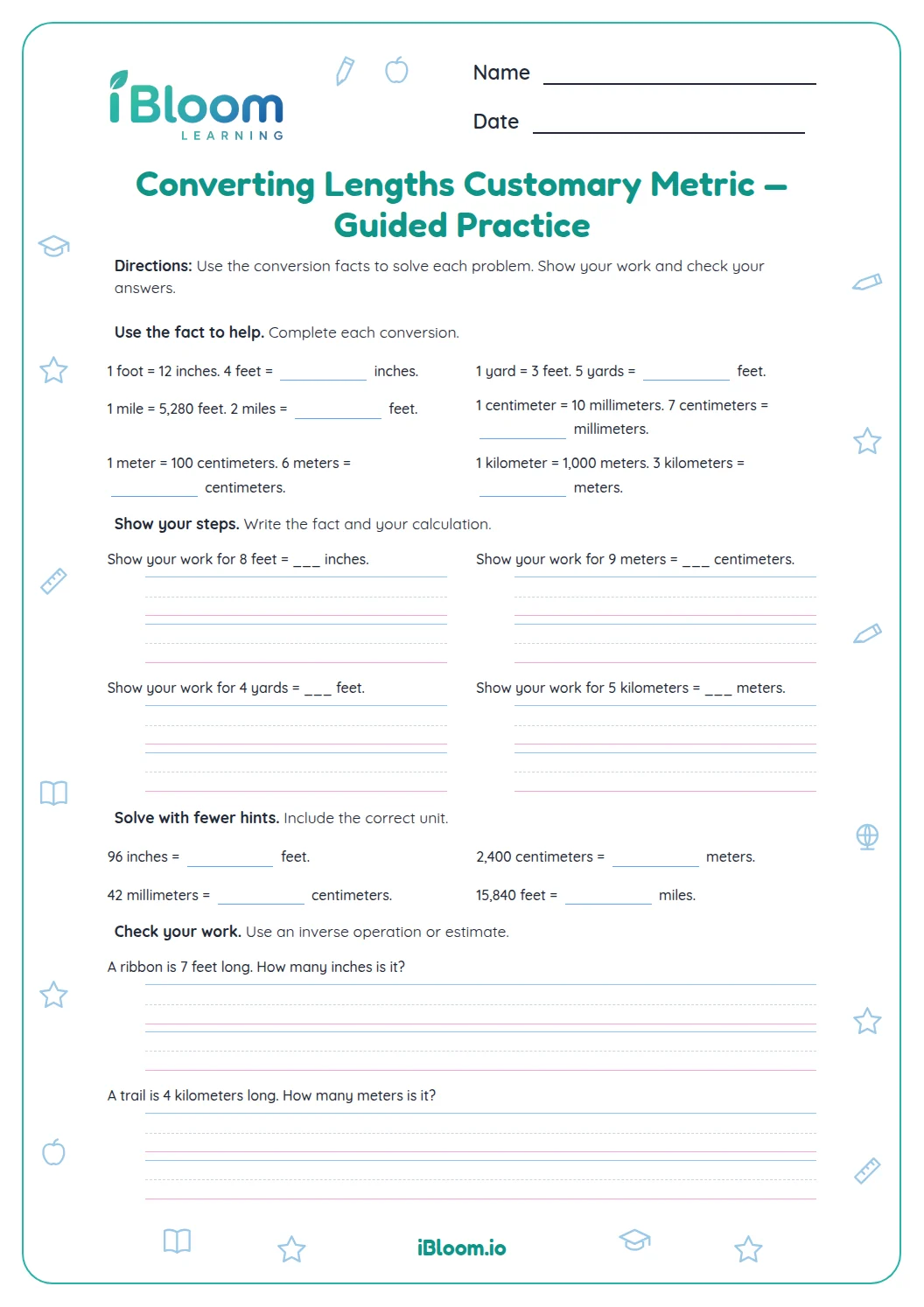
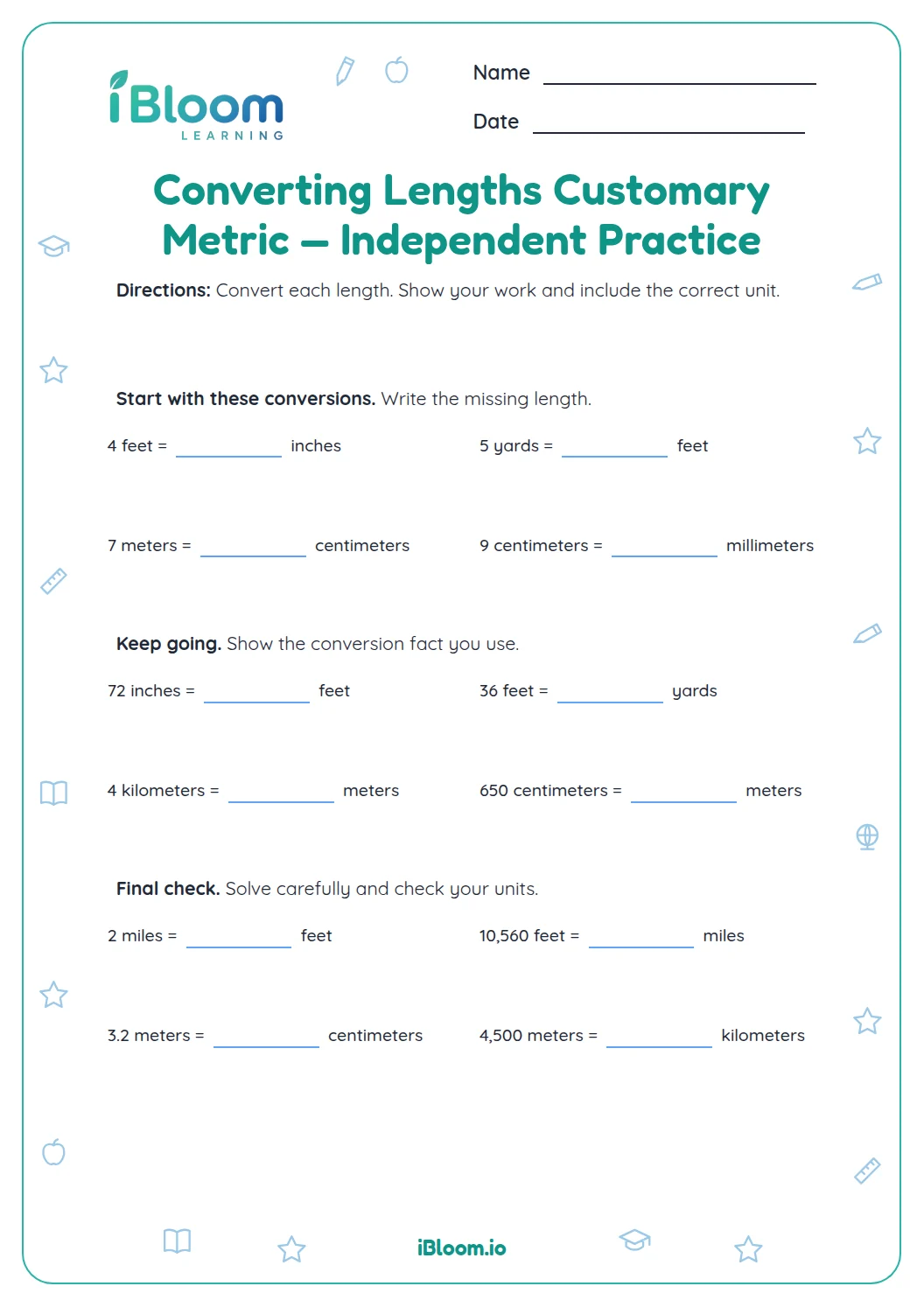
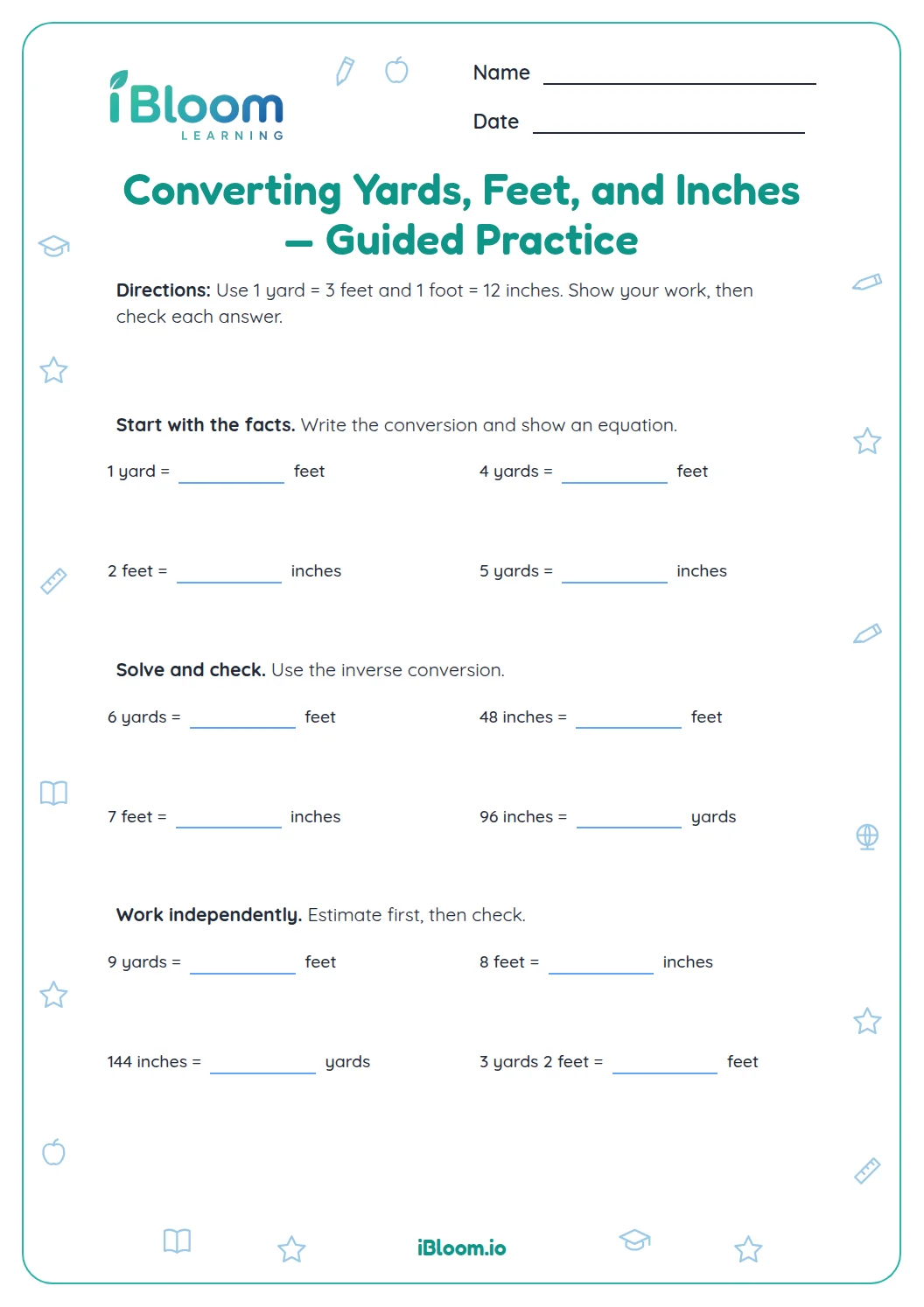
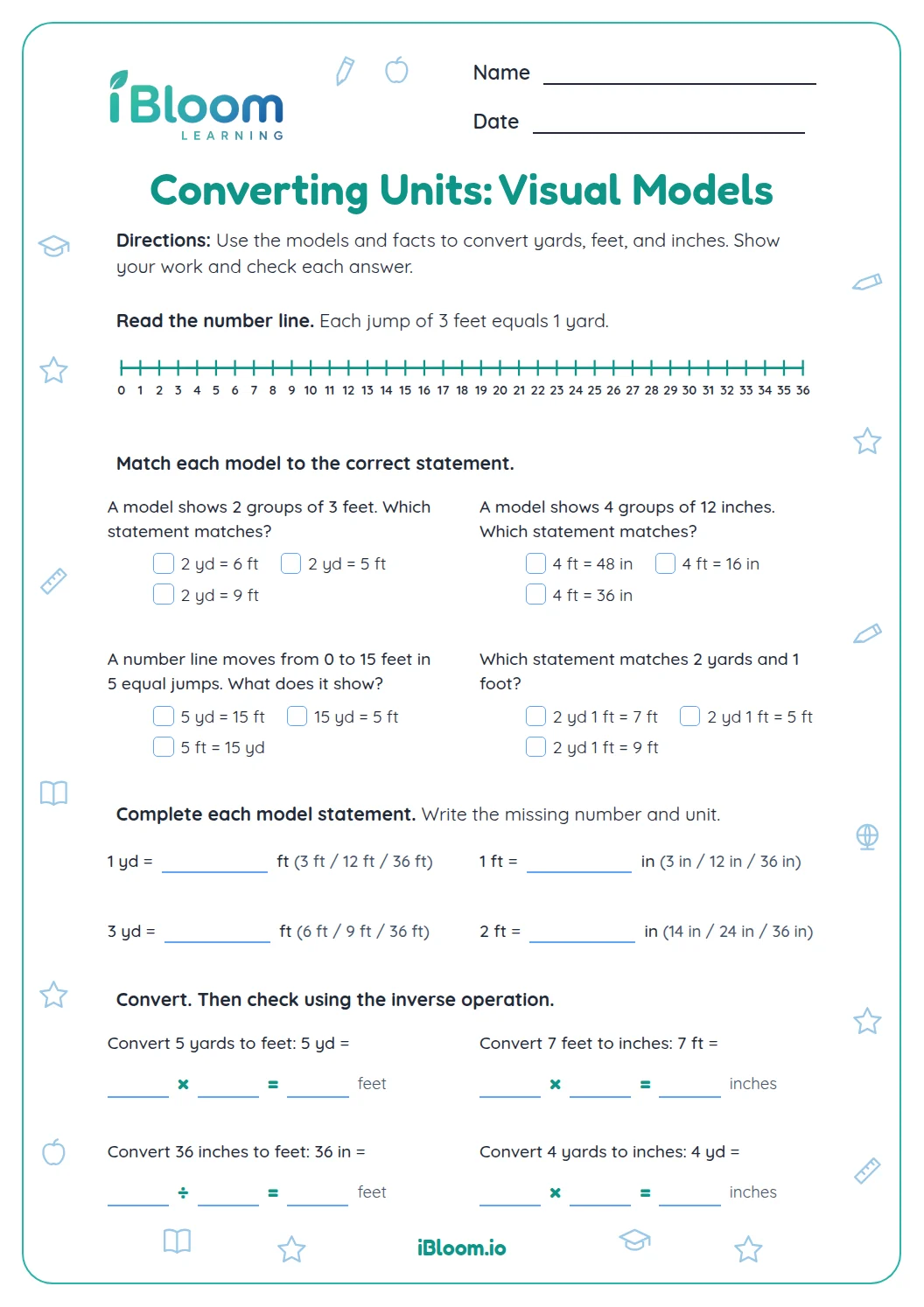
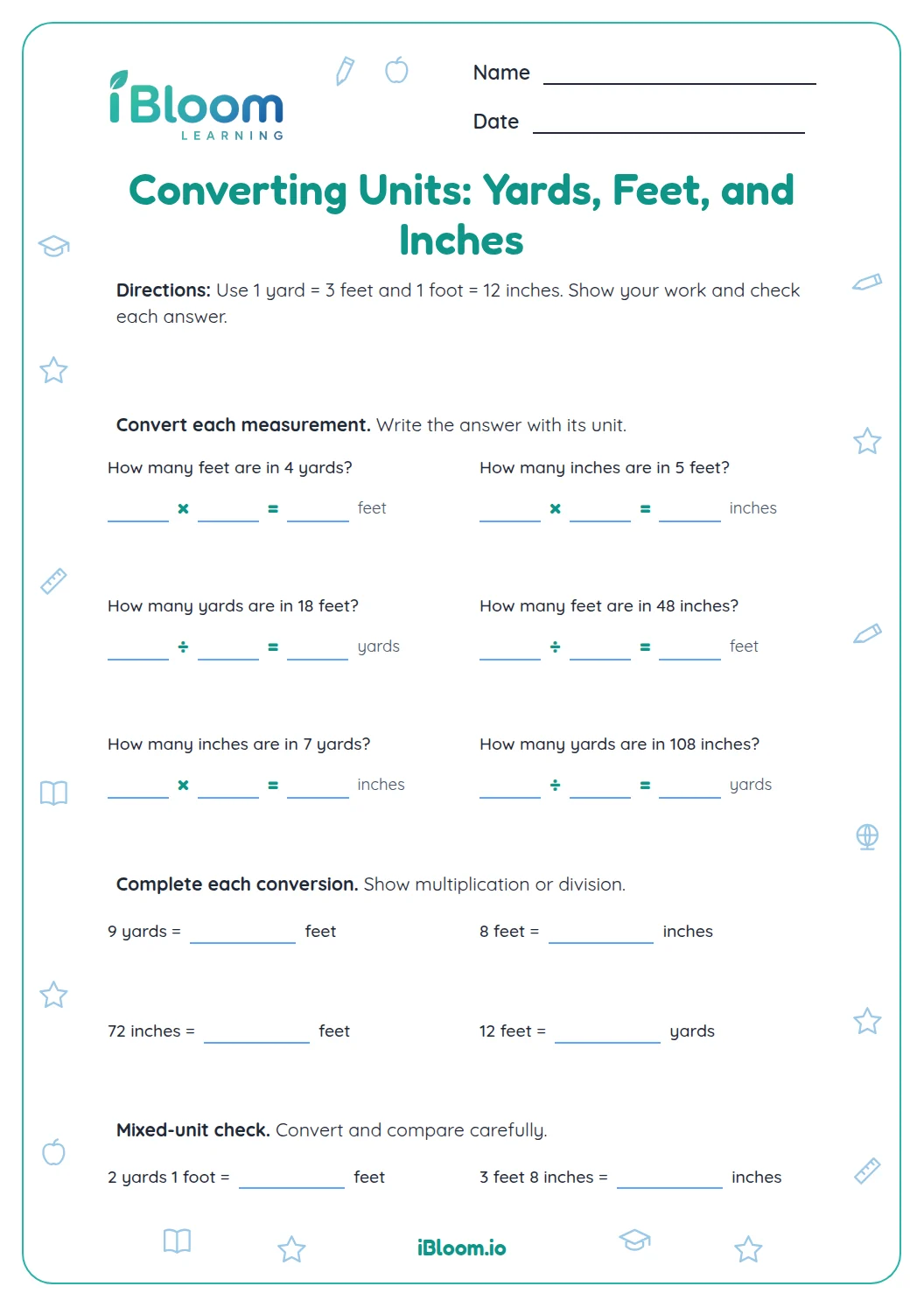
Part A has eight direct conversions among customary and metric units. Part B applies conversion facts in short situations and includes two decimal inch-centimeter calculations. There are 14 questions and a separate answer key.
How to use this worksheet
- 1Underline the given conversion fact and circle the unit requested.
- 2Decide whether you are making more smaller units or fewer larger units.
- 3Multiply or divide, then write the target unit.
- 4Estimate the size before checking the exact calculation.
- 5Use the stated inch-centimeter rate in Part B, then estimate the decimal result.
Common mistakes and quick fixes
The mistake
Multiplying when converting to a larger unit, producing a much bigger number.
The fix
Compare unit sizes: if each larger unit contains many smaller units, divide to regroup smaller units into larger ones.
The mistake
Changing the number but leaving the old unit label.
The fix
Write the requested unit beside the answer and check that it matches the question.
The mistake
Treating 1 mile ≈ 1.61 kilometers as exact.
The fix
Keep the word “about” in the answer because the prompt gives an approximate conversion.
Common Core alignment
Students convert between customary or metric units and use the conversions in measurement questions.
Convert among standard measurement units within one system.
On this sheet: Questions practice customary-within-customary and metric-within-metric conversions, then apply them in measurement contexts.
Show the official wordingHide the official wording
Convert among different-sized standard measurement units within a given measurement system (e.g., convert 5 cm to 0.05 m), and use these conversions in solving multi-step, real world problems.
What to practice next
Make more practice
Further reading
Questions parents and teachers ask
Should students memorize the cross-system facts?
The inch-centimeter facts are stated in the questions, so students can focus on using the rate, calculating and labeling the result. The other items also state the conversion facts they need. This keeps attention on the conversion process. The questions include the facts needed for each conversion.
Why can a conversion make the number larger?
A larger unit contains several smaller units, so the same length uses more small units. One yard equals three feet, for example. Converting yards to feet multiplies by three; converting feet to yards divides by three. Comparing unit sizes helps you choose the operation.
Why is the inch-centimeter rate included?
The worksheet provides 1 inch = 2.54 centimeters so students can use a decimal rate in multiplication and division. For example, 12.5 inches converts to 31.75 centimeters. The stated rate lets students focus on the calculation and unit label. The rate is supplied beside the conversion prompt.
What should students write after calculating?
Students should include the target unit named in the question, such as 42 feet or 800 centimeters. The unit is part of the measurement answer. Estimating the length can help catch a misplaced decimal or a conversion in the wrong direction.
How many conversion questions are included?
There are 14 questions. Eight ask for direct conversions, and six apply conversion facts in short situations or stated cross-system calculations. The separate answer key lists every converted length with its unit so students can check both the number and measurement label.