


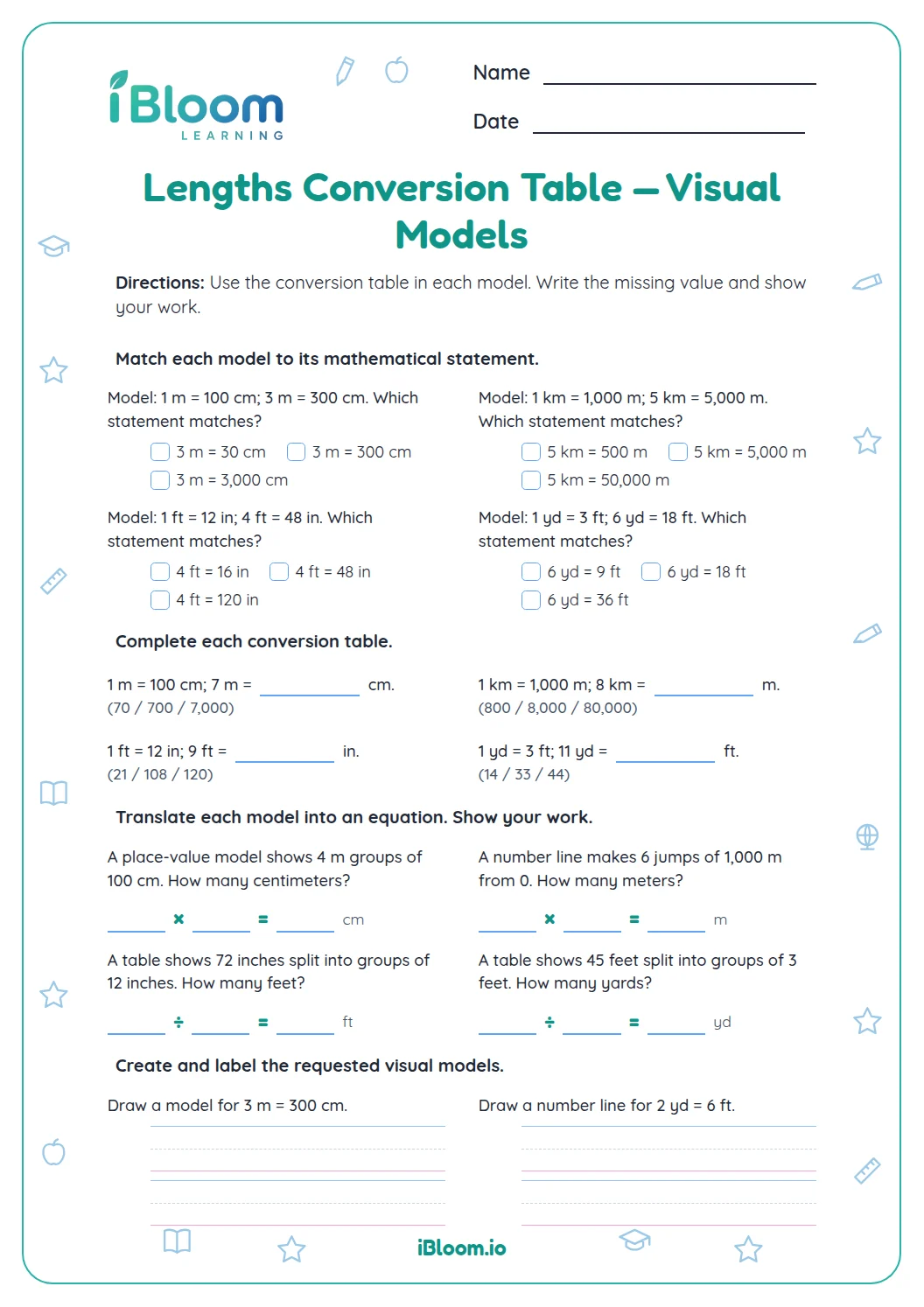
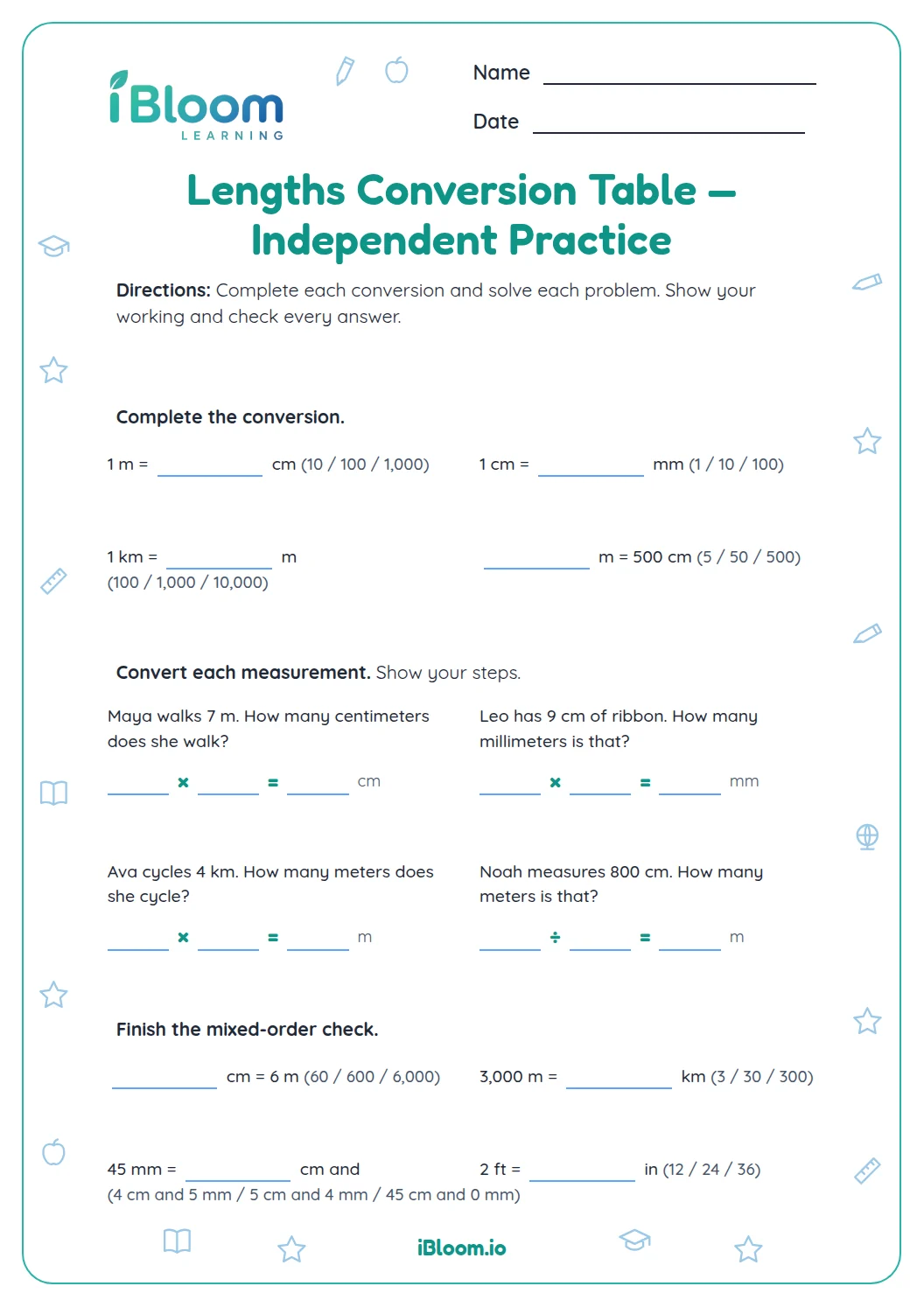
About this worksheet
This free printable worksheet shows Grade 5 students why a length conversion works before they apply it. Two dot arrays show 4 yards as 12 feet and 3 feet as 36 inches, base-ten blocks show 250 centimeters as 2.5 meters, and two number lines show 1 2/3 yards as 5 feet and 1.5 kilometers as 1,500 meters. Two word problems then use the same thinking with miles, yards, kilometers and meters. It practices Common Core 5.MD.A.1, and a two-page answer key shows every answer.
Aligned to 5.MD.A.1
What is on this converting lengths worksheet?
Seven questions in three parts, each starting from a picture of the conversion. The models change from one question to the next, so students see the same idea with customary and metric units, whole numbers, fractions and decimals.
Part A asks which statement a model matches: two dot arrays for yards, feet and inches, and base-ten blocks for centimeters and meters. Part B gives two number lines with equal jumps, and students count the jumps to fill in a blank. Part C has two word problems with a working space and an answer box.
- Part A: two dot arrays and base-ten blocks (questions 1 to 3)
- Part B: number lines for 1 2/3 yards and 1.5 kilometers (questions 4 and 5)
- Part C: a trail in miles and a two-day run in kilometers and meters (questions 6 and 7)
How does a model help with converting units?
A model shows the size of the conversion factor. In question 1, each row of dots is 1 yard, and each row has 3 dots for 3 feet. Four rows mean 4 yards and 12 feet, so the statement is 4 yd = 12 ft. Question 2 works the same way with rows of 12 inches: 3 rows are 3 feet, or 36 inches.
The base-ten blocks in question 3 do the same job for metric lengths. Each flat is 100 centimeters, or 1 meter, and each rod is 10 centimeters. Two flats and five rods make 250 centimeters, or 2 meters and 50 centimeters, which is 2.5 meters.
- 1The line counts kilometers. Each jump is 500 meters.
- 2The dot is on the 3rd jump from 0.
- 33 jumps × 500 m = 1,500 m
- 4Check: 1.5 × 1,000 = 1,500
- 5Answer: 1,500 meters
When do you multiply and when do you divide?
When you change to a smaller unit, you need more of them, so you multiply. Yards to feet, kilometers to meters and meters to centimeters all work this way. When you change to a larger unit, you need fewer, so you divide.
Question 6 shows the first case. The trail is 3 miles, and 1 mile is 1,760 yards, so the trail is 3 × 1,760 = 5,280 yards. Asking “Should my answer be bigger or smaller than 3?” before calculating catches a divide-instead-of-multiply slip.
How do you add lengths that are in different units?
Question 7 has two lengths, 2.5 kilometers and 1,200 meters. They cannot be added until both are in the same unit. Change the kilometers first: 2.5 × 1,000 = 2,500 meters. Then add: 2,500 + 1,200 = 3,700 meters.
Writing the unit next to every number keeps this clear. If the units do not match, convert one of them before you add.
How to use this worksheet at home or in class
- 1Ask your student to name the larger and smaller unit in each question before they start.
- 2For questions 1 and 2, count the dots in one row and then the rows before choosing a statement.
- 3For question 3, have your student count the flats and the rods separately, then say the length in centimeters.
- 4On the number lines, count the jumps from 0 to the dot and multiply by the size of one jump.
- 5In Part C, write the conversion in the working space first, then do the arithmetic.
- 6Check with the answer key, and ask whether each answer is bigger or smaller than the starting number.
Common mistakes and quick fixes
The mistake
Dividing instead of multiplying in question 6, so 3 miles becomes about 0.002 yards.
The fix
Ask whether a yard is bigger or smaller than a mile. A yard is smaller, so the trail is a lot of yards, and the answer must be bigger than 3.
The mistake
Placing the decimal point wrongly in question 3 and choosing 25 m or 0.25 m for 250 cm.
The fix
Count the blocks: 2 flats are 2 whole meters, and 5 rods are only half of one more meter. The answer is between 2 and 3, so it is 2.5 m.
The mistake
Adding 2.5 and 1,200 in question 7 to get 1,202.5.
The fix
Point to the two units. Kilometers and meters cannot be added directly, so change 2.5 km to 2,500 m first, and then add.
Common Core alignment
Grade 5 students convert among units within one measurement system and use conversions in real-world problems.
Convert yards to feet and kilometers to meters, then use conversions to solve real-world problems.
On this sheet: Questions 1 to 5 convert within the customary and metric systems, and questions 6 and 7 use conversions in real-world problems.
Show the official wordingHide the official wording
Convert among different-sized standard measurement units within a given measurement system (e.g., convert 5 cm to 0.05 m), and use these conversions in solving multi-step, real world problems.
What to practice next
Make more practice
Further reading
Questions parents and teachers ask
What conversions does a Grade 5 student need to know for this worksheet?
Students use 1 yard = 3 feet, 1 foot = 12 inches, 1 kilometer = 1,000 meters, 1 meter = 100 centimeters and 1 mile = 1,760 yards. Question 6 gives the miles-to-yards fact, and the models in questions 1 to 5 show the others, so a student can work out each one from the picture.
Why does the worksheet use number lines for conversions?
A number line shows equal jumps, which is exactly what a conversion factor is. In question 4, each jump is 1 foot, and 3 jumps make a yard, so 1 2/3 yards lands on the 5th jump: 5 feet. Counting jumps first gives the multiplication a meaning students can see.
Should students use a conversion table or work from the model?
Start from the model, then check with the fact. When students can see that 1 kilometer is two jumps of 500 meters, they have a reason to multiply rather than a rule to remember. A conversion table is a good check afterward, but the models make the reasoning visible.
Why do the base-ten blocks stand for centimeters?
Base-ten blocks show tens and hundreds, which match the metric system. A rod stands for 10 centimeters, and a flat stands for 100 centimeters, or 1 meter. Counting them gives 250 centimeters, and regrouping the flats and rods shows that this is 2.5 meters.
How can I check a conversion answer quickly?
Ask whether the answer should be larger or smaller than the starting number. Changing to a smaller unit gives a larger number, and changing to a larger unit gives a smaller one. In question 6, 3 miles should become many yards, so 5,280 makes sense and 0.002 does not.
What should we practice after this worksheet?
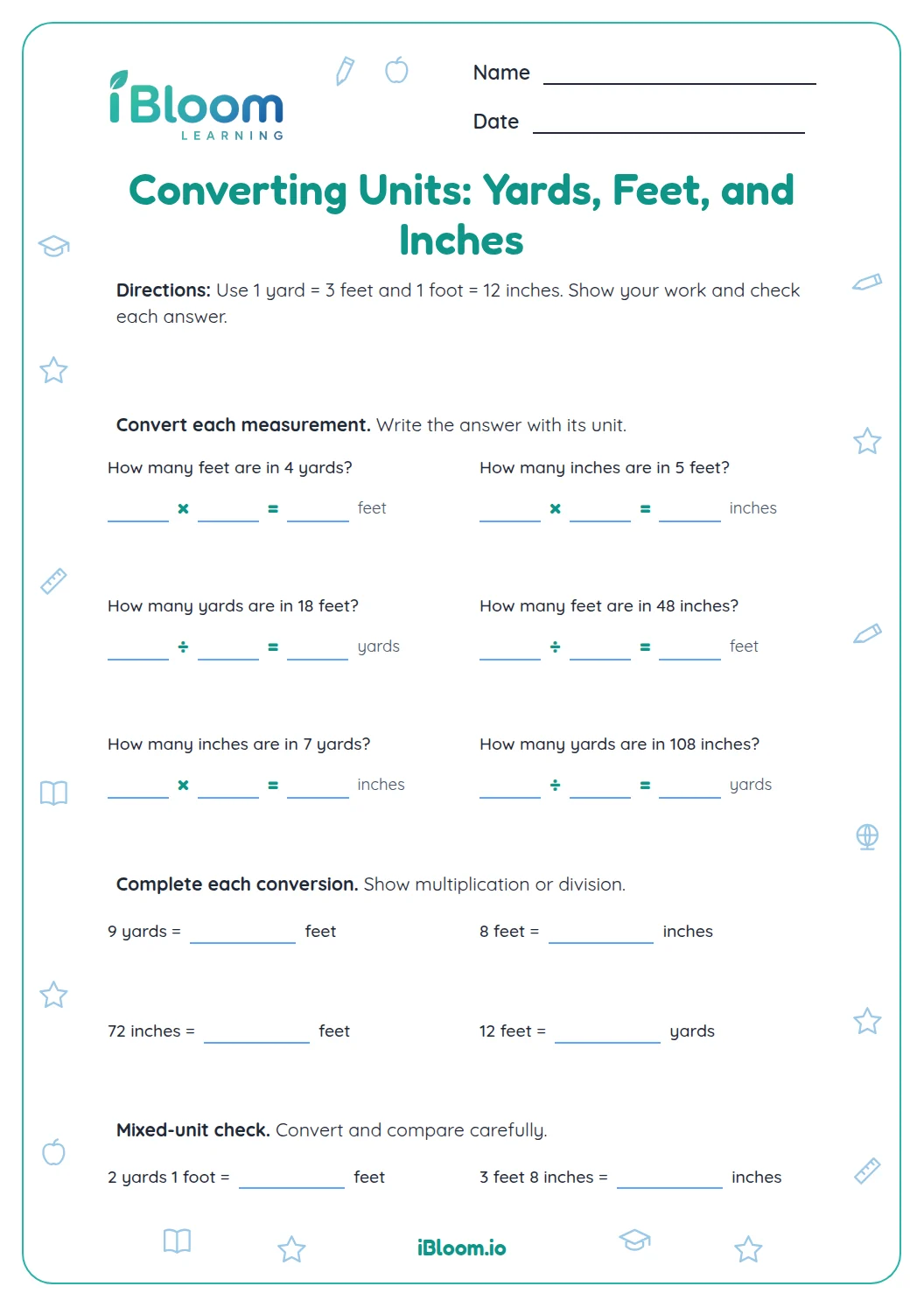
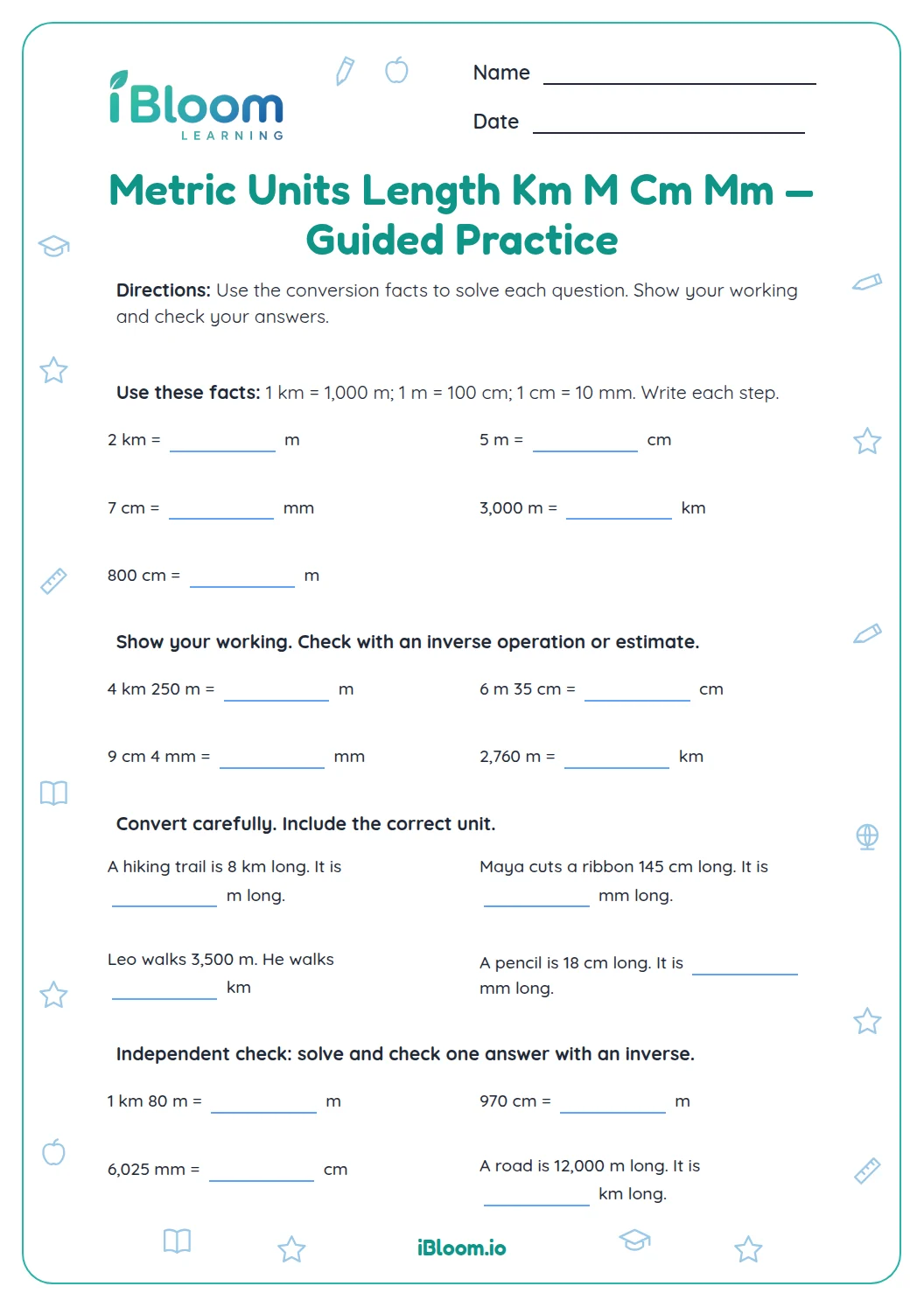
Try the yards, feet and inches sheet to practice question 1 style conversions, and the metric kilometers, meters, centimeters and millimeters sheet for the metric ones. The decimals worksheet is a good next step for numbers such as 2.5 km. A conversion table then helps with checking answers.