

About this worksheet
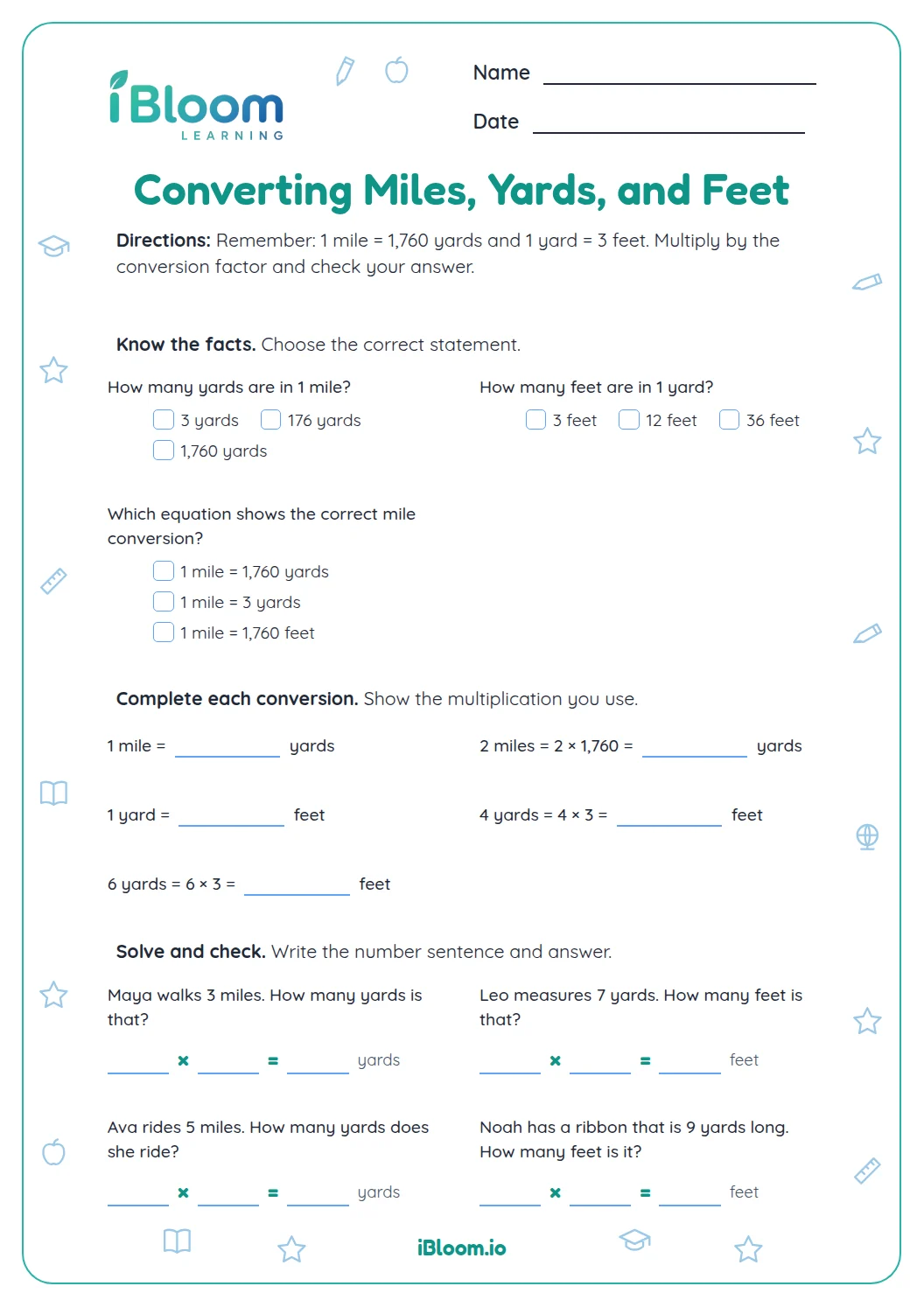
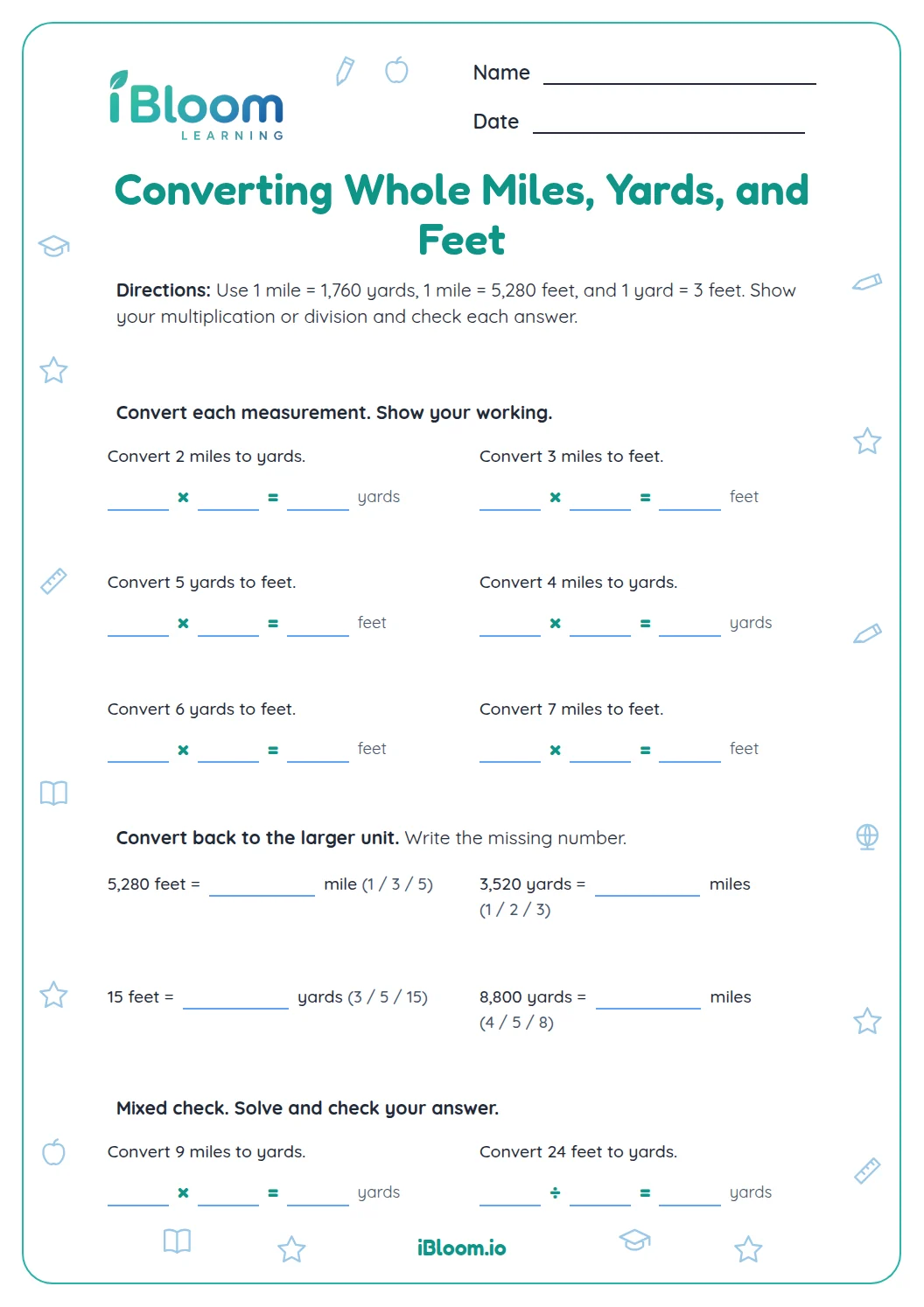
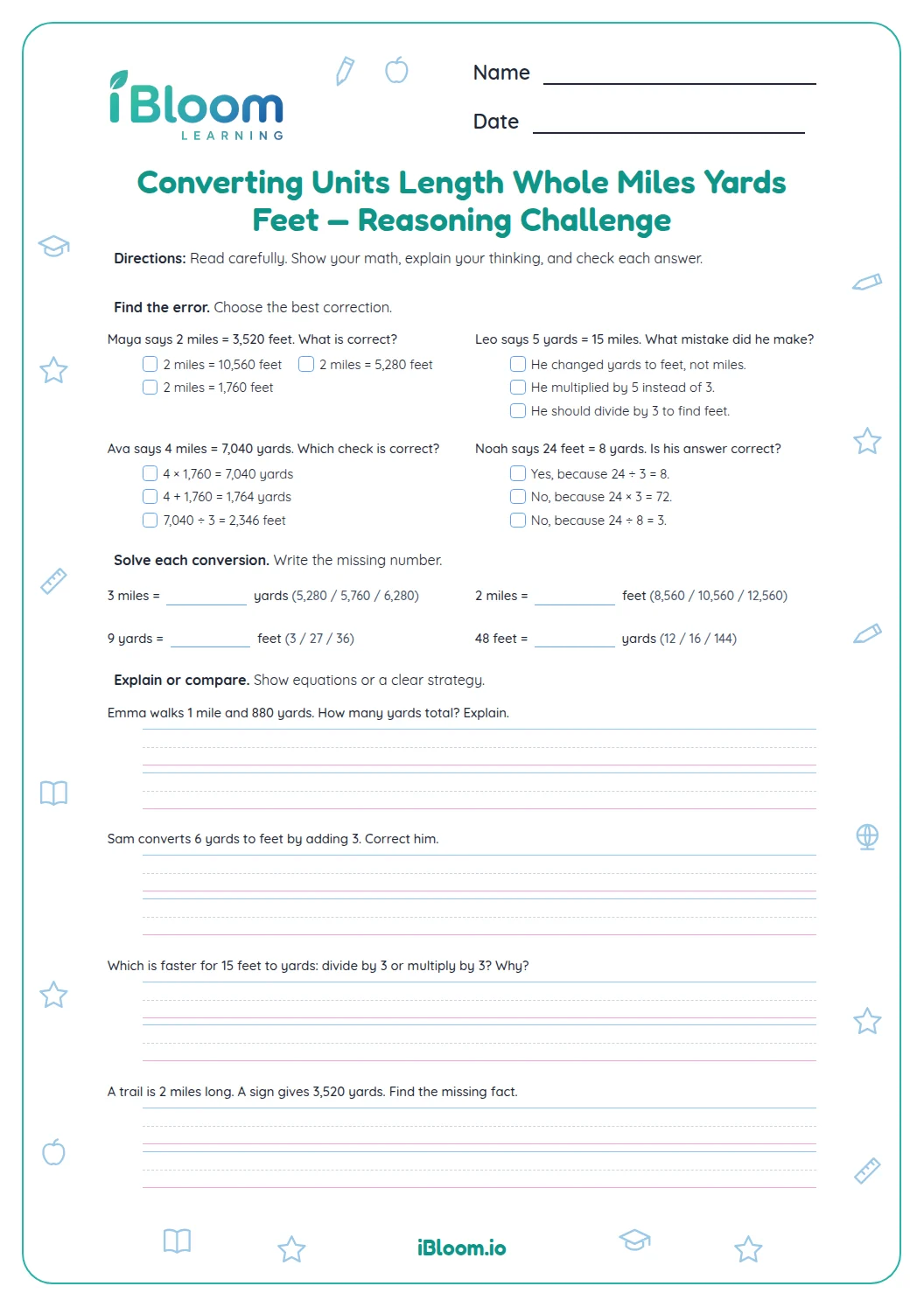
This printable Grade 5 math worksheet practices converting miles, yards, and feet. Students use 1 mile = 1,760 yards and 1 yard = 3 feet in direct conversions, mixed-unit work, comparisons, and contexts. It includes 16 questions: conversion facts, mixed units, comparisons, and word problems and a separate answer key. The work aligns with CCSS 5.MD.A.1.
Aligned to 5.MD.A.1
How do I work with converting miles, yards, and feet?
Students use 1 mile = 1,760 yards and 1 yard = 3 feet in direct conversions, mixed-unit work, comparisons, and contexts.
Track the units as you multiply or divide.
- 13 miles 20 yards = ___ yards
- 23 × 1,760 + 20 = 5,300
- 3The length is 5,300 yards.
What practice is included?
16 questions: conversion facts, mixed units, comparisons, and word problems. The questions move from direct practice to applying the same idea.
How to use this worksheet
- 1Write the conversion fact you need.
- 2Decide whether you are moving to a smaller or larger unit.
- 3Multiply or divide by the conversion factor.
- 4Include the requested unit.
- 5Check by converting back.
Common mistakes and quick fixes
The mistake
Multiplying when converting to a larger unit.
The fix
Use fewer larger units for the same length, so divide.
The mistake
Using 3 feet for a mile conversion.
The fix
Convert miles to yards first, then yards to feet.
The mistake
Dropping the leftover yards in a mixed length.
The fix
Convert the miles, then add the remaining yards.
Common Core alignment
This worksheet practices the following Common Core skill.
Track the units as you multiply or divide.
On this sheet: Students use 1 mile = 1,760 yards and 1 yard = 3 feet in direct conversions, mixed-unit work, comparisons, and contexts.
Show the official wordingHide the official wording
Convert among different-sized standard measurement units within a given measurement system (e.g., convert 5 cm to 0.05 m), and use these conversions in solving multi-step, real world problems.
What to practice next
Make more practice
Further reading
Questions parents and teachers ask
How many questions are on the worksheet?
There are 16 questions. They cover conversion facts, miles to yards or feet, yards to feet, mixed miles and yards, comparisons, and short length situations. A separate answer key is included. Reading each unit label aloud can help keep the conversion factor and final answer connected.
What conversion facts should students use?
Use 1 mile = 1,760 yards and 1 yard = 3 feet. For a conversion from miles to feet, apply both facts: 1 mile equals 5,280 feet. Reading each unit label aloud can help keep the conversion factor and final answer connected.
When should a student multiply?
Multiply when converting to a smaller unit because more of those units fit the same length. For example, multiply yards by 3 to find feet. Reading each unit label aloud can help keep the conversion factor and final answer connected.
How do you convert mixed miles and yards?
Convert the miles to yards, then add the extra yards. For 3 miles 20 yards, calculate 3 × 1,760 + 20 = 5,300 yards. Reading each unit label aloud can help keep the conversion factor and final answer connected. Ask the learner to explain one answer using the pictured word or stated values.
Does the worksheet include word problems?
Yes. Four questions put the conversions in short contexts, including a trail, rope, route, and field. Students write the result with its unit. Reading each unit label aloud can help keep the conversion factor and final answer connected. Ask the learner to explain one answer using the pictured word or stated values.
Is an answer key provided?
Yes. A separate answer key gives answers for all 16 conversion questions, including the values with units. Reading each unit label aloud can help keep the conversion factor and final answer connected. The included conversions let families review both customary length relationships at home or in class.