


About this worksheet
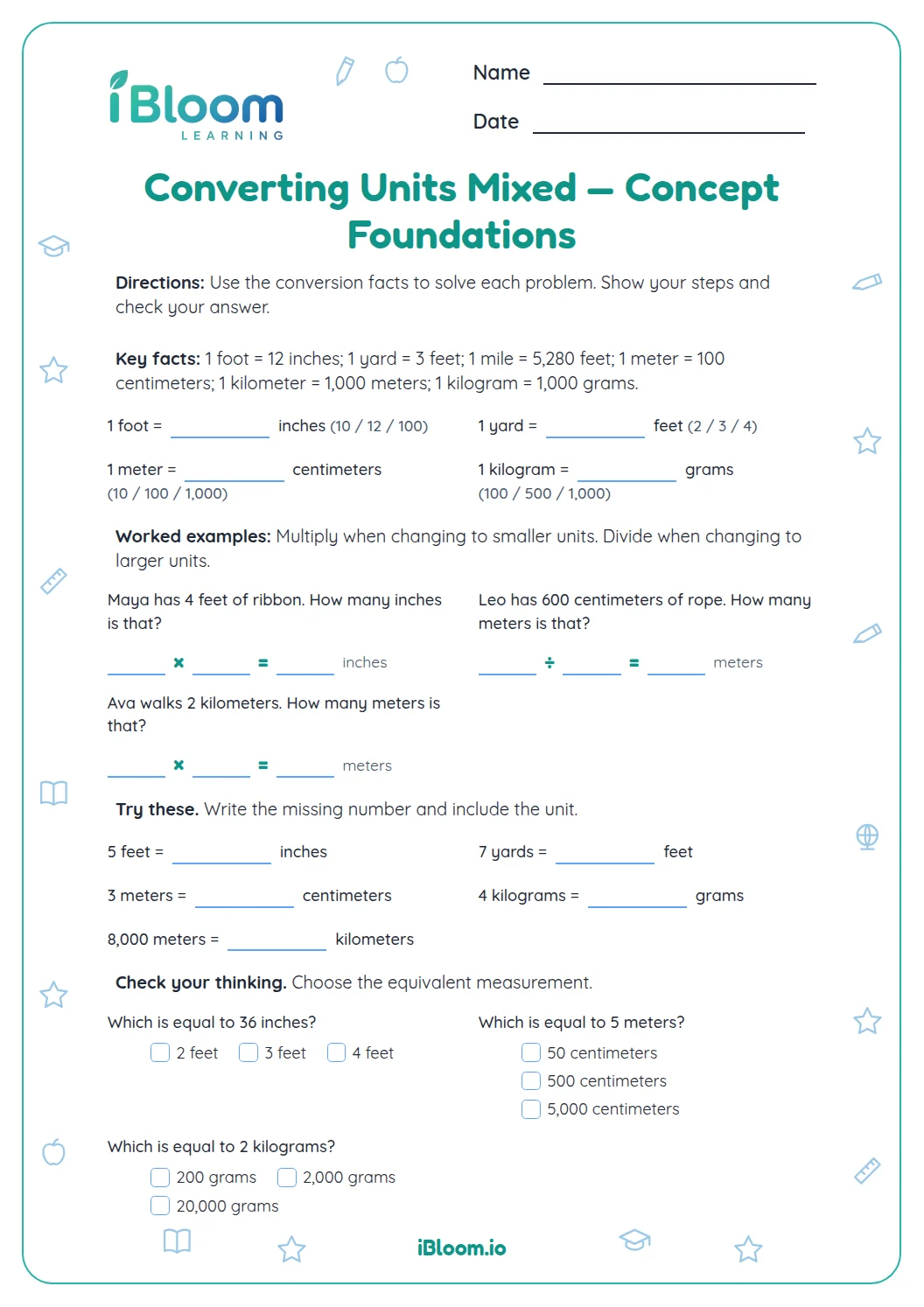
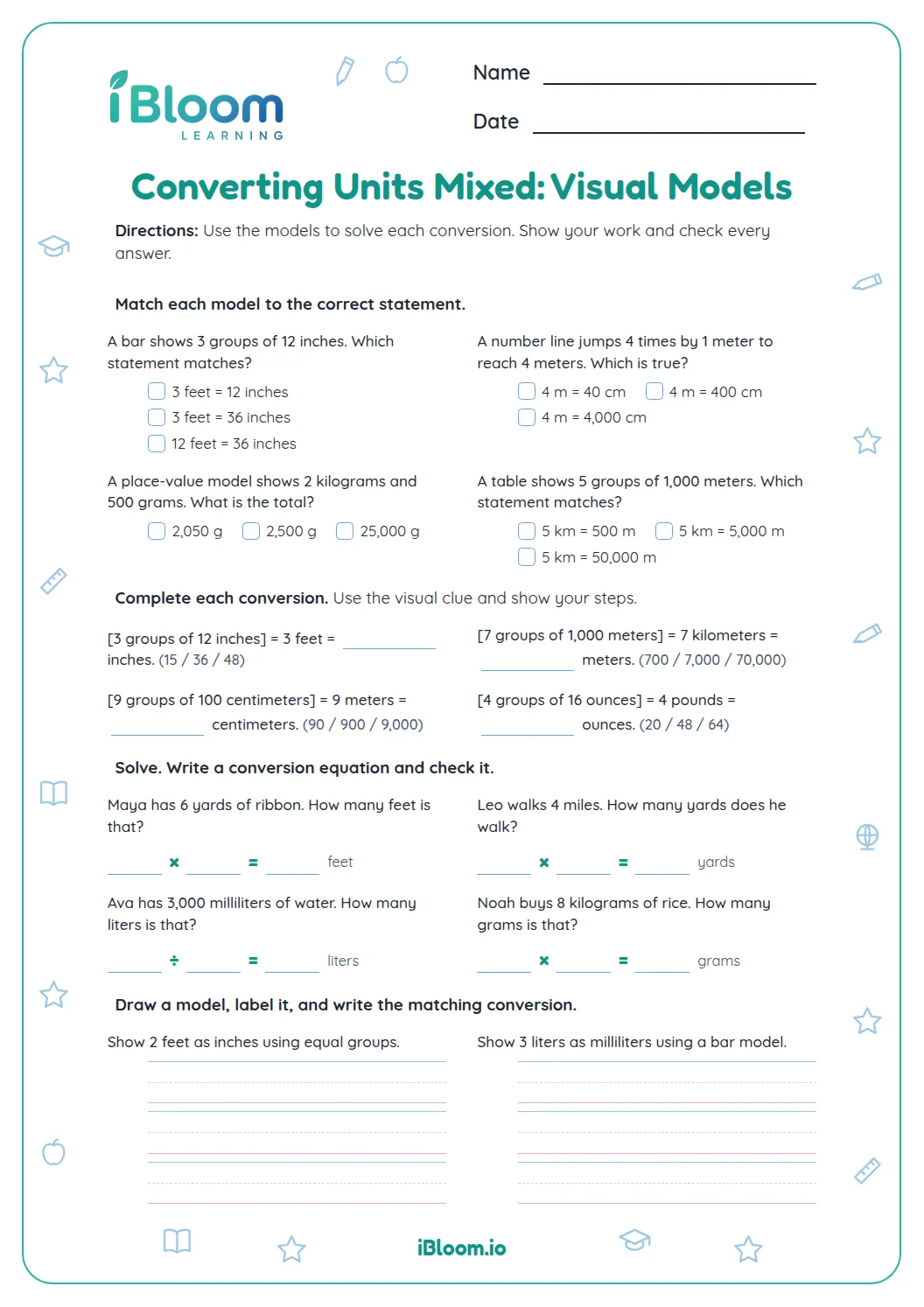
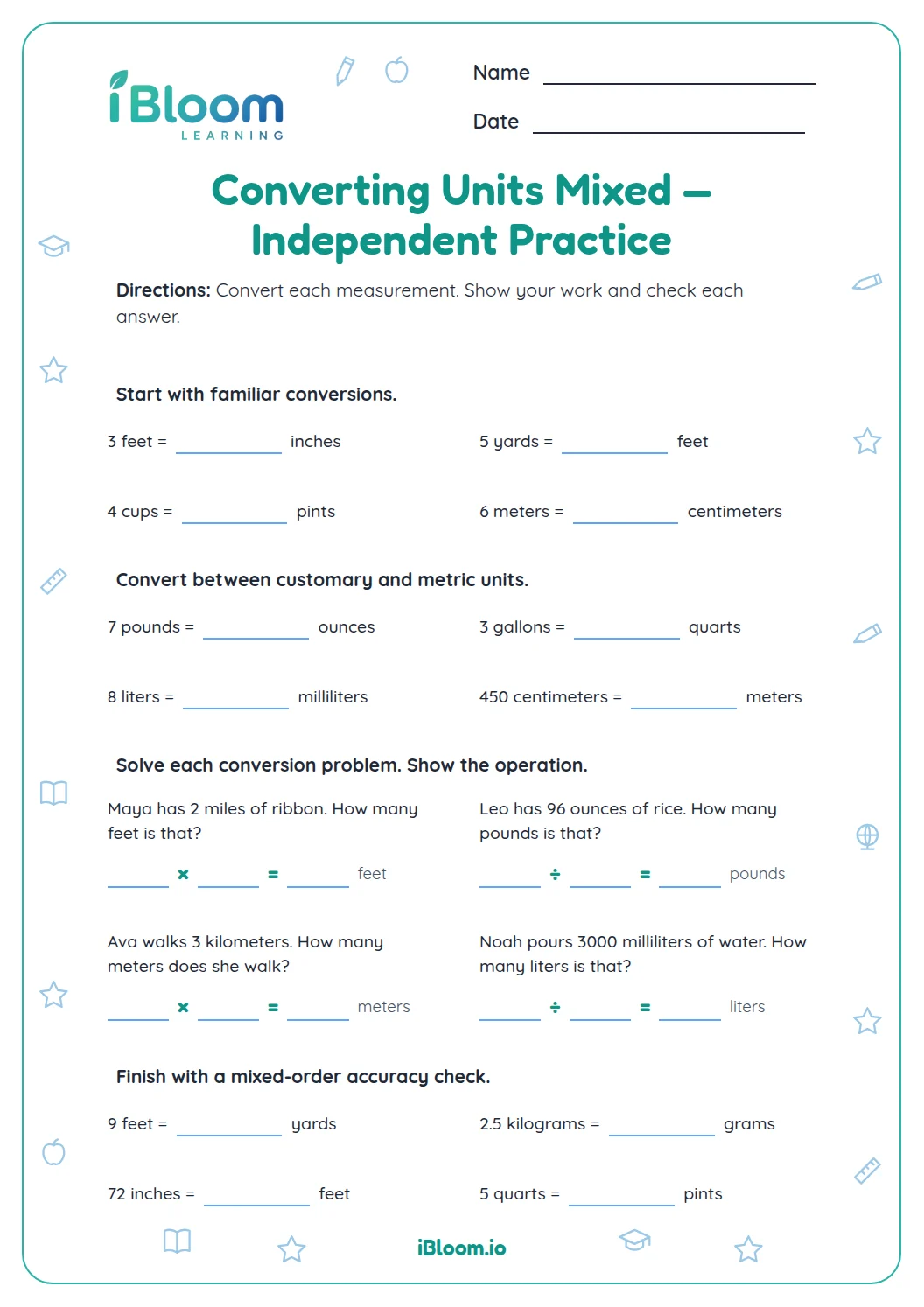
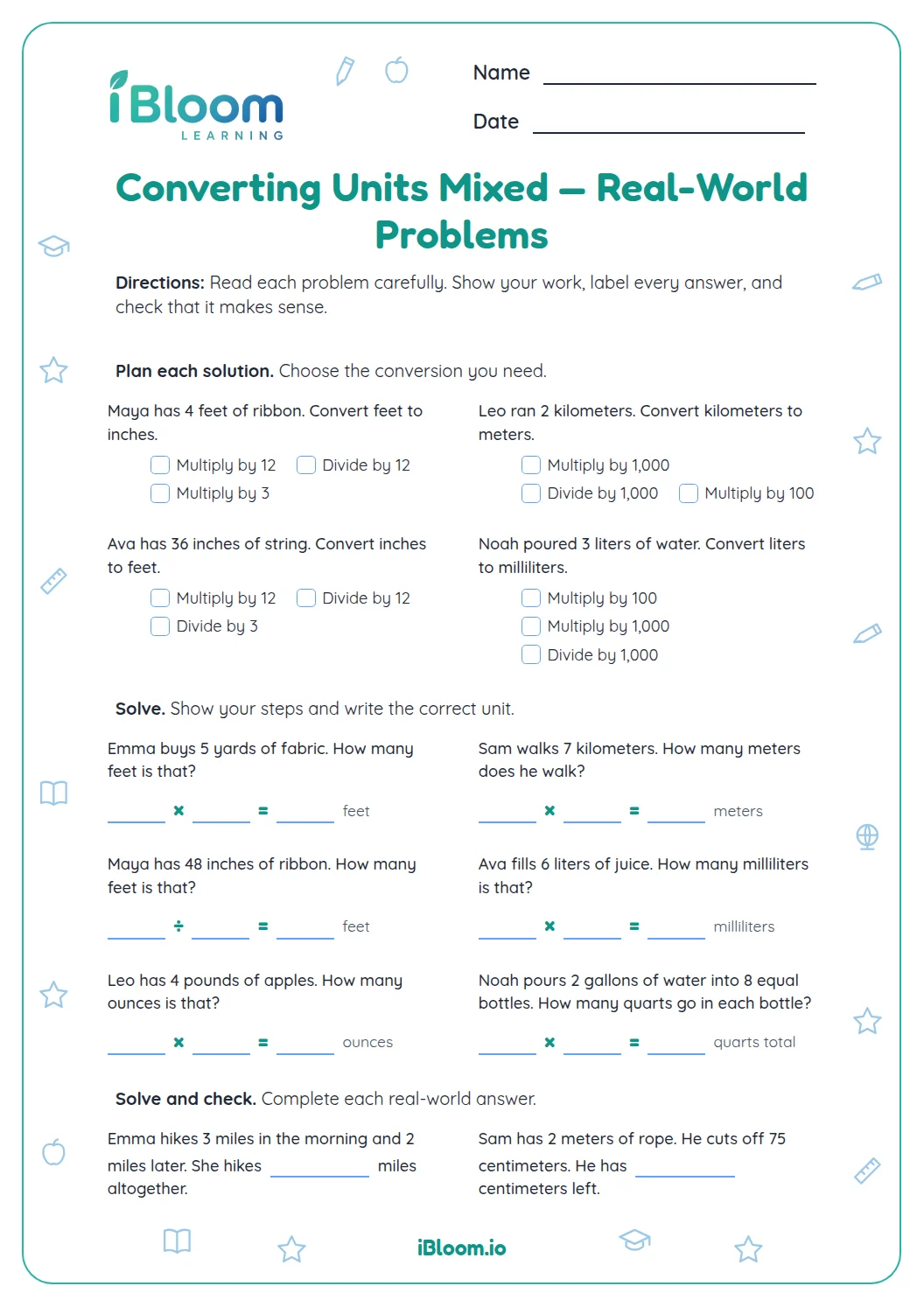
Grade 5 students practice customary and metric conversions, compare amounts in one unit, and solve multi-step measurement situations.
Aligned to 5.MD.A.1
Which conversions and problems are included?
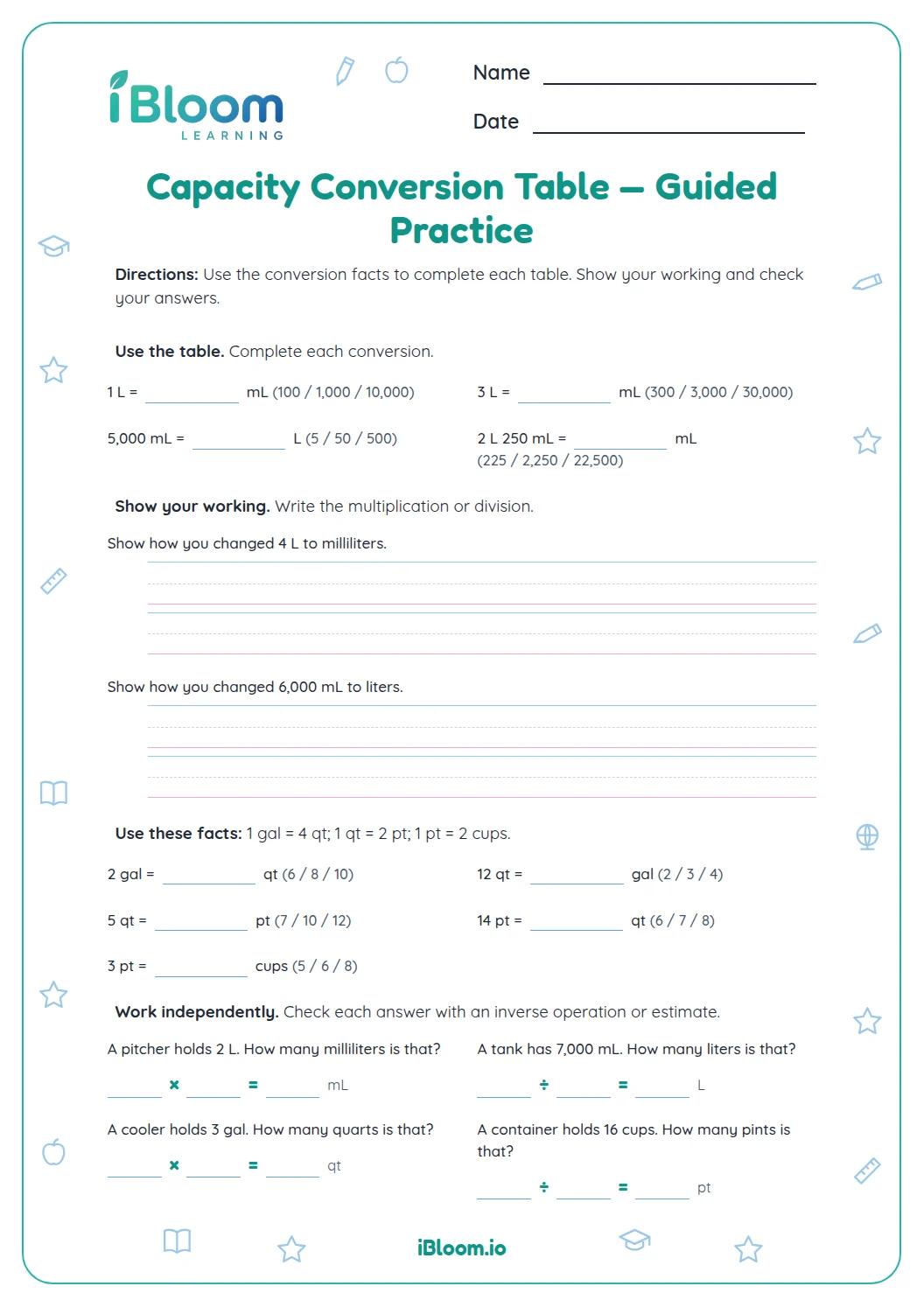
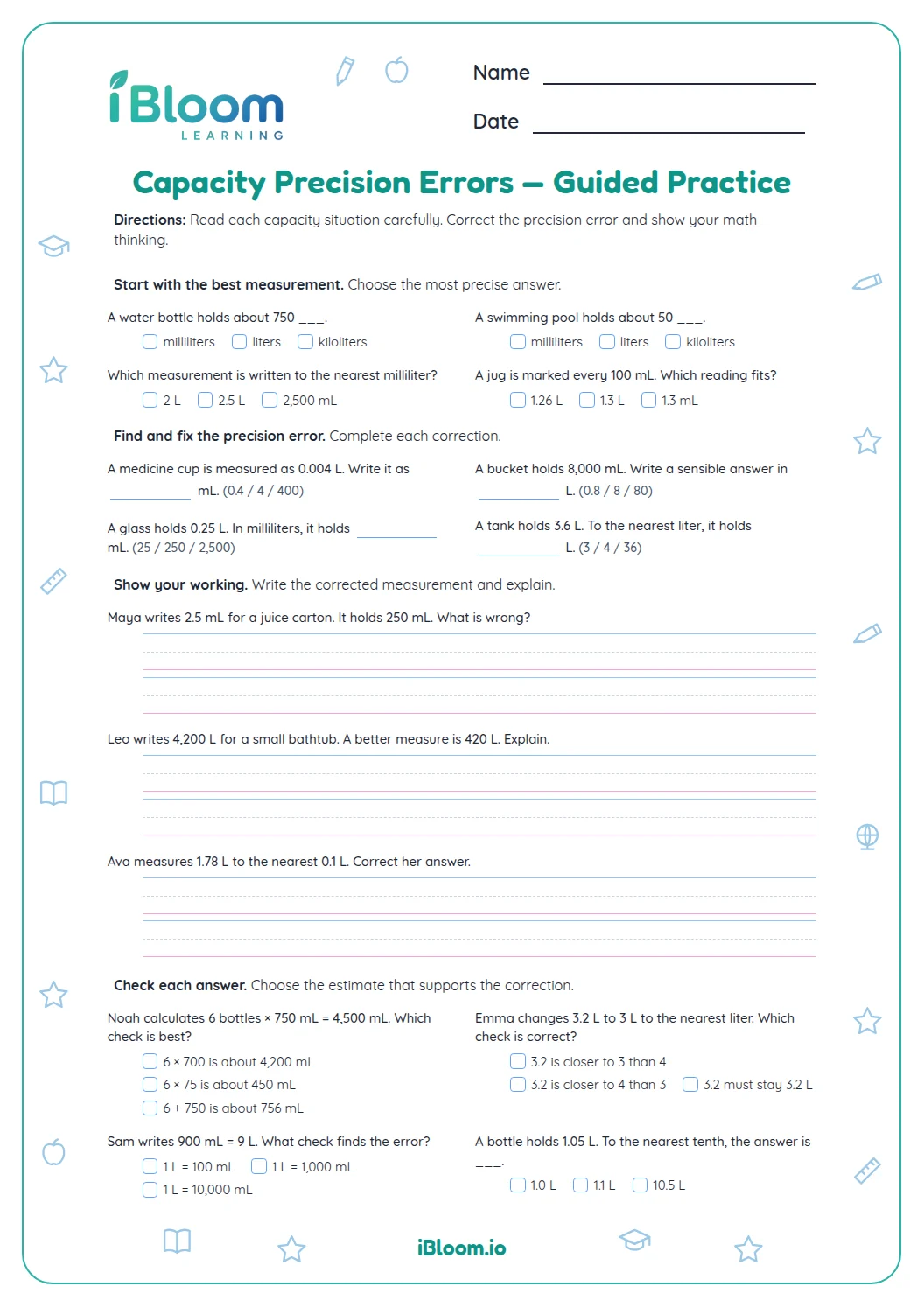
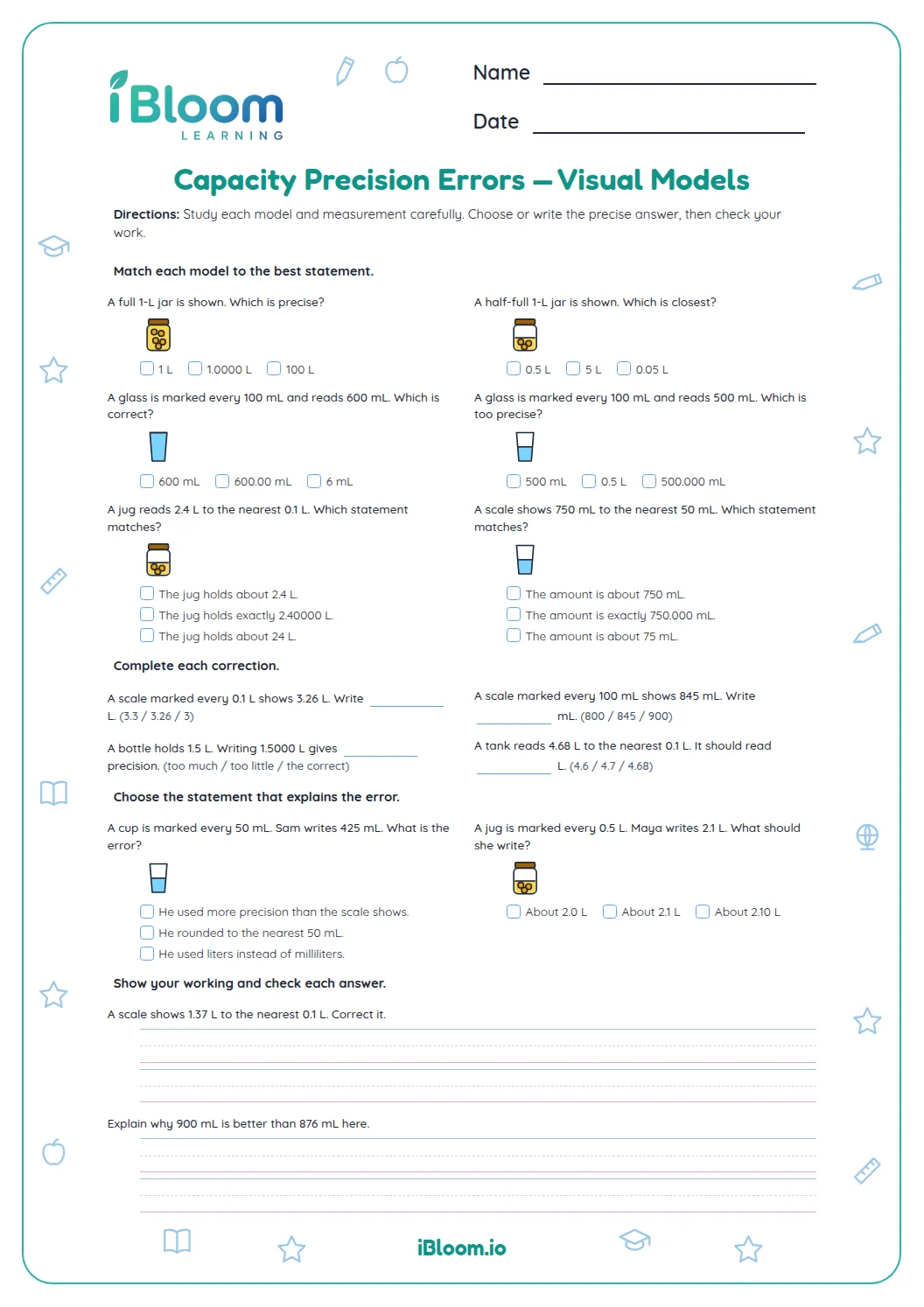
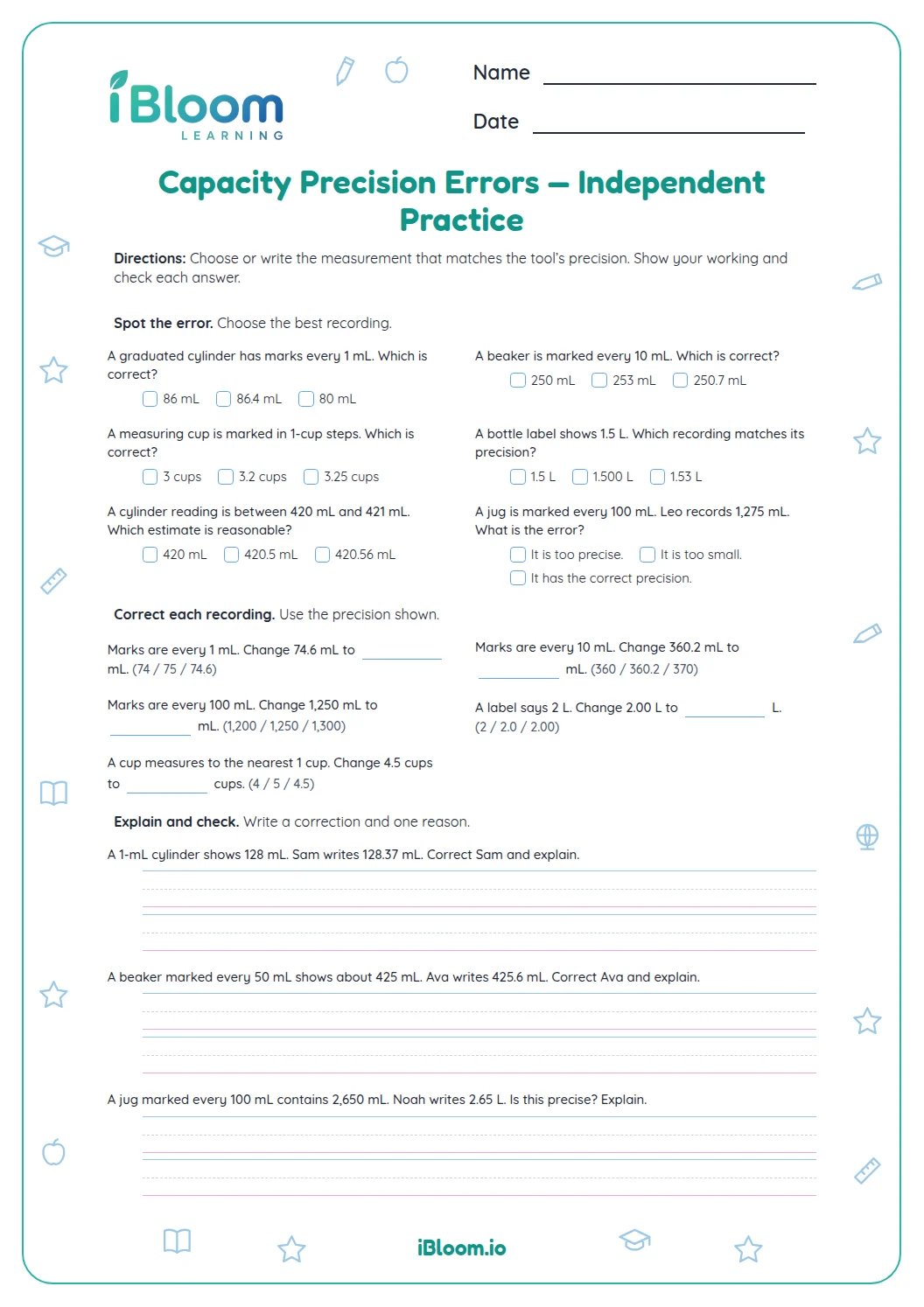
Part A practices nine direct customary and metric conversions. Part B compares measurements and solves two situations using the same unit relationships. Part C provides room to show a conversion; Part D asks for a final applied answer.
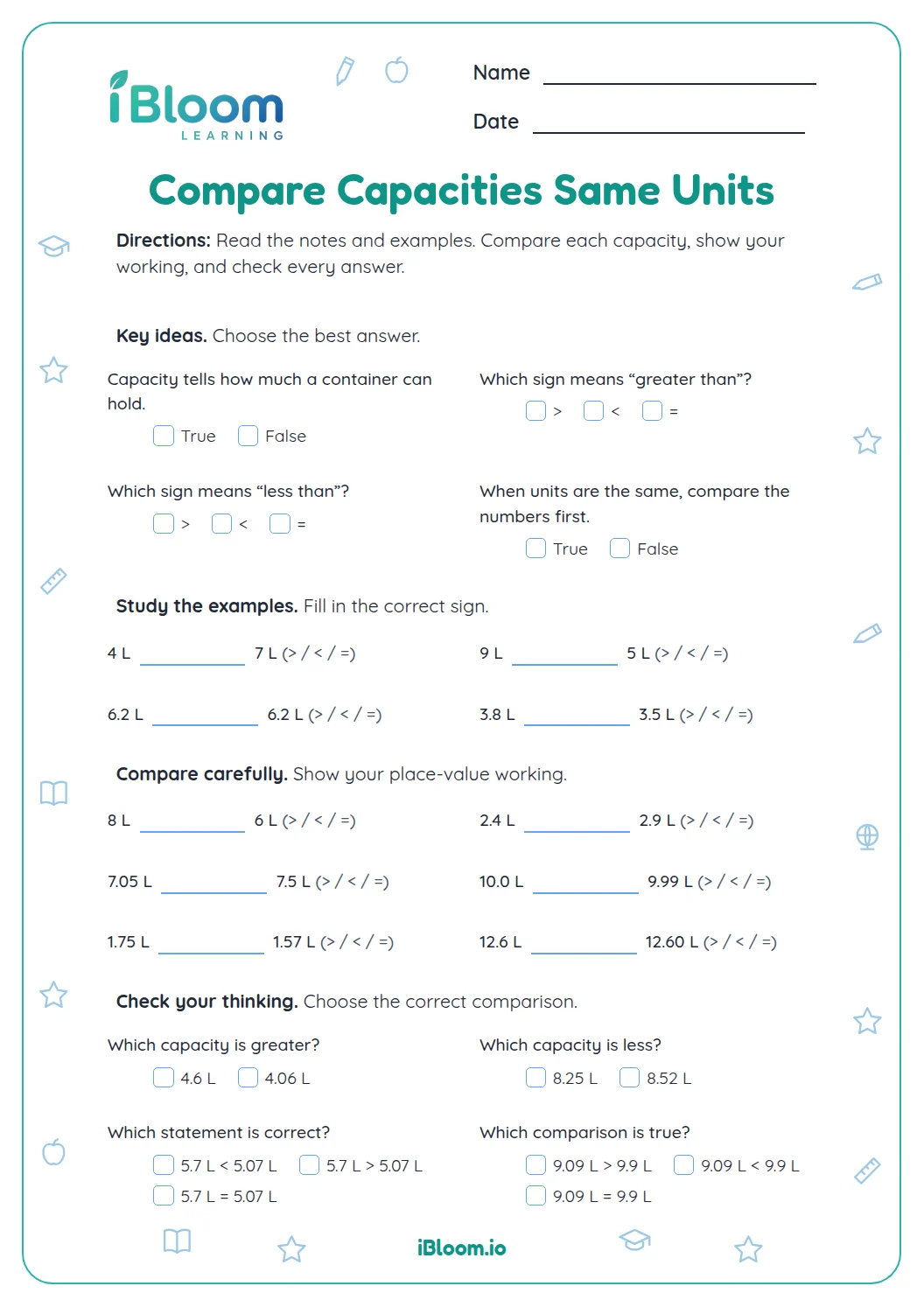
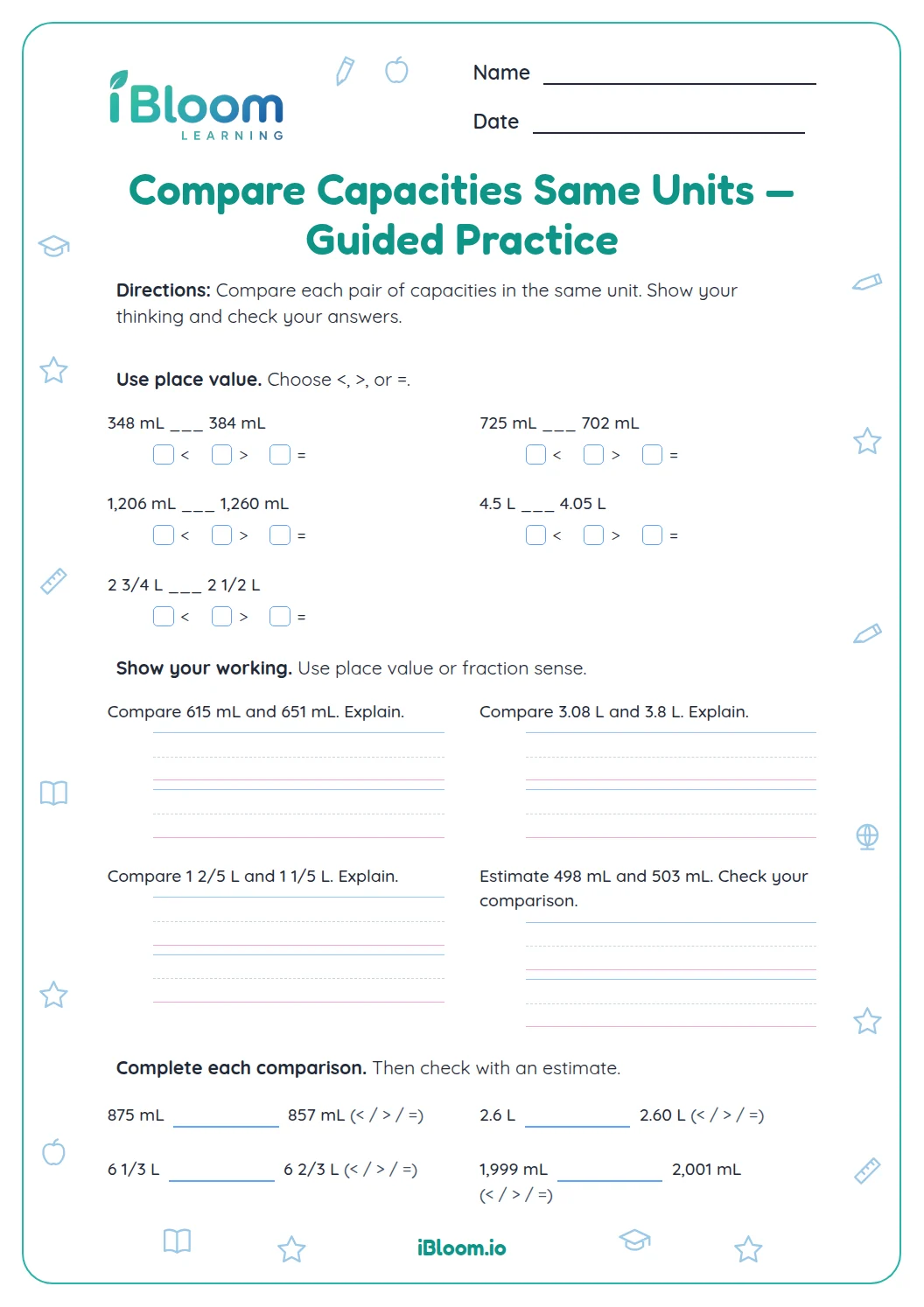
For a comparison, convert both measurements to the same unit before deciding which is greater. Keep units beside values as you work.
- 1A 5-yard roll is 15 feet long because 1 yard = 3 feet.
- 2After using 11 feet: 15 − 11 = 4 feet remain.
- Part A: convert customary and metric units
- Part B: compare and solve measurement questions
- Part C: show conversion work
- Part D: solve a final unit-conversion problem
How do you choose multiply or divide?
Write the unit relationship before calculating. When changing to a smaller unit, the number grows; when changing to a larger unit, it gets smaller. Convert before comparing, then check that the size makes sense.
How can students check a conversion?
Write the unit relationship before calculating. A larger unit gives a smaller number; a smaller unit gives a larger number. Keep the unit in each step, then check that the final quantity is reasonable.
How to use this worksheet
- 1Read the short direction at the start of each part.
- 2Solve each item and keep units or operation signs with the values.
- 3For reasoning questions, use the evidence named in the prompt.
- 4Check calculations against the separate answer key.
Common mistakes and quick fixes
The mistake
Multiplying when converting to a larger unit, such as turning 3,500 m into 35,000 km.
The fix
A larger unit contains more of the measurement, so the number gets smaller. Divide by 1,000.
The mistake
Comparing 3 yd and 100 in without matching units.
The fix
Convert 3 yd to 108 in, then compare 108 with 100.
The mistake
Comparing lengths in yards and inches without converting.
The fix
Convert both lengths to inches first; 3 yards is 108 inches.
Curriculum alignment
This worksheet gives students practice with the cited Common Core skill.
Convert like measurement units within a given measurement system.
On this sheet: Parts A–C convert customary and metric units and use those conversions in multi-step situations.
Show the official wordingHide the official wording
Convert among different-sized standard measurement units within a given measurement system (e.g., convert 5 cm to 0.05 m), and use these conversions in solving multi-step, real world problems.
What to practice next
Make more practice
Further reading
Questions parents and teachers ask
Why should a student convert before comparing measurements?
A number of feet cannot be compared directly with a number of inches because the units describe different-sized pieces. Convert both amounts to the same unit first. For example, 3 yards is 108 inches, so it is greater than 100 inches. Matching units makes the comparison fair and the reasoning easy to check.
How can students tell whether to multiply or divide in a conversion?
Think about the size of the new unit. Moving to a smaller unit means more units are needed, so multiply. Moving to a larger unit means fewer units are needed, so divide. Check whether the result grew or shrank in the expected direction before moving on.
Which measurement systems appear on this page?
The practice uses customary units such as feet, yards, inches, pounds, ounces, gallons, quarts and cups, along with metric units such as kilometers, meters, centimeters, kilograms and grams. Students convert within one system at a time, then use those relationships in practical situations.
What should a student do when a problem takes two steps?
Write down the conversion or intermediate amount first, including its unit. Then use that amount in the next step and keep the units attached. At the end, check that the answer uses the unit the question asks for and is a sensible size.
How can a student check an answer on this sheet?
Convert back to the original unit or estimate the quantity to see if it is reasonable. For example, a metric conversion should change by a factor of ten, one hundred, or one thousand. The answer key lets students check the final number and unit after completing each problem.