



About this worksheet
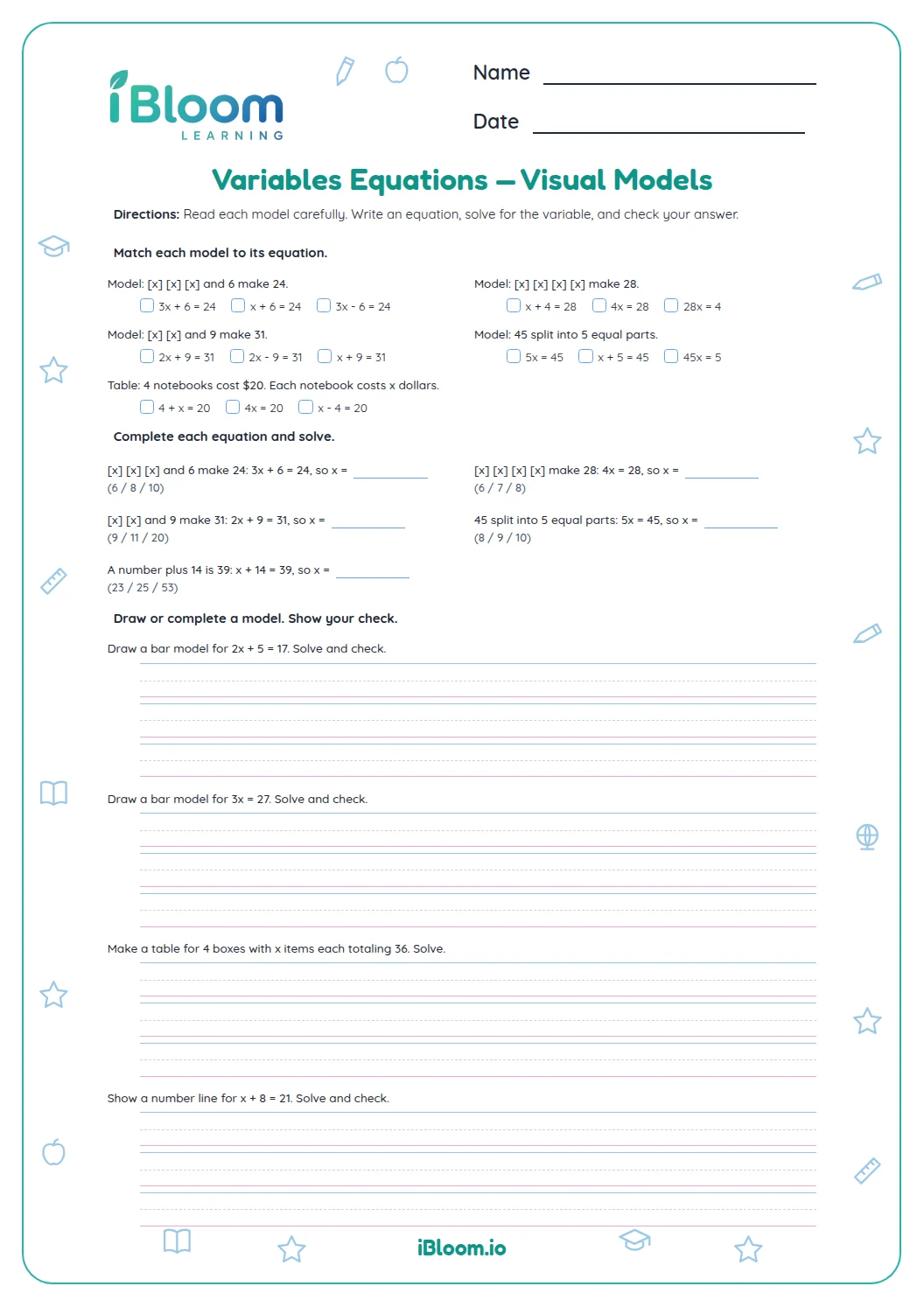
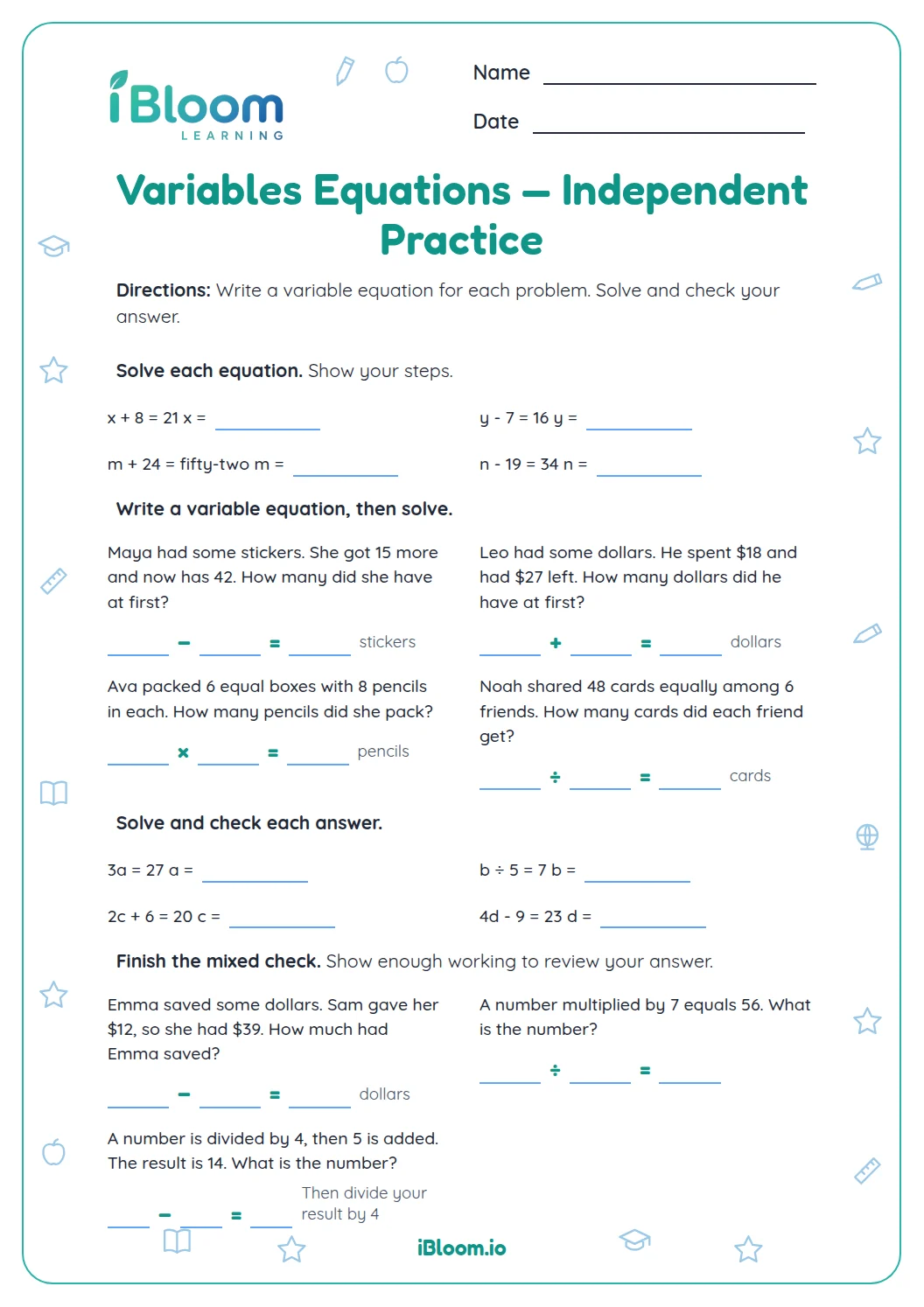
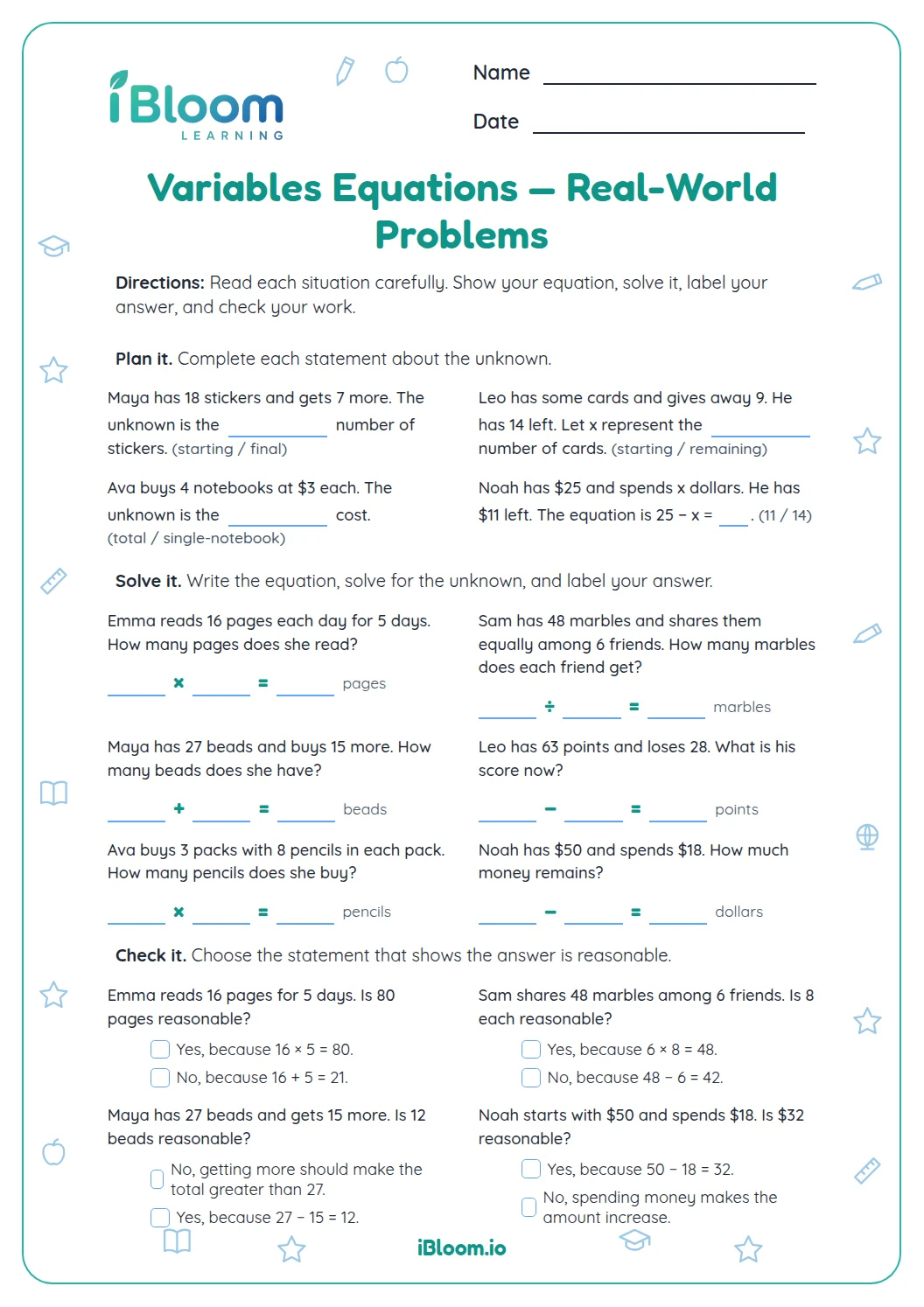
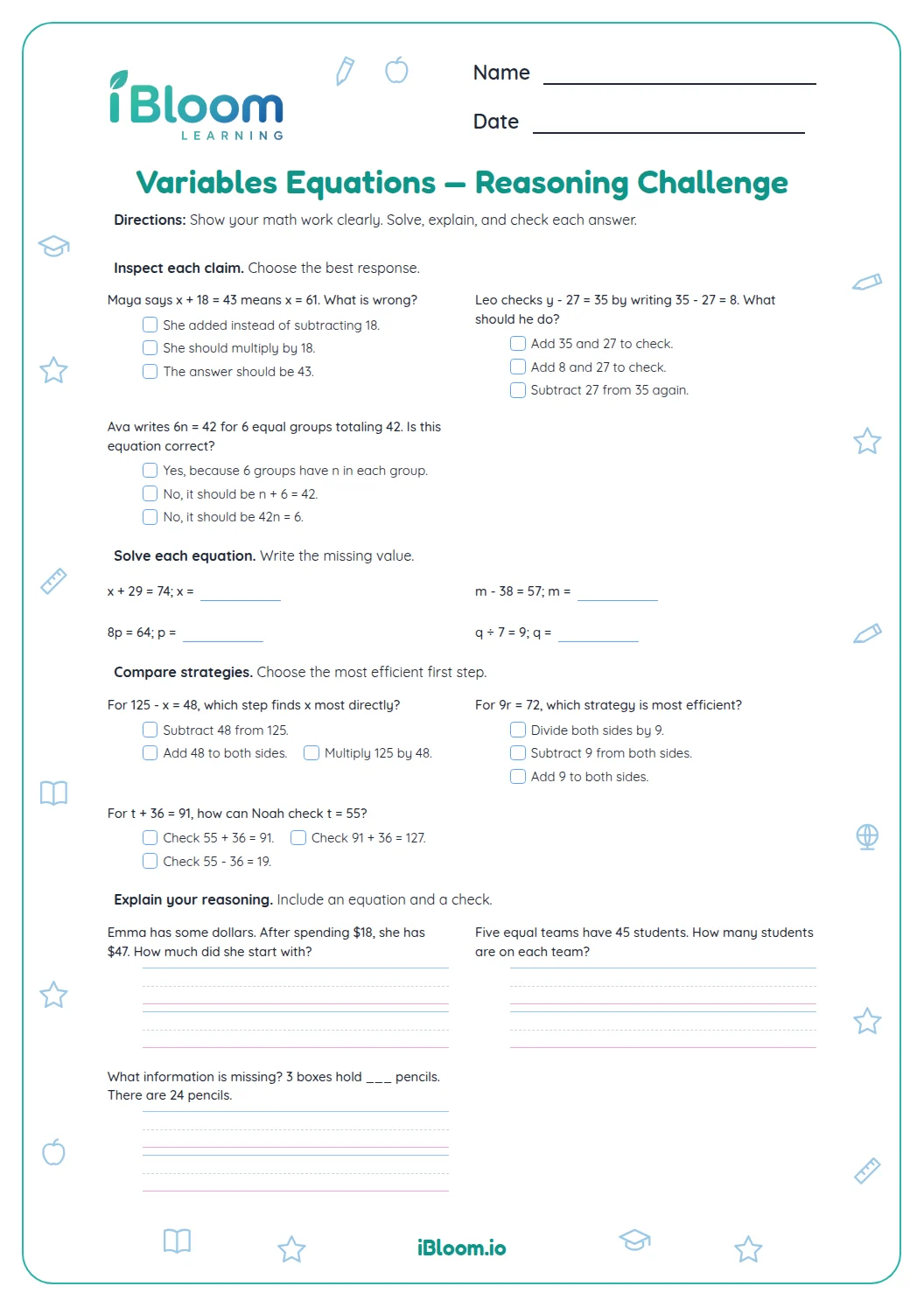
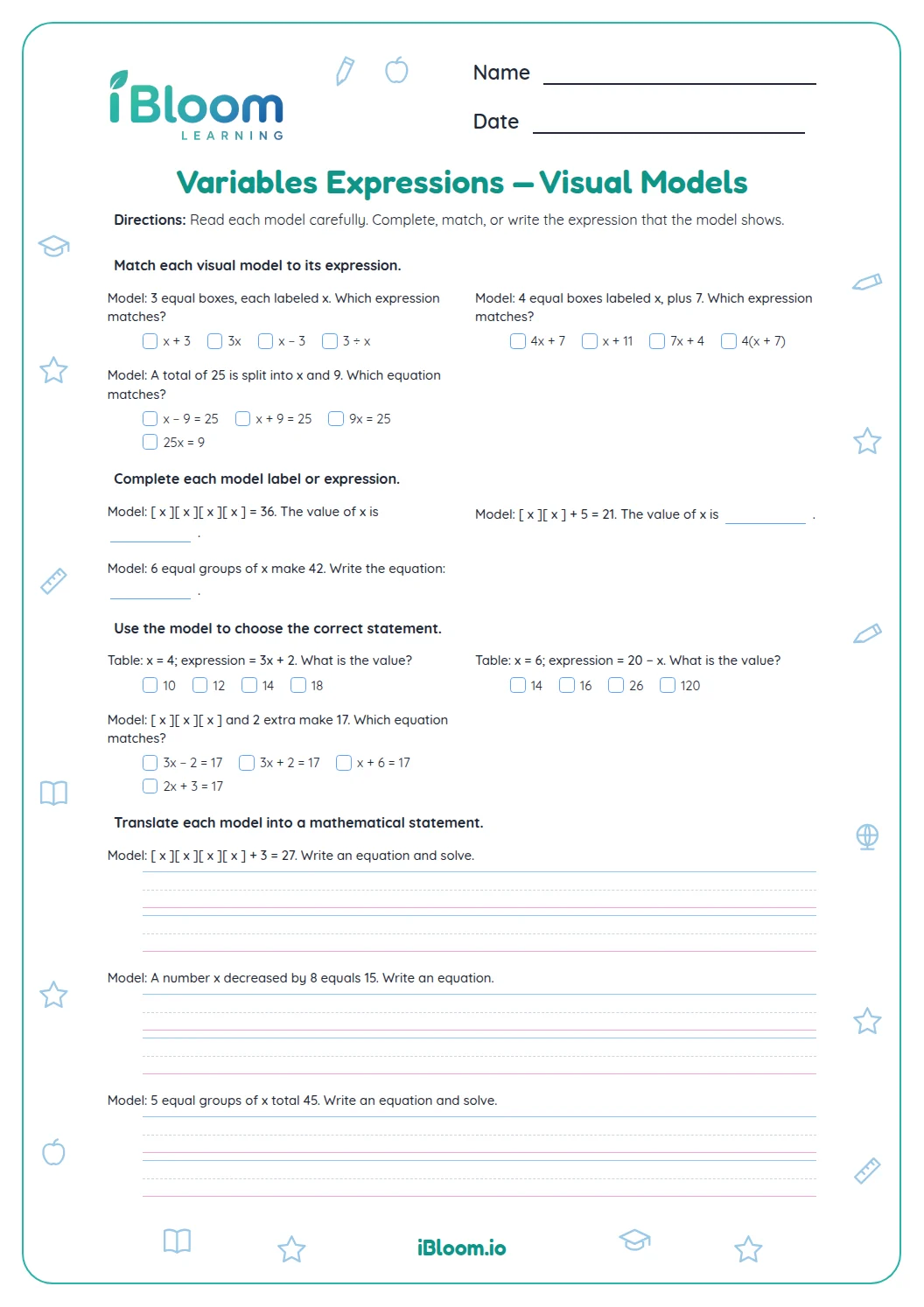
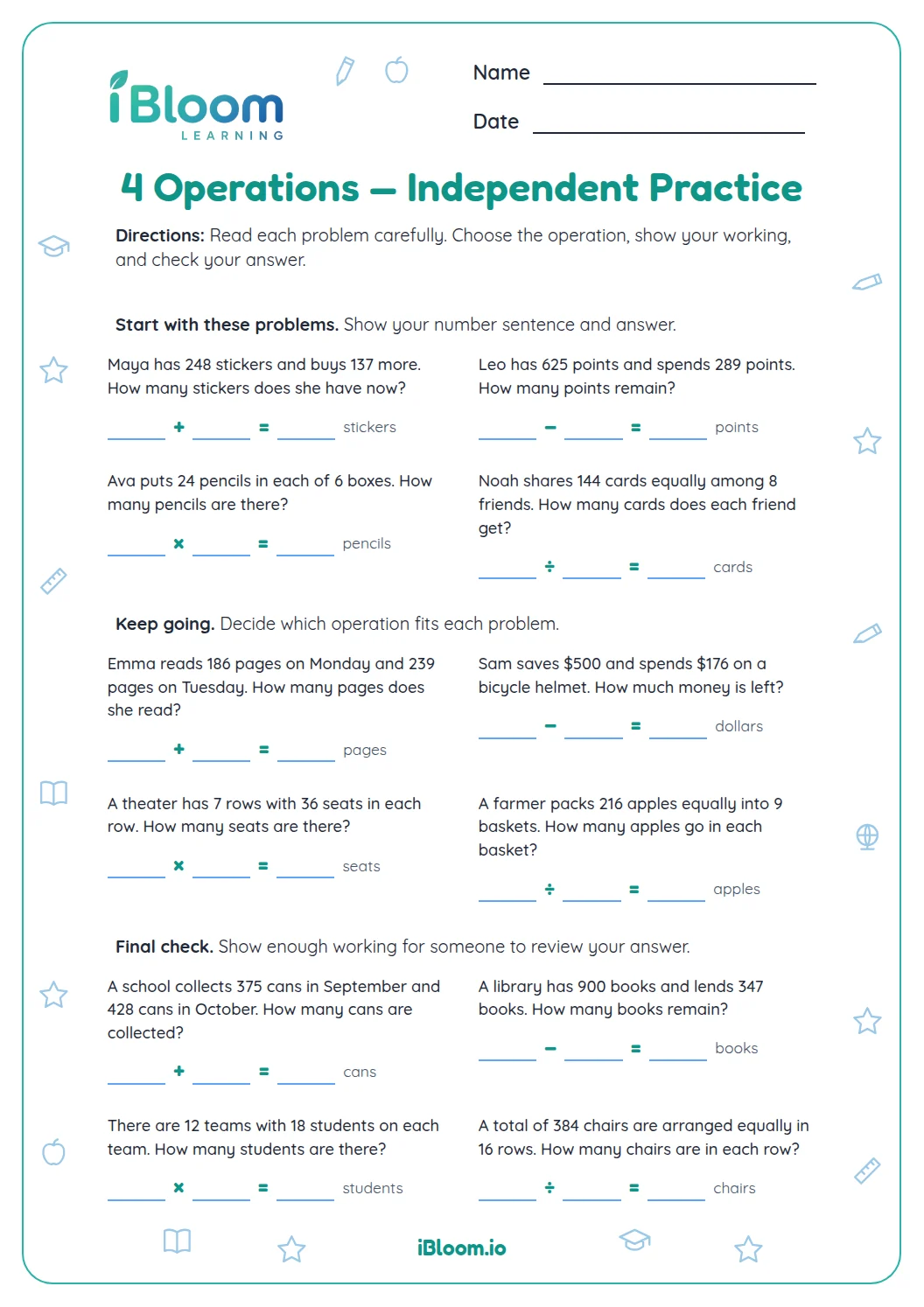
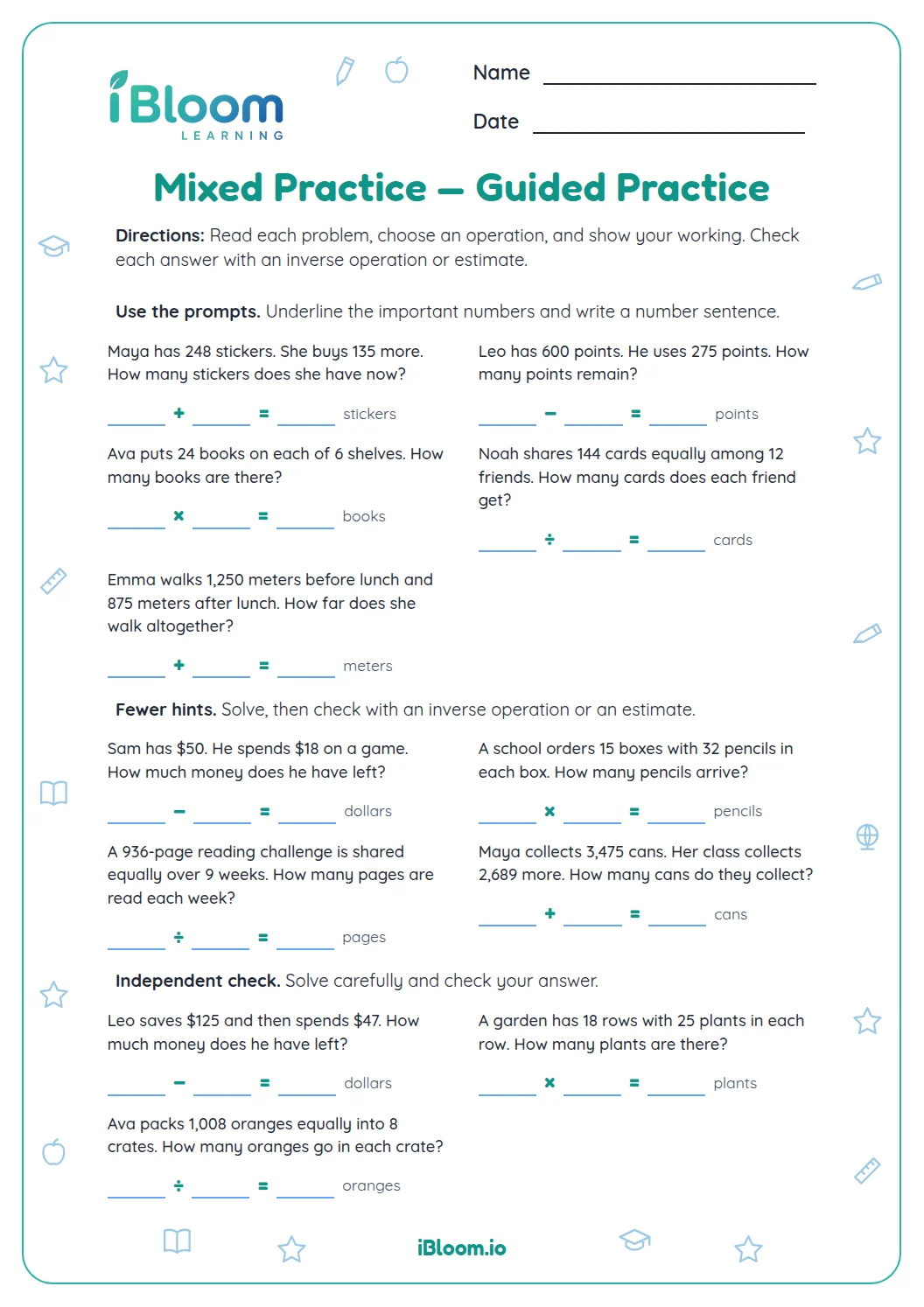
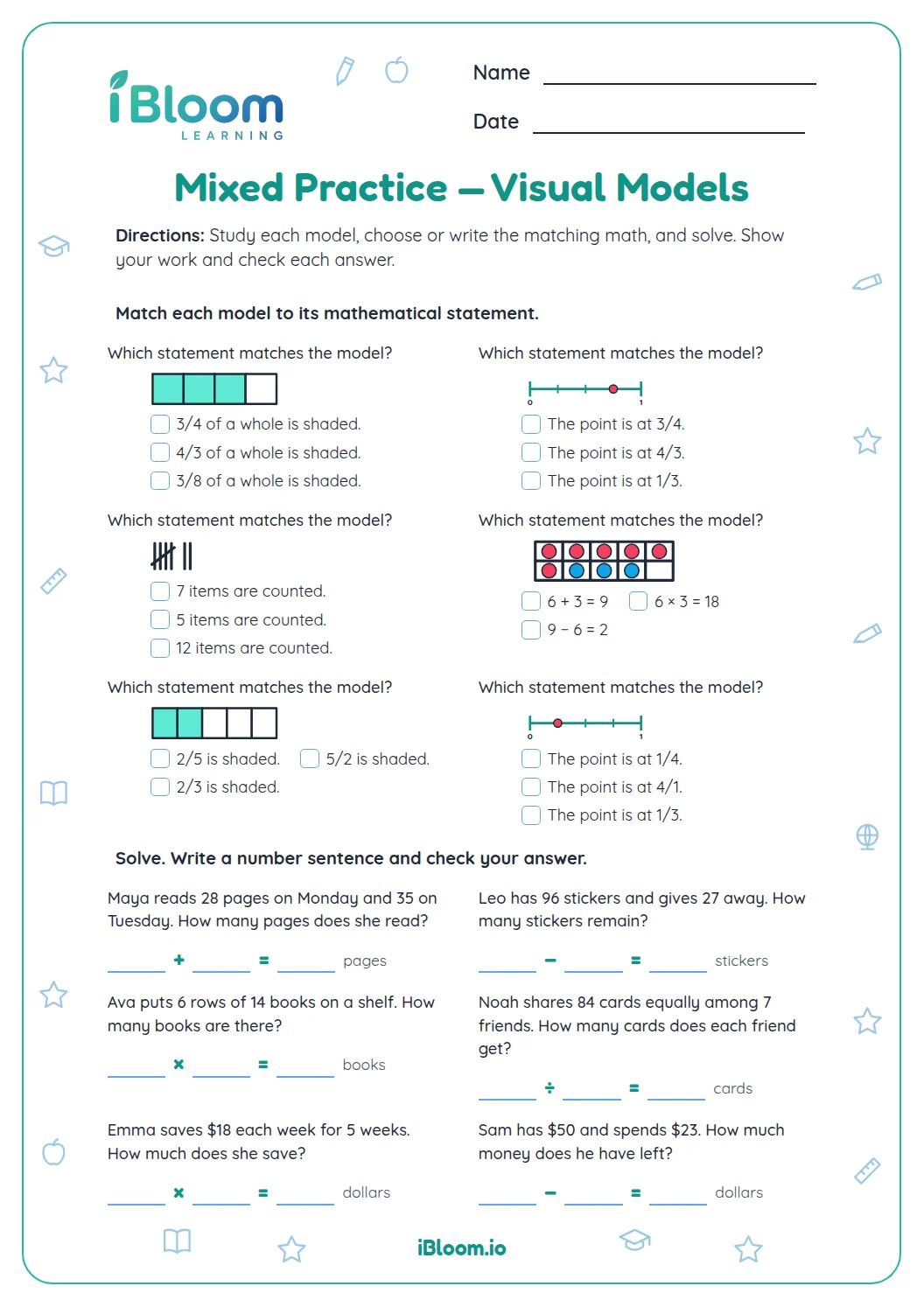
This Grade 5 variables and equations worksheet introduces a letter as a name for an unknown number. Students match statements to equations, solve addition, subtraction, multiplication, and division equations, then write and solve equations for two word problems. The 14 questions move from recognizing what a variable means to modeling practical situations. The answer key includes equation models, values, and units for the final problems.
What does a variable stand for?
A variable is a letter that represents an unknown number. In 8 + n = 19, n is the amount that combines with 8 to make 19. Part A asks students to connect sentences and situations to the equations that represent them.
How can an inverse operation find the variable?
Use the operation that undoes the one acting on the variable. For n + 16 = 41, subtract 16 from both sides to get n = 25. Substitute 25 back into the original equation: 25 + 16 = 41.
- 1n + 16 = 41
- 2Subtract 16: n = 41 − 16 = 25. Check: 25 + 16 = 41.
How do you turn a story into an equation?
Choose a letter for the unknown, then identify how the known amounts relate. Nora’s starting beads plus 18 equals 53, so b + 18 = 53. Subtract 18 to find that she started with 35 beads. Include the unit when the story asks for one.
How to use this worksheet
- 1{'step': 'Name the unknown with a variable.', 'detail': 'Choose a letter for the amount the problem asks you to find.'}
- 2{'step': 'Translate the relationship into an equation.', 'detail': 'Use the story’s operation and equal relationship.'}
- 3{'step': 'Undo the operation on the variable.', 'detail': 'Use the inverse operation to isolate it.'}
- 4{'step': 'Check by substitution.', 'detail': 'Put the value into the original equation.'}
- 5{'step': 'Answer with a unit when needed.', 'detail': 'State days, cones, dollars, or another requested unit.'}
Common mistakes and quick fixes
The mistake
Changing the order in a subtraction story.
The fix
Write the starting amount first and subtract the amount taken away.
The mistake
Using addition for equal groups.
The fix
Represent repeated equal groups with multiplication.
The mistake
Giving a number without the requested unit.
The fix
Read the question again and label the result.
What to practice next
Questions parents and teachers ask
What is a variable?
A variable is a letter that stands for a number. In n + 16 = 41, n represents the unknown addend. Finding n means identifying the number that makes the equation true, then checking it in the original equation.
How do you solve a one-step equation?
Use the inverse operation to undo the operation connected to the variable. If 7m = 56, divide 56 by 7 to get m = 8. Substitute 8 back into the equation to check that 7 × 8 equals 56.
How many problems are included?
There are 14 questions in three parts. Six questions focus on matching meanings and equations, six ask students to solve or complete equations, and two are word problems that call for an equation and a short answer with units.
Should students write an equation for the word problems?
Yes. The final part asks students to model each situation and solve it. Writing the equation helps show how the known quantities relate to the unknown, while a final unit such as days or cones makes the answer clear.
What if there is more than one way to solve an equation?
A student may use a related fact, mental math, or an inverse operation as long as the result is correct and the equation checks. For example, Nora’s starting beads can be found by subtracting 18 from 53 or by counting up from 18 to 53.