


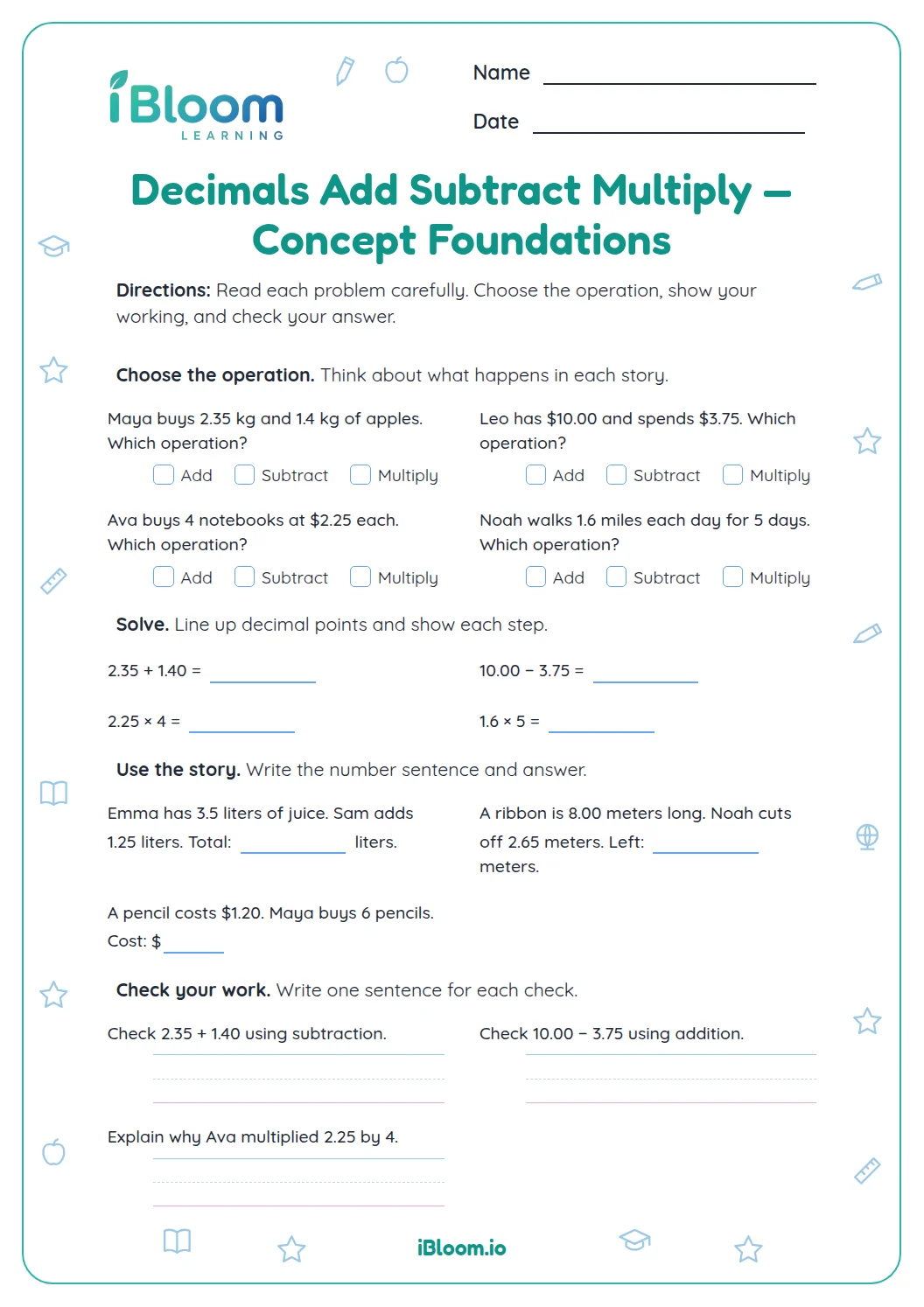

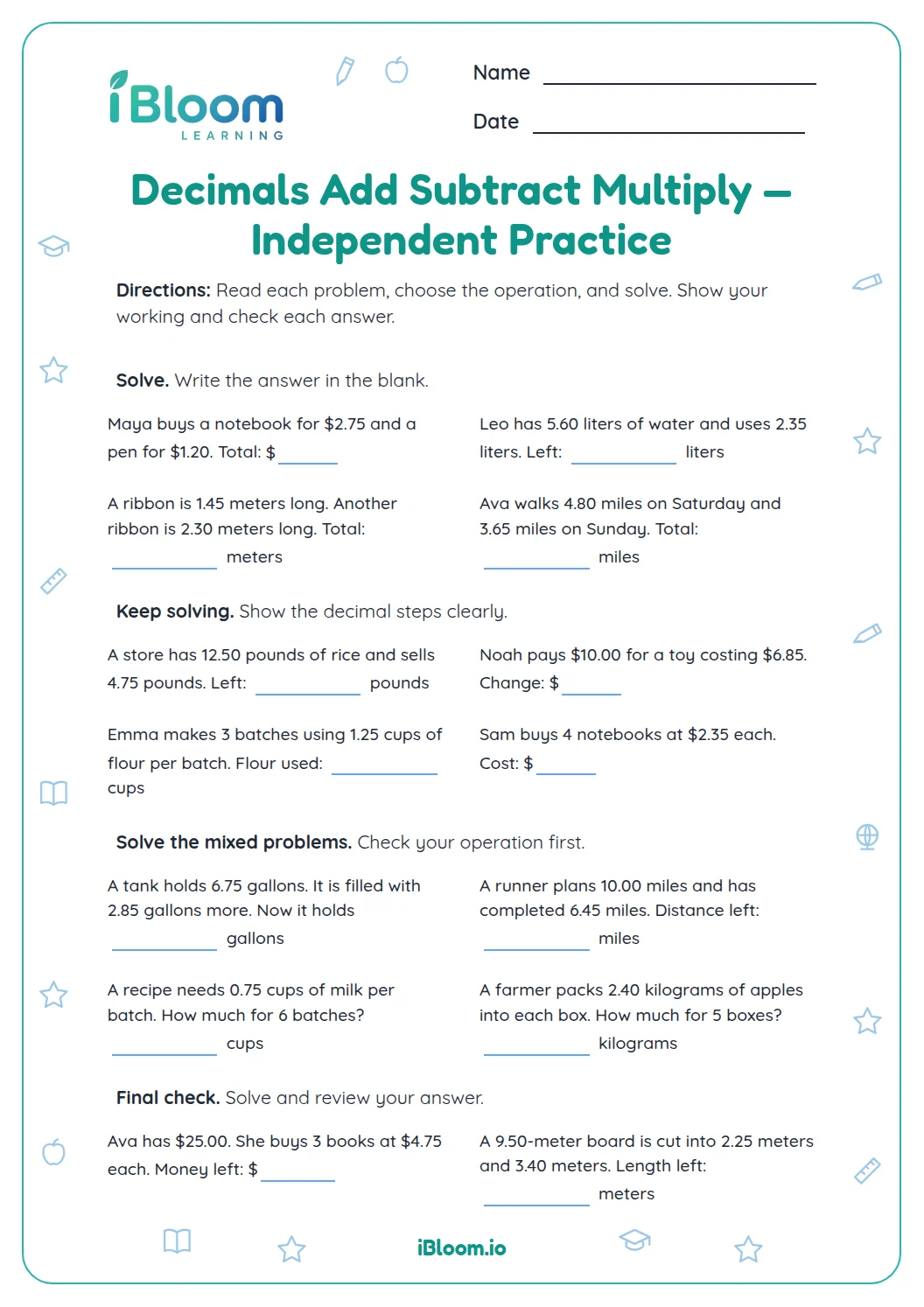
About this worksheet
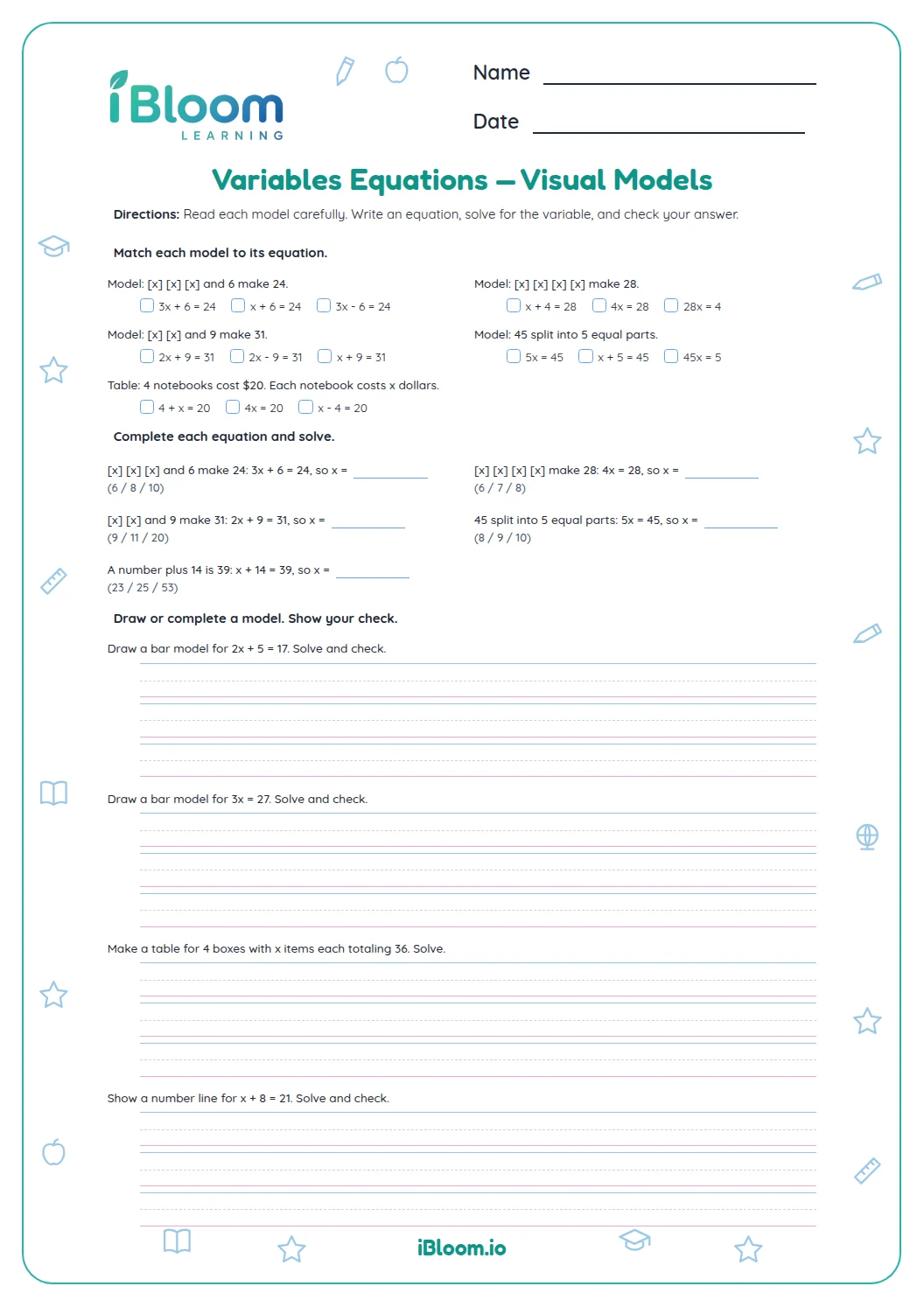
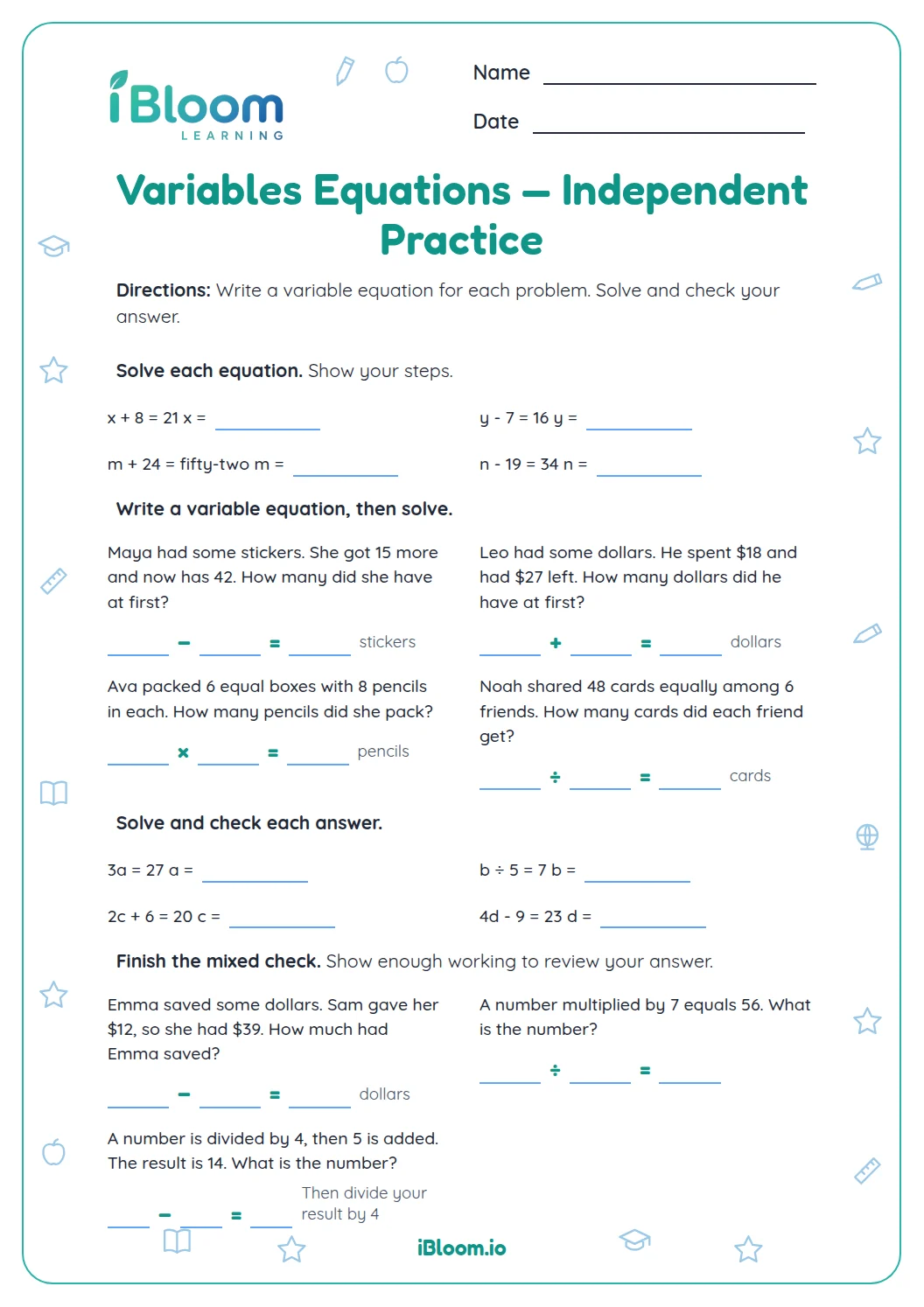
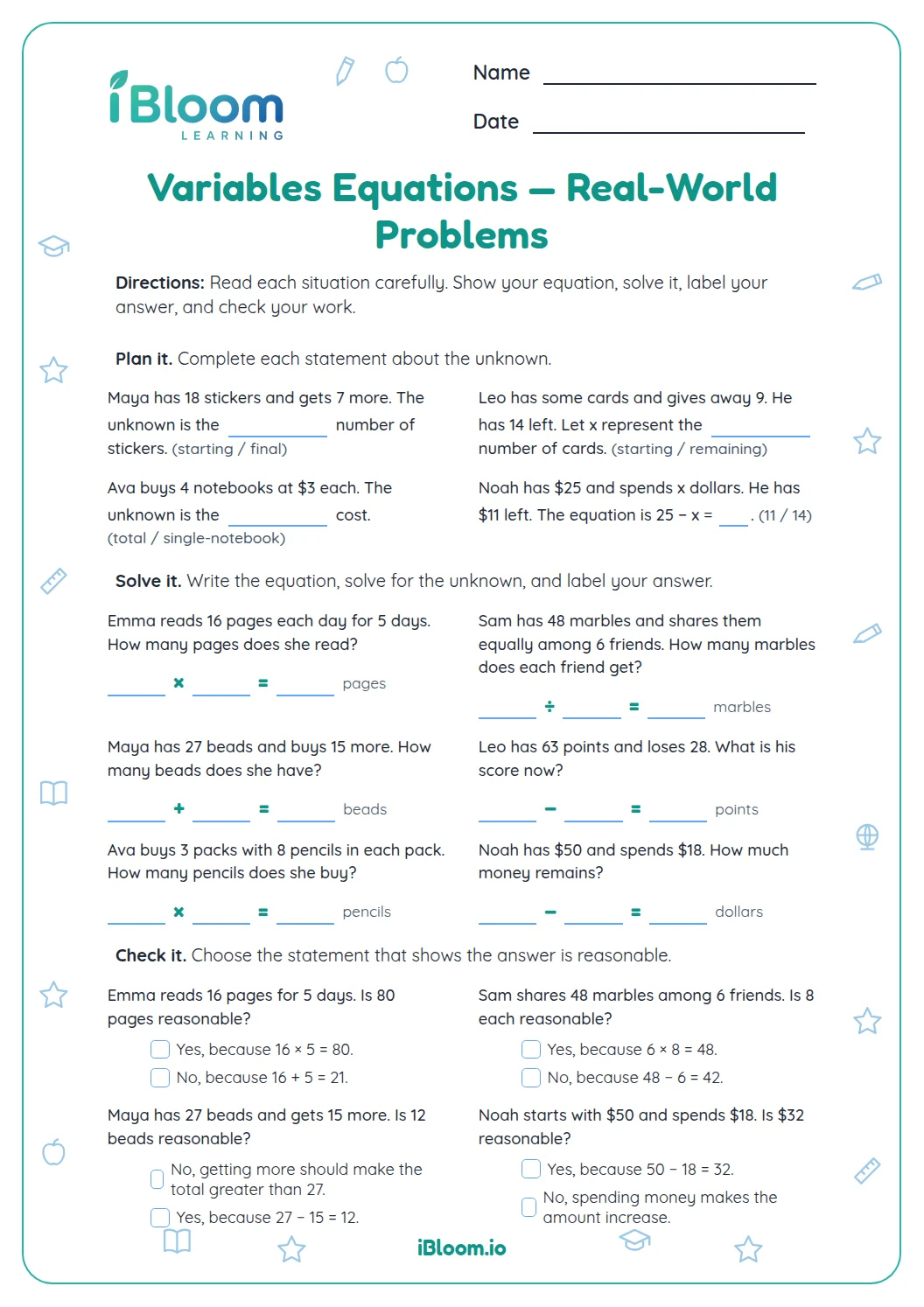
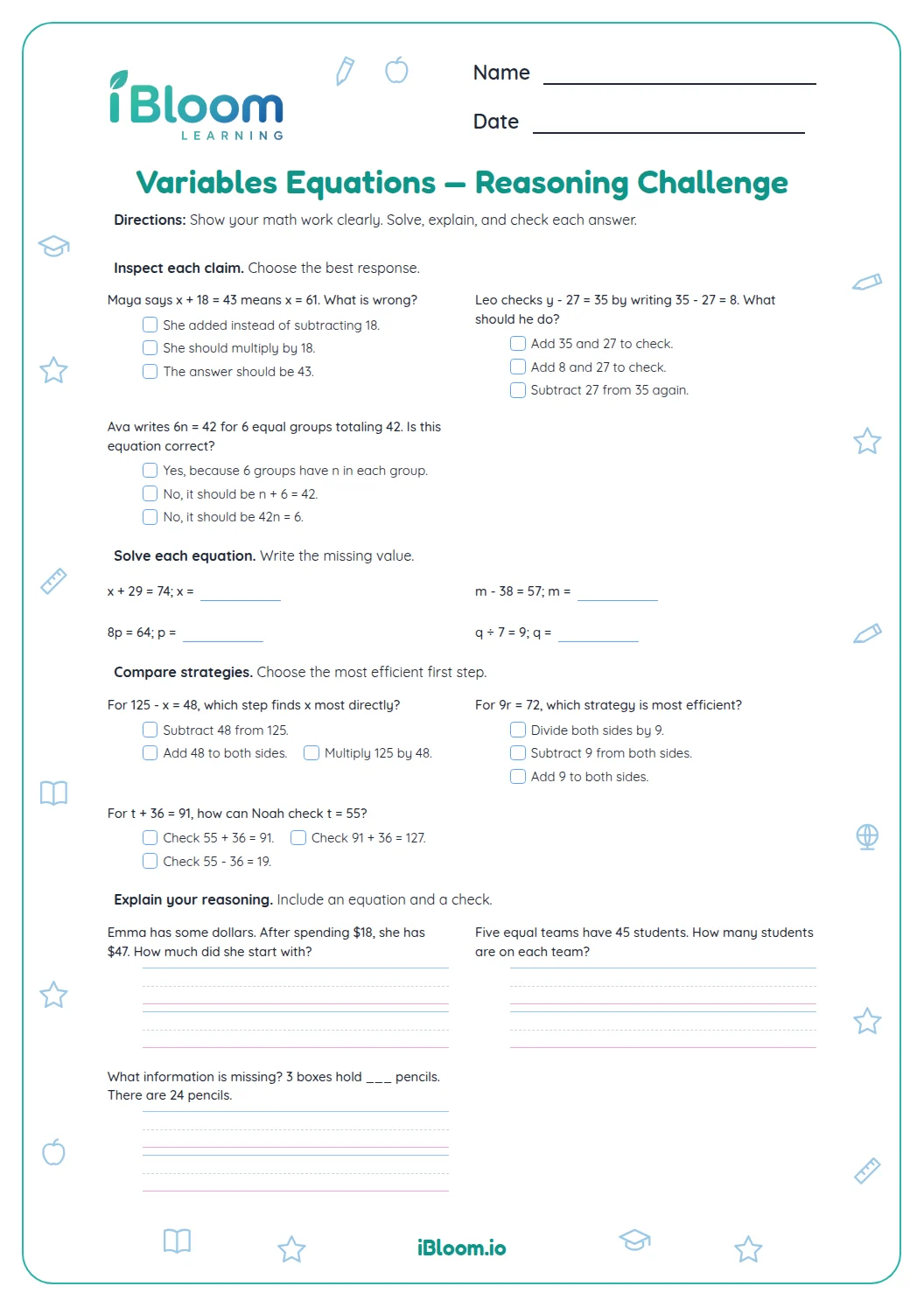
This worksheet gives Grade 5 learners 16 word problems that connect an unknown quantity to an equation. Situations include markers, equal groups, tickets, distances, and money, with working space to write a relationship and solve for the unknown. Children can check each value by substituting it back into the story equation. The one-step real-world equations practice CCSS 6.EE.B.7. A separate answer key is included.
Aligned to 6.EE.B.7
How do you choose a variable?
A variable stands for the quantity the problem asks you to find. In question 1, b represents the markers in the box before six more are added.
- 1b + 6 = 23
- 2Subtract 6 from both sides.
- 3b = 17
- 4Check: 17 + 6 = 23
Which operation matches the story?
Look for the relationship, not just a keyword. Equal groups connect multiplication to a total; a starting amount plus a change connects addition to a new total. Decide what each number represents before solving.
How can you check a solution?
Put the value back into the equation. If both sides match and the value makes sense in the story, the equation is solved correctly.
How to use this worksheet
- 1Underline the quantity you need to find.
- 2Choose a letter for that unknown.
- 3Write an equation using the facts in the story.
- 4Solve with an inverse operation or equal groups.
- 5Substitute your value to check the equation.
Common mistakes and quick fixes
The mistake
Using the total as the unknown.
The fix
Label the unknown quantity before writing the equation.
The mistake
Reversing the change in an addition story.
The fix
Check whether the story describes what was there before or after the change.
The mistake
Stopping after finding a number.
The fix
Substitute it into the equation and verify both sides.
This worksheet uses one-step equations to solve real-world situations.
write and solve one-step equations for unknowns in real-world situations
On this sheet:
Show the official wordingHide the official wording
Solve real-world and mathematical problems by writing and solving equations of the form x + p = q and px = q for cases in which p, q and x are all nonnegative rational numbers.
What to practice next
Make more practice
Questions parents and teachers ask
What does this Grade 5 worksheet practice?
The 16 problems ask learners to represent one-step situations with equations and find an unknown quantity. The stories use equal groups, additions, subtractions, and equal sharing, with room to show the equation and solution. The worked examples use the same kind of quantities and relationships that appear in these questions, so learners can follow the reasoning and check a result.
How do students choose a variable?
Choose a letter to stand for the quantity the question asks you to find. In question 1, b stands for the markers before six are added, so b + 6 = 23 and b = 17. Use the page to check each step.
What operations appear in the word problems?
The stories use addition, subtraction, multiplication, and division relationships. For example, question 4 describes five equal trays holding 45 muffins, so 5m = 45 and each tray has 9 muffins. The worked examples use the same kind of quantities and relationships that appear in these questions, so learners can follow the reasoning and check a result.
How can a learner check an equation solution?
Substitute the value into the equation and see whether both sides are equal. For question 7, seven bags with 8 seeds each give 56 seeds, so 7 × 8 = 56 checks p = 8. Use the page to check each step.
Is an answer key included?
Yes. A separate answer key gives a value for each unknown and includes equations for the items that ask learners to write one. Learners can compare their equation and result, then check the value in the story. Use the page to check each step.