



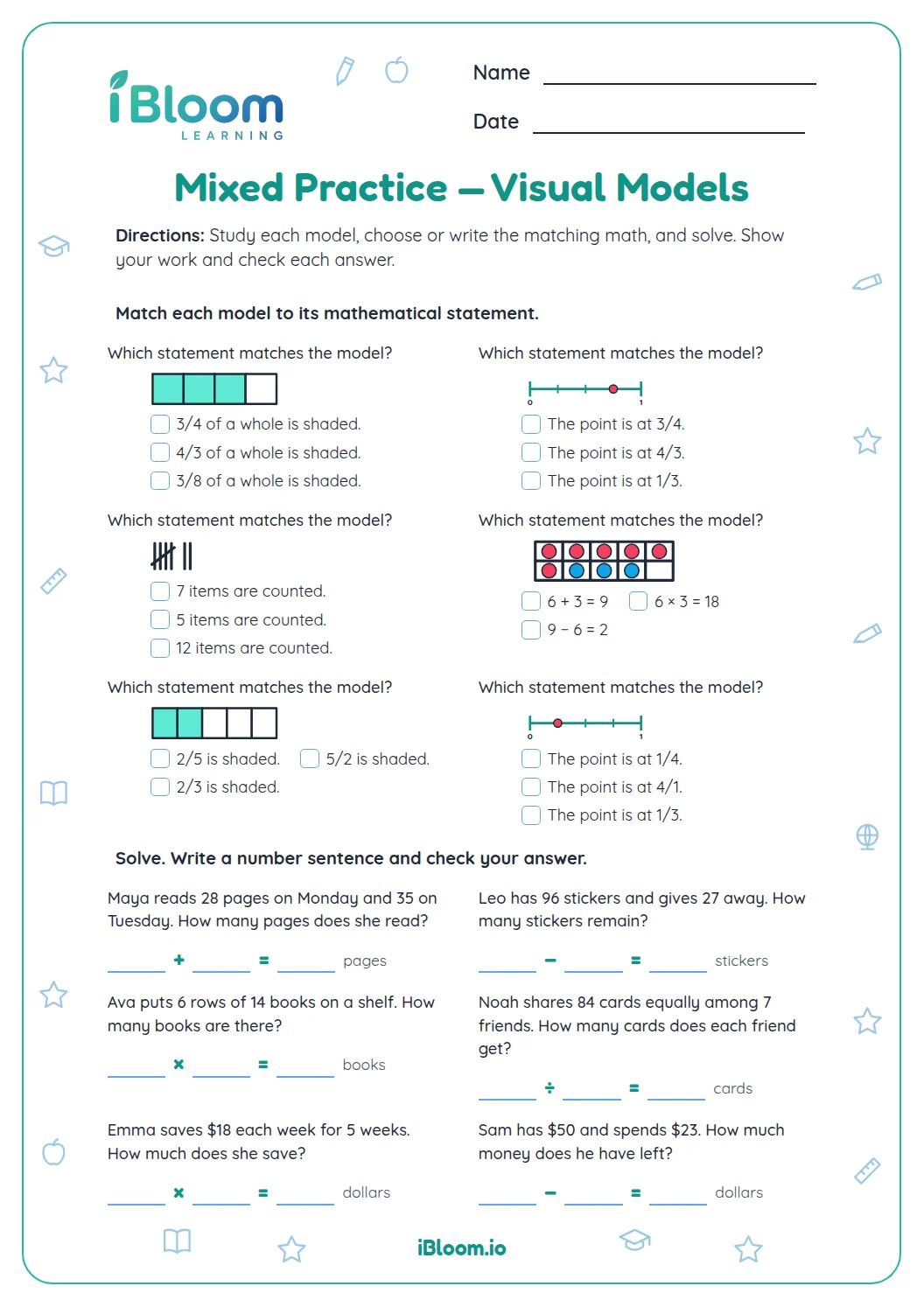

About this worksheet
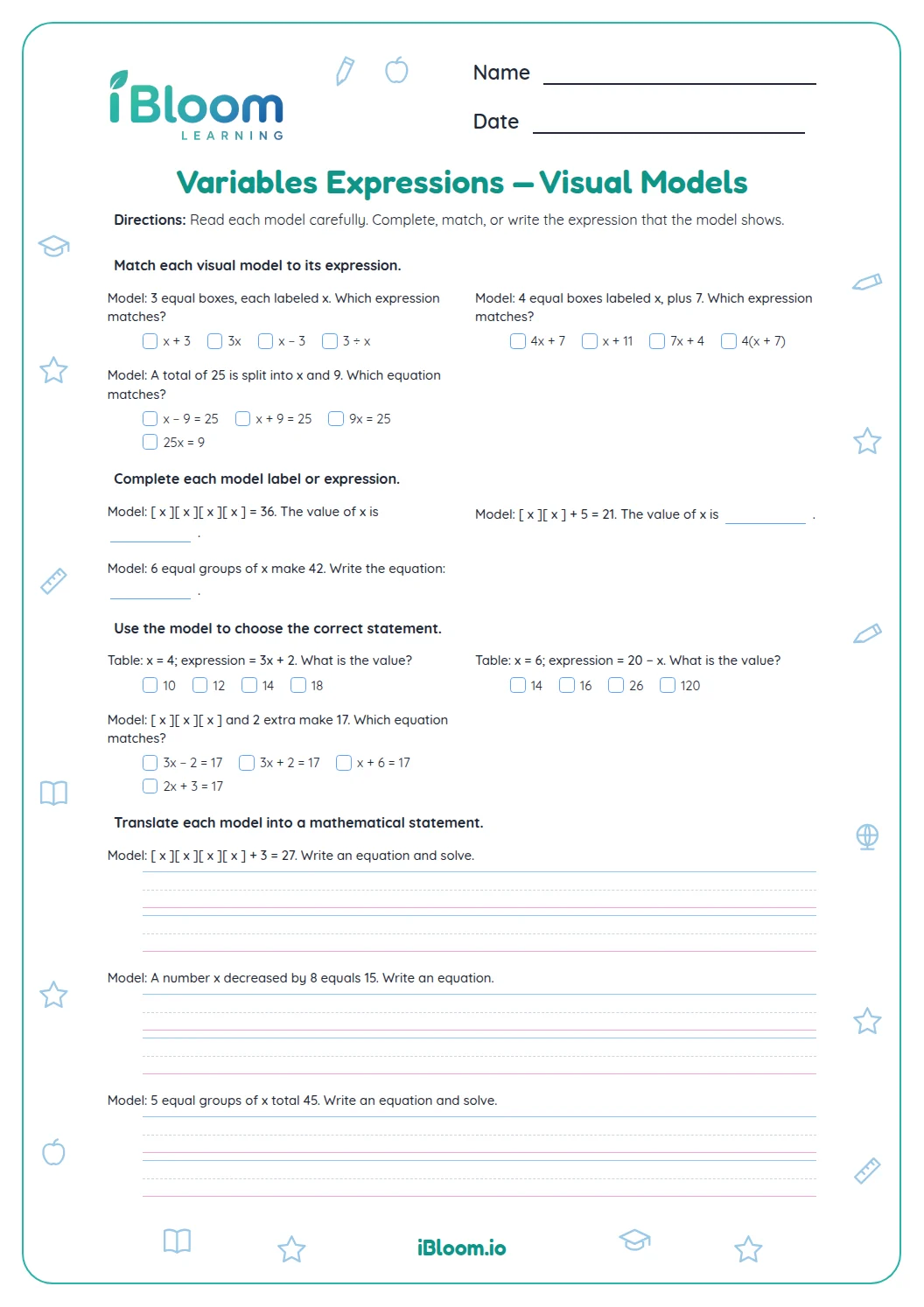
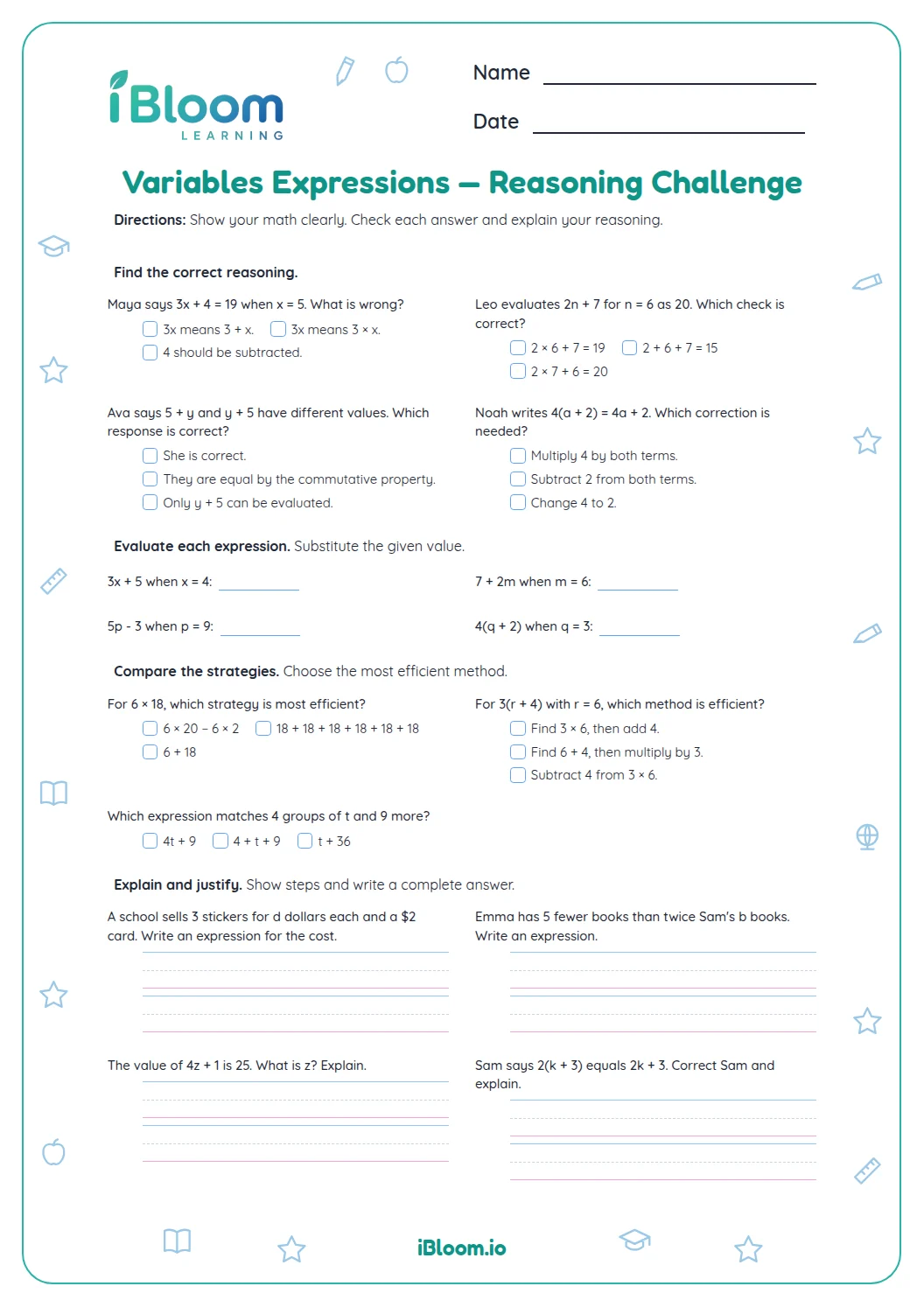
This free Grade 5 printable builds variable-expression fluency in three steps. Students translate phrases such as “8 more than n,” substitute a given value, and use an expression to solve a short everyday situation. The 16 questions move from expression writing to evaluation and application, with room to show thinking and a separate answer key. The variables stand for unknown or changing quantities, so the same expression can describe many values.
How do words become an expression?
Find the quantity that can change and give it a letter. Then translate the operation words in order. “8 more than n” means start with n and add 8, so the expression is n + 8. “5 fewer than p” starts with p and subtracts 5.
- 1“4 times k” → 4 × k
- 2The variable stays in the expression; no value for k is given.
How do you evaluate an expression?
Replace every variable with its assigned value, then follow the order of operations. In q11, 3 × c + 2 with c = 4 becomes 3 × 4 + 2, or 14. Multiplication happens before addition.
How does an expression describe a situation?
Use the same operation that connects the quantities in the story. If each notebook costs $4, n notebooks cost 4 × n dollars. Substituting n = 6 gives 24 dollars. Include the unit when the context asks for one.
How to use this worksheet
- 1Read each phrase and identify the unknown quantity before choosing a letter.
- 2In Part A, write an expression only; do not invent a value for its variable.
- 3In Part B, replace the variable with the given number and use the usual order of operations.
- 4In Part C, write the expression before substituting the stated value.
- 5Check that the final answer matches the situation and includes its unit when needed.
Common mistakes and quick fixes
The mistake
Writing 8 × n for “8 more than n.”
The fix
“More than” signals addition, so write n + 8. Read the phrase as “n, then add 8.”
The mistake
Writing 5 − p for “5 fewer than p.”
The fix
Start with the amount that is being reduced: p − 5. Substitute a sample value to check that the result is smaller than p.
The mistake
Adding before multiplying in 3 × c + 2.
The fix
Substitute first, then multiply before adding: 3 × 4 + 2 = 14.
What to practice next
Make more practice
Questions parents and teachers ask
What does a variable mean?
A variable is a letter that stands for a number. In q1, n could be any number, so n + 8 describes a quantity eight greater than n. In the evaluation section, a value is supplied so the expression can be calculated.
Does “5 fewer than p” mean 5 − p?
No. “5 fewer than p” means start with p and take away 5, so the expression is p − 5. For example, if p = 12, then 12 − 5 = 7. The phrase names the starting quantity after “than,” which helps keep the order clear.
What is the difference between an expression and an equation?
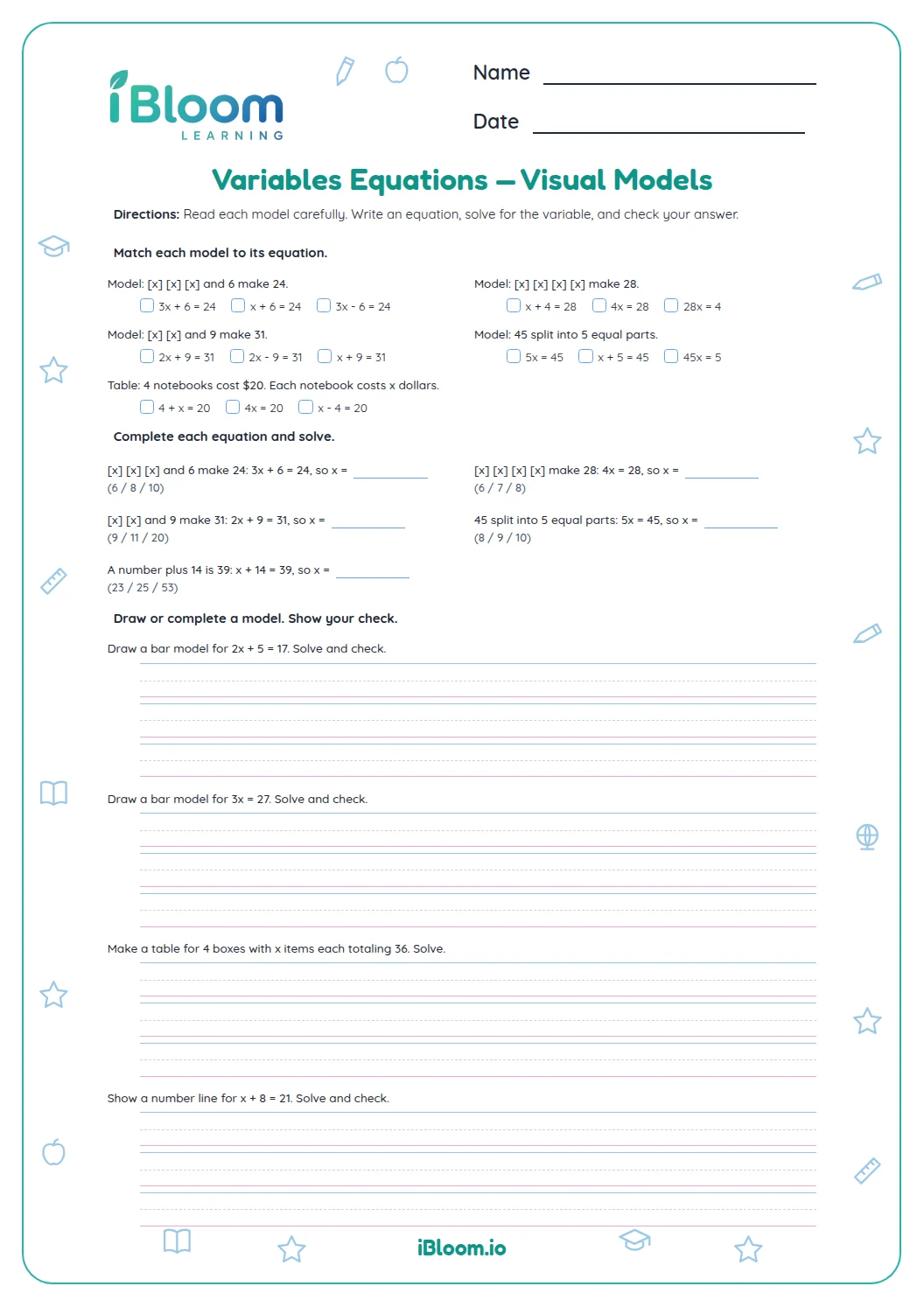
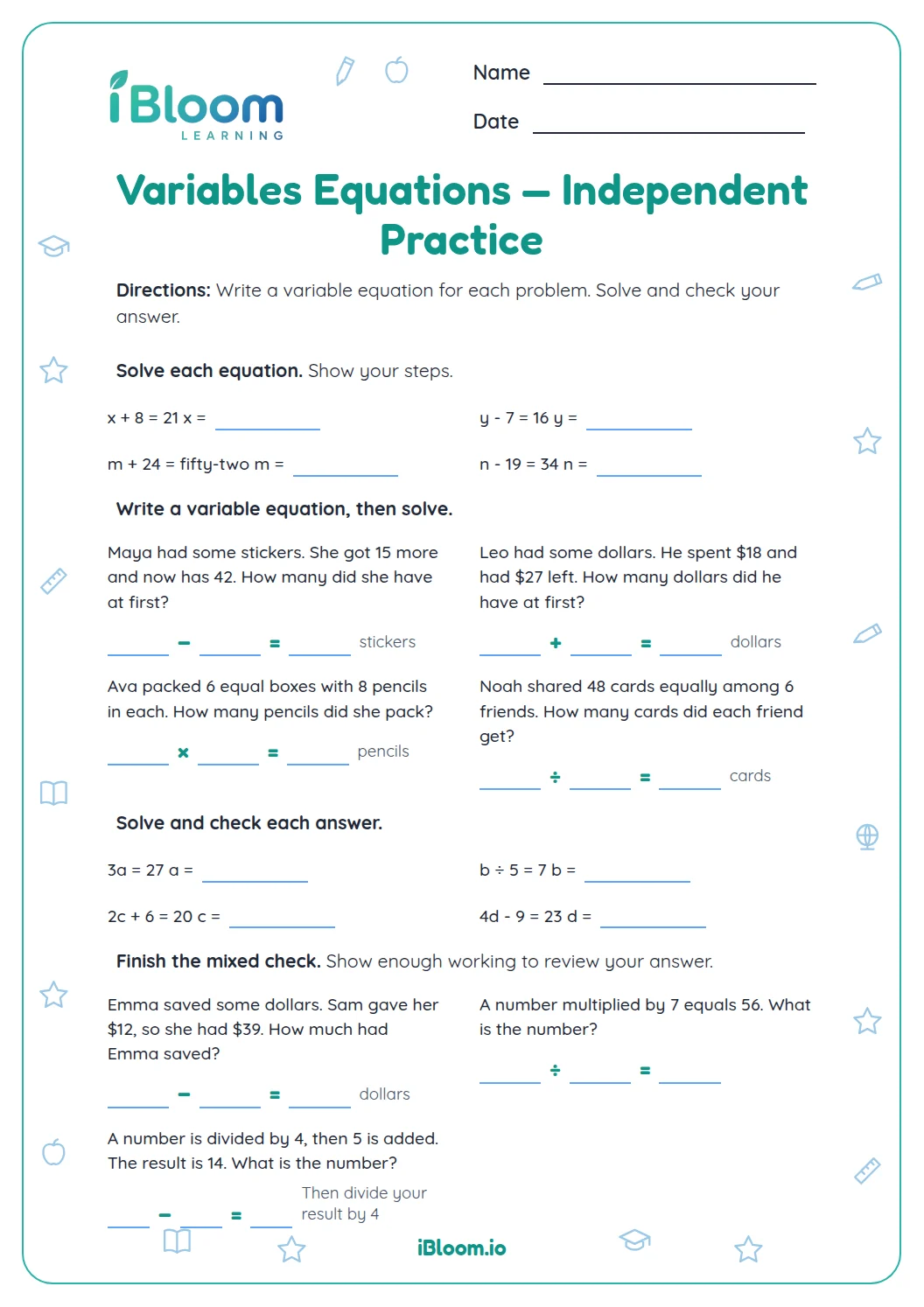
An expression names a quantity, such as 7 × b, but has no equals sign. An equation says two quantities are equal, such as 7 × b = 42. This page asks students to write expressions and evaluate them when a variable value is given.
When should students use order of operations?
Use order of operations whenever an expression has more than one operation. In q11, substitute c = 4 to get 3 × 4 + 2. Multiply first, then add: 12 + 2 = 14. This order keeps the value consistent.
Why do the story problems ask for an expression before a value?
Writing the expression first shows the relationship in the situation. The expression 4 × n works for any number of notebooks. After that, substituting n = 6 answers the specific question about six notebooks. The expression remains useful for other values too.
How can I check an evaluated expression?
Substitute the assigned value again and calculate one step at a time. You can also estimate whether the answer is reasonable. For 50 − 2 × 7, multiply first to get 14, then subtract to get 36. Recheck the variable value before calculating.