



About this worksheet
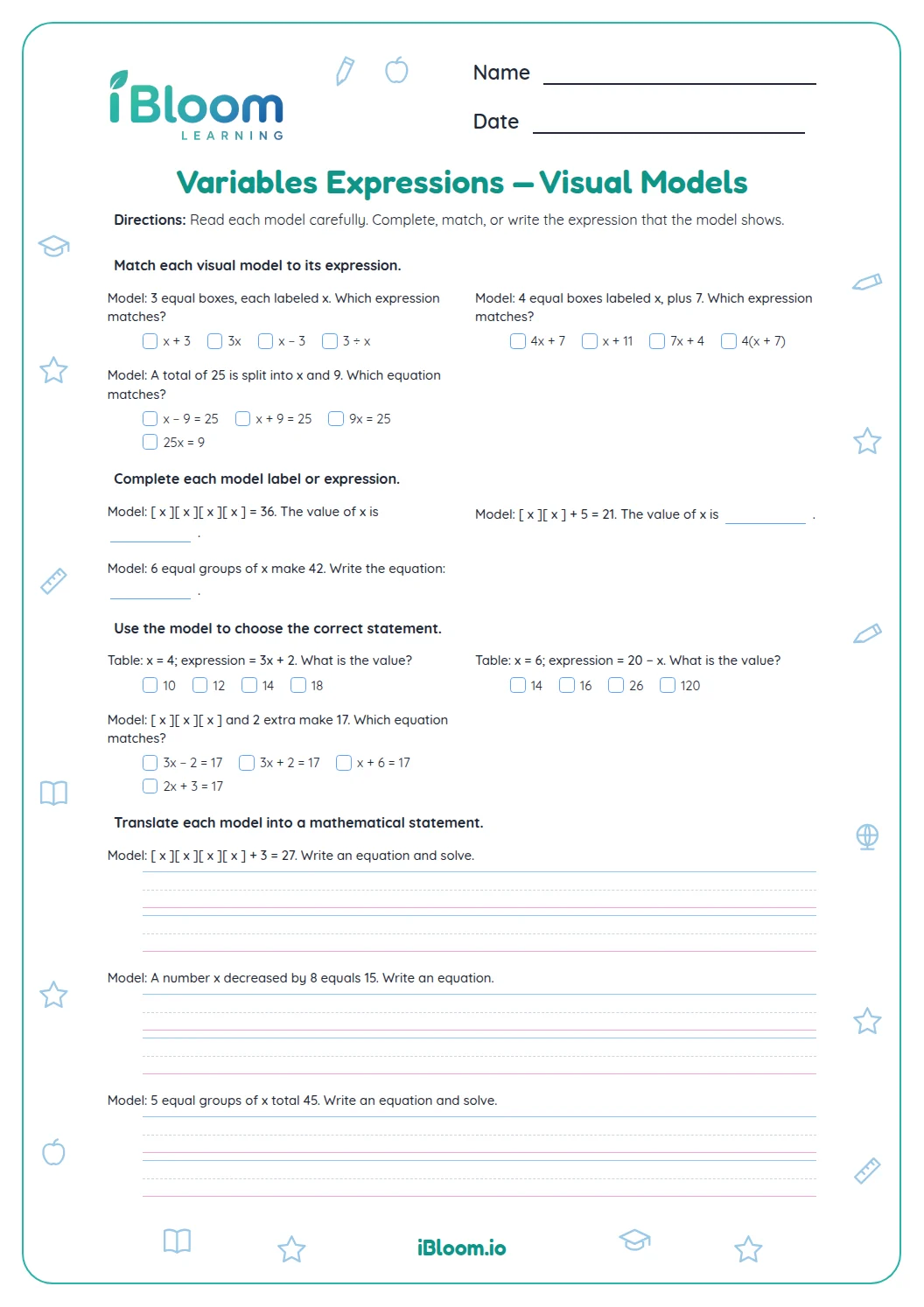
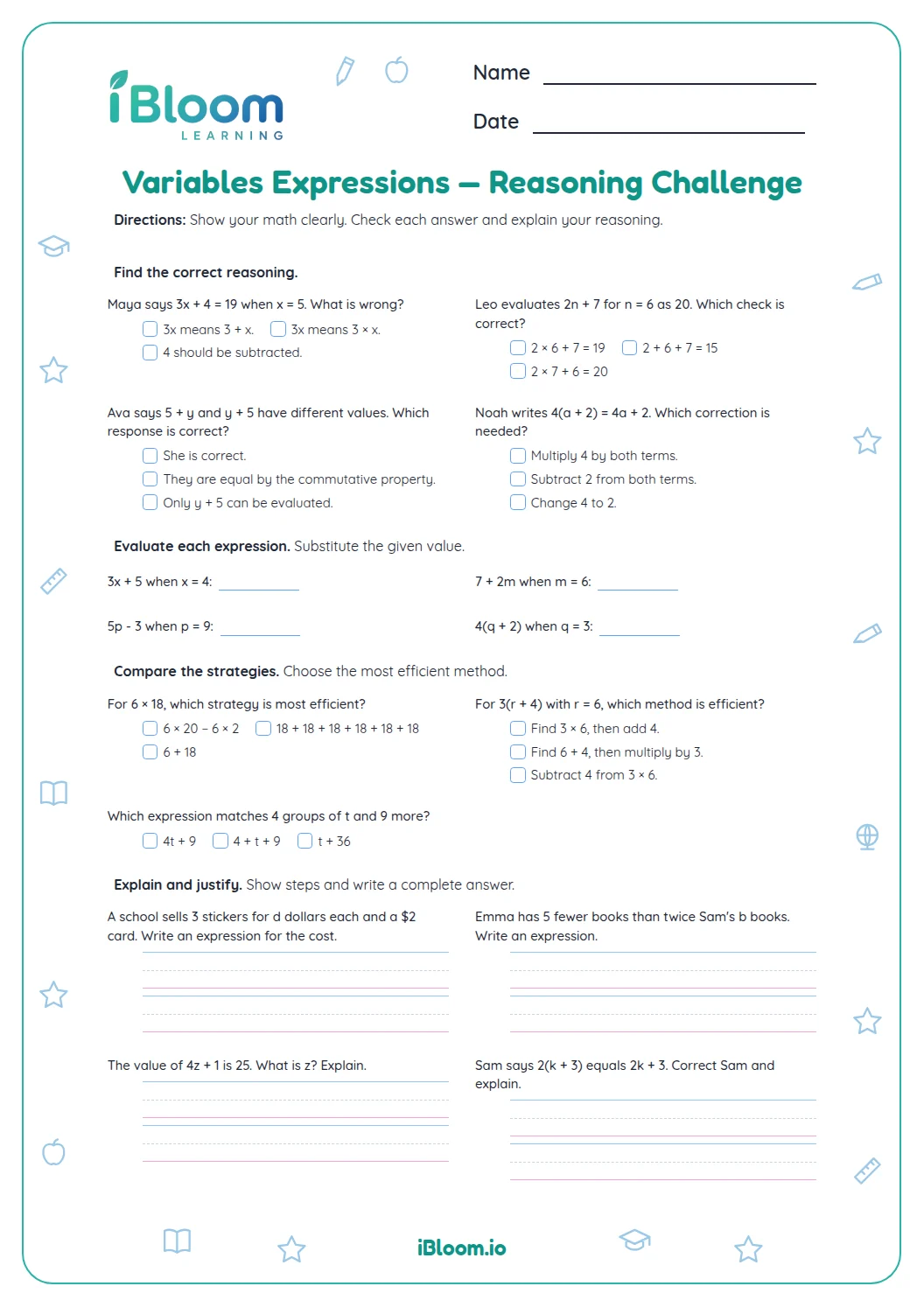
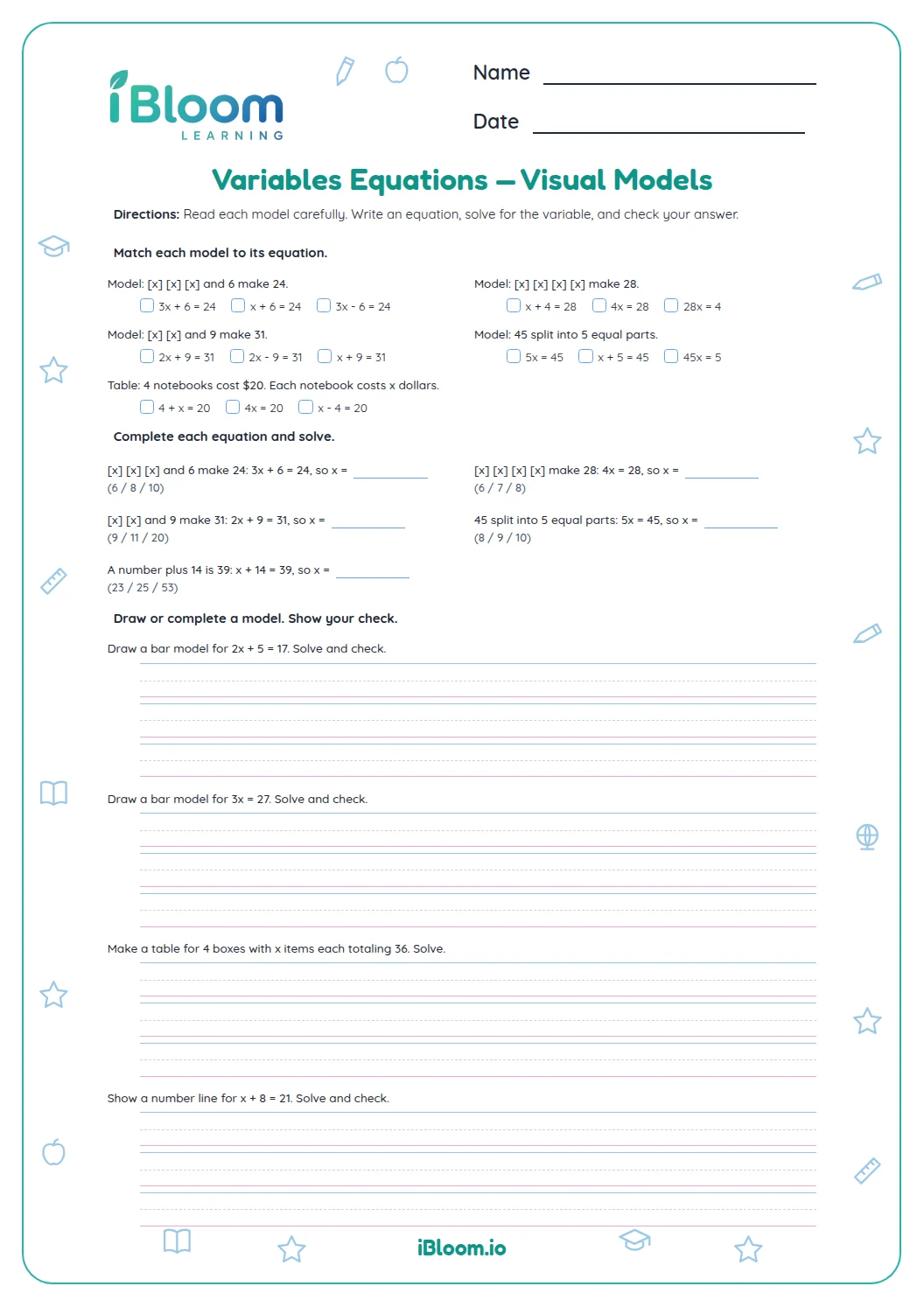
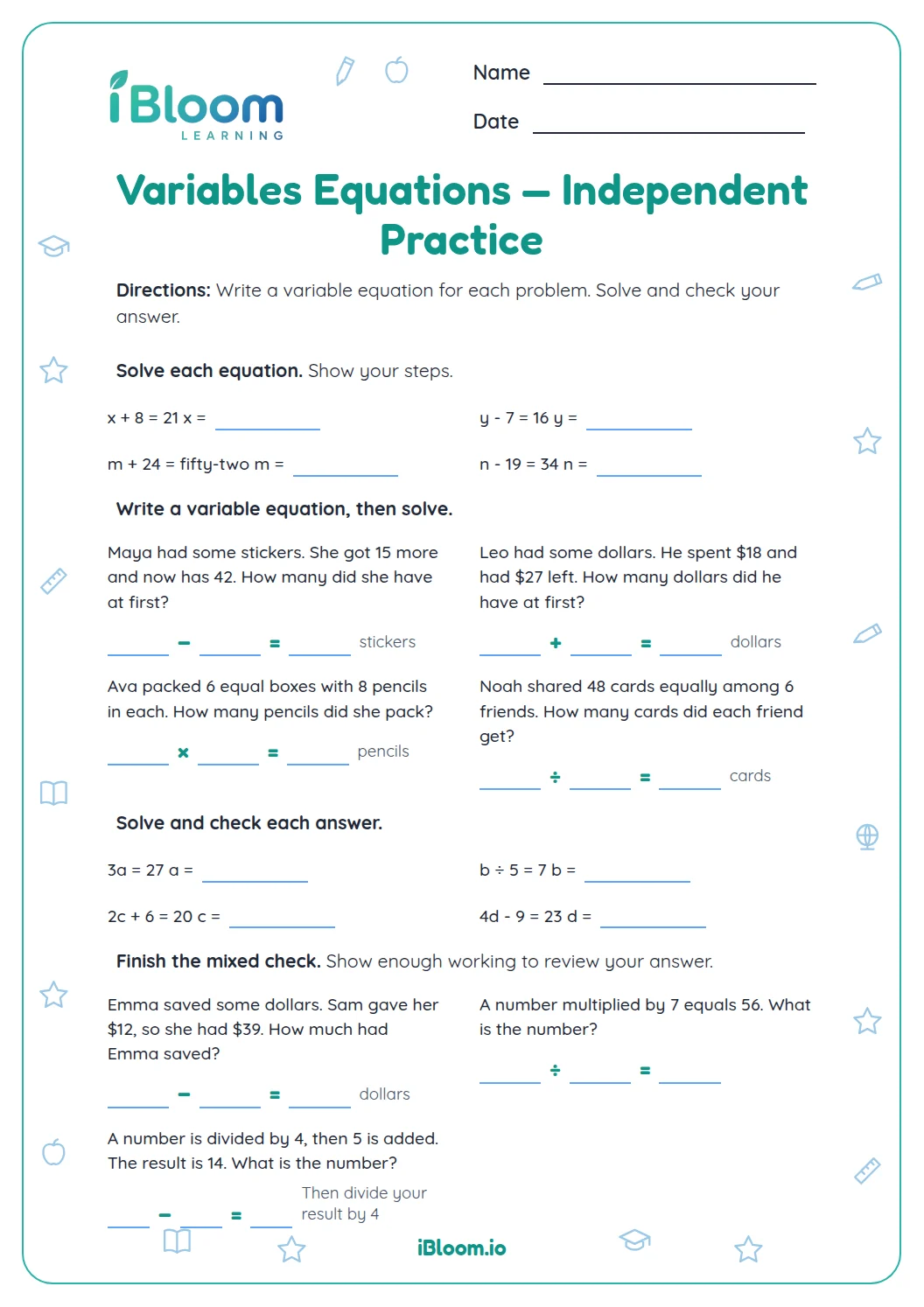
This free Grade 5 worksheet introduces how a letter can stand for an unknown or changing number. Learners match phrases to expressions, write expressions, evaluate expressions after substituting a value, and model familiar situations such as equal groups or a change in quantity. The separate answer key gives a concise check for all 16 questions.
What does a variable represent?
A variable is a letter that stands for a number. It can represent a quantity that is not yet known or that may change. For example, if n is the number of notebooks, n + 7 represents seven more notebooks.
The letter is part of the expression; it does not mean multiply unless the expression shows multiplication, such as 4x.
How do you translate words into an expression?
Find the unknown quantity first, then look for words that name an operation. “More than” means addition, “less than” can mean subtraction in the order stated, and “groups of” means multiplication.
- 1Which expression means 7 more than n?
- 2The unknown amount is n.
- 3“7 more” means add 7 to n.
- 4Answer: n + 7.
How does an expression describe a situation?
Part A connects phrases to expressions. Part B turns two phrases into expressions. Part C evaluates four expressions for given variable values, and Part D applies the same ideas to stickers, bags of cards, a cut rope, and teams sharing a quantity.
How to use this worksheet
- 1Underline the unknown quantity and choose a letter for it.
- 2Circle the operation words, such as more, fewer, groups, or shared equally.
- 3Write the variable and operation in the same order as the situation requires.
- 4For an evaluation question, substitute the given value before calculating.
- 5Remember that 4x means four groups of x.
- 6Check the expression or value against the answer key.
Common mistakes and quick fixes
The mistake
Using addition for “groups of.”
The fix
Groups of means multiplication, so four groups of x is 4x.
The mistake
Reversing “less than.”
The fix
“12 less than p” starts with p and subtracts 12: p − 12.
The mistake
Forgetting to substitute the given value before calculating.
The fix
Replace the variable with its number, then follow the operation shown.
What to practice next
Make more practice
Questions parents and teachers ask
What is a variable in an expression?
A variable is a letter that represents a number. In n + 7, the letter n stands for the starting amount and + 7 shows that seven more are added. This worksheet uses letters such as n, x, p, and s to represent quantities.
What is the answer to question 1?
The answer is n + 7. “Seven more than n” means start with n and add seven. The order matters: n is the starting amount, so it comes before the plus sign. The answer key gives the expression for every item.
Does 4x mean 4 plus x?
No. In this worksheet, 4x means four groups of x, or 4 multiplied by x. The phrase “four groups of” is the clue. Addition would be written as 4 + x, which means a different relationship between the quantities in this expression.
How can I help with phrases that use “less than”?
Read the phrase from the starting amount. “12 less than p” means begin with p and take away 12, so write p − 12. Asking “What amount do I have first?” can help keep the subtraction order clear when you translate the words into an expression.
How many questions are included?
There are 16 questions over two worksheet pages: six multiple-choice items, two expression-writing blanks, four evaluation blanks, and four short situation responses. The final four describe familiar quantities, and the separate two-page answer key gives an expression for each so learners can check their work.