




About this worksheet
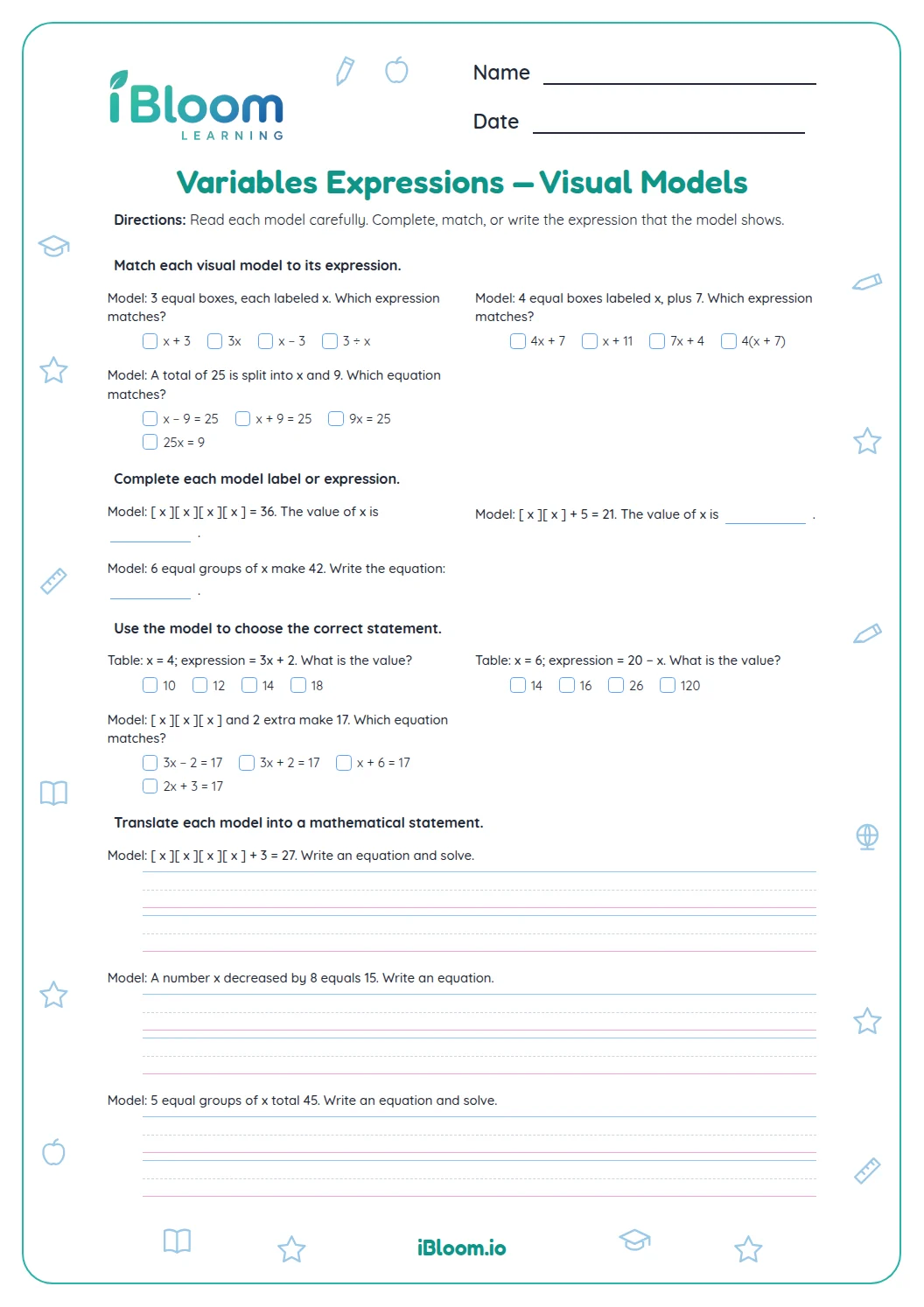
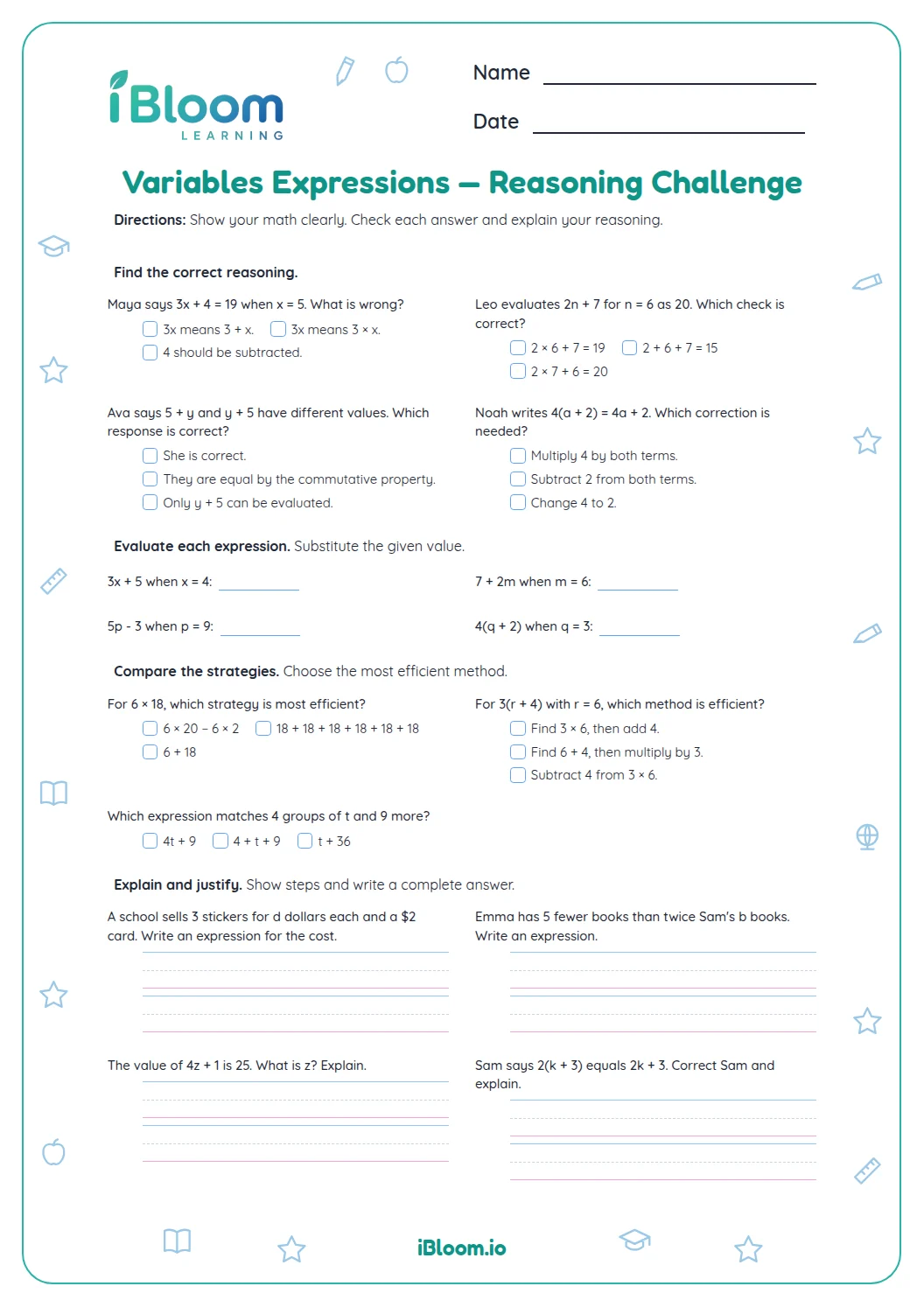
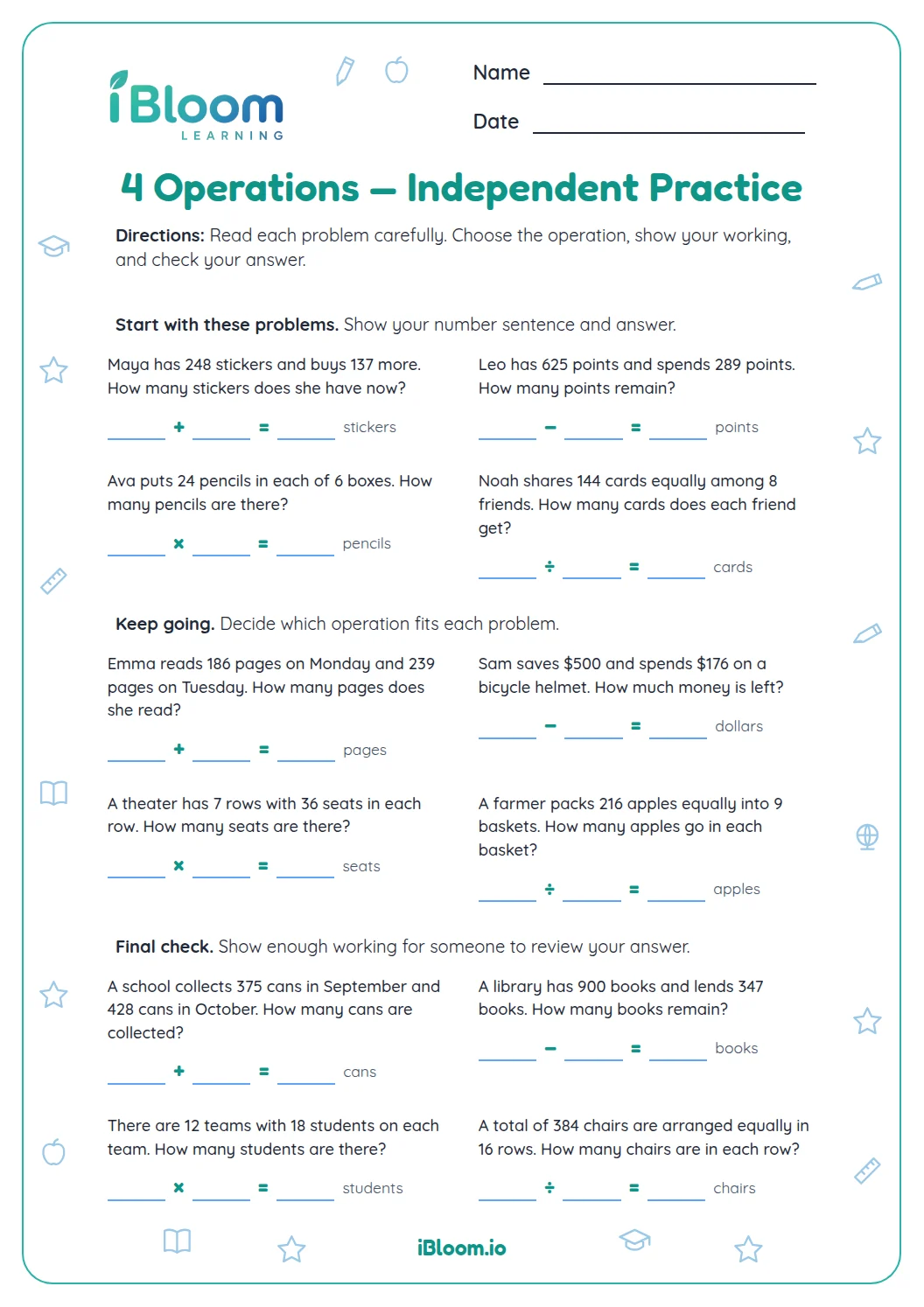
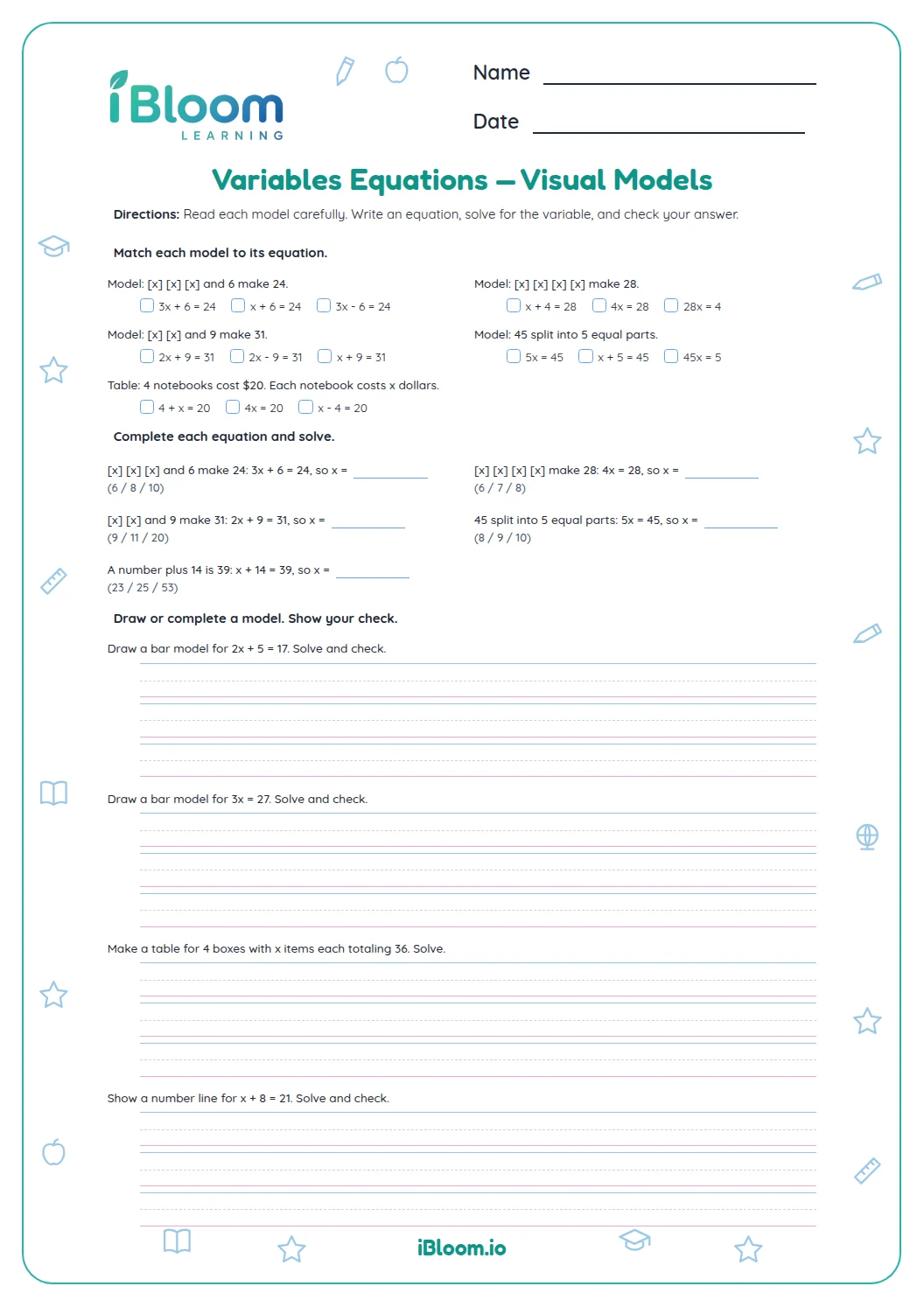
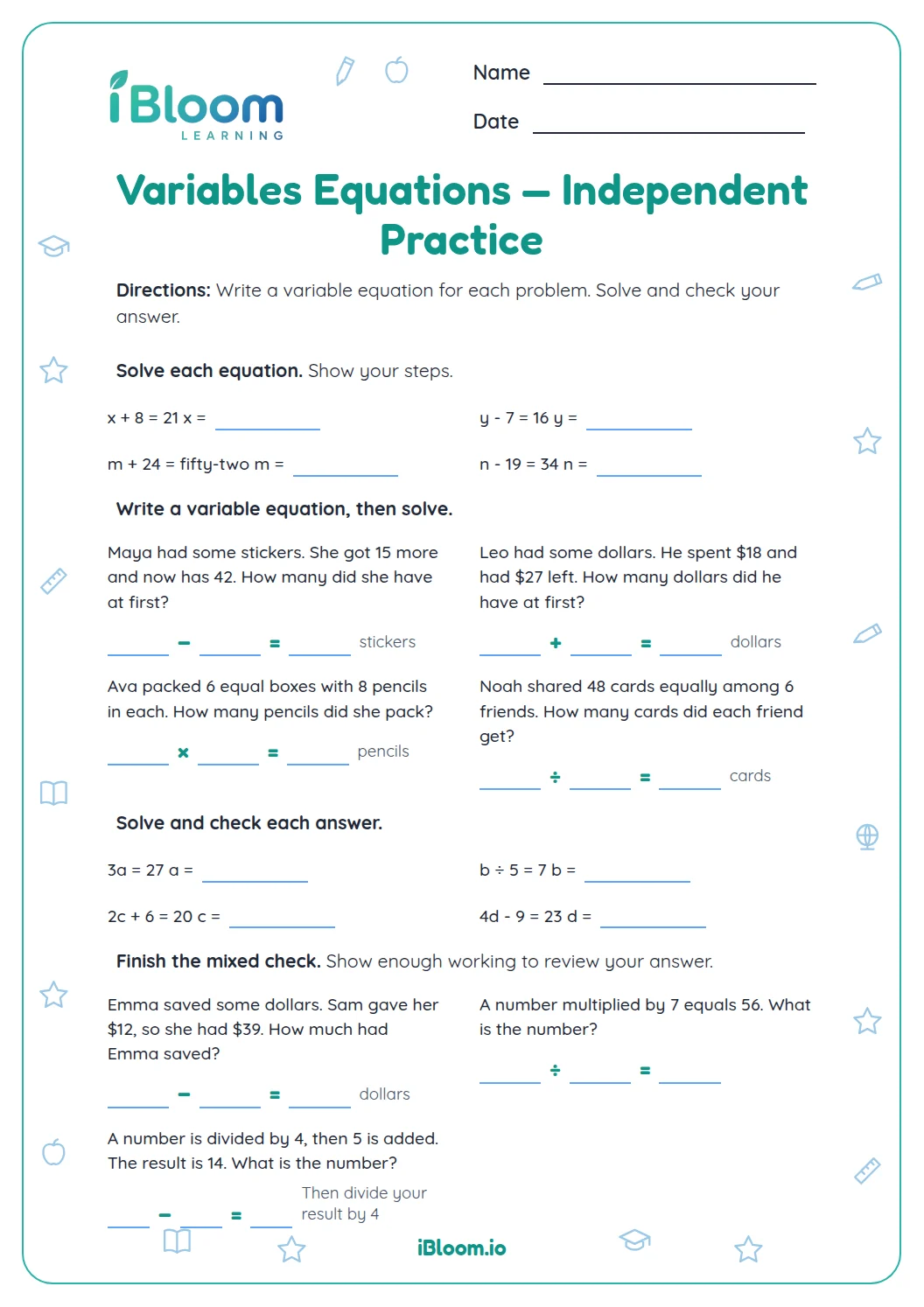
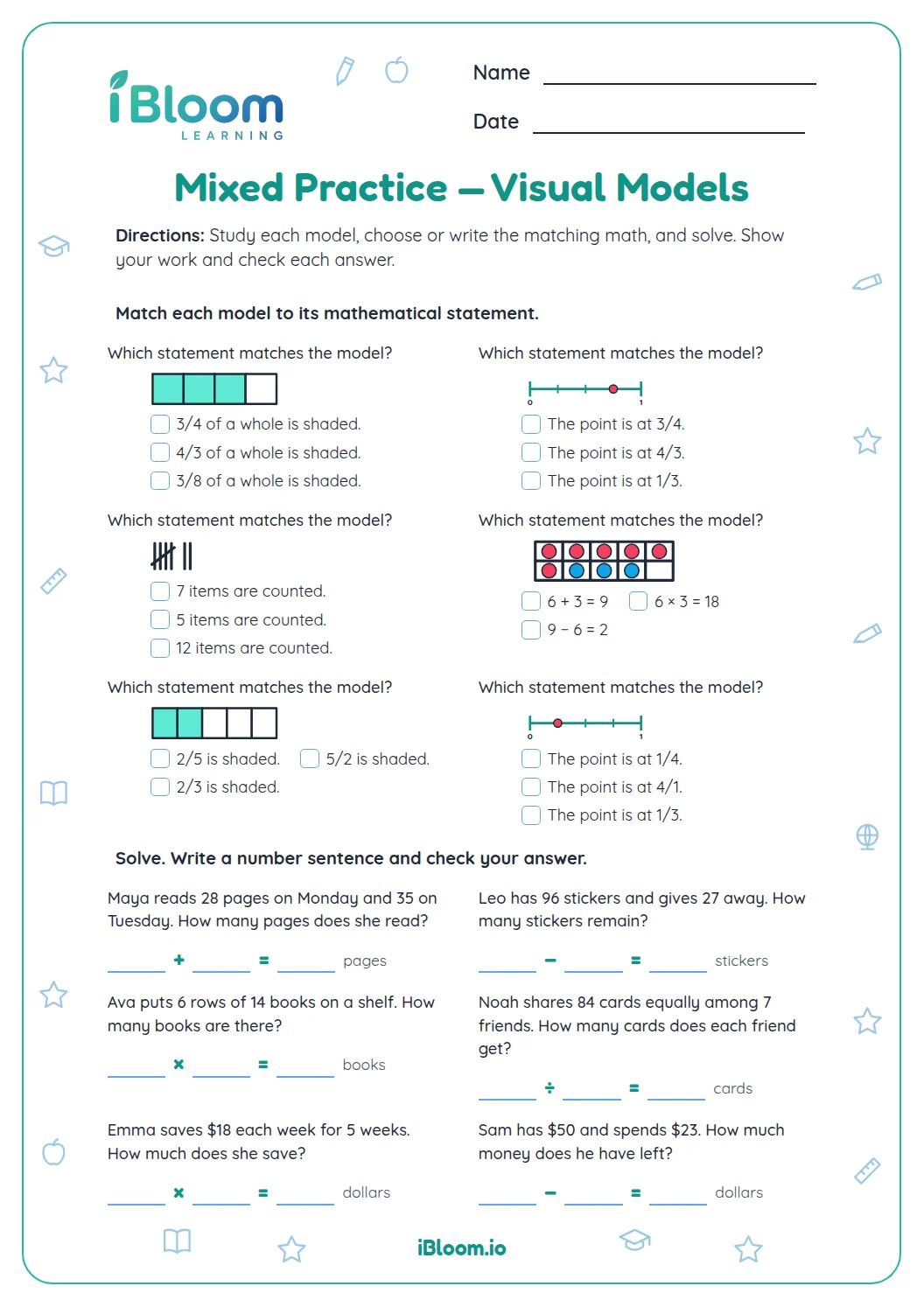
This free Grade 5 worksheet connects variable expressions to familiar situations such as notebooks in packs, flowers in rows, and weekly savings. Students choose an expression that matches a story, substitute a value for a variable, and solve multiplication, division, addition and subtraction situations. The answer key gives the expression or numerical result for each item.
How do you choose an expression for a story?
Identify what the variable represents, then notice how quantities relate. “Four notebooks in each of n packs” means 4 groups of n, so the expression is 4n. “Twenty-five dollars, then d dollars spent” means subtract d from 25.
Question 2 uses 4n because each pack contains four notebooks and the number of packs is n. Adding 4 + n would combine the two numbers but would not count the notebooks in equal groups.
- 1Four notebooks per pack, n packs → 4n
- 2If n = 3, then 4n = 4 × 3 = 12 notebooks.
How do you evaluate an expression?
Replace the variable with its given value, then follow the operations in the expression. In 3m + 2 when m = 5, replace m with 5: 3 × 5 + 2 = 17. Keep the multiplication together before adding.
Write the substituted expression before calculating. That makes it easier to spot whether the value was placed in the right position.
- 120 − 4c when c = 3
- 220 − 4 × 3 = 20 − 12 = 8
How do you connect a story to an answer?
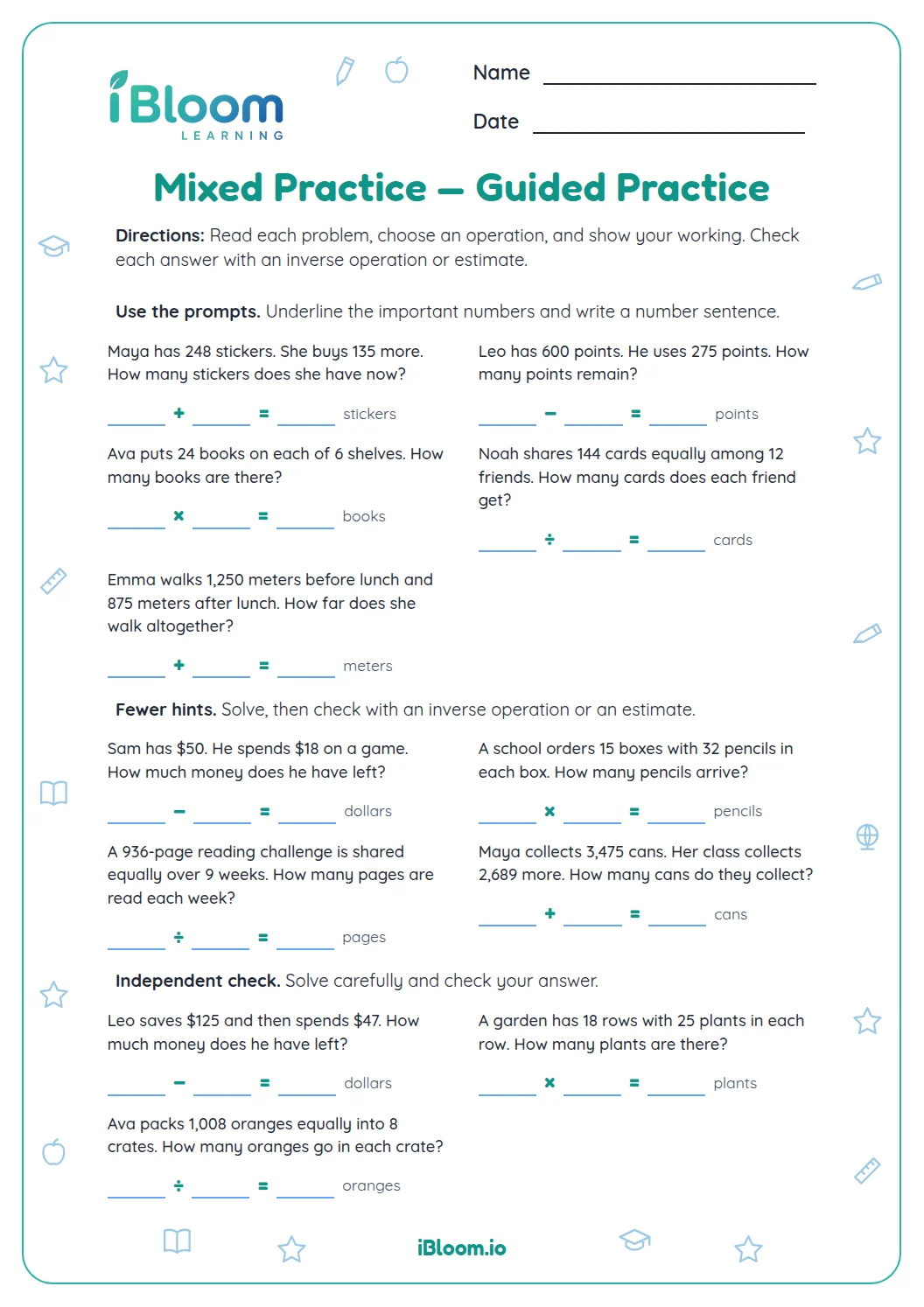
Choose the operation from the relationship in the story, write a number sentence, and include the unit in the answer. Equal groups point to multiplication or division; a change in an amount may call for addition or subtraction.
For the table story, 7 tables × 4 students per table = 28 students. The unit reminds the reader what the number counts.
How to use this worksheet
- 1Read the whole situation before choosing an operation.
- 2Write what the variable stands for in your own words.
- 3Use multiplication for equal groups and subtraction for an amount that decreases.
- 4When a value is given, substitute it wherever the variable appears.
- 5Check that the final answer has the right unit and makes sense in the story.
Common mistakes and quick fixes
The mistake
Using addition for equal groups, such as 4 notebooks in each of n packs
The fix
“Each” signals equal groups, so multiply: 4n. If n = 3, there are 12 notebooks.
The mistake
Subtracting the amount spent from the amount left
The fix
Start with the original amount and subtract what was spent: 25 − d.
The mistake
Replacing a variable but skipping the multiplication
The fix
In 3m + 2 with m = 5, calculate 3 × 5 first, then add 2.
What to practice next
Make more practice
Questions parents and teachers ask
What does a variable mean in these problems?
A variable is a letter that stands for a number in a situation. In 4n, n can stand for the number of notebook packs, while 4 tells how many notebooks are in each pack. When the value of n is known, substitute it and calculate the total.
How can I tell whether to add or multiply?
Look for the relationship between the quantities. “Each” or “in every pack” usually describes equal groups and multiplication. “Gets 9 more” describes adding. “Spends” or “gives away” describes taking away, so subtract the change from the starting amount.
Does the worksheet include an answer key?
Yes. A separate answer key lists all 14 answers, including the expression choices, evaluated expressions and word-problem results. For story problems, answers include units such as students, beads or dollars so children can check both the number and what it counts in each story.
Why does 4n mean 4 times n?
In algebra, a number written next to a variable means multiplication. If each notebook pack has 4 notebooks and there are n packs, 4n counts four notebooks n times. For three packs, substitute 3: 4 × 3 = 12 notebooks.
What can my child do after this page?
Try the linked variables-and-equations page to represent unknown values in equations, or move to mixed word problems to choose among operations. The measurement page applies similar reasoning to quantities with units, such as length, and explains the unit.