




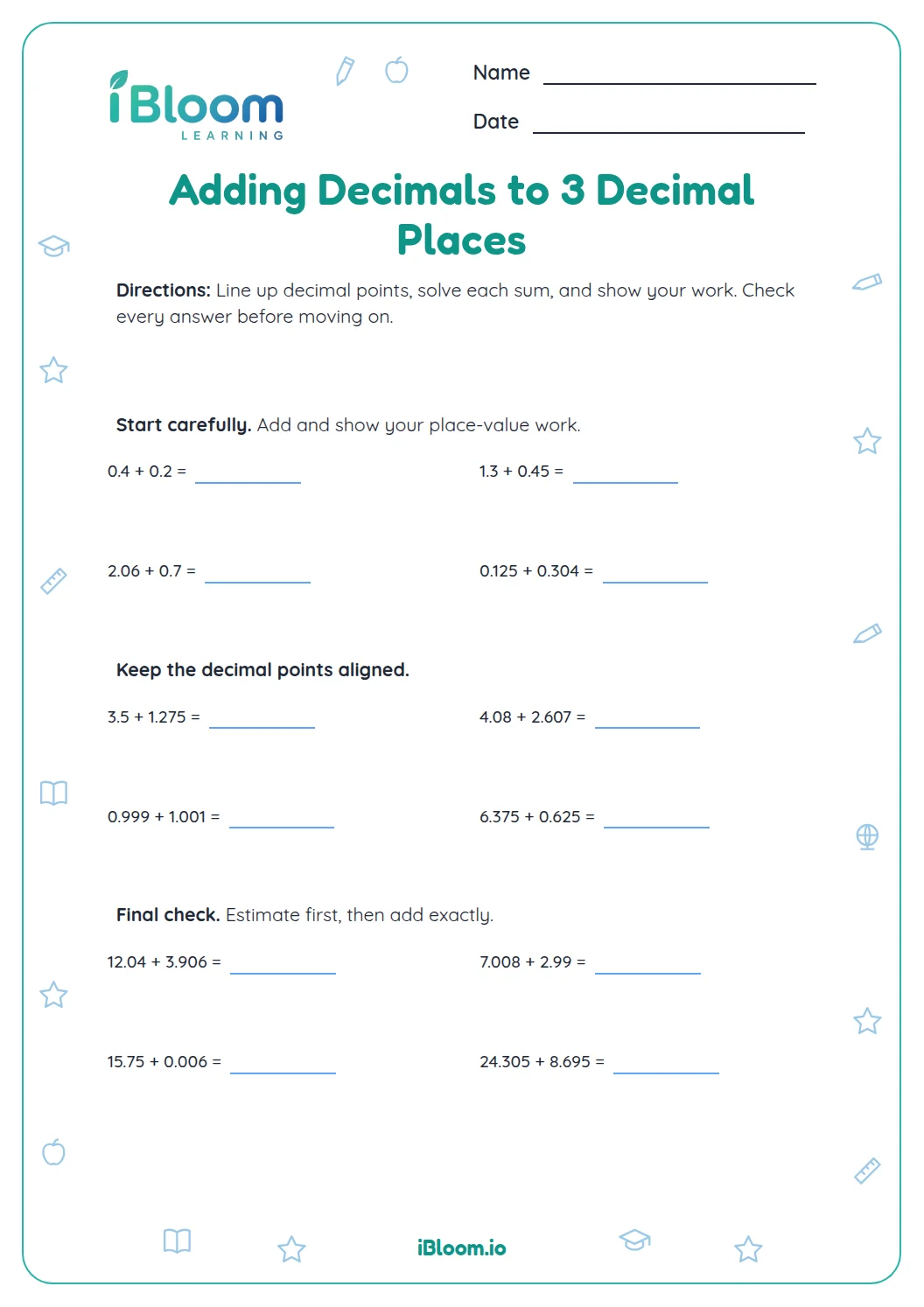
About this worksheet
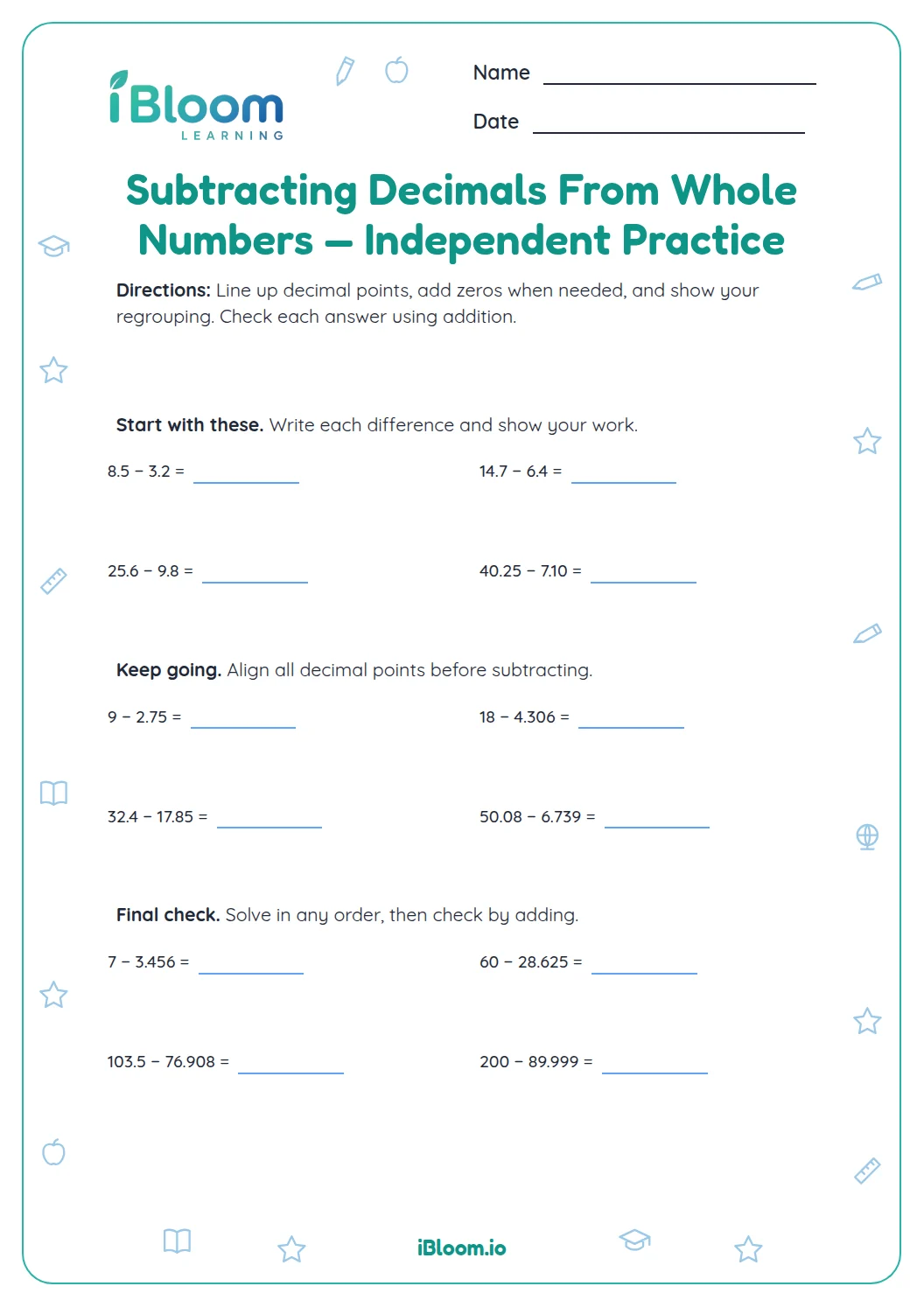
This Grade 6 worksheet builds decimal subtraction from whole-number notation to tenths, hundredths, and thousandths. Students line up decimal points, add placeholder zeros, and solve 12 number sentences plus three short applications. The answer key includes exact differences.
Aligned to 6.NS.B.3
Why line up decimal points?
Decimal points mark the same place-value boundary in both numbers. Align them vertically so ones subtract from ones, tenths from tenths, and so on. Add placeholder zeros to the whole number when the decimal has more places.
- 17.000 − 0.845
- 2Subtract by place value: 6.155
Do zeros change the whole number?
Writing 8 as 8.000 does not change its value; the zeros show tenths, hundredths, and thousandths places. Borrow across places as needed, just as in whole-number subtraction.
- 18.000 − 3.600 = 4.400, or 4.4
How can you check a decimal difference?
Add the difference to the amount subtracted. For question 14, 8.72 + 6.28 = 15.00, which matches the original ribbon length. An estimate also helps catch a misplaced decimal point.
How to use this decimal subtraction worksheet
- 1Estimate the difference before calculating.
- 2Write the whole number with enough decimal places to match the other number.
- 3Line up decimal points and subtract each place, regrouping when needed.
- 4In application questions, attach the unit from the story.
- 5Add the difference to the number subtracted to check.
Common mistakes and quick fixes
The mistake
Subtracting digits before aligning place values.
The fix
Line up the decimal points first, then subtract column by column.
The mistake
Thinking placeholder zeros change a number.
The fix
Remember that 8, 8.0, and 8.000 have the same value.
The mistake
Placing the decimal point by counting answer digits.
The fix
Keep the decimal point in the same aligned column as the numbers above it.
Common Core alignment
This worksheet gives students practice with 6.NS.B.3 through the questions on the sheet.
Compute with decimals to hundredths and thousandths using place-value strategies.
On this sheet: Compute with decimals to hundredths and thousandths using place-value strategies.
Show the official wordingHide the official wording
Fluently add, subtract, multiply, and divide multi-digit decimals using the standard algorithm for each operation.
What to practice next
Make more practice
Further reading
Questions parents and teachers ask
Why should decimal points line up?
Lining up decimal points keeps like place values in the same column. Ones line up with ones, tenths with tenths, and hundredths with hundredths. This lets students subtract each place accurately and place the decimal point in the answer. The decimal point stays aligned in the sum as well.
Can zeros be added to a whole number?
Yes. Writing 8 as 8.000 keeps the same value while making the tenths, hundredths, and thousandths columns visible. The zeros act as placeholders; they help align the subtraction and do not change the amount. The worksheet includes tenths, hundredths, and thousandths.
How can I check a subtraction answer?
Add the amount subtracted to the difference. In question 14, 15 − 6.28 = 8.72; checking gives 8.72 + 6.28 = 15.00. Estimating first also helps show whether the answer is in a sensible range. The check should return to the starting whole-number amount.
What kinds of problems are on the page?
The worksheet has 12 number sentences and three short applications involving a bottle, ribbon, and running distance. The decimal parts range from one to three places, so students practice lining up different place values. Students can omit a zero at the end of a decimal answer.
Should a trailing zero be included in the answer?
A trailing zero to the right of a decimal does not change its value, so 4.400 and 4.4 are equivalent. The key gives concise answers; students may keep a zero when it helps show aligned place values. The examples build toward three-place decimal subtraction.