







About this worksheet
This free printable Grade 6 worksheet shows what happens when a decimal is subtracted from a whole number such as 4, 6 or 10. Children match hundredths grids and tenths strips to subtraction sentences, read two models to find what is left, then subtract by lining up decimal points with 1, 2 and 3 decimal digits and solve a rope problem. It practices fluent decimal subtraction with the standard algorithm (CCSS 6.NS.B.3) and the use of models for decimals to hundredths (5.NBT.B.7). A separate answer key is included.
Aligned to 6.NS.B.3 and 5.NBT.B.7
How do you subtract a decimal from a whole number?
A whole number has a decimal point that is easy to forget: 10 is the same as 10.00. Writing it that way gives the whole number the same decimal places as the number being subtracted, and the digits can line up by place value. Then subtract from the right, regrouping across the zeros.
In question 8, 10 − 7.06 becomes 10.00 − 7.06. The 6 hundredths cannot come out of 0 hundredths, so regroup from the tens until the hundredths place has 10, which leaves 2.94.
- 110 − 7.06 = ___
- 210 = 10.00
- 310.00 − 7.06
- 4= 2.94
- 5Check: 2.94 + 7.06 = 10.00
What do the grids and strips show?
On a hundredths grid, the whole grid is 1 and each small square is 0.01. A full column of ten squares is 0.1, so the 3 shaded columns in question 1 are 0.3, and the sentence is 1 − 0.3 = 0.7. The tenths strips work the same way: a full strip is 1, and each section is 0.1.
Question 4 shades 37 of 100 squares, and the unshaded squares show the answer, 0.63. Question 5 shows one full grid plus 25 squares, so 1.25 is taken from 4, which leaves 2.75.
What is on this worksheet?
Ten questions on two pages, from reading models to computing on their own.
- Part A, Match the model: three multiple-choice questions, two with hundredths grids and one with tenths strips, each with three sentences that differ only in place value
- Part B, Read the model: two questions where children find what is left, with working space
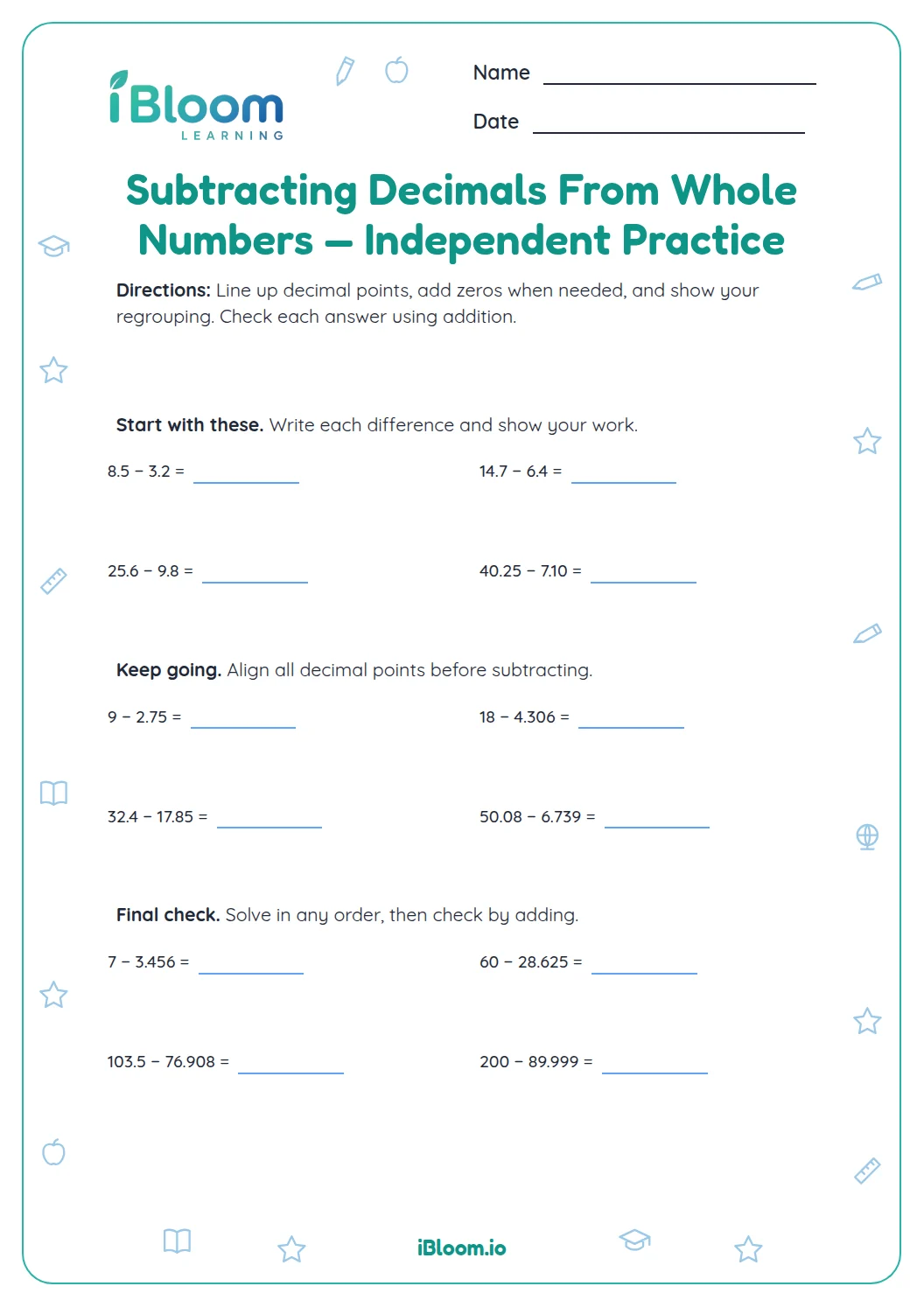
- Part C, Line up and subtract: four number sentences with 1, 2 and 3 decimal digits, such as 8 − 3.4 and 5 − 2.308
- Part D, Solve the problem: a rope story with a number sentence and a labeled answer
- A 2-page answer key
Why do the choices in Part A look so alike?
The three choices in each question change only where the decimal digit sits: 0.3, 0.03 and 0.003 look similar but are tenths, hundredths and thousandths. Choosing correctly shows that a child reads the model by place value and not by guessing the digits.
How to use this worksheet at home or in class
- 1Start with the models. For question 1, ask your child to count the shaded columns and say the amount as tenths before looking at the choices.
- 2Pick the sentence in question 2 together, saying why the other two choices have the wrong place value.
- 3In Part B, have your child subtract the shaded amount from the whole and say what the unshaded part of the grid shows.
- 4In Part C, write each whole number with a decimal point and zeros first, then line up the decimal points.
- 5Add the answer to the number taken away to check it. The total should be the whole number you started with.
- 6Mark with the answer key, and redo any problem where the decimal points were not lined up.
Common mistakes and quick fixes
The mistake
Lining up the digits on the right instead of the decimal points, so that 5 sits under the 8 in 5 − 2.308.
The fix
Write 5 as 5.000 first, so the ones, tenths, hundredths and thousandths all sit in matching columns.
The mistake
Dropping the zero in 7.06 and treating it as 7.6, so 10 − 7.06 comes out as 2.4.
The fix
The zero holds the tenths place. Read 7.06 as 7 and 6 hundredths, and write 10.00 − 7.06.
The mistake
Reading 30 shaded squares as 0.03 because the grid has so many small squares.
The fix
Each square is 0.01, so 30 squares make 0.30 or 0.3. Three full columns of ten are three tenths.
Common Core alignment
Most US states use the Common Core standards or a close state version. This sheet practices the decimal subtraction standards below.
Subtract multi-digit decimals fluently with the standard algorithm.
On this sheet: Parts C and D subtract decimals with up to three digits from whole numbers by lining up the decimal points.
Show the official wordingHide the official wording
Fluently add, subtract, multiply, and divide multi-digit decimals using the standard algorithm for each operation.
Use models and place value to subtract decimals to hundredths.
On this sheet: Parts A and B use hundredths grids and tenths strips, and the check step uses addition to undo subtraction.
Show the official wordingHide the official wording
Add, subtract, multiply, and divide decimals to hundredths, using concrete models or drawings and strategies based on place value, properties of operations, and/or the relationship between addition and subtraction; relate the strategy to a written method and explain the reasoning used.
What to practice next
Make more practice
Further reading
Questions parents and teachers ask
What should my child know before this worksheet?
Your child should know decimal place value to thousandths and be comfortable subtracting whole numbers with regrouping. The sheet also assumes they know that 0.3 and 0.30 are equal. If place value is shaky, work with the hundredths grid first and say each shaded amount aloud as tenths and hundredths.
What is the answer to 6 − 2.75?
The answer is 3.25. Write 6 as 6.00, line up the decimal points, and subtract: 6.00 − 2.75. The hundredths need regrouping, and the answer is 3.25. A quick check is to add the pieces back: 2.75 + 3.25 = 6.00. Question 7 on the worksheet asks exactly this.
Why do we write zeros after the whole number?
The zeros do not change the value, since 5 and 5.000 are the same, but they give each digit a column. Without them it is easy to subtract the digits that are not in the same place. Adding zeros so both numbers end in the same place makes the subtraction clear.
How does the model in question 4 give the answer?
The model shows 37 of the 100 squares shaded, which is 0.37. The squares left unshaded, 63 of the 100, are what remains after taking 0.37 away from 1. So 1 − 0.37 = 0.63. Children can check by adding: 0.37 + 0.63 makes the whole grid, 1.
Does the sheet include a word problem?
Yes, Part D has one. A rope is 9 meters long and Dev cuts off 3.45 meters, so children write 9 − 3.45 and get 5.55 m. The answer box asks for the unit, and the working space is large enough to line up 9.00 and 3.45 before subtracting.
Is there an answer key for this worksheet?
Yes. A 2-page answer key matches the worksheet. It shows the correct sentence for each match question, the answers for the models, each number sentence in Part C, and the rope answer with its unit. You can print the worksheet alone or download the worksheet and key together as a free PDF.