





About this worksheet
This Grade 6 reasoning challenge practices subtracting decimals from whole numbers through error analysis, method comparison, and missing values. Students work with tenths, hundredths, and thousandths, then check subtraction with addition or estimation. Fourteen questions and a separate answer key support practice with CCSS 6.NS.B.3.
Aligned to 6.NS.B.3
How can you spot a decimal subtraction error?
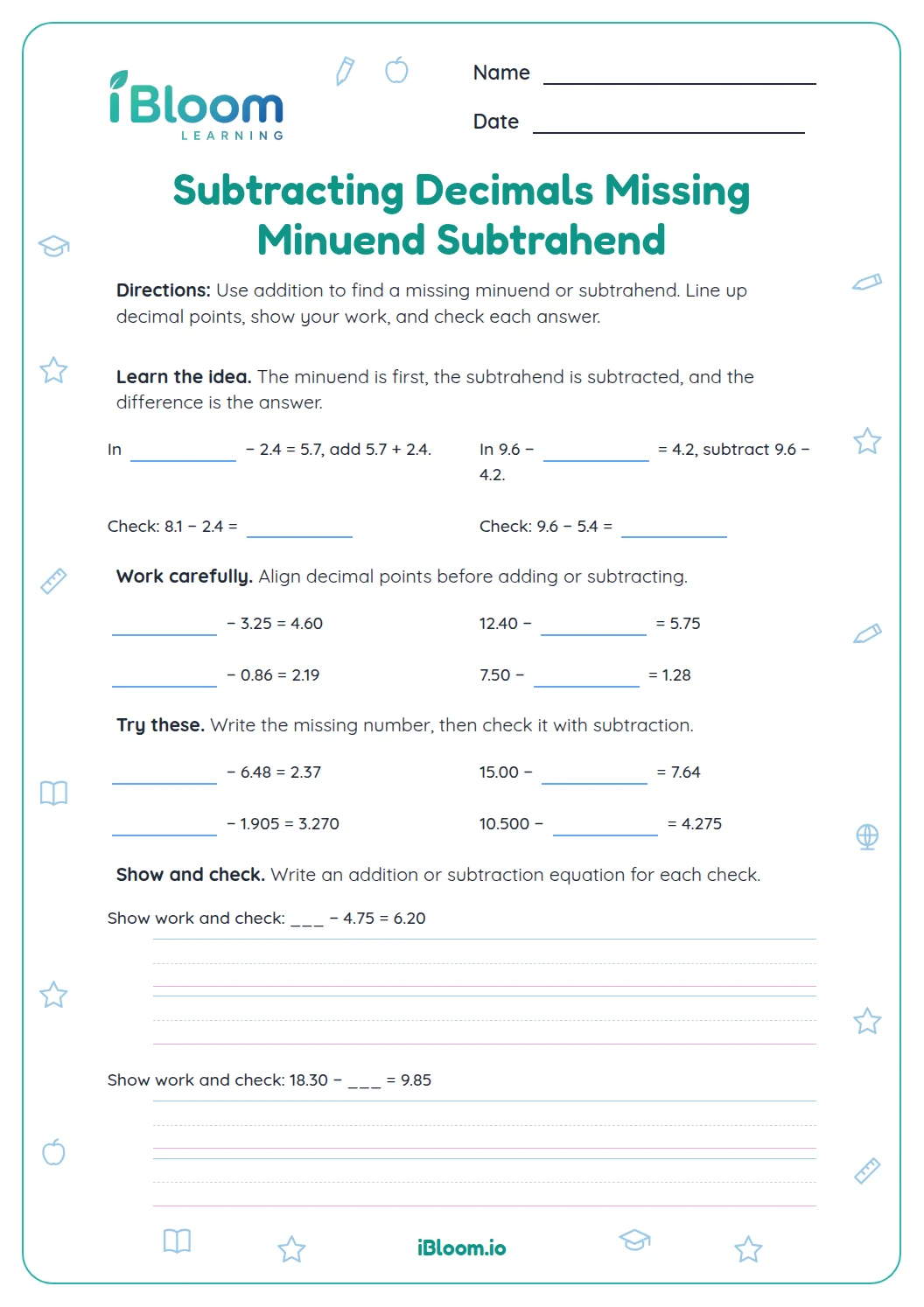
Line up decimal points, then check that the difference and the subtrahend add back to the starting number.
- 112.000 − 4.680 = 7.320
- 2Check: 7.320 + 4.680 = 12.000.
How can two methods reach the same difference?
Subtract by place value or count up from the decimal being subtracted. Compensation can make a subtraction easier.
- 112 − 3.475 = 8.525
- 2Count up: 3.475 to 4 is 0.525; then 4 to 12 is 8.
How to use this worksheet
- 1Read the model or direction at the start of each part.
- 2Work through the questions in order, showing steps where useful.
- 3Reread each answer in the context of its question.
- 4Use the answer key to check and correct your work.
Common mistakes and quick fixes
The mistake
Subtracting digits without lining up decimal points.
The fix
Place decimal points in one vertical column first.
The mistake
Treating a missing hundredths or thousandths digit as a different place.
The fix
Add placeholder zeros to show matching places.
The mistake
Dropping the decimal point in the difference.
The fix
Bring the decimal point straight down in the answer.
Common Core alignment
This worksheet gives focused practice with the standard below.
Subtract multi-digit decimals accurately using aligned place values.
On this sheet: Subtract multi-digit decimals accurately using aligned place values.
Show the official wordingHide the official wording
Fluently add, subtract, multiply, and divide multi-digit decimals using the standard algorithm for each operation.
What to practice next
Make more practice
Further reading
Questions parents and teachers ask
What does decimal alignment mean?
Decimal alignment means placing decimal points in the same column before subtracting. Add zeros to show matching places, such as writing 12.000 − 4.680. This helps keep tenths, hundredths, and thousandths in their correct columns. Show each place-value step so a reader can follow the reasoning. Keep decimal points in one column.
How can addition check subtraction?
Add the subtrahend to the difference. The sum should equal the starting whole number, as in 7.320 + 4.680 = 12.000. This check can reveal a regrouping or place-value error. Show each place-value step so a reader can follow the reasoning. Keep decimal points in one column.
What does compensation mean here?
Compensation changes a subtraction into an equivalent, easier calculation. For 20 − 0.999, add 0.001 to both values to get 20.001 − 1.000 = 19.001. The difference stays the same. Show each place-value step so a reader can follow the reasoning. Keep decimal points in one column.
What kinds of reasoning appear on the sheet?
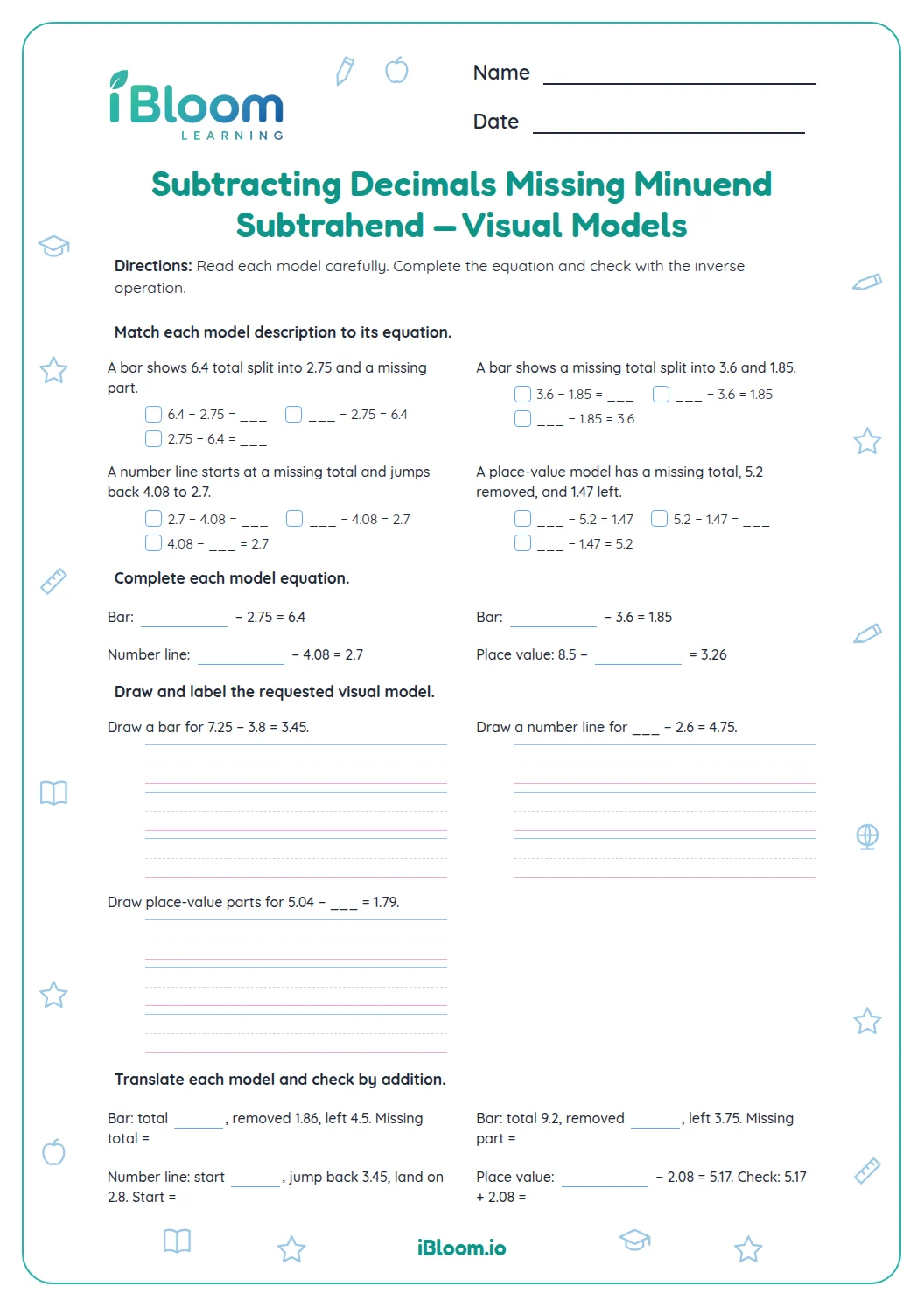
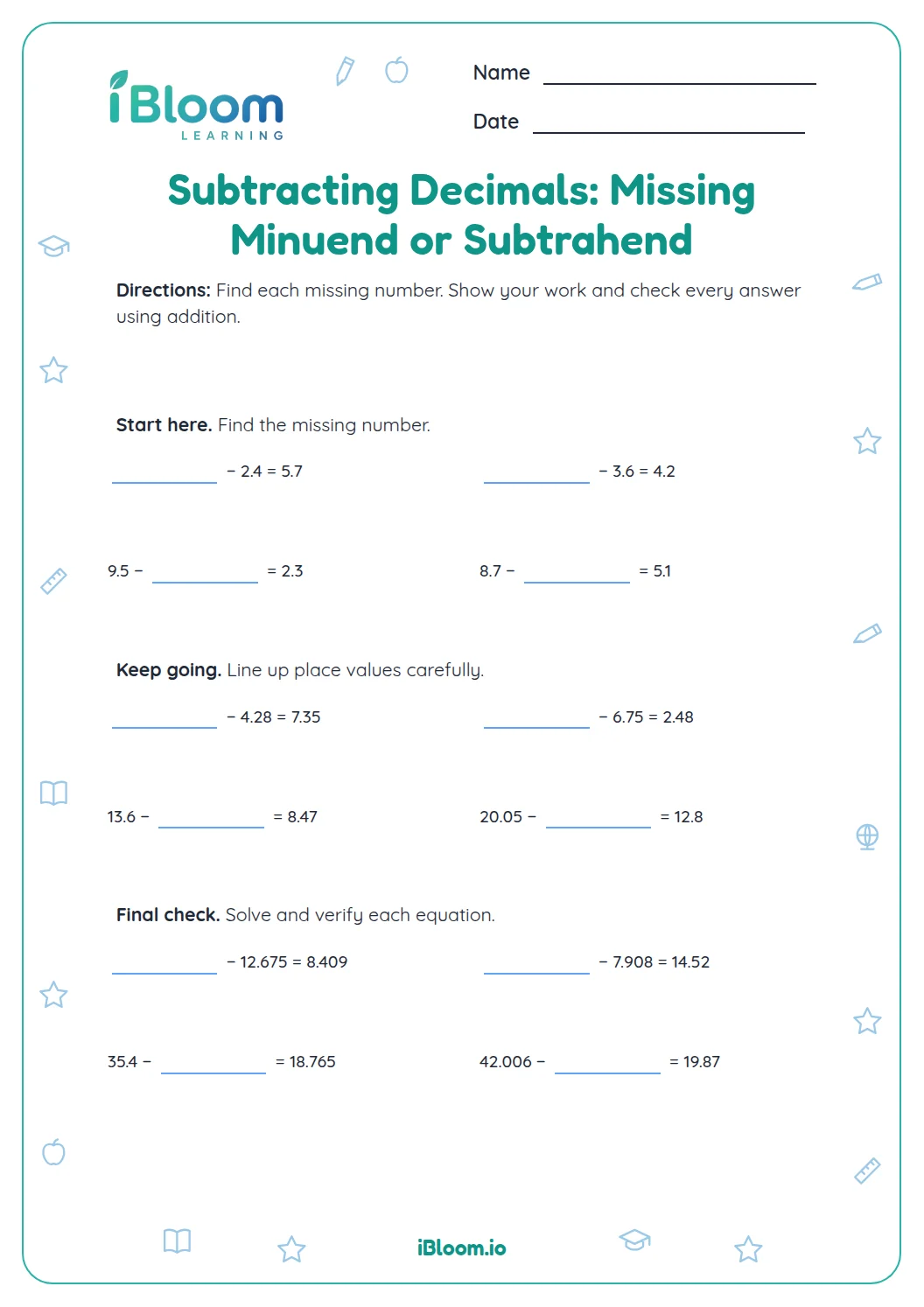
Students inspect worked examples, compare subtraction methods, complete missing values, and check results with addition. The 14 questions include selected responses and calculations using tenths, hundredths, and thousandths. Each item asks them to attend to place value and operation meaning.
Is an answer key included?
Yes. A separate key lists the selected responses and calculation results. Students can compare their choices and check each difference by adding the subtrahend back to the answer. The key supports independent checking after the worksheet is complete.