




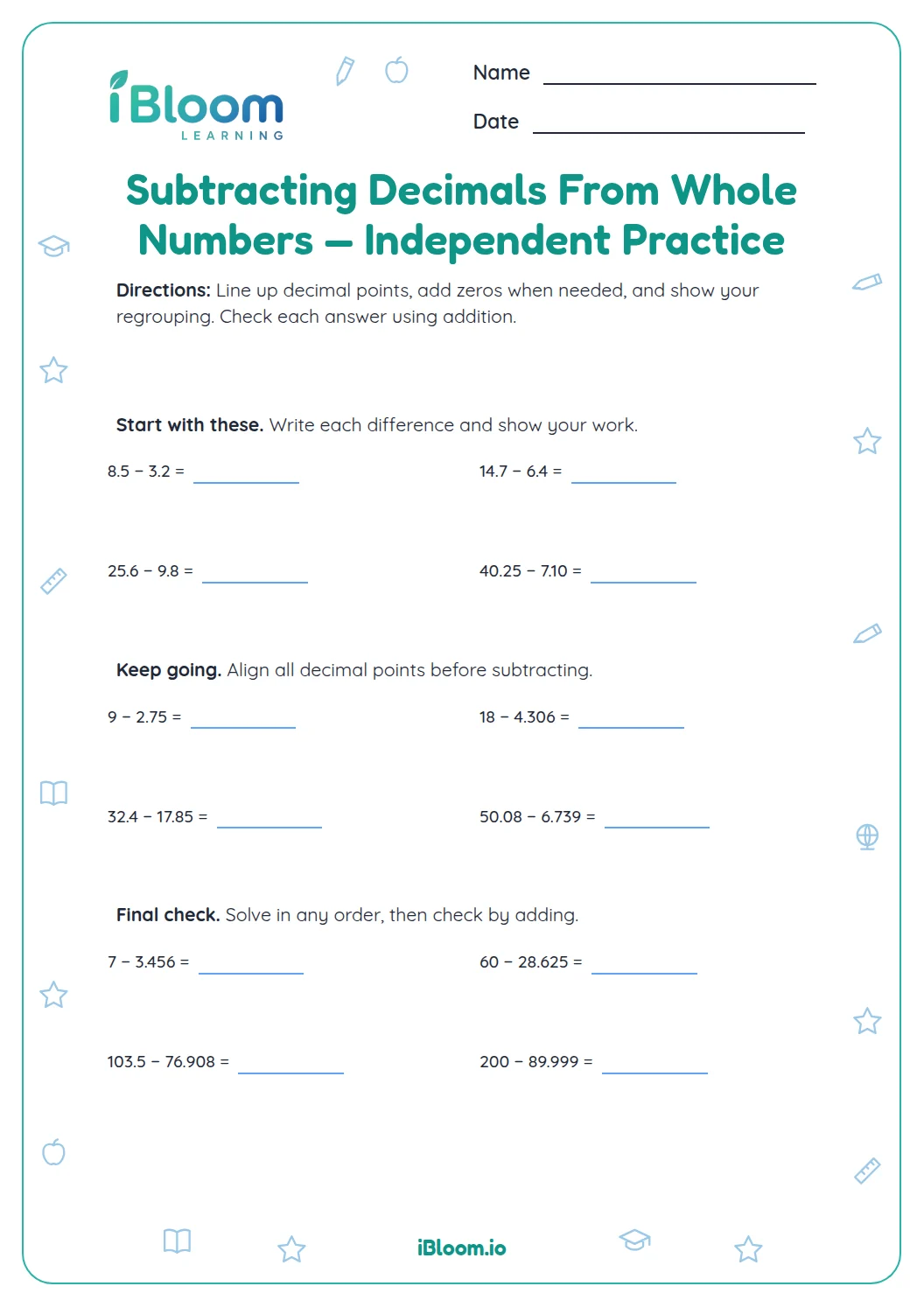
About this worksheet
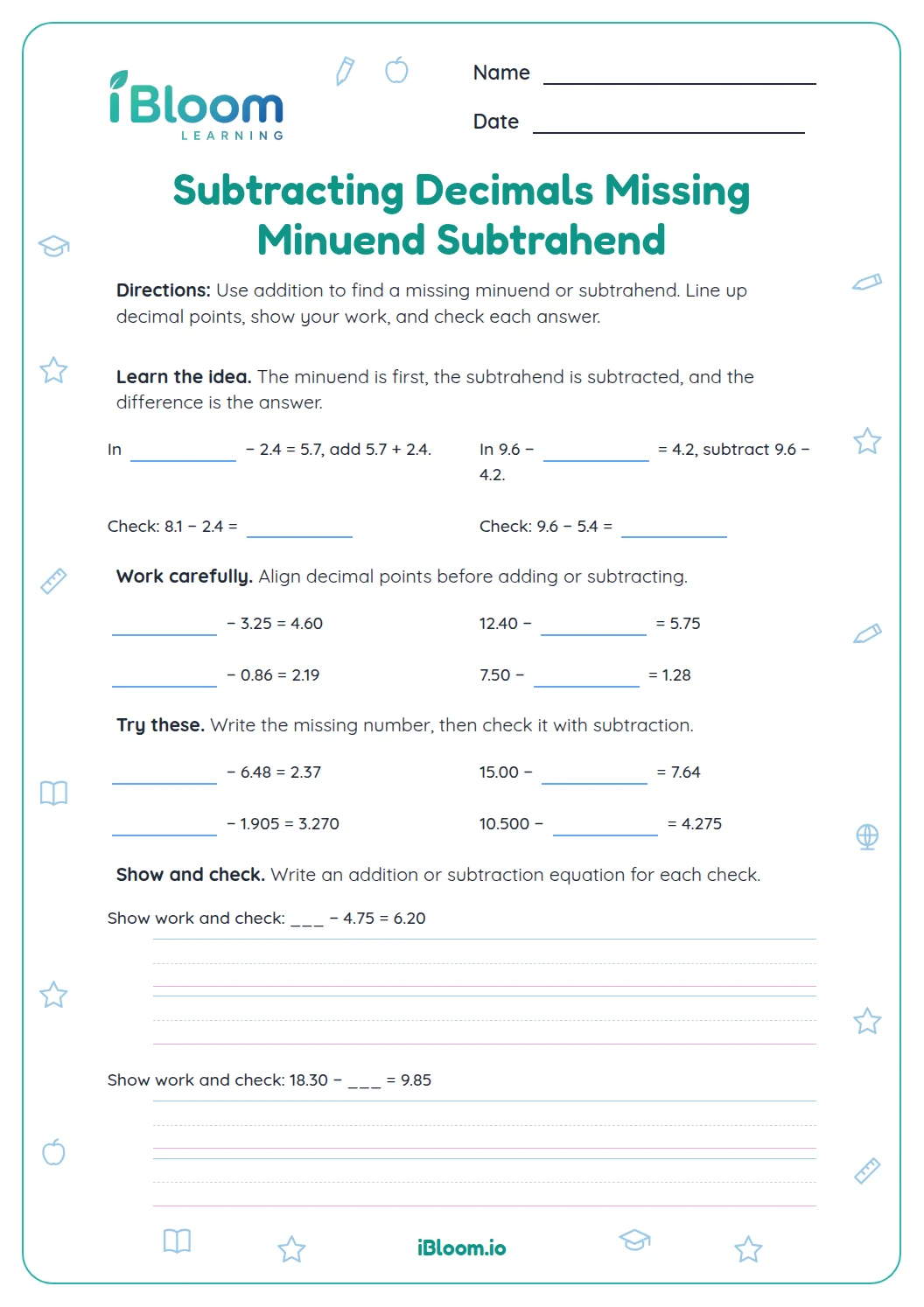
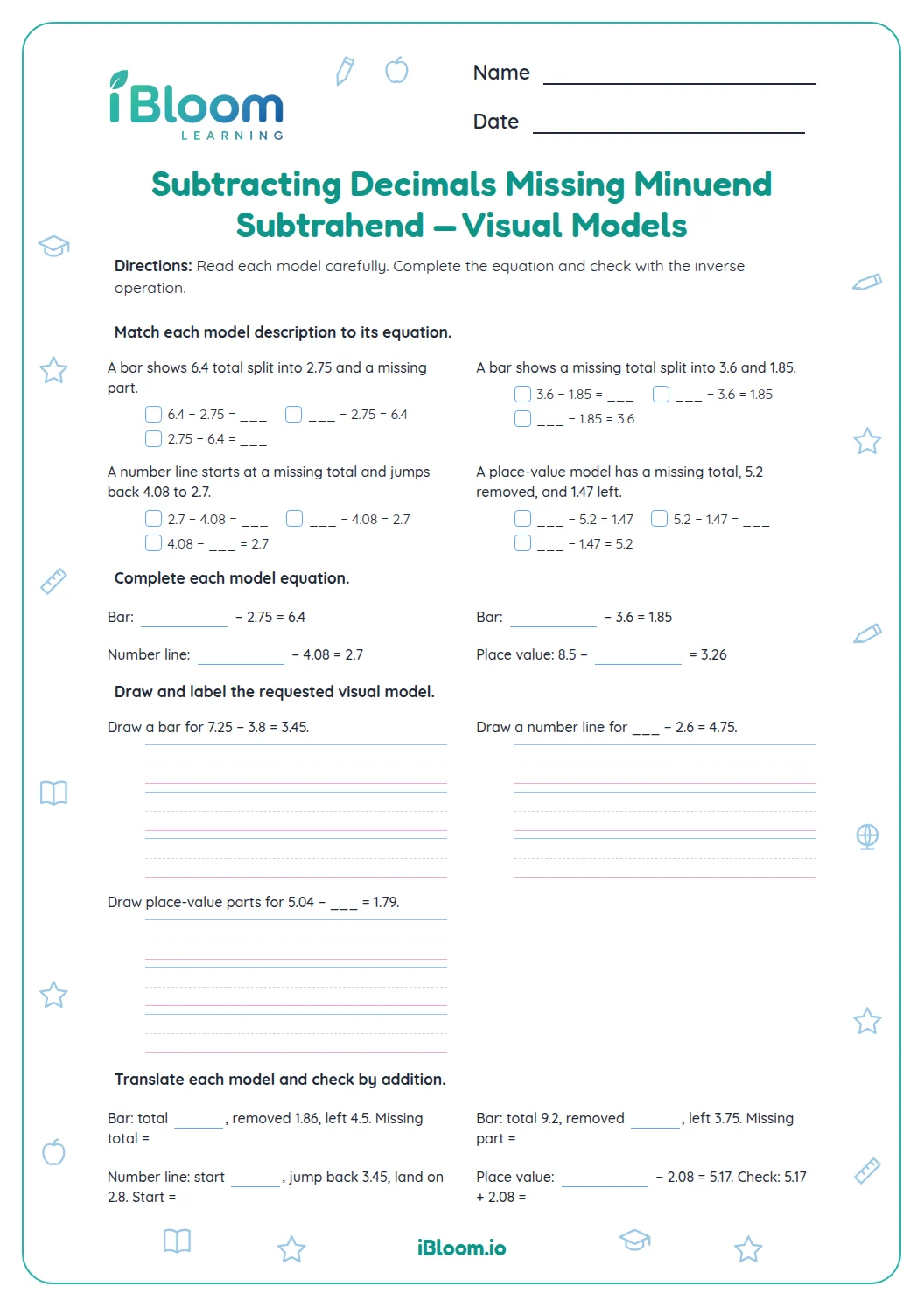
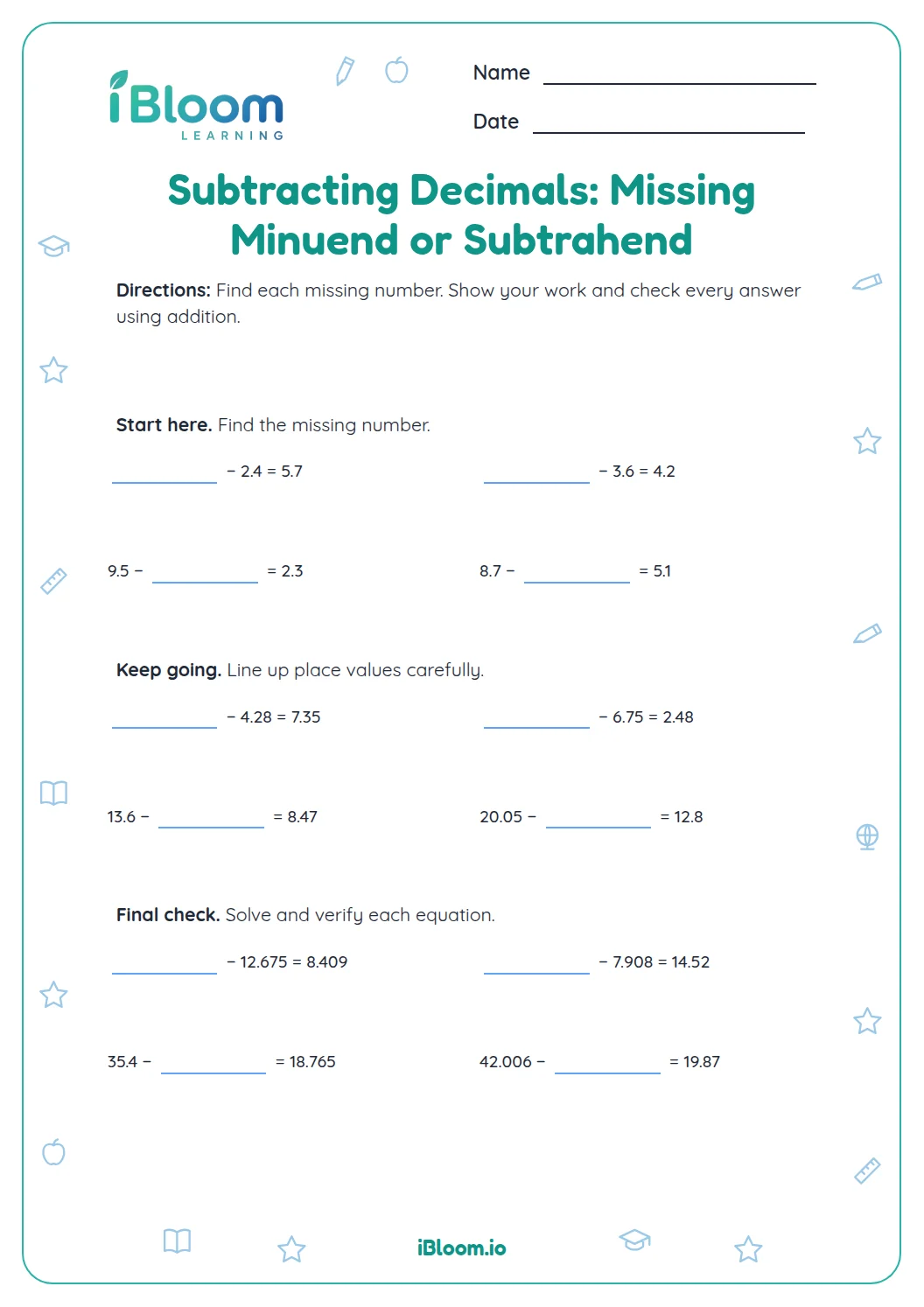
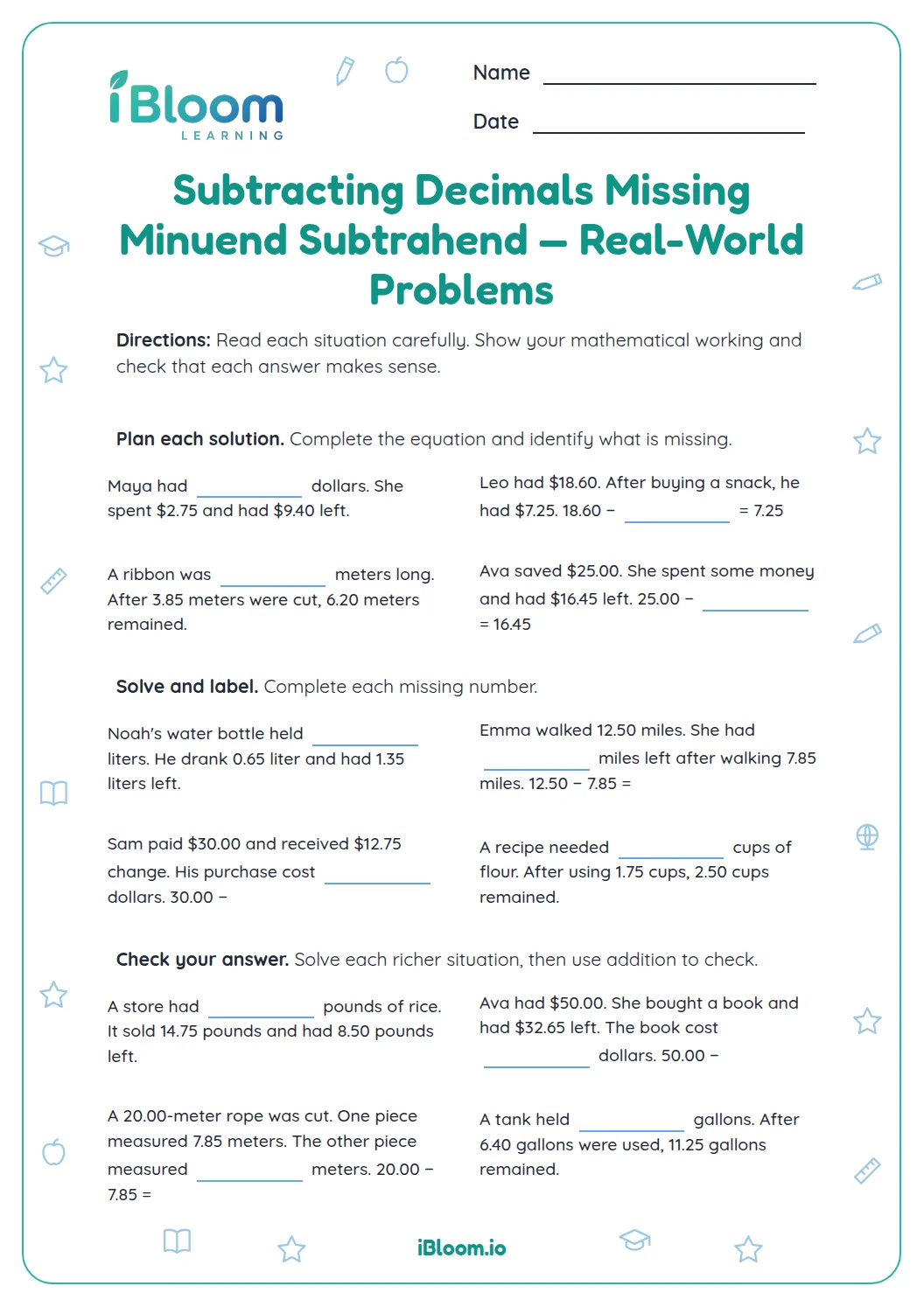
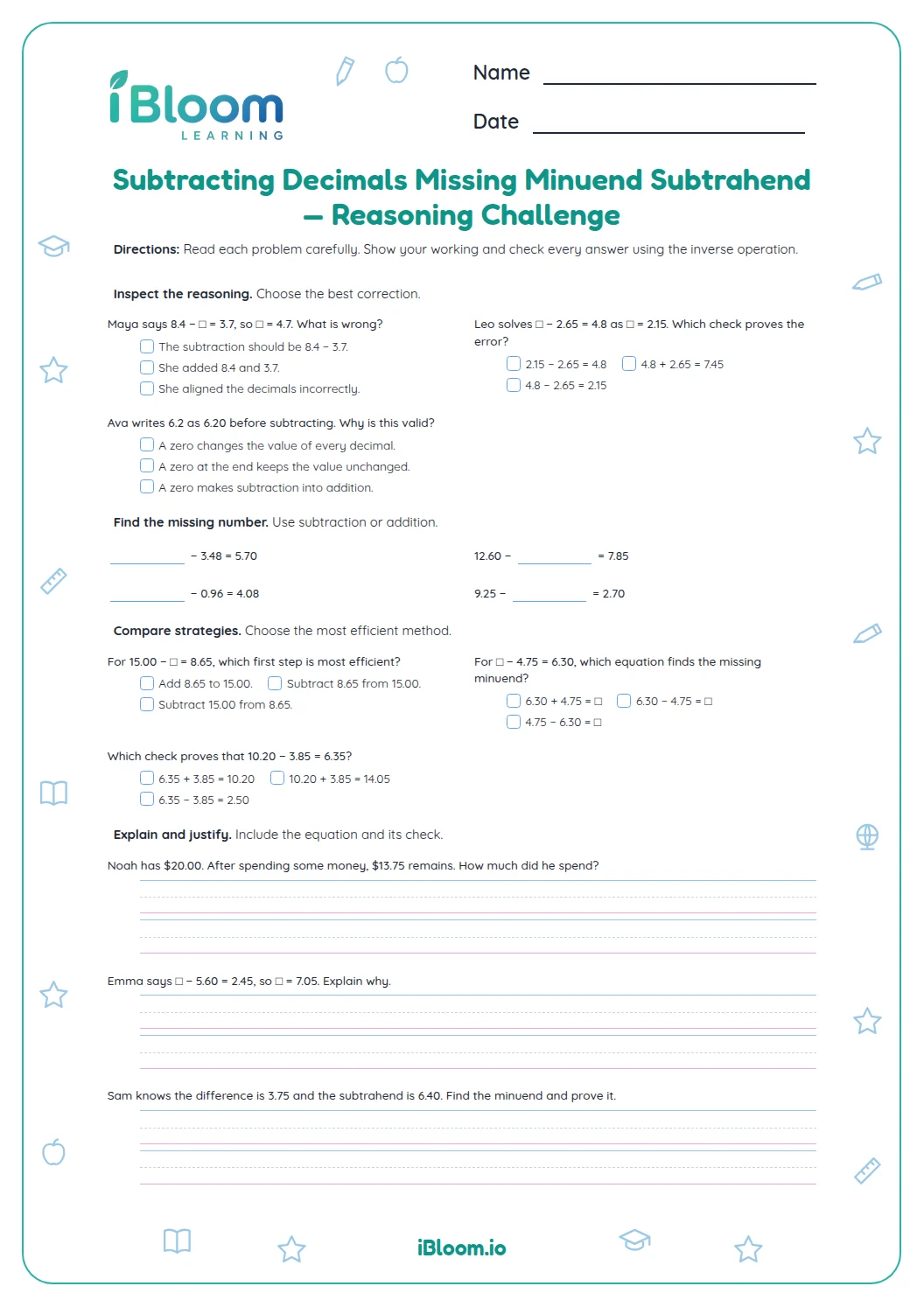
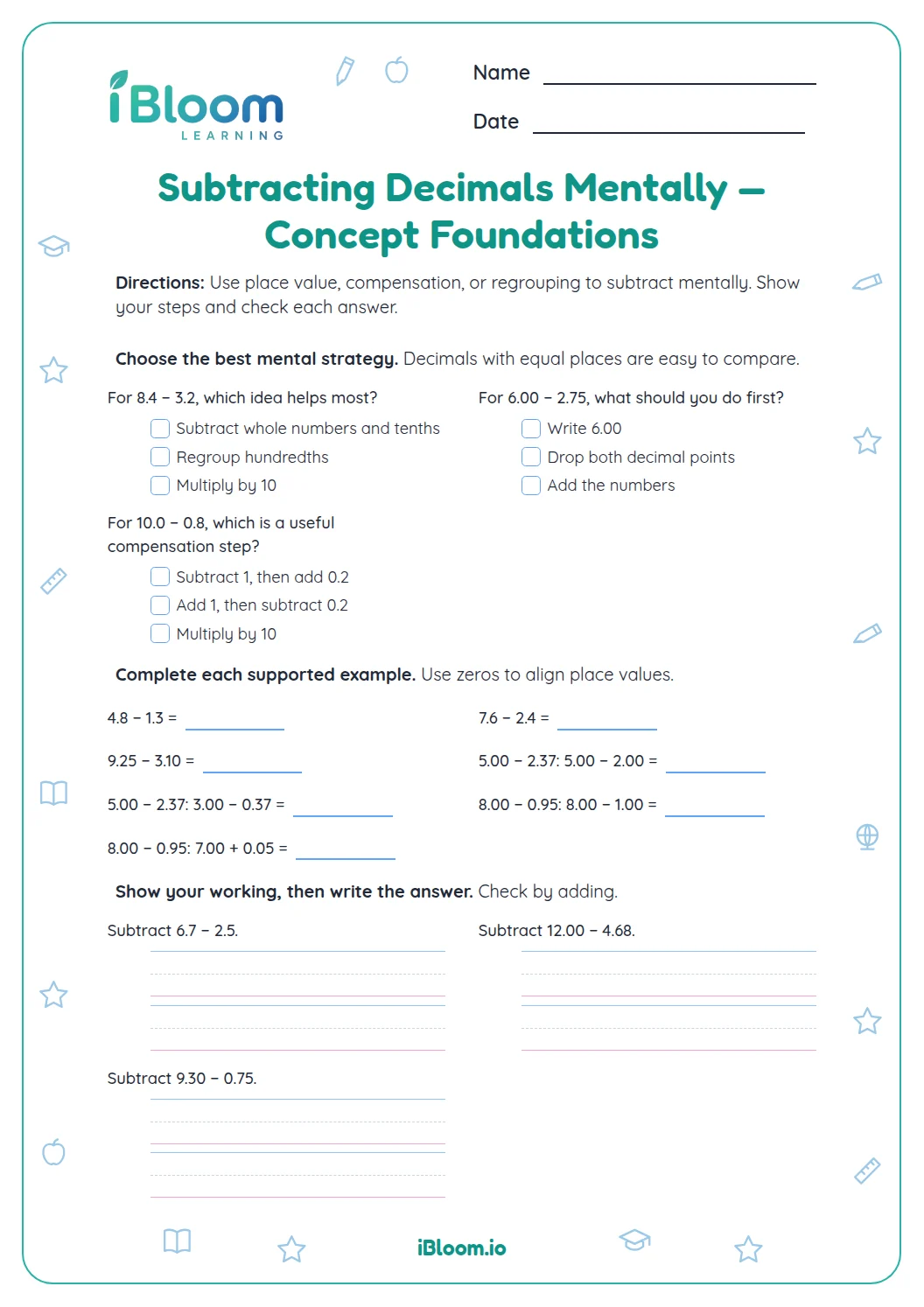
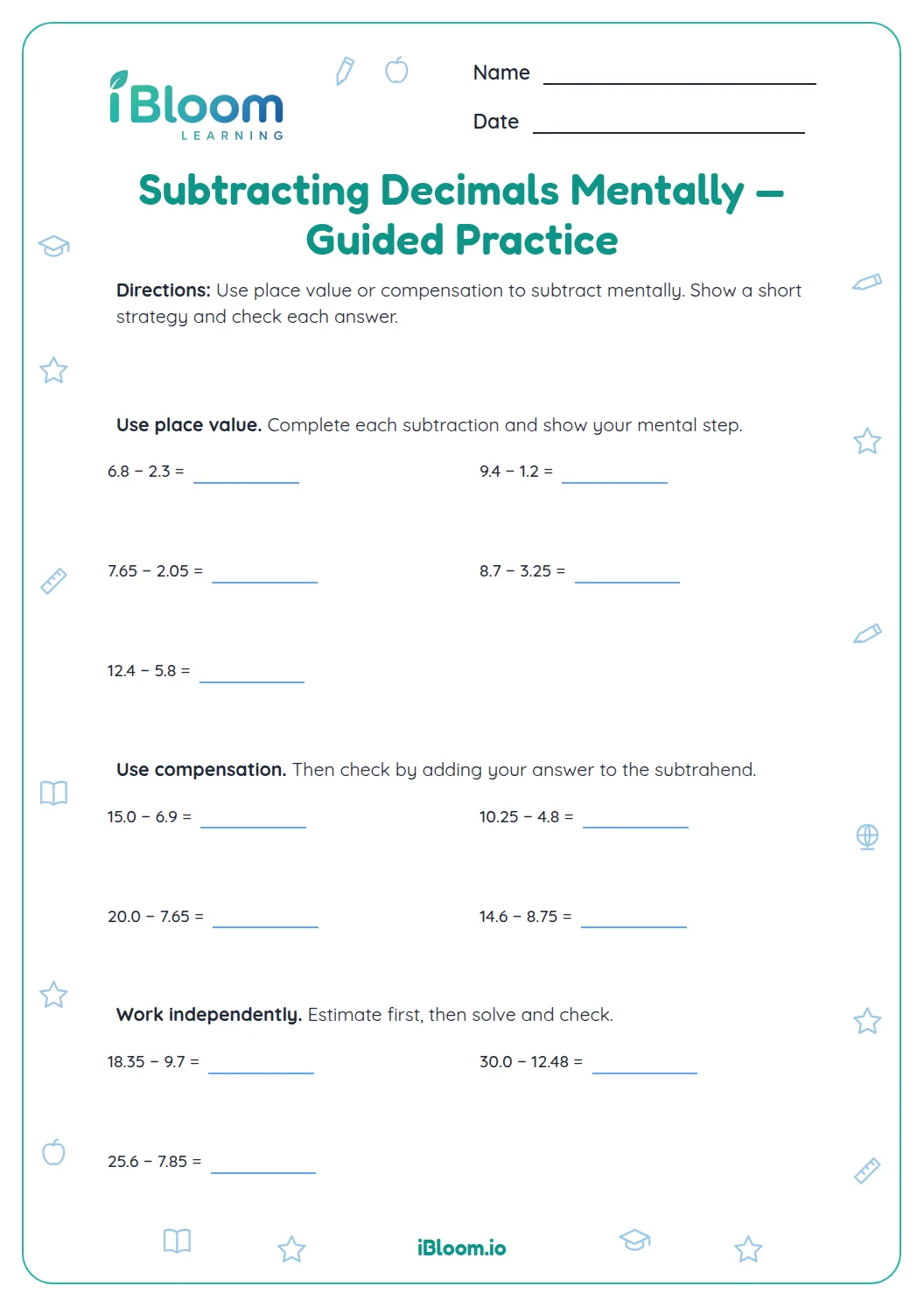
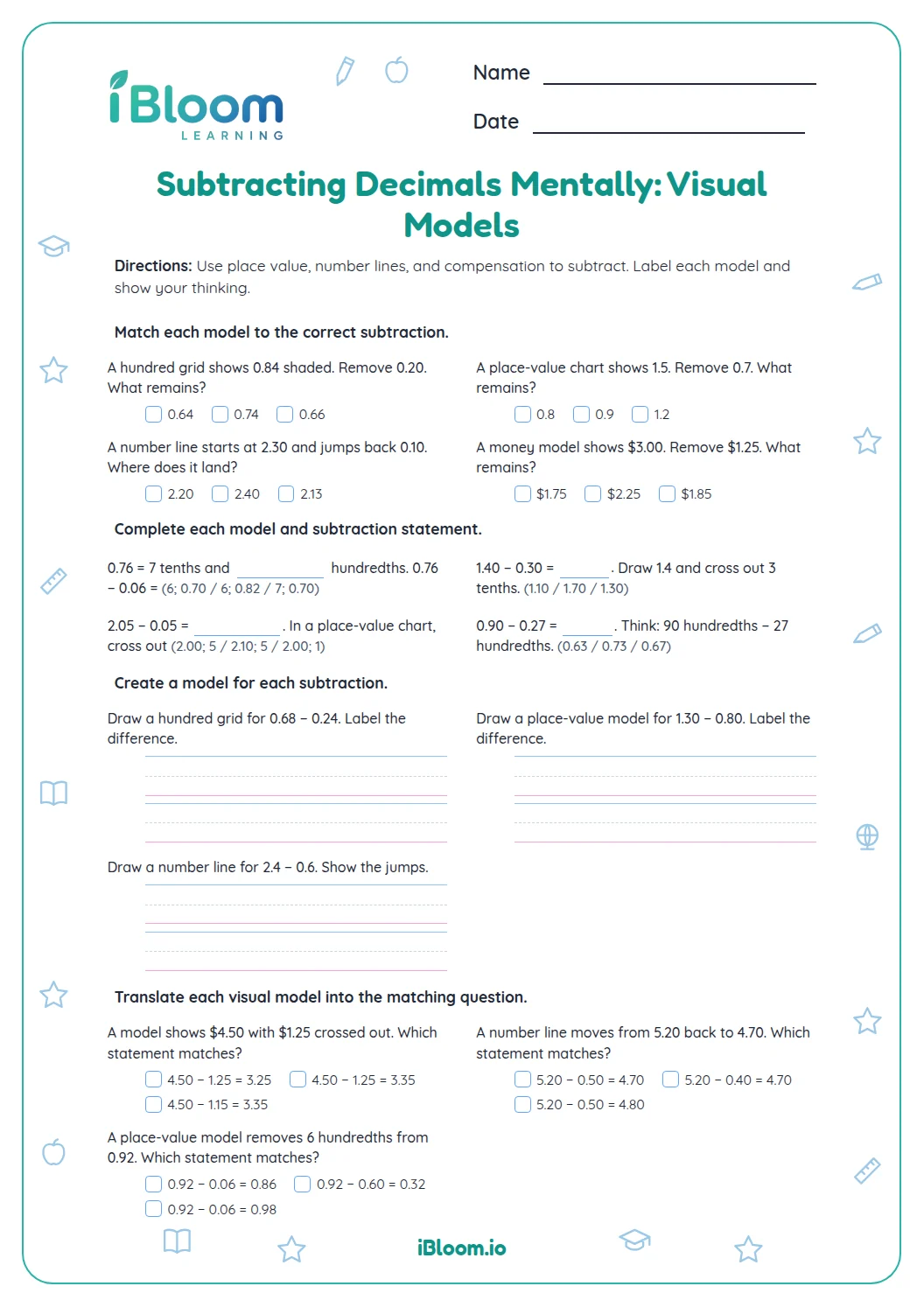
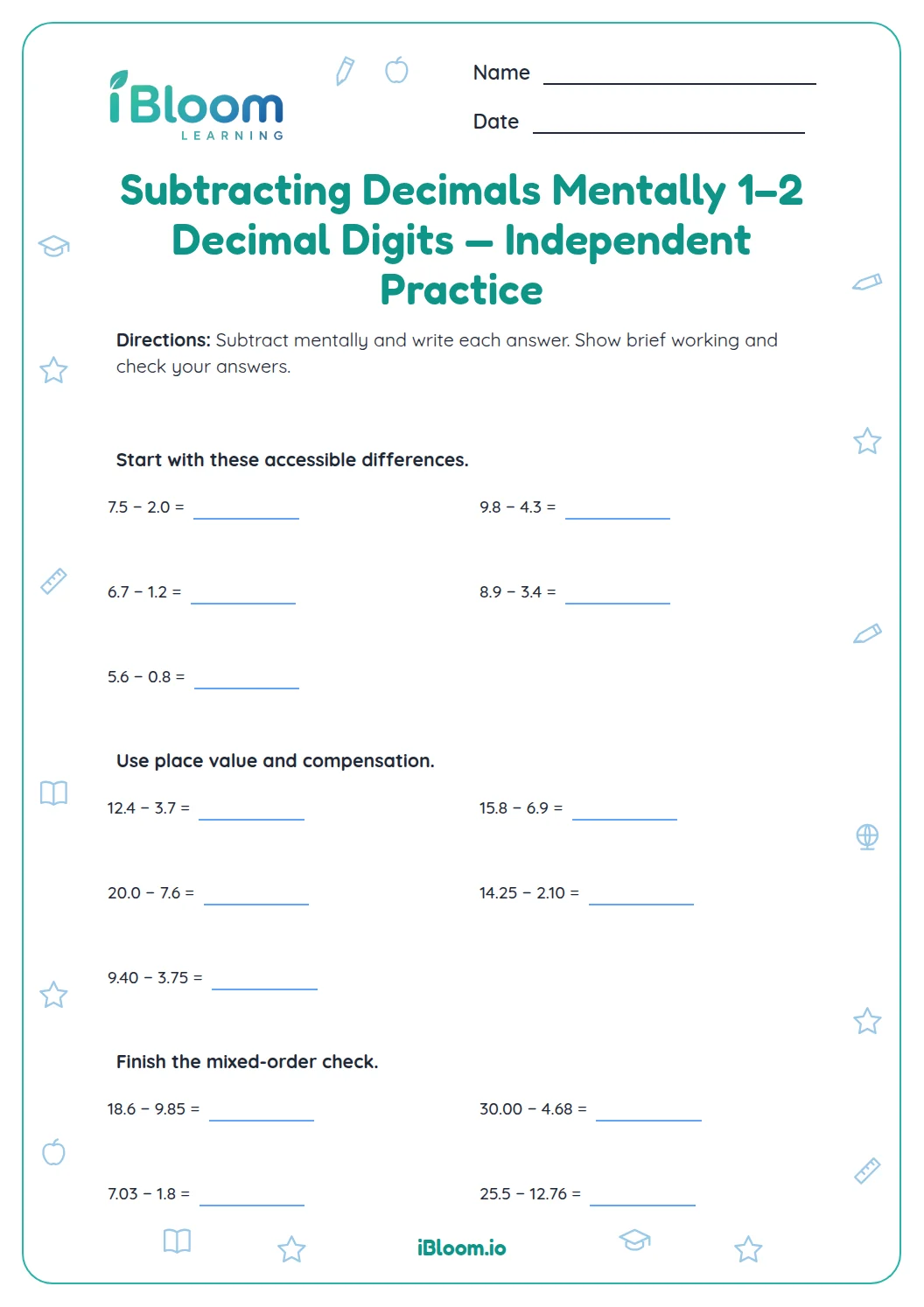
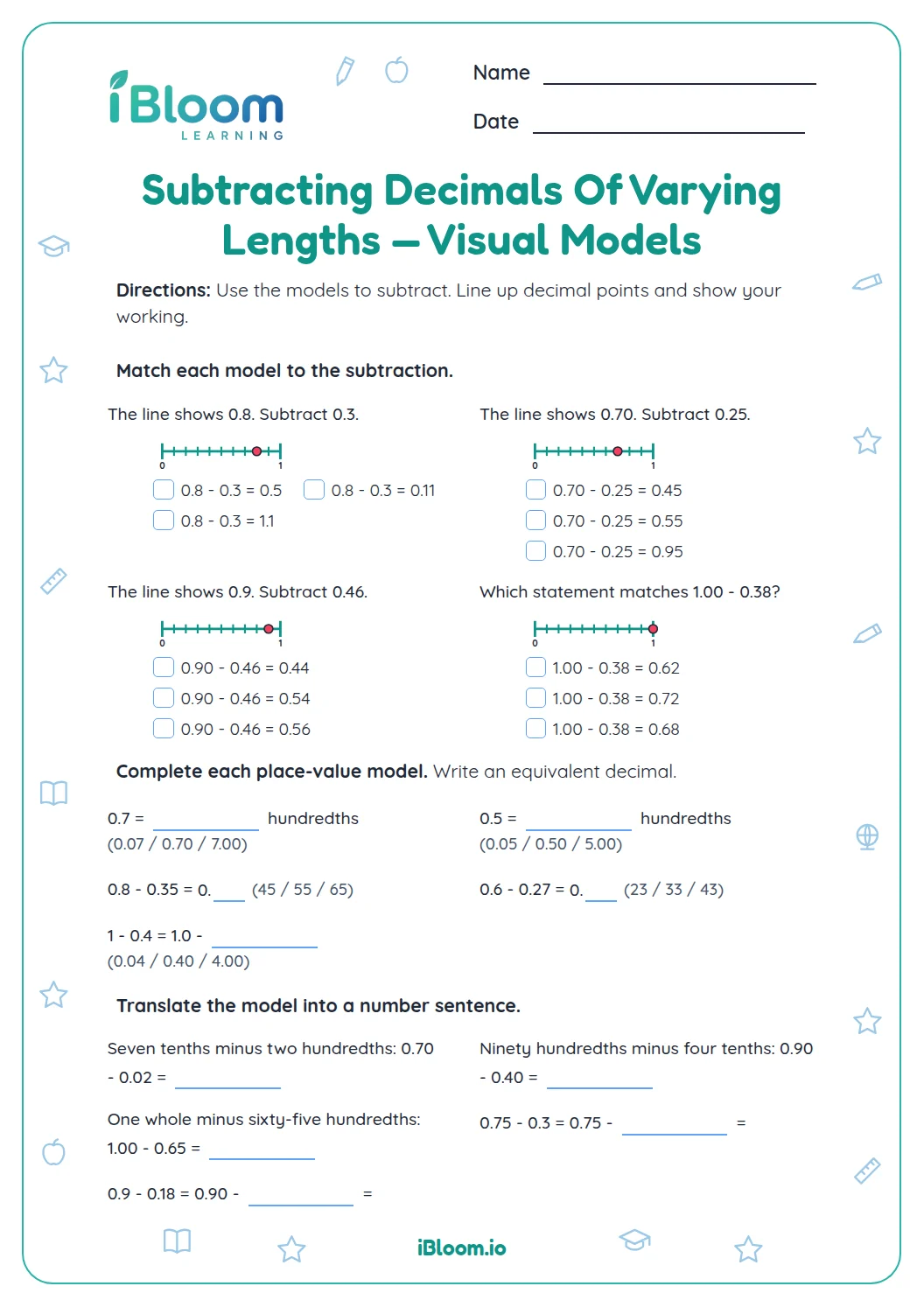
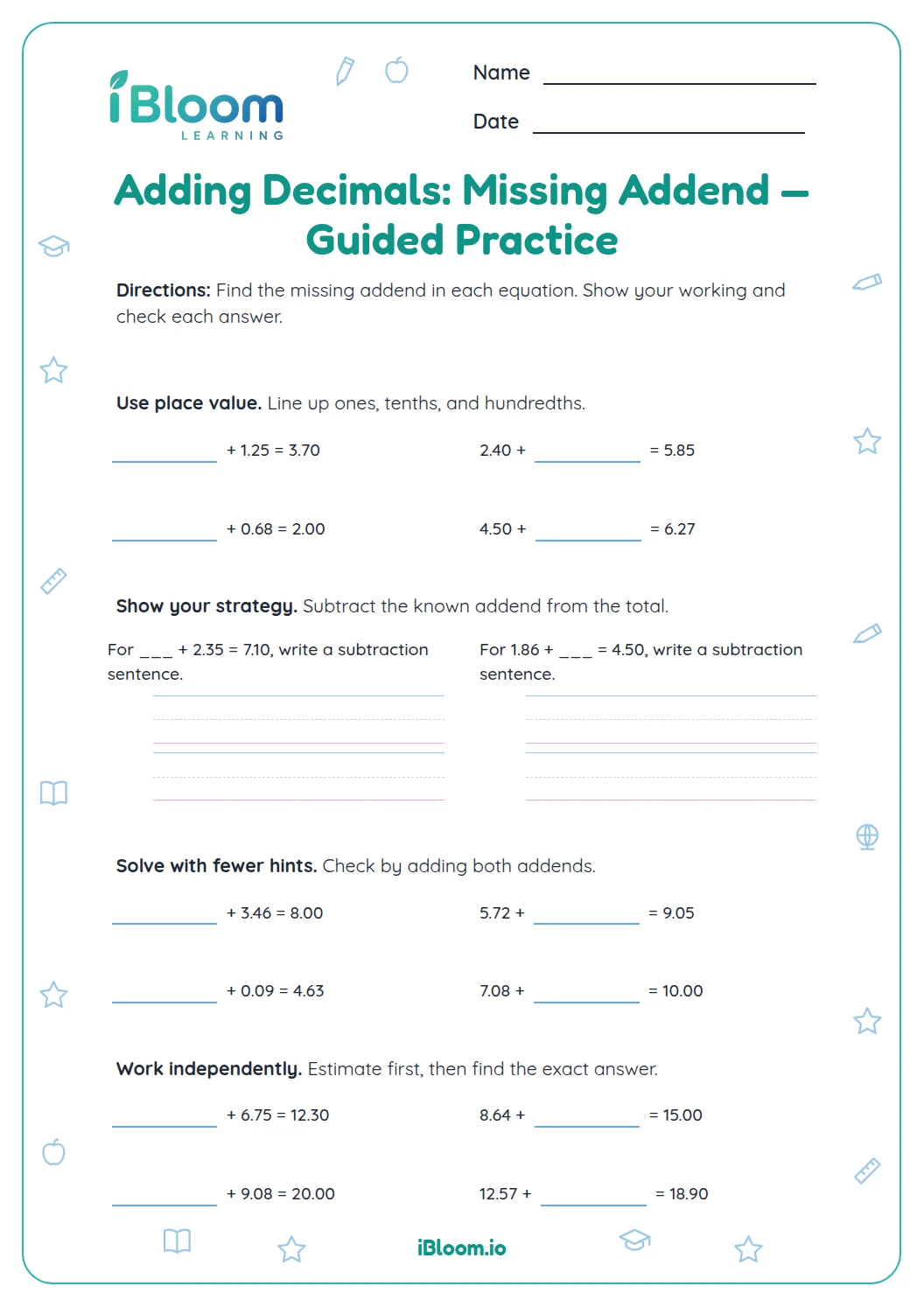
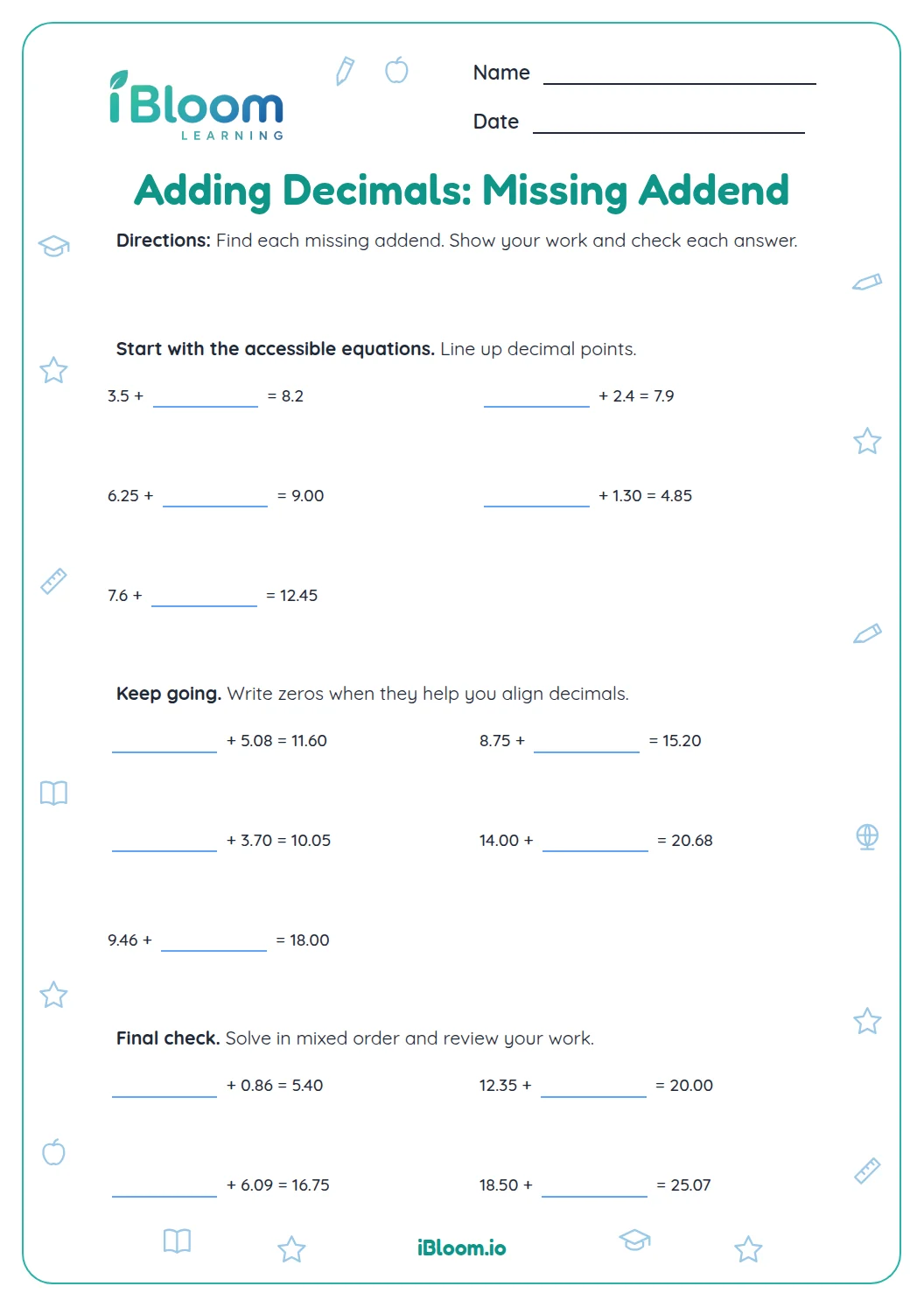
This free printable Grade 6 worksheet guides students through subtraction equations with a missing starting amount or missing amount taken away. Four operation choices establish when to add or subtract, followed by four missing-minuend equations and four missing-subtrahend equations. Four mixed equations provide space to align decimal places and check by substitution. Values extend through thousandths, including unequal decimal lengths and zeros. The practice aligns with Common Core 6.NS.B.3. A separate answer key gives each operation and missing value.
Aligned to 6.NS.B.3
What do minuend and subtrahend mean?
The minuend is the starting amount, the subtrahend is the amount taken away, and the difference is the result. In 8.6 − ___ = 3.27, the starting amount and difference are known. The missing amount is what was removed.
Part A asks students to identify the calculation before they compute. The same four equations return in Parts B and C so students can apply the choices they made.
How do you find a missing starting amount?
Add the two known amounts: the part taken away and the part remaining. In question 5, align 4.80 and 2.35 by their decimal points before adding. The zero in 4.80 makes the hundredths column visible.
- 1___ − 2.35 = 4.8
- 24.80 + 2.35 = 7.15
- 3Check: 7.15 − 2.35 = 4.80
- 4The missing minuend is 7.15.
How do you find the missing amount taken away?
Subtract the known difference from the starting amount. For question 11, write 10.020 − 6.875. After regrouping, the missing amount is 3.145. Adding 6.875 and 3.145 returns 10.020.
The mixed questions remove the operation cue. Students first locate the blank, calculate in columns, and substitute the result into the original subtraction equation. This final check can catch both an incorrect operation and a misplaced decimal point.
Follow the missing part
- 1Name the starting amount, amount taken, and difference in each equation.
- 2Choose the operation in Part A before calculating.
- 3Use the model in Part B to add when the starting amount is missing.
- 4Use the model in Part C to subtract when the amount taken is missing.
- 5In Part D, align decimal points and add zeros where helpful.
- 6Substitute each result into the original equation and check that both sides agree.
Common missing-number errors
The mistake
Subtracting the known numbers whenever a minus sign appears.
The fix
Locate the blank first: a missing starting amount requires addition.
The mistake
Lining up the last digits instead of the decimal points.
The fix
Rewrite 4.8 as 4.80 so tenths and hundredths share their own columns.
The mistake
Writing 0.508 as 0.058 when adding zeros.
The fix
Append zeros on the right; keep each original digit in its place.
Common Core alignment
Use standard decimal addition and subtraction to recover missing numbers.
On this sheet: Students align decimal places to calculate missing subtraction terms through thousandths and check each equation.
Show the official wordingHide the official wording
Fluently add, subtract, multiply, and divide multi-digit decimals using the standard algorithm for each operation.
What to practice next
Make more practice
Further reading
Questions parents and teachers ask
Which part of the subtraction equation is missing?
The worksheet practices both possible input positions. Part B hides the minuend, or starting amount. Part C hides the subtrahend, or amount taken away. Part D mixes the two positions. Students should name the missing part before choosing the calculation that will recover it.
Why do some equations appear in two parts?
The first four equations appear again after the operation-choice practice. This lets students first decide how to solve and then carry out that same decision. The later questions introduce new numbers, including thousandths and whole-number starting amounts, before the final part mixes both blank positions.
Are trailing zeros allowed in an answer?
Yes, trailing zeros to the right of a decimal preserve its value. An answer of 12.800 is equivalent to 12.8, and 10.000 is equivalent to 10. Students can keep helpful zeros during column work, then use either equivalent form when writing the missing number.
How can students check a missing subtrahend?
Put the answer back into the original subtraction equation. For question 9, 8.60 − 5.33 equals 3.27, so the missing subtrahend is correct. Students can also add the subtrahend and difference: 5.33 + 3.27 returns the starting amount of 8.60 exactly.
What support is printed on the sheet?
Part A gives operation choices, and Parts B and C each include a completed model in the directions. Part D provides work grids for decimal alignment and checking. Students can refer back to either model whenever they need help deciding what to do with a blank.