




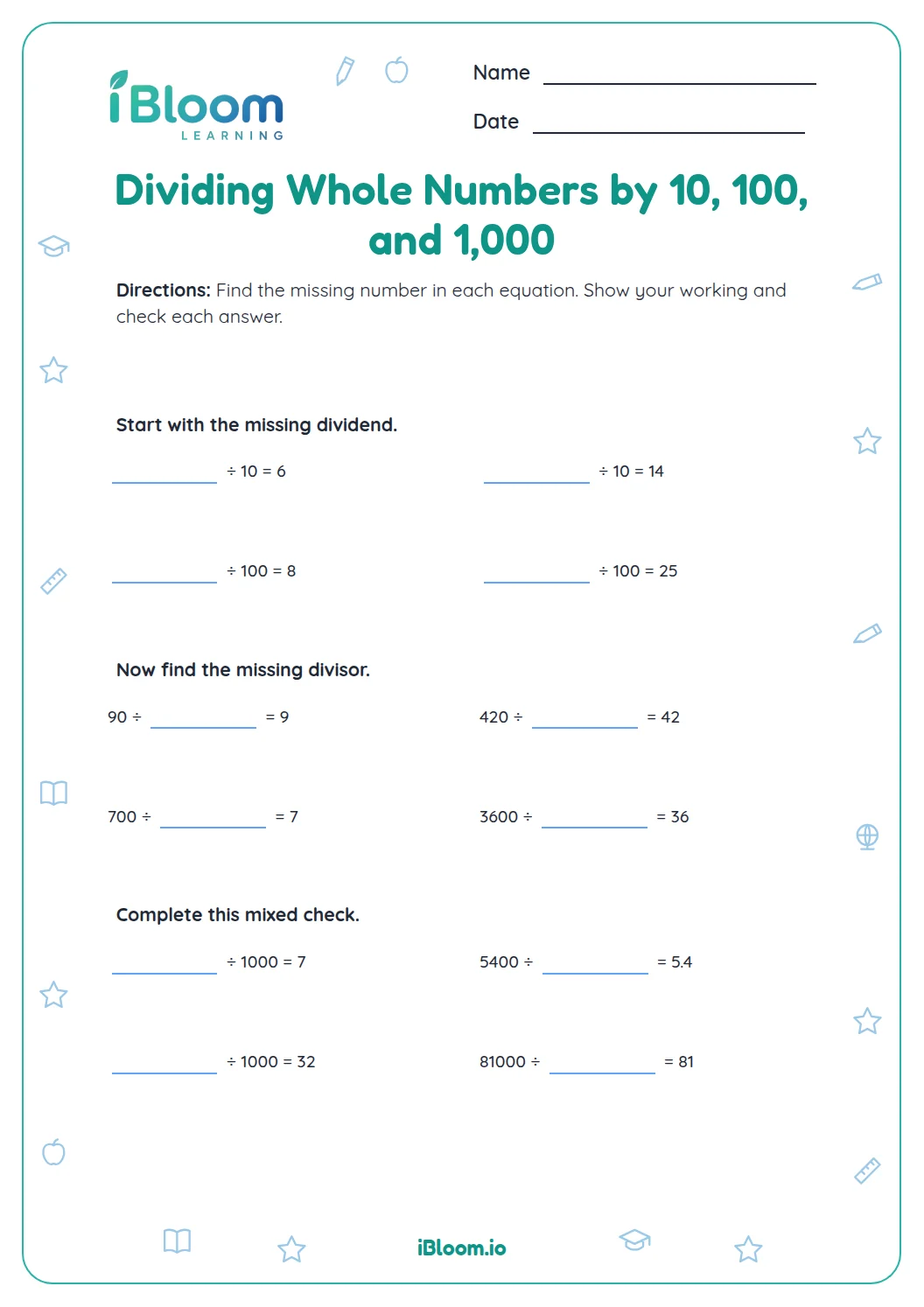
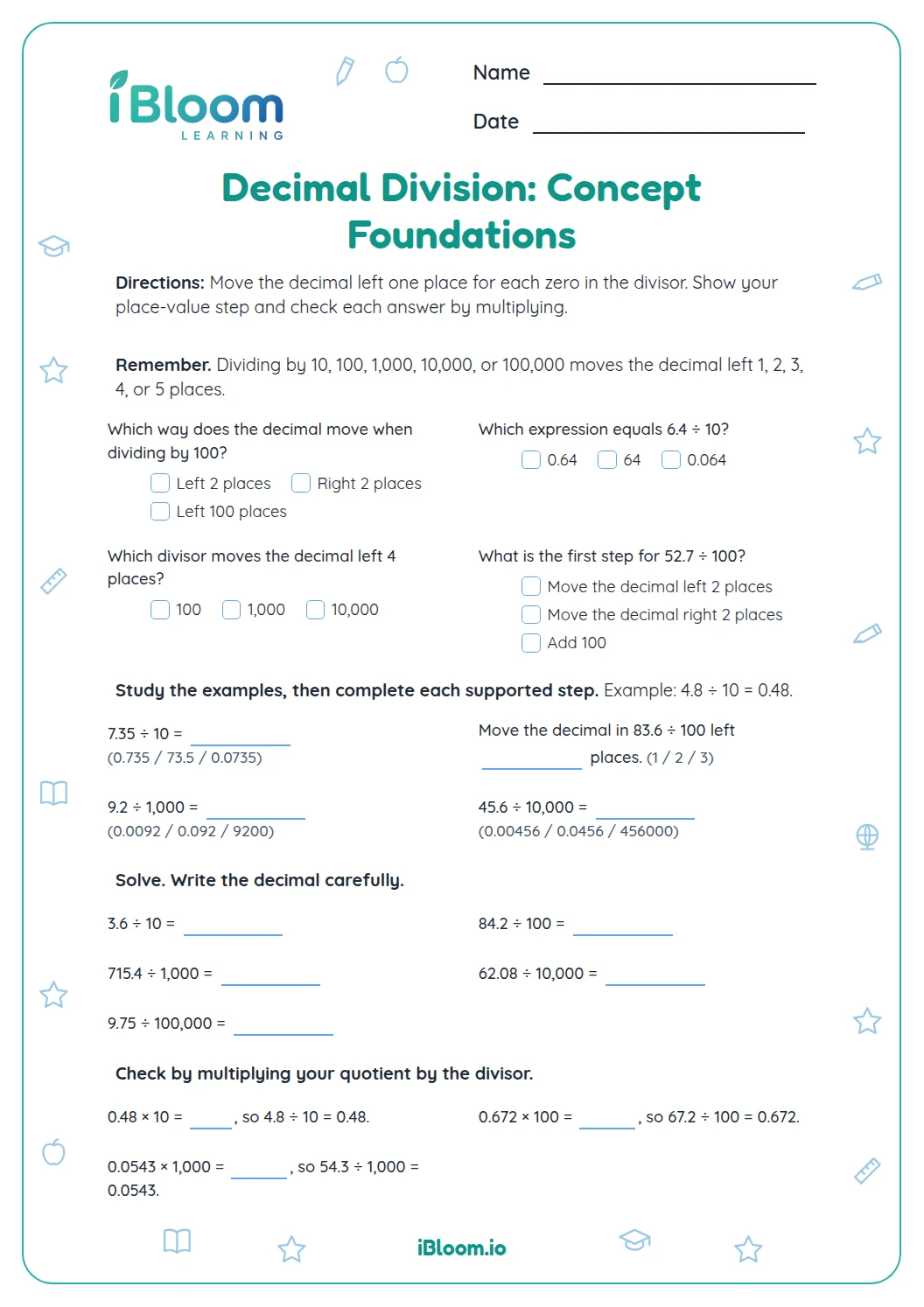
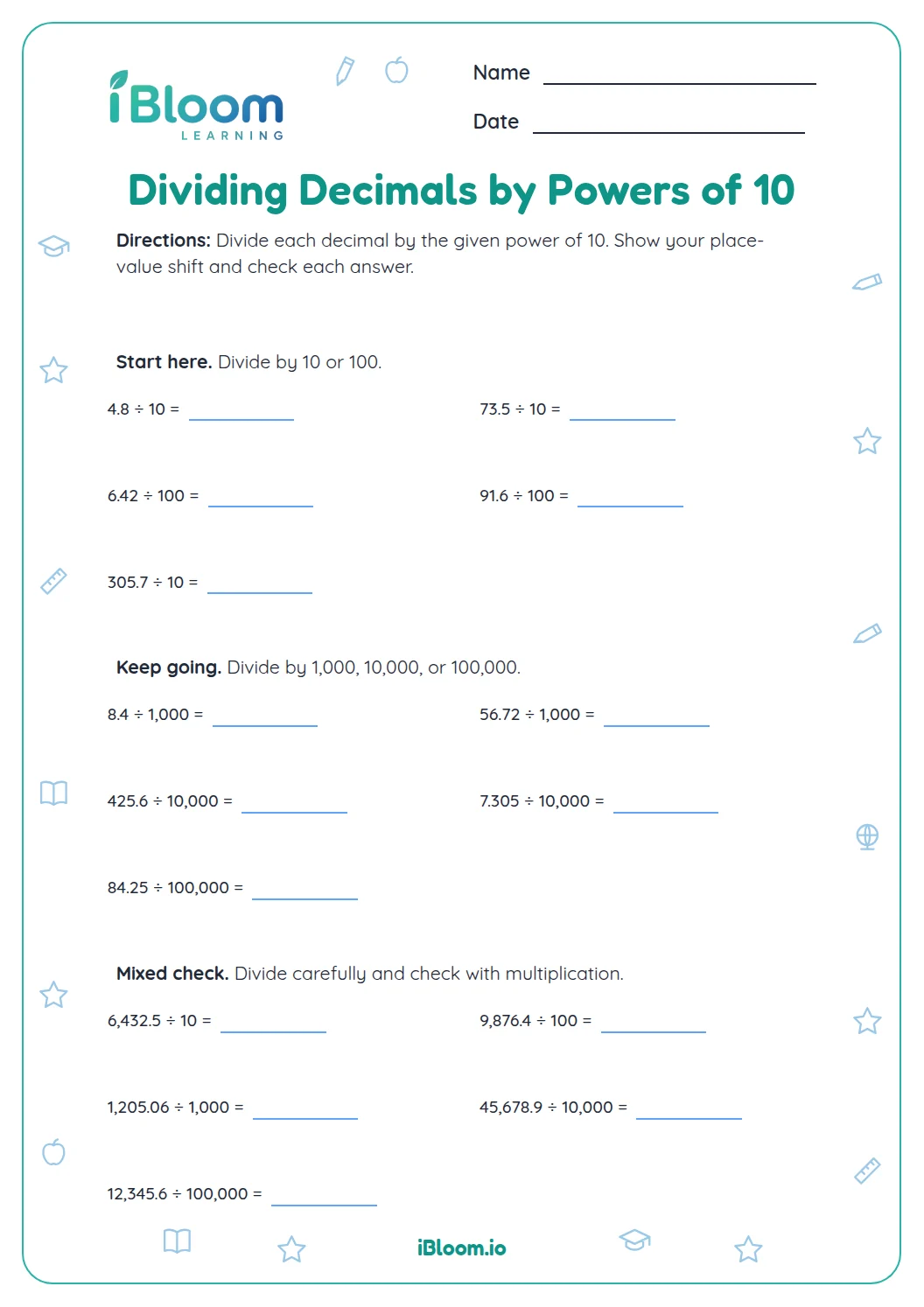
About this worksheet
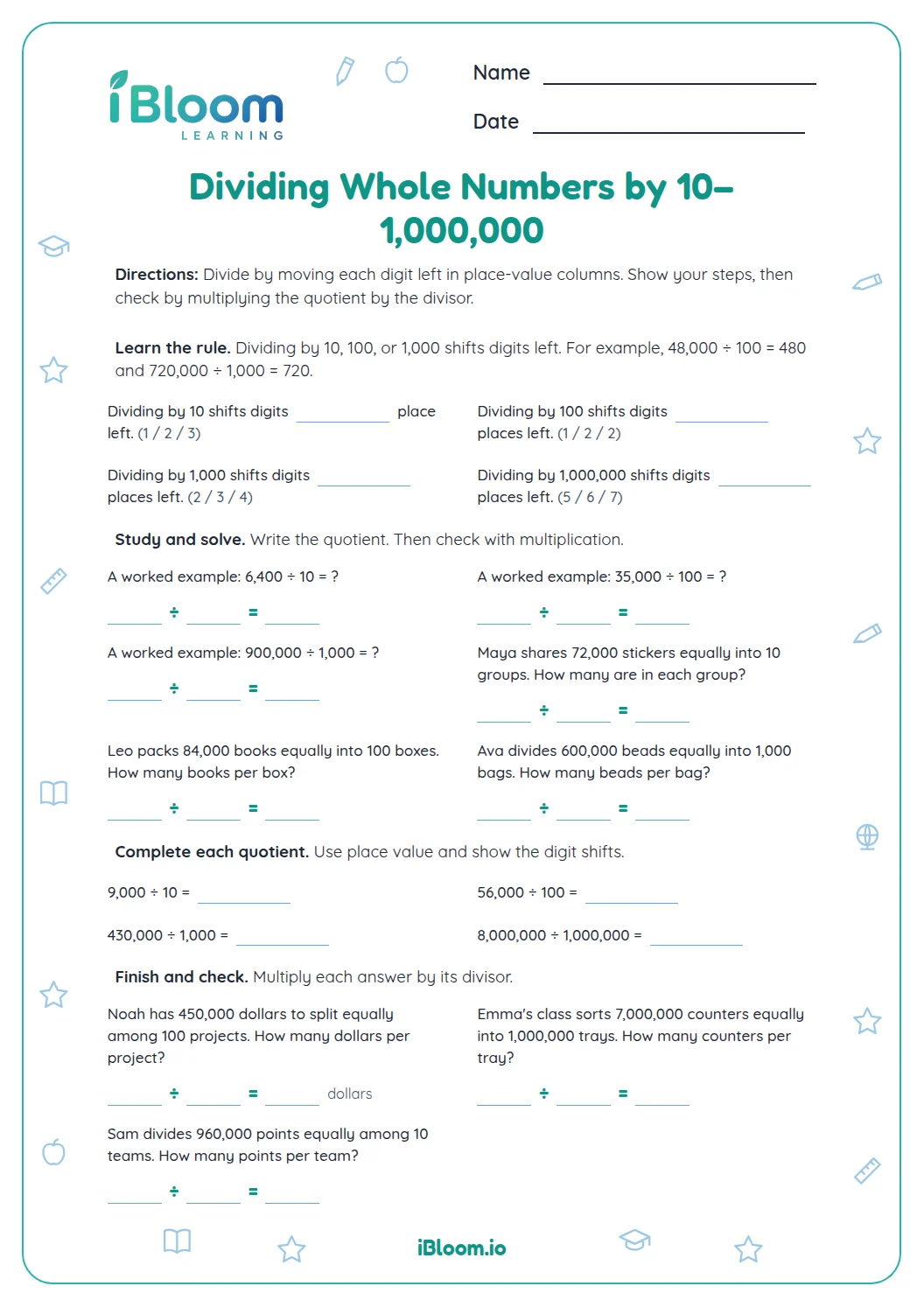
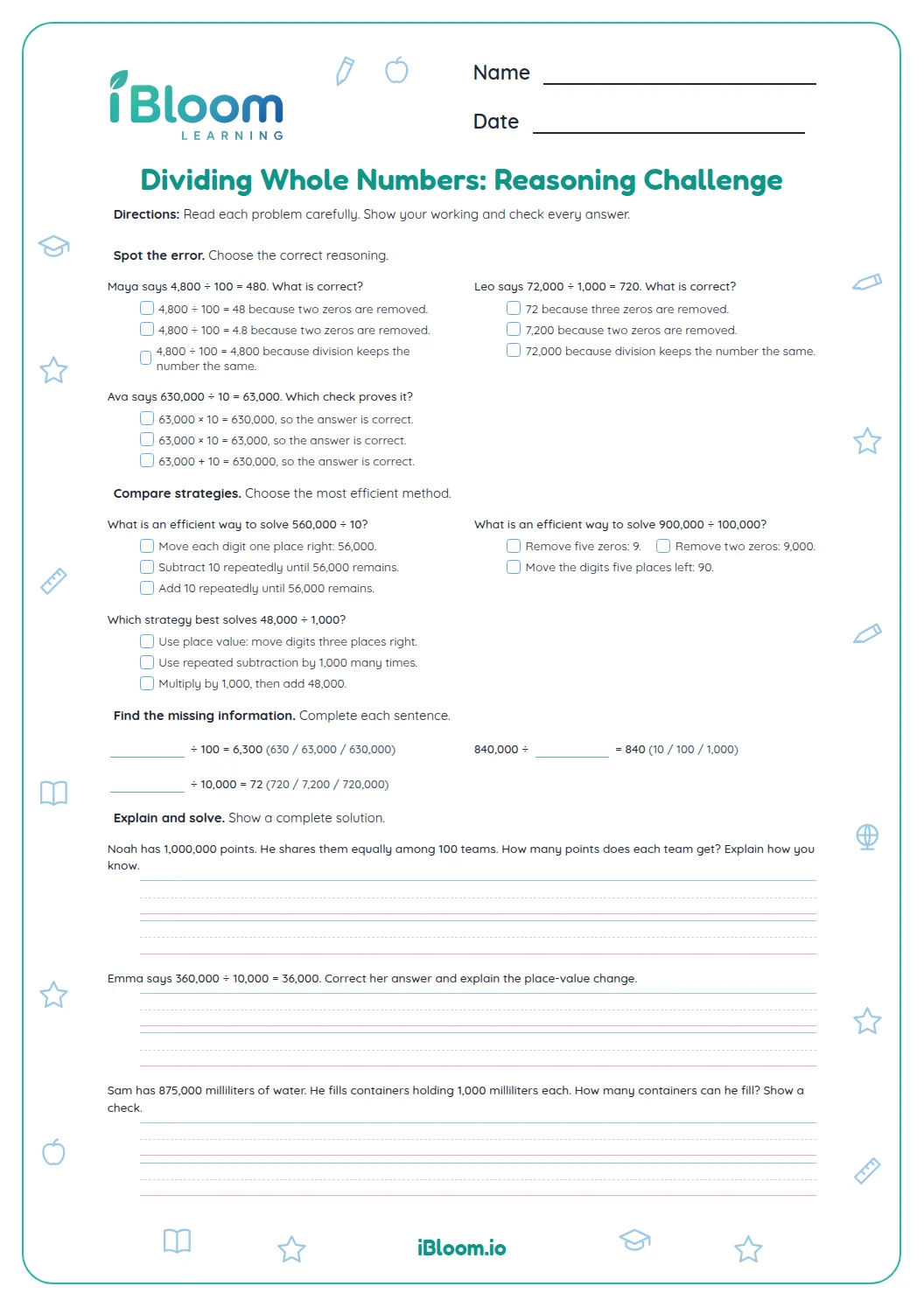
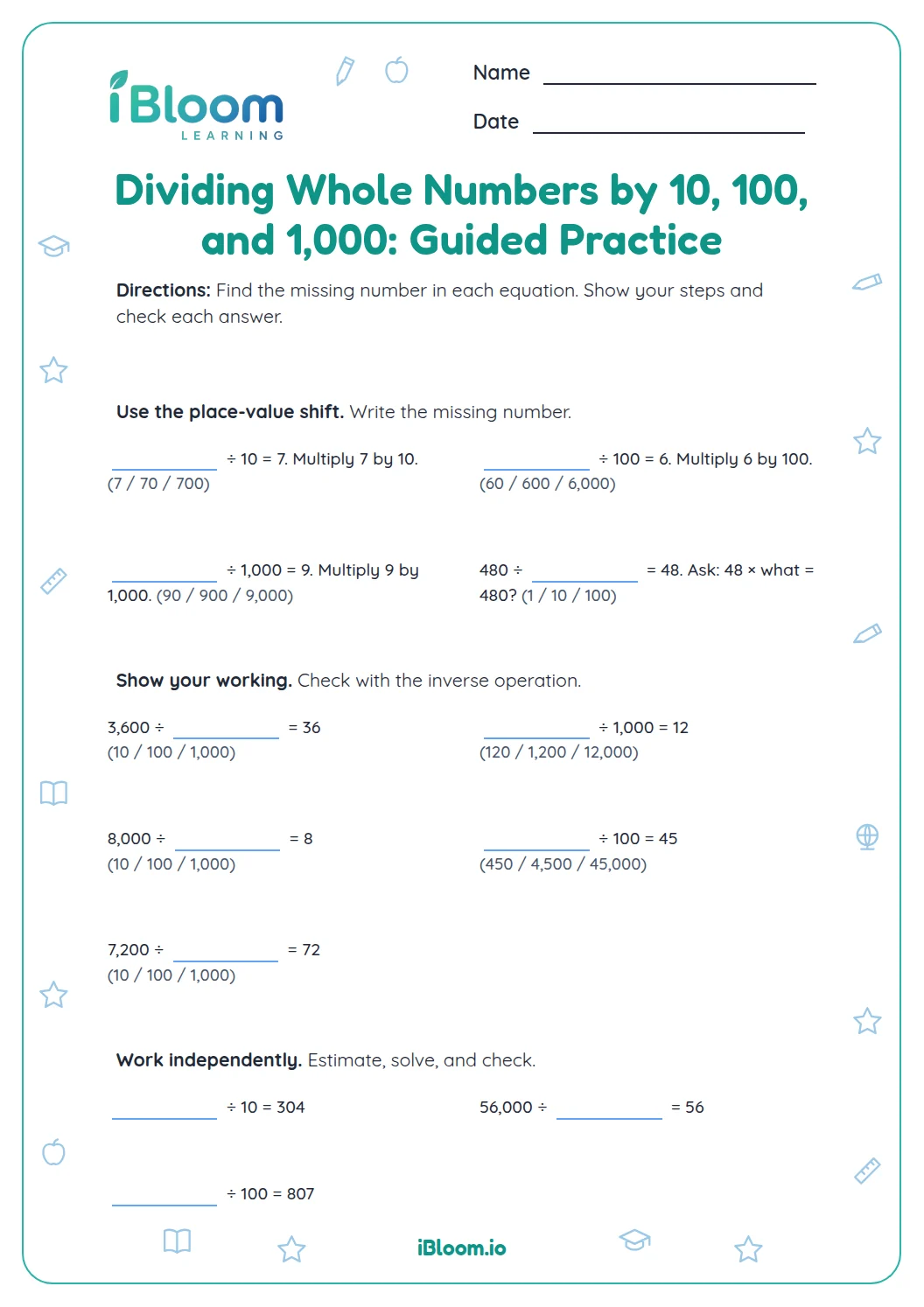
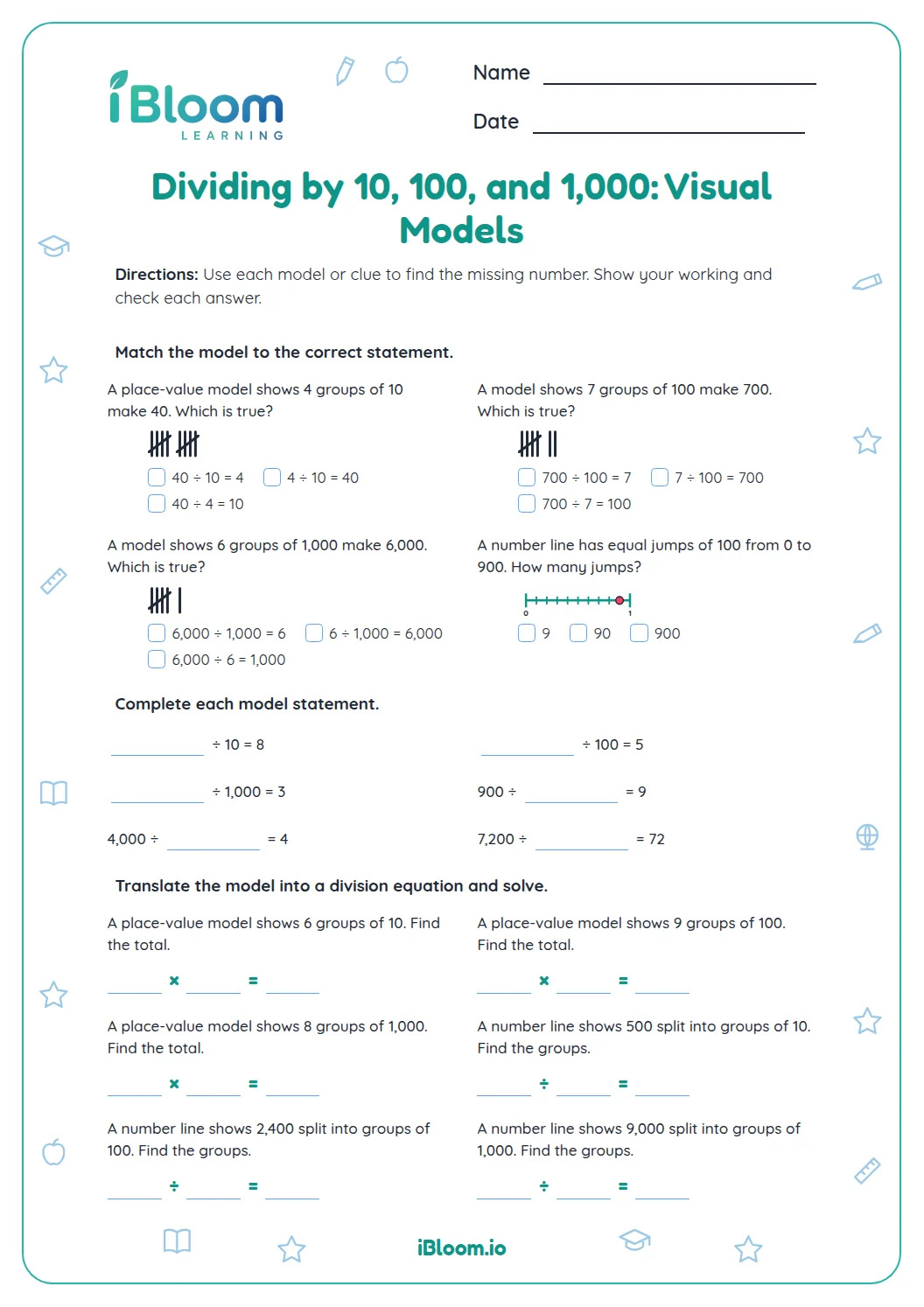
This free Grade 6 worksheet turns division by 10, 100, and 1,000 into practical situations about supplies, schools, tickets, farms, and money. Students decide whether the quotient counts groups or gives an amount per group, then label their answers with the right unit. The dividends reach 7,200,000, and every situation has a whole-number quotient. A separate answer key is included. The work practices fluency with multi-digit division in CCSS 6.NS.B.3.
Aligned to 6.NS.B.3
What does the quotient count?
A division story may ask for the number of groups or for the amount in each group. Notice which quantity is already known, then divide the total by that quantity. Keep the story’s unit in the final response.
- 14,800 pencils ÷ 10 pencils per box
- 24,800 ÷ 10 = 480
- 3The quotient counts boxes.
- 4Answer: 480 boxes
How does place value help?
Dividing by 10, 100, and 1,000 changes place values by one, two, or three places. Students can also use multiplication to check: quotient × divisor should equal the starting total.
How should money answers be written?
Keep the dollar sign when the question asks how much money each group receives or earns. Commas help show the value clearly, especially when the quotient is large.
Why label each answer?
The number alone may not tell whether it represents boxes, batches, regions, or dollars. A unit links the quotient to the question and helps students notice whether they found the group size or the number of groups.
How can I use this worksheet?
- 1Underline the total amount in the story.
- 2Circle the divisor or group size.
- 3Decide whether the quotient counts groups or items per group.
- 4Divide by tracking the place-value shift.
- 5Write the unit that completes the answer.
- 6Multiply to check the quotient against the original total.
Common mistakes and quick fixes
The mistake
Moving digits the wrong number of places.
The fix
Count one place for 10, two for 100, and three for 1,000.
The mistake
Giving the right number with the wrong meaning.
The fix
Reread whether the question asks “how many groups” or “how many in each group.”
The mistake
Leaving off a unit or dollar sign.
The fix
Name the countable group or write the money symbol in the final answer.
Curriculum alignment
These situations use division of whole numbers by powers of ten to find equal groups or group sizes.
Use the standard algorithm to divide multi-digit decimals fluently.
On this sheet: The practice divides multi-digit whole-number quantities by 10, 100, or 1,000, yielding whole-number quotients.
Show the official wordingHide the official wording
Fluently add, subtract, multiply, and divide multi-digit decimals using the standard algorithm for each operation.
What to practice next
Make more practice
Further reading
Questions parents and teachers ask
How do you divide a whole number by 10, 100, or 1,000?
Use place value to find the quotient. Dividing by 10, 100, or 1,000 shifts each place value one, two, or three places to the right in the quotient’s place-value chart, or equivalently moves the digits’ place values down by that many places. The story tells what unit the answer should name.
Why does the answer need a label?
A quotient may count boxes, rolls, groups, dollars, or items per classroom. The unit makes clear what the number means in the situation. Several questions also use money, so the answer key keeps the dollar sign and comma formatting.
What is the difference between number of groups and items per group?
Read what is being asked. If a total is split among a known number of groups, the quotient gives the amount in each group. If the group size is known, the quotient gives how many groups can be filled.
Do all problems divide exactly?
Yes. Each situation is chosen so that division by 10, 100, or 1,000 gives a whole-number quotient. Students can use place value and then multiply the quotient by the divisor to check the original total. Each problem is written with an exact division relationship, so no remainder or rounding decision is needed.
How can students check a quotient?
Multiply the quotient by the divisor and see whether it recreates the starting amount. For example, 480 boxes of 10 pencils each gives 4,800 pencils. This check helps catch a quotient that has too many or too few zeros.
Is an answer key included?
Yes. The key lists the quotients with units where the story asks for them. It also gives the correct option for the multiple-choice items, so students can check each situation after completing the worksheet. Use it to check both the quotient and the unit that tells what the quotient represents.