






About this worksheet
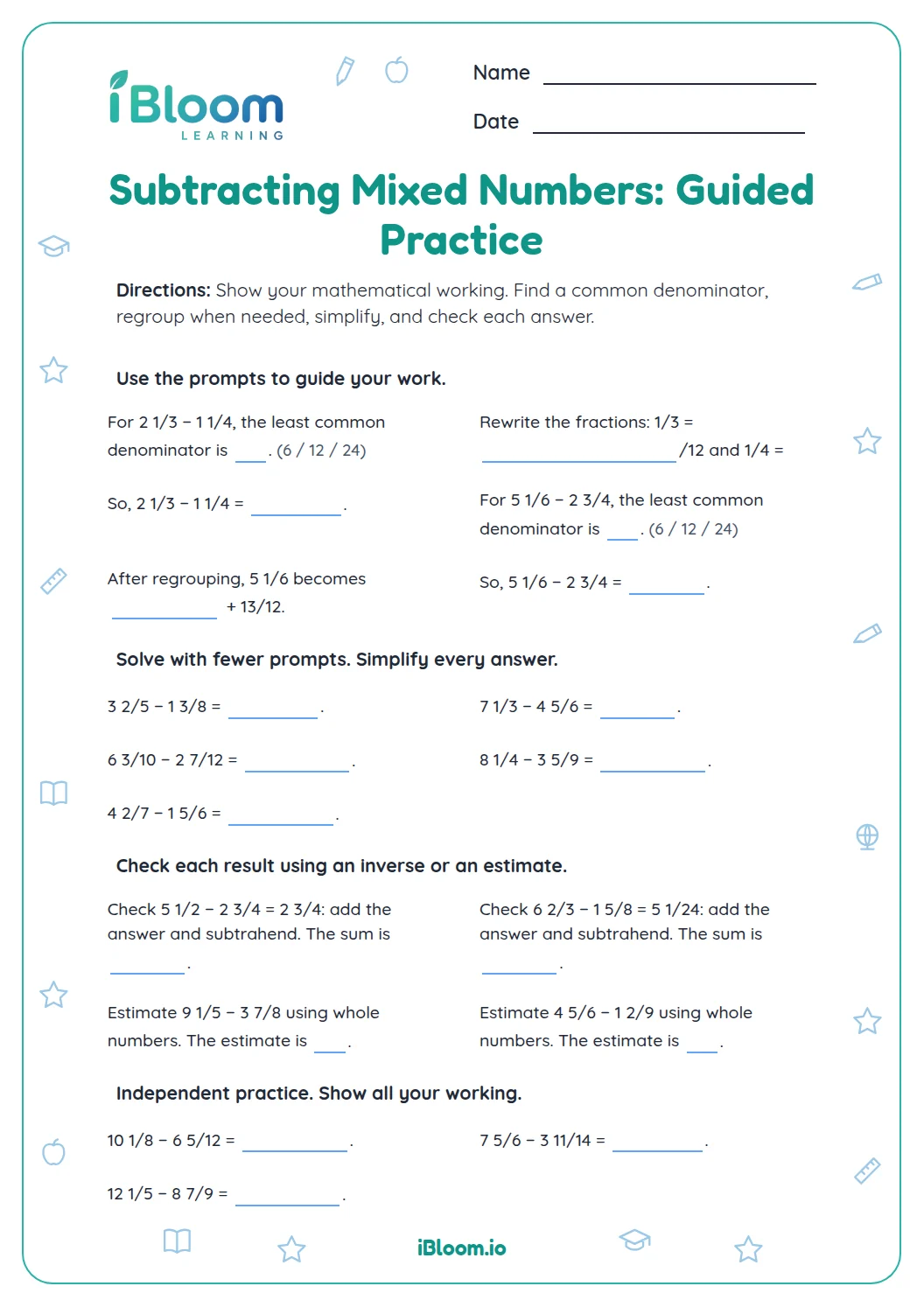
This Grade 6 worksheet introduces subtraction of mixed numbers with every denominator from 2 through 12 represented. Students subtract like-denominator fractions, regroup one whole when needed, and compare two differences. The examples reinforce equivalent-fraction reasoning in CCSS 5.NF.A.1, with a separate answer key for the 15 questions on two worksheet pages.
Aligned to 5.NF.A.1
What idea helps solve these questions?
This Grade 6 worksheet introduces subtraction of mixed numbers with every denominator from 2 through 12 represented. Students subtract like-denominator fractions, regroup one whole when needed, and compare two differences. The examples reinforce equivalent-fraction reasoning in CCSS 5.NF.A.1, with a separate answer key for the 15 questions on two worksheet pages.
How does the practice build?
When the fraction being subtracted is larger, rename one whole as an equivalent fraction with the same denominator.
How to use this worksheet
- 1Subtract fractional parts when the first fraction is large enough.
- 2If needed, rename one whole as a fraction with the same denominator.
- 3Subtract the fractions, then subtract the whole-number parts.
- 4Simplify the result when possible.
- 5For the comparison, solve both expressions before choosing a sign.
Common mistakes and quick fixes
The mistake
Subtracting the smaller numerator from the larger without regrouping.
The fix
Check whether the first fraction is large enough; if not, rename one whole.
The mistake
Changing the denominator while regrouping.
The fix
Keep the denominator and convert one whole into that many numerator units.
The mistake
Forgetting to simplify the result.
The fix
Check whether numerator and denominator share a common factor.
Common Core alignment
Use equivalent fractions to subtract mixed numbers, including regrouping.
On this sheet: Use equivalent fractions to subtract mixed numbers, including regrouping.
Show the official wordingHide the official wording
Add and subtract fractions with unlike denominators (including mixed numbers) by replacing given fractions with equivalent fractions in such a way as to produce an equivalent sum or difference of fractions with like denominators.
What to practice next
Make more practice
Further reading
Questions parents and teachers ask
Which denominators appear?
The first eleven subtraction problems include every denominator from 2 through 12. Later questions revisit regrouping and compare two mixed-number differences. This gives the learner a chance to connect the written clue to the strategy before moving on to another problem.
How does regrouping work in 4 1/5 − 2 3/5?
Rename 4 1/5 as 3 6/5. Then subtract 2 3/5 to get 1 3/5. The fifths stay in the same-sized parts as you regroup and subtract. A quick check is to add 2 3/5 back to 1 3/5; the sum is 4 1/5.
Why does one whole become 12/12 or 7/7?
A whole contains the same number of fractional parts as the denominator. Renaming it this way lets students subtract fractions with a common denominator. This gives the learner a chance to connect the written clue to the strategy before moving on to another problem.
Should answers be simplified?
Yes. Reduce a fraction when its numerator and denominator have a common factor, and write the result as a mixed number when appropriate. This gives the learner a chance to connect the written clue to the strategy before moving on to another problem.
Is the answer key included?
Yes. The printable comes with a separate two-page key for its 15 questions, including the regrouping and comparison answers. This gives the learner a chance to connect the written clue to the strategy before moving on to another problem.