





About this worksheet
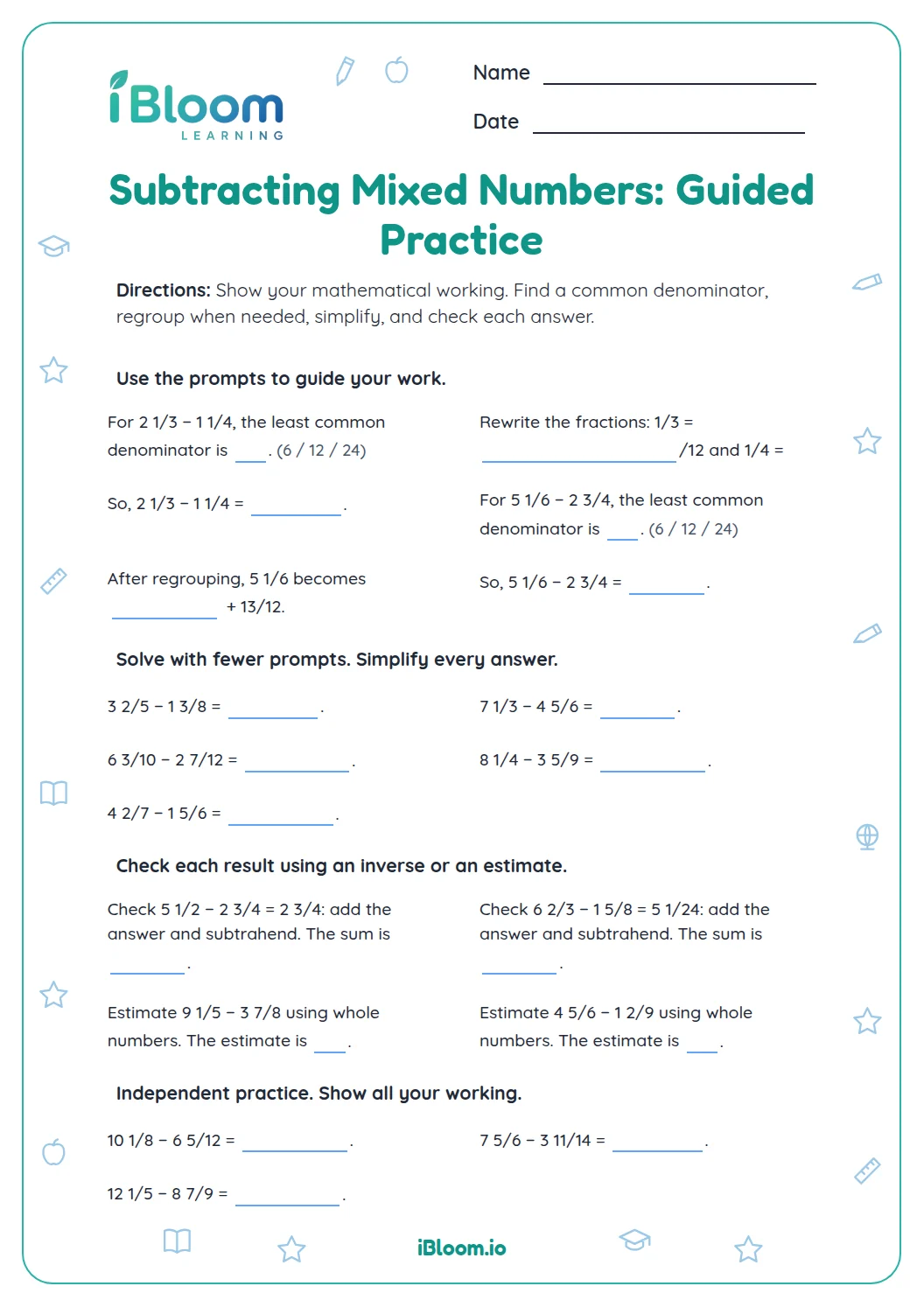
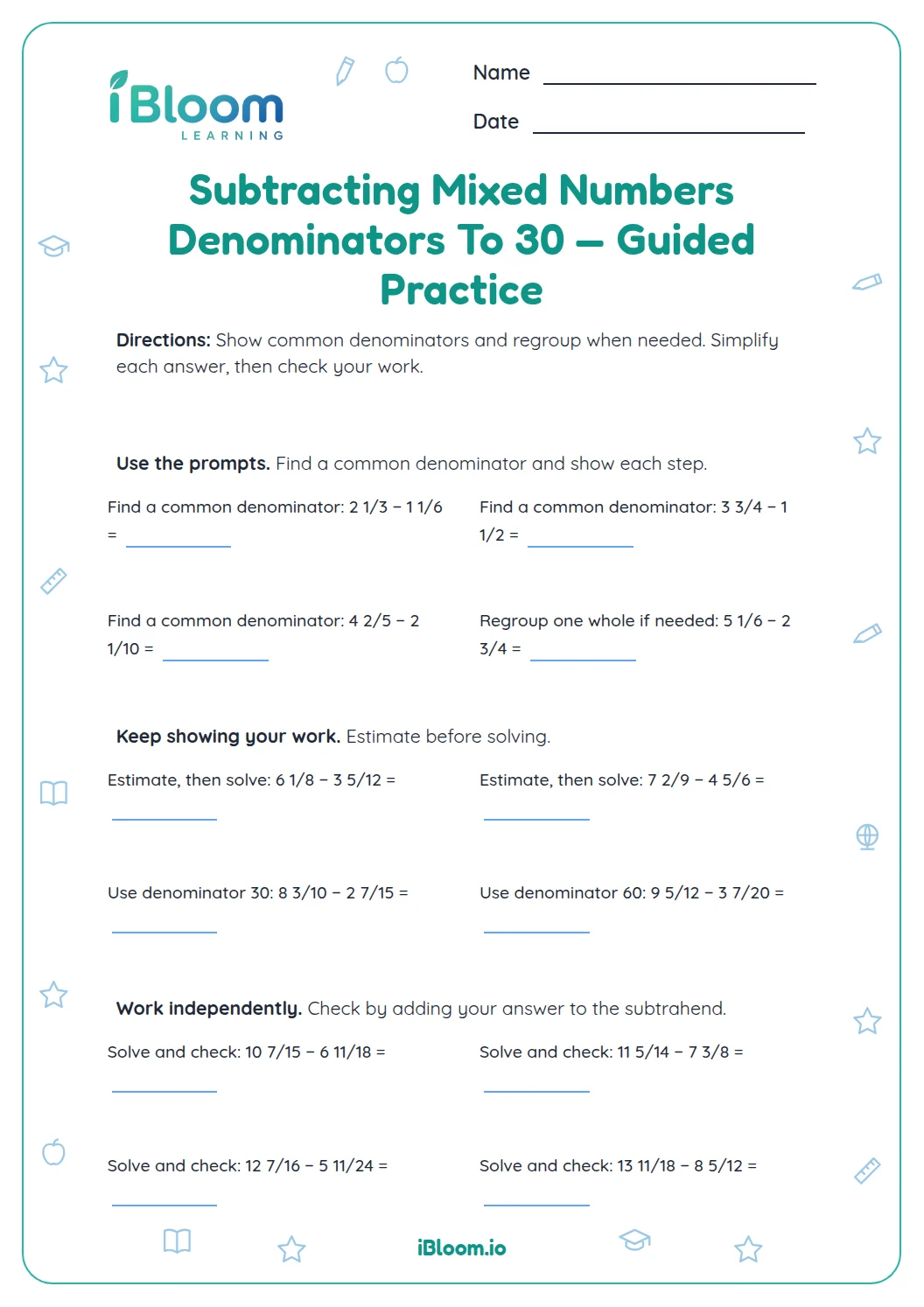
This Grade 6 printable builds mixed-number subtraction from calculations to everyday situations. The 14 questions include unlike denominators, regrouping, and six problems with units such as yards, liters, and miles. Learners show a common denominator, simplify, and check that each result fits the situation. An answer key is included.
Aligned to CCSS 5.NF.A.1
When do you regroup?
Rename one whole as fractional parts when the first fraction is smaller than the fraction being subtracted. For example, 4 1/4 becomes 3 5/4. With unlike denominators, first make equivalent fractions with the same denominator.
What kinds of problems are included?
Part A has eight calculations that build common-denominator and regrouping fluency. Part B uses subtraction in measurement stories, including ribbon, water, distance, and ingredients.
- Part A: eight mixed-number differences.
- Part B: six real-world subtraction problems.
- Write units in the story answers and simplify each result.
How can you check a subtraction result?
After subtracting, compare the result with the starting amount. In a “how much remains?” question, the answer should be less than the original amount.
- 13 1/2 − 1 1/4
- 2Rename 1/2 as 2/4: 3 2/4 − 1 1/4
- 3Subtract: 2 1/4
How to use this worksheet
- 1Read the directions and complete Part A before moving on.
- 2Read each sentence or expression fully before choosing or calculating.
- 3Mark the clue, factor, or operation that supports your answer.
- 4For written work, reread the response and check that it answers the prompt.
- 5Use the separate answer key to check each response and revisit any missed step.
Common mistakes and quick fixes
The mistake
Answering from one familiar word or number without reading the full prompt.
The fix
Read the whole item and identify the clue or operation it asks you to use.
The mistake
Stopping after a first step when the item needs more reasoning.
The fix
Check whether the prompt asks for a meaning, a greatest value, or a final result.
The mistake
Copying an answer without checking that it fits the sentence or calculation.
The fix
Read the completed response again and compare it with the original question.
Curriculum alignment
This worksheet practices the following Common Core standard.
Subtract mixed numbers by making equivalent fractions with like denominators.
On this sheet: Part A practices equivalent fractions and subtraction; Part B applies the same process to mixed-number measurement situations.
Show the official wordingHide the official wording
Add and subtract fractions with unlike denominators (including mixed numbers) by replacing given fractions with equivalent fractions in such a way as to produce an equivalent sum or difference of fractions with like denominators.
What to practice next
Make more practice
Further reading
Questions parents and teachers ask
When should a learner regroup in mixed-number subtraction?
Regroup when the fraction in the first mixed number is smaller than the fraction being subtracted. Rename one whole using the denominator, then subtract the fractional parts and the whole numbers. For example, 4 1/4 can become 3 5/4.
Why do unlike denominators need a common denominator?
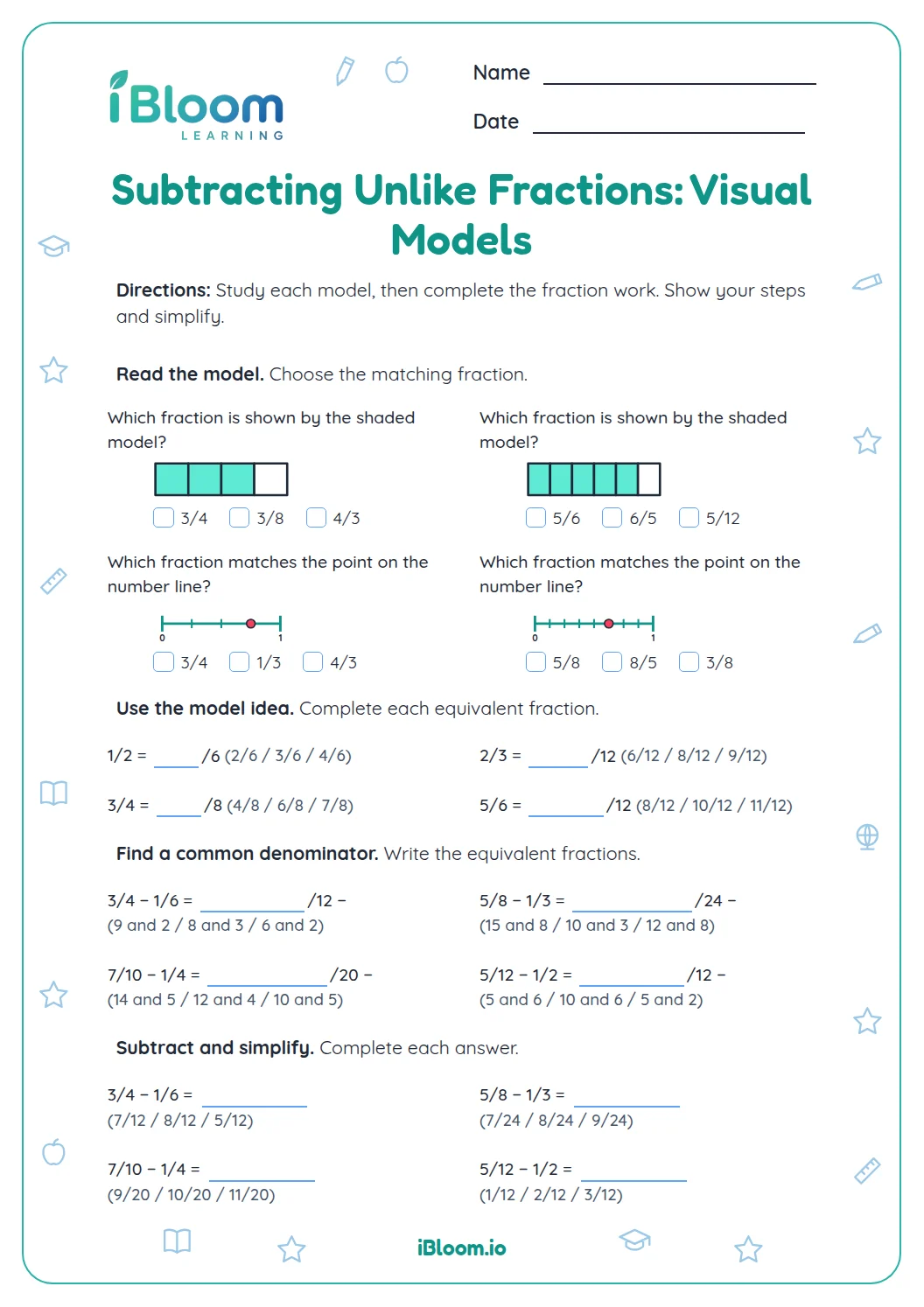
The denominator names the size of each fractional piece. Convert both fractions to equivalent fractions with the same denominator so the pieces are equal in size before subtracting. The worksheet asks learners to show that shared denominator in the calculation section.
Should answers be simplified?
Yes. Reduce the fractional part when its numerator and denominator share a factor, while keeping any whole-number part. For example, 2 2/4 simplifies to 2 1/2 without changing its value. The answer key shows simplified mixed numbers so learners can compare equivalent forms consistently.
How can a word problem be represented?
Identify the starting amount and the amount removed. Write a subtraction sentence with those quantities, including their units, then calculate the difference. Check that the result makes sense for the situation. For a “how much remains?” question, the answer should be less than the starting amount.
What is on the answer key?
The key gives a result for all 14 items, including six story problems. For the stories, keep the unit from the prompt, such as yards or liters, and simplify the mixed-number answer. Learners can also check each answer against the starting amount.