







About this worksheet
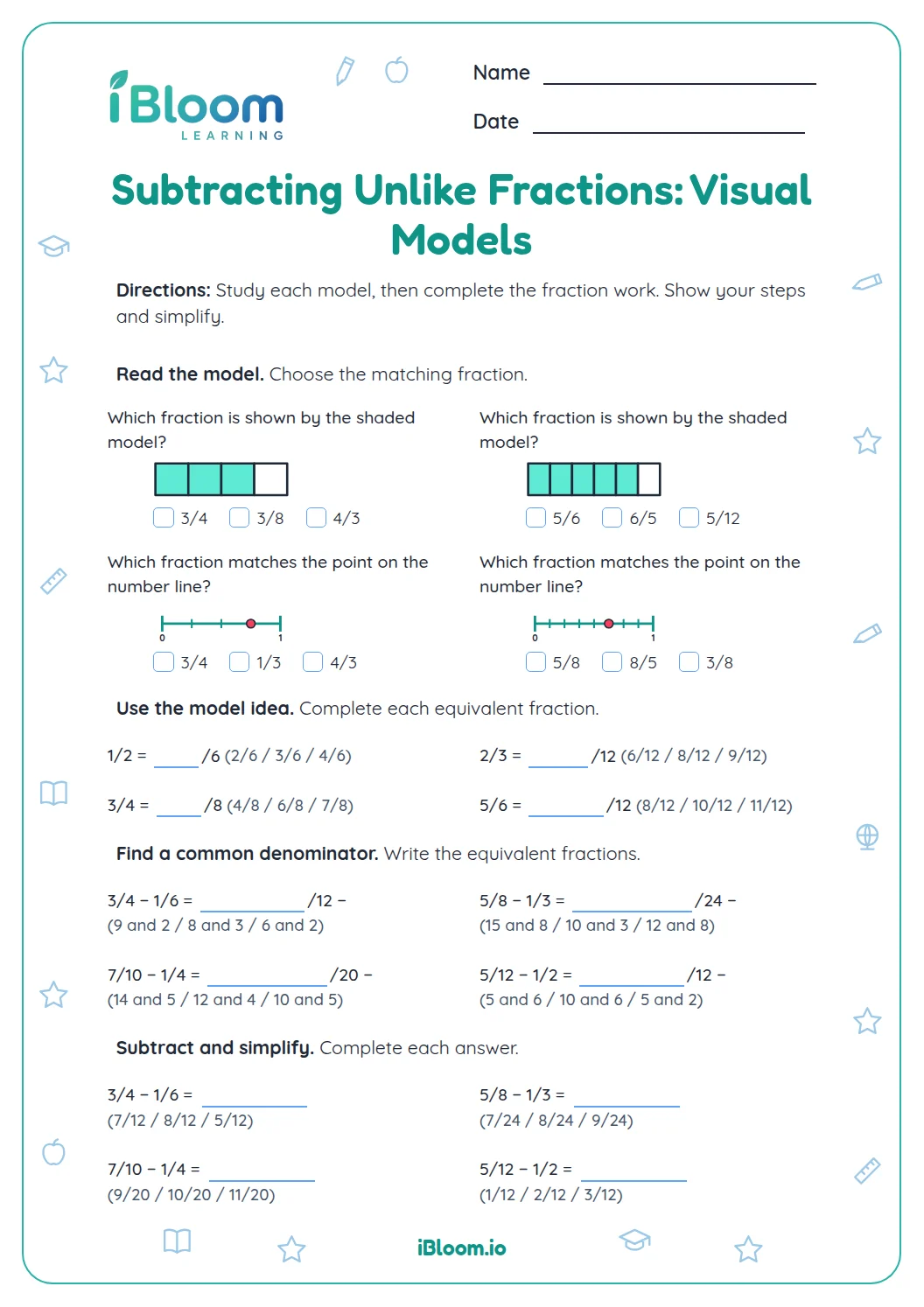
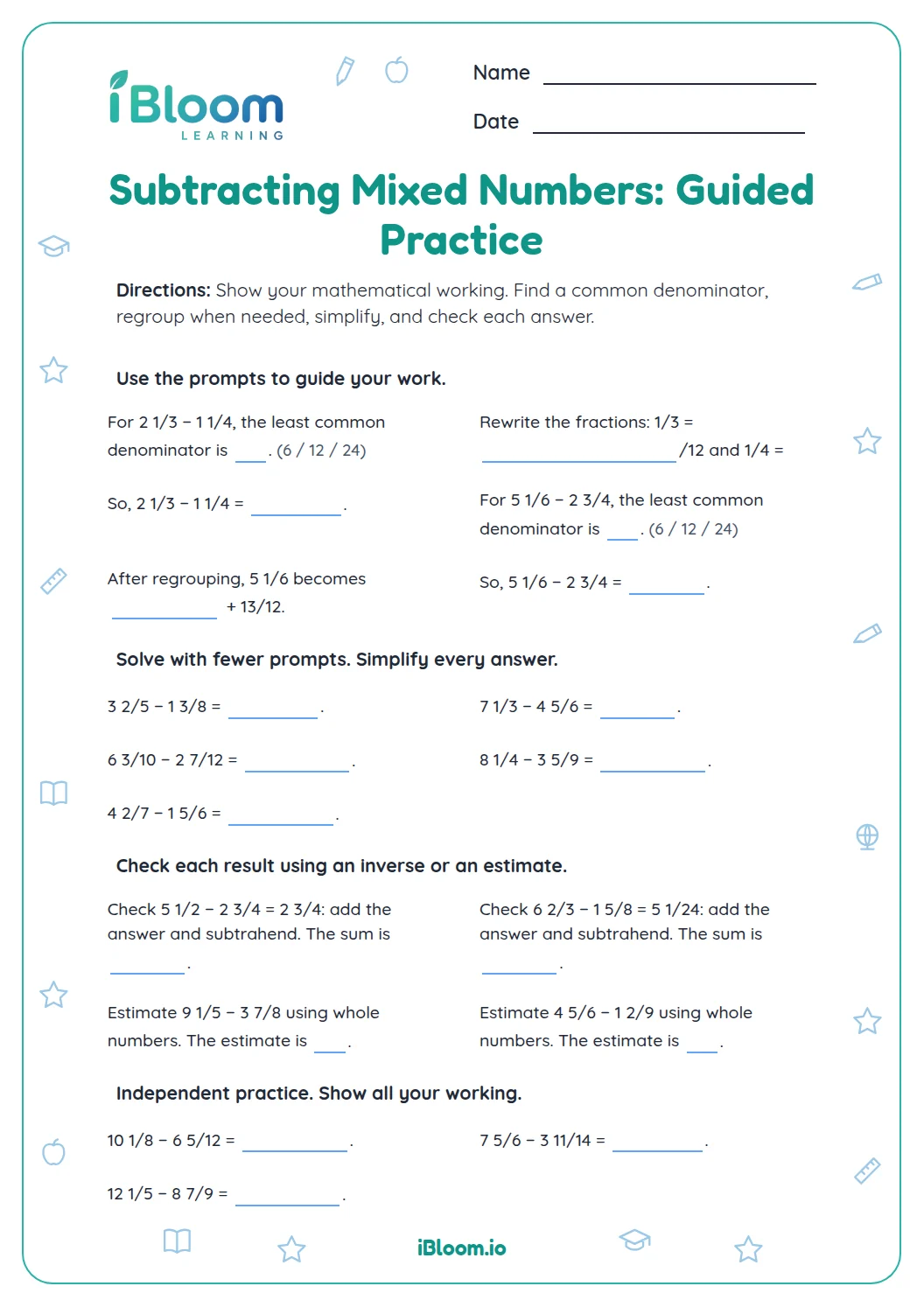
This Grade 6 printable practices subtracting fractions with unlike denominators from 2 through 12. Learners rename fractions with common denominators, subtract and simplify, then use subtraction in two short situations. The separate key shows the simplified results; the standard alignment is CCSS 5.NF.A.1.
Aligned to 5.NF.A.1
How do you subtract unlike fractions?
Rename both fractions with a common denominator, subtract only the numerators, then simplify. Check by adding the difference to the fraction you subtracted.
- 13/4 − 1/2
- 23/4 − 2/4 = 1/4
- 3Check: 1/4 + 1/2 = 3/4
What does each part practice?
The sheet has 16 questions in three parts and includes every denominator from 2 through 12.
- Part A: Practice renaming with like denominators.
- Part B: Find common denominators and simplify.
- Part C: Model and solve two subtraction situations.
How can a learner check a difference?
Add the subtrahend to the difference. The sum should equal the starting fraction. For answers greater than zero, the difference should also be smaller than the starting amount.
How to use this worksheet
- 1Find a common denominator before subtracting.
- 2Subtract the numerators and keep the common denominator.
- 3Reduce the fraction when numerator and denominator share a factor.
- 4Add the difference to the subtrahend to check.
Common mistakes and quick fixes
The mistake
Subtracting both numerators and denominators.
The fix
Rename both fractions first; subtract numerators and keep the common denominator.
The mistake
Using unlike denominators in the subtraction step.
The fix
Make equivalent fractions with the same denominator before subtracting.
The mistake
Leaving a fraction unreduced.
The fix
Look for a common factor in the numerator and denominator.
Curriculum alignment
This worksheet gives learners practice with the standard below.
Find equivalent fractions to subtract fractions with unlike denominators.
On this sheet: Every exercise subtracts fractions with unlike denominators and simplifies.
Show the official wordingHide the official wording
Add and subtract fractions with unlike denominators (including mixed numbers) by replacing given fractions with equivalent fractions in such a way as to produce an equivalent sum or difference of fractions with like denominators. For example, 2/3 + 5/4 = 8/12 + 15/12 = 23/12. (In general, a/b + c/d = (ad + bc)/bd.)
What to practice next
Make more practice
Further reading
Questions parents and teachers ask
Why do the denominators need to match?
The denominator names the size of each part. Rename both fractions so their parts are the same size, then subtract the numerators. For example, change 1/2 to 2/4 before subtracting it from 3/4. Learners can write each equivalent fraction beside the original to keep the common-denominator step visible.
How can a learner check a subtraction answer?
Add the fraction being subtracted to the difference. The total should match the starting fraction. For 3/4 − 1/2 = 1/4, check that 1/4 + 1/2 equals 3/4. Learners can write each equivalent fraction beside the original to keep the common-denominator step visible.
Does the sheet include denominators from 2 through 12?
Yes. The practice includes each denominator from 2 through 12 in its fraction questions. Learners first subtract fractions with familiar equivalent denominators, then work with less direct common denominators and simplify. Learners can write each equivalent fraction beside the original to keep the common-denominator step visible.
What is in the answer key?
The separate answer key gives a result for each of the 16 questions. It can be used to check simplified fractions and the two word-problem answers after the learner has shown their own steps. Learners can write each equivalent fraction beside the original to keep the common-denominator step visible.
How long should this practice take?
Plan for about 20 minutes, depending on how much work the learner shows. The first part reinforces renaming, the second adds simplification practice, and the last part applies subtraction to two contexts. Learners can write each equivalent fraction beside the original to keep the common-denominator step visible.