


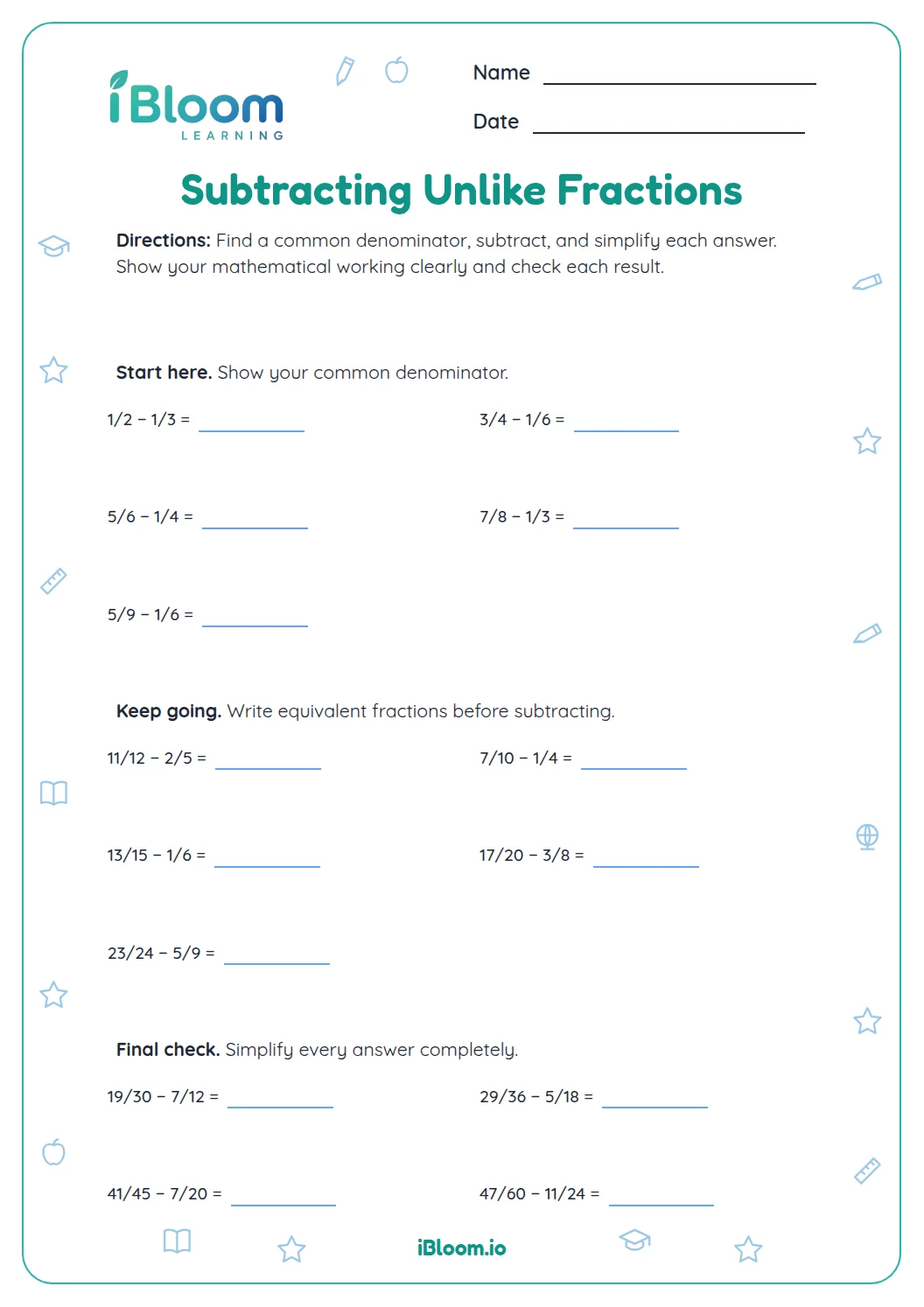
About this worksheet
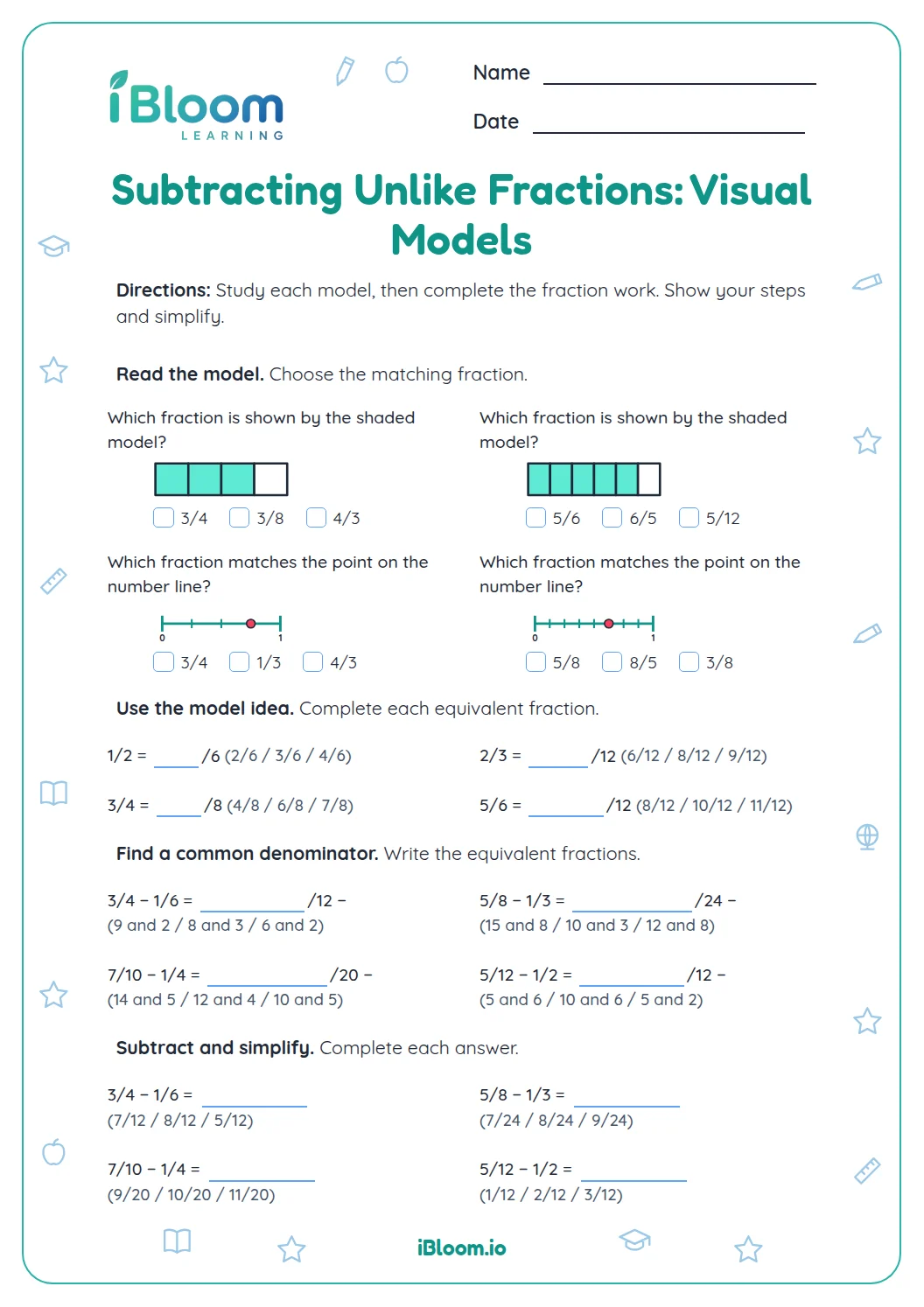
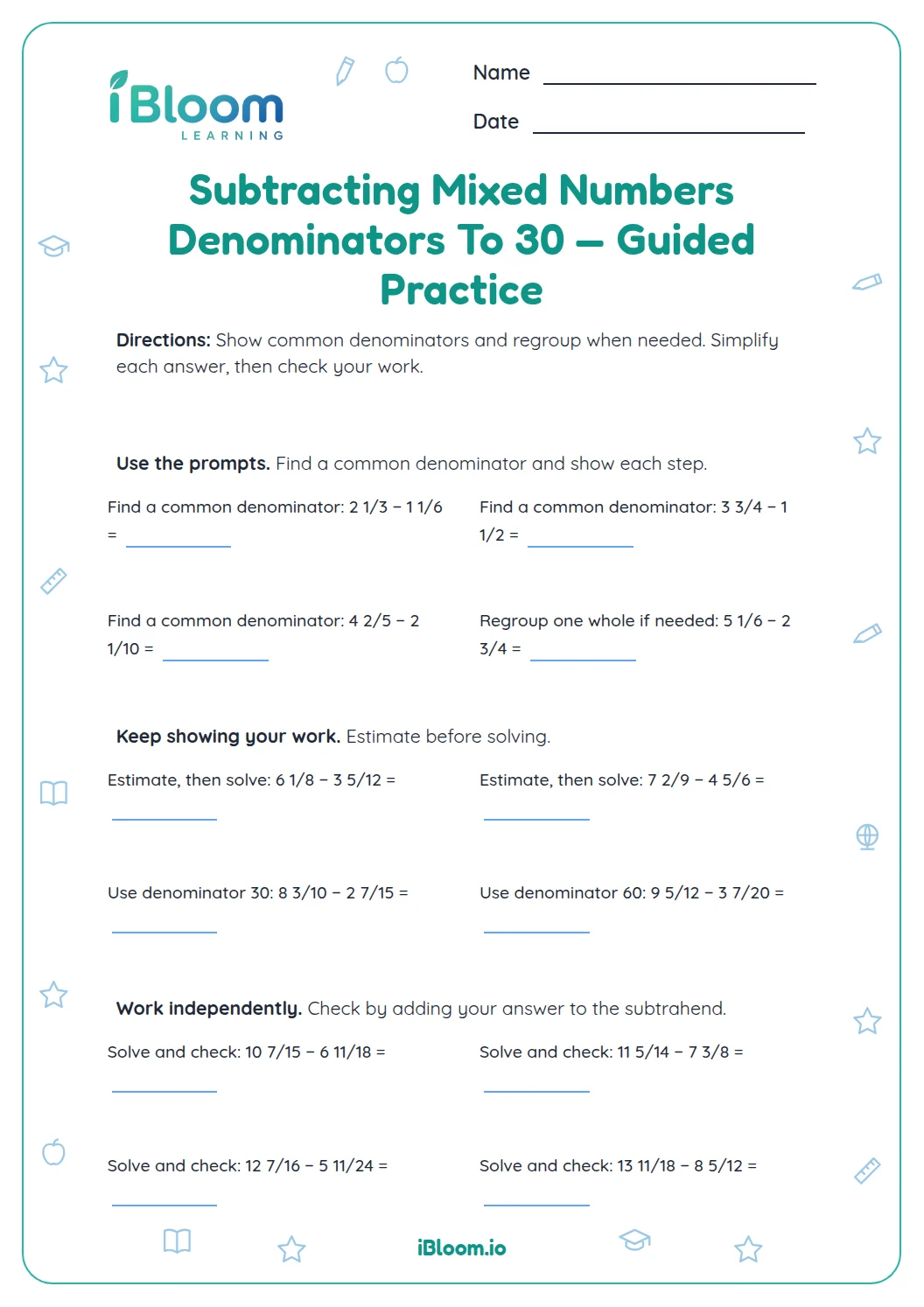
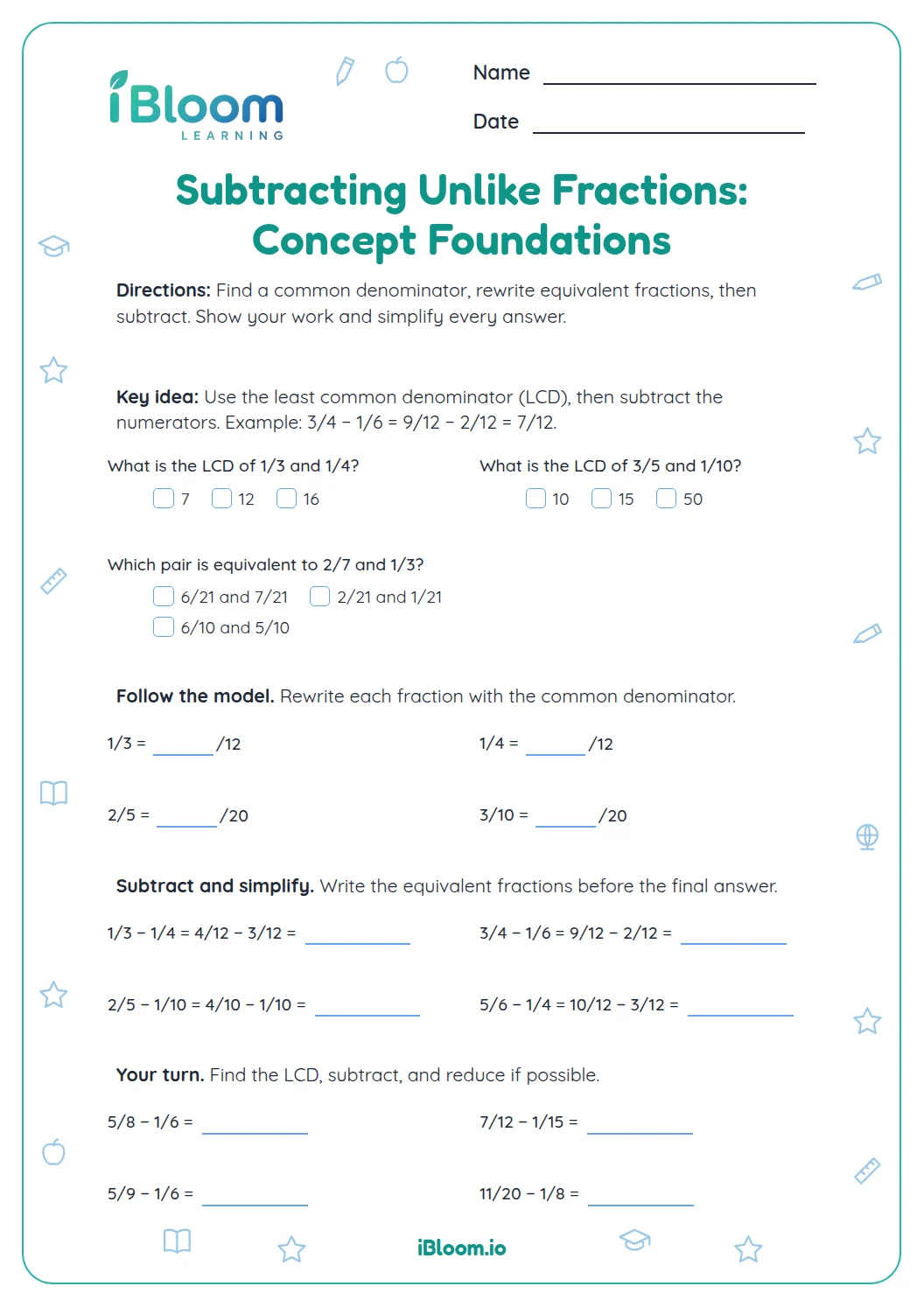
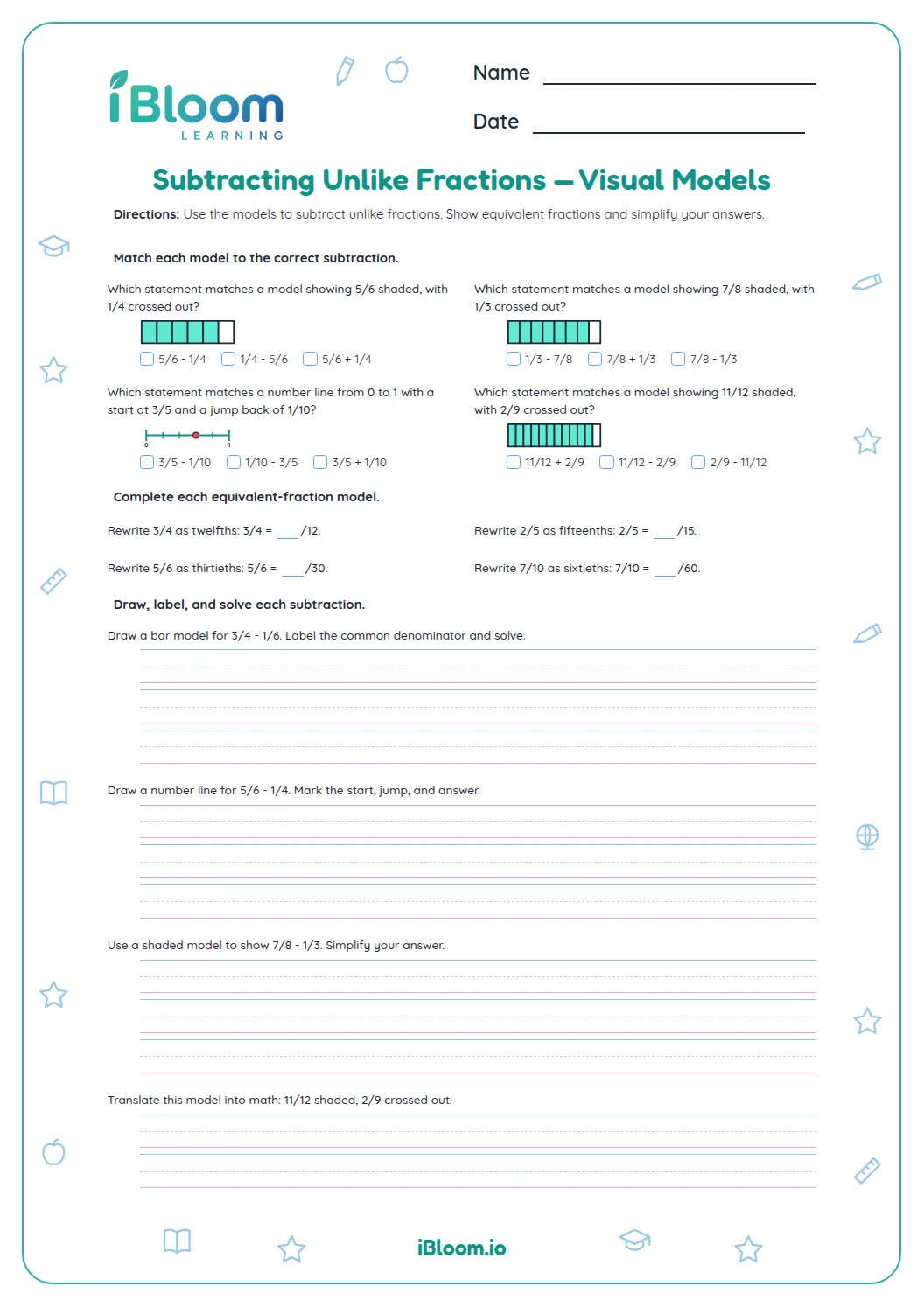
This free Grade 6 math worksheet guides students through subtracting fractions with unlike denominators and mixed numbers. It practices CCSS 5.NF.A.1 by using equivalent fractions to make like denominators before subtracting. Eighteen problems progress from fraction subtraction to mixed-number regrouping, with a separate answer key.
Aligned to 5.NF.A.1
How do you subtract fractions with unlike denominators?
Rename both fractions so they refer to equal-sized parts. Then subtract the numerators and keep the common denominator. For question 1, sixths and fourths can both be written as twelfths.
- 15/6 − 1/4
- 210/12 − 3/12
- 37/12
How do you subtract when a mixed number is involved?
Use a common denominator for the fractional parts first. If the fraction being subtracted is larger than the starting fraction, regroup one whole as a fraction with that denominator. In question 13, 2 5/6 becomes 1 22/12 before subtracting 1/4, leaving 2 7/12.
- 12 5/6 = 1 22/12
- 21 22/12 − 1 3/12
- 31 19/12 = 2 7/12
How can you check a difference?
Estimate before calculating: a fraction close to one half subtracted from another can help you predict the size. Then add the difference to the fraction you subtracted. A result larger than the starting fraction signals a calculation or regrouping slip.
A routine for unlike denominators
- 1Find a common denominator that both fractions can use.
- 2Rewrite each fraction as an equivalent fraction.
- 3Subtract the numerators and keep the common denominator.
- 4Regroup a whole when the top fraction is too small.
- 5Simplify the result and check by adding back.
Common fraction subtraction slips
The mistake
Subtracting the denominators along with the numerators.
The fix
Rename both fractions, subtract only the numerators, and keep the shared denominator.
The mistake
Regrouping 2 5/6 as 1 5/6 when taking away a larger fraction.
The fix
Trade one whole for 6/6, so 2 5/6 becomes 1 11/6 before finding a common denominator.
The mistake
Stopping at an unsimplified fraction when the numerator and denominator share a factor.
The fix
Check for a common factor after subtracting, then write the equivalent fraction in simplest form.
Common Core alignment
This page connects the listed standard to the reading and practice on the sheet.
Use equivalent fractions to subtract fractions with unlike denominators.
On this sheet: Use equivalent fractions to subtract fractions with unlike denominators.
Show the official wordingHide the official wording
Add and subtract fractions with unlike denominators (including mixed numbers) by replacing given fractions with equivalent fractions in such a way as to produce an equivalent sum or difference of fractions with like denominators. For example, 2/3 + 5/4 = 8/12 + 15/12 = 23/12. (In general, a/b + c/d = (ad + bc)/bd.)
What to practice next
Make more practice
Further reading
Questions parents and teachers ask
Why do the fractions need a common denominator?
A common denominator renames both fractions as the same-sized pieces, so their numerators can be subtracted meaningfully. For example, sixths and fourths can both be renamed as twelfths. The first part of this worksheet gives practice finding those equivalent fractions before subtracting. The worked example also shows how the renamed pieces preserve each fraction’s value.
Can the common denominator be larger than 30?
The worksheet uses starting denominators up to 30, including 30 in question 18. A common denominator may be greater than 30 when the two denominators do not share a convenient multiple. Choose a number both denominators divide evenly into, then simplify the result when possible.
How do I regroup a mixed number?
Trade one whole for a fraction equal to that whole. For sixths, one whole is 6/6; for twelfths, one whole is 12/12. Add those pieces to the fractional part before subtracting when the starting fraction is smaller. Ask learners to verify that each replacement names the same amount.
Does the answer need to be simplified?
Yes, simplify when the numerator and denominator share a factor. For example, 6/8 can be written as 3/4. Reducing keeps the value the same, and the answer key accepts equivalent fractions when the work shows the correct difference. The numerical value stays unchanged after reducing.
What is in the answer key?
The key gives results for all 18 subtraction questions across two worksheet pages. Compare equivalent forms, check any regrouping, and add a difference back to the fraction subtracted to confirm the starting value. It also shows simplified answers.