

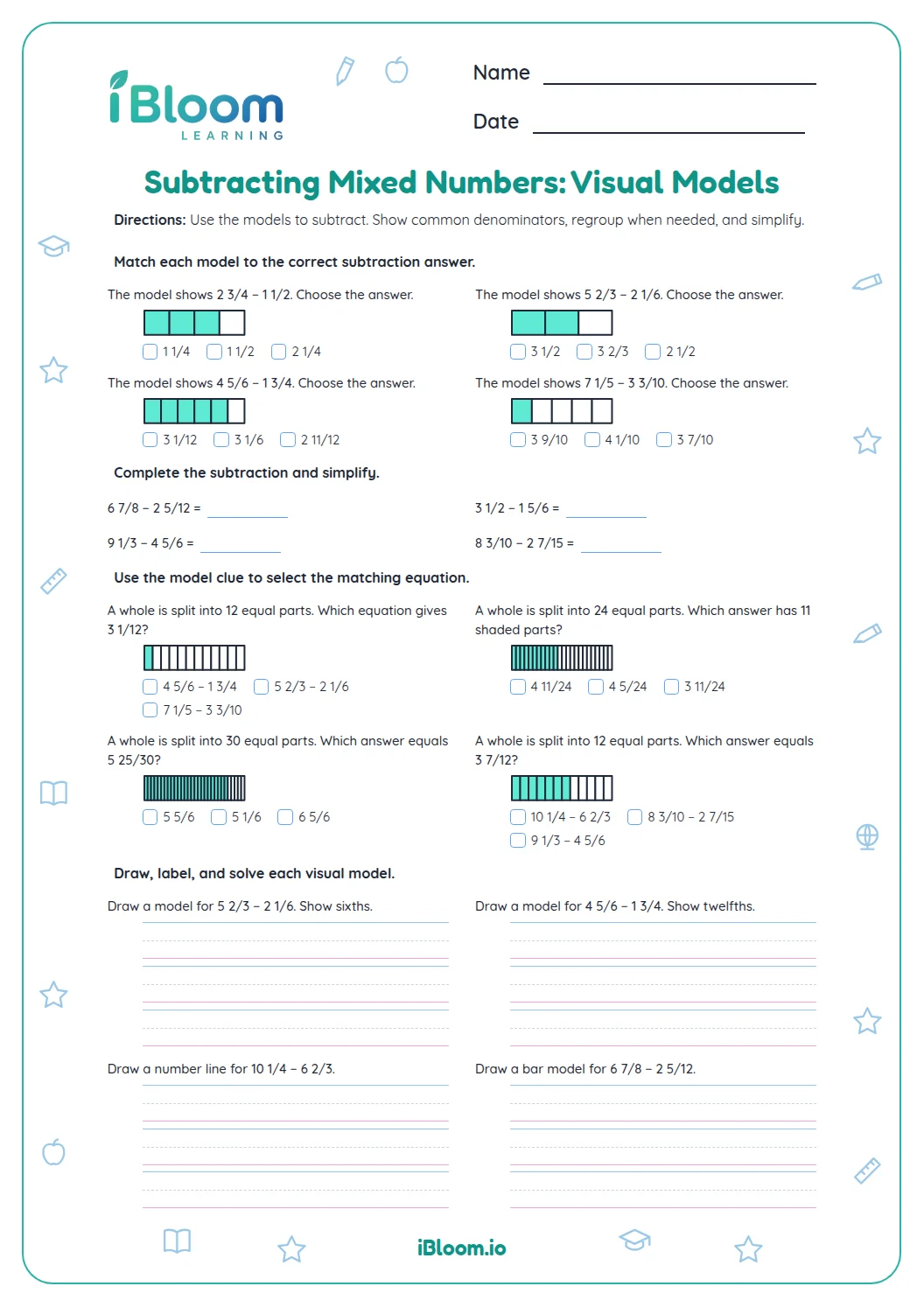


About this worksheet
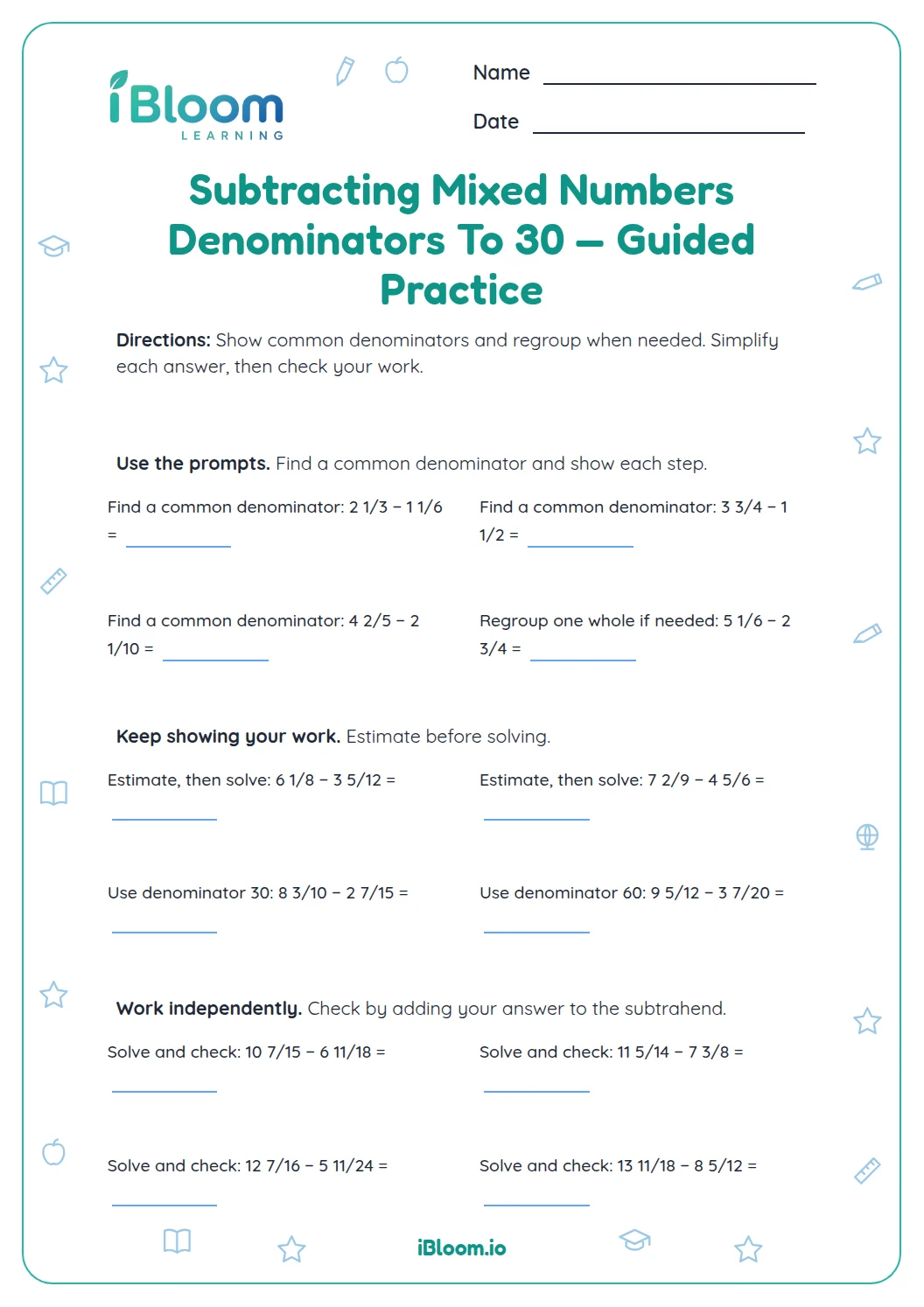
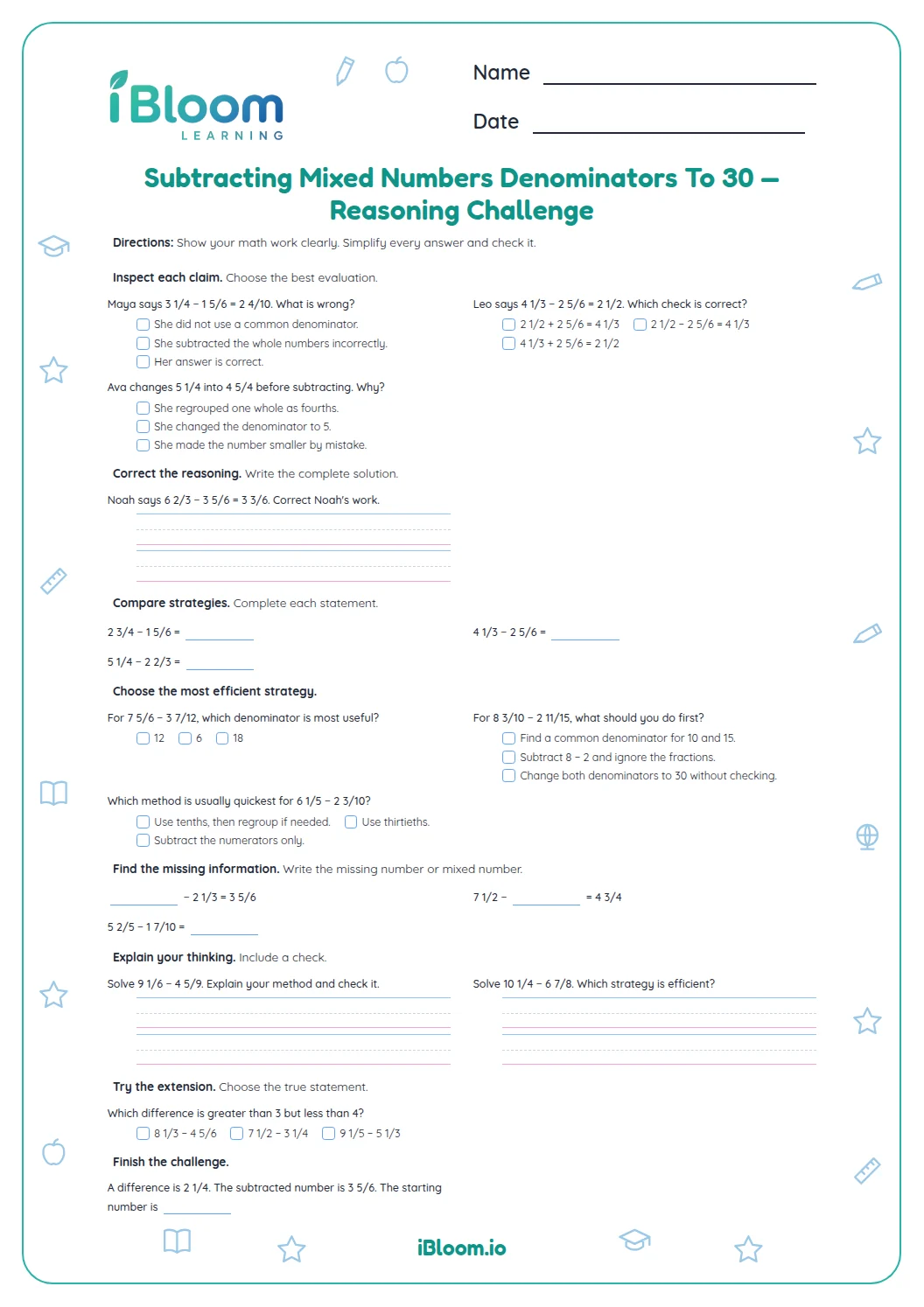
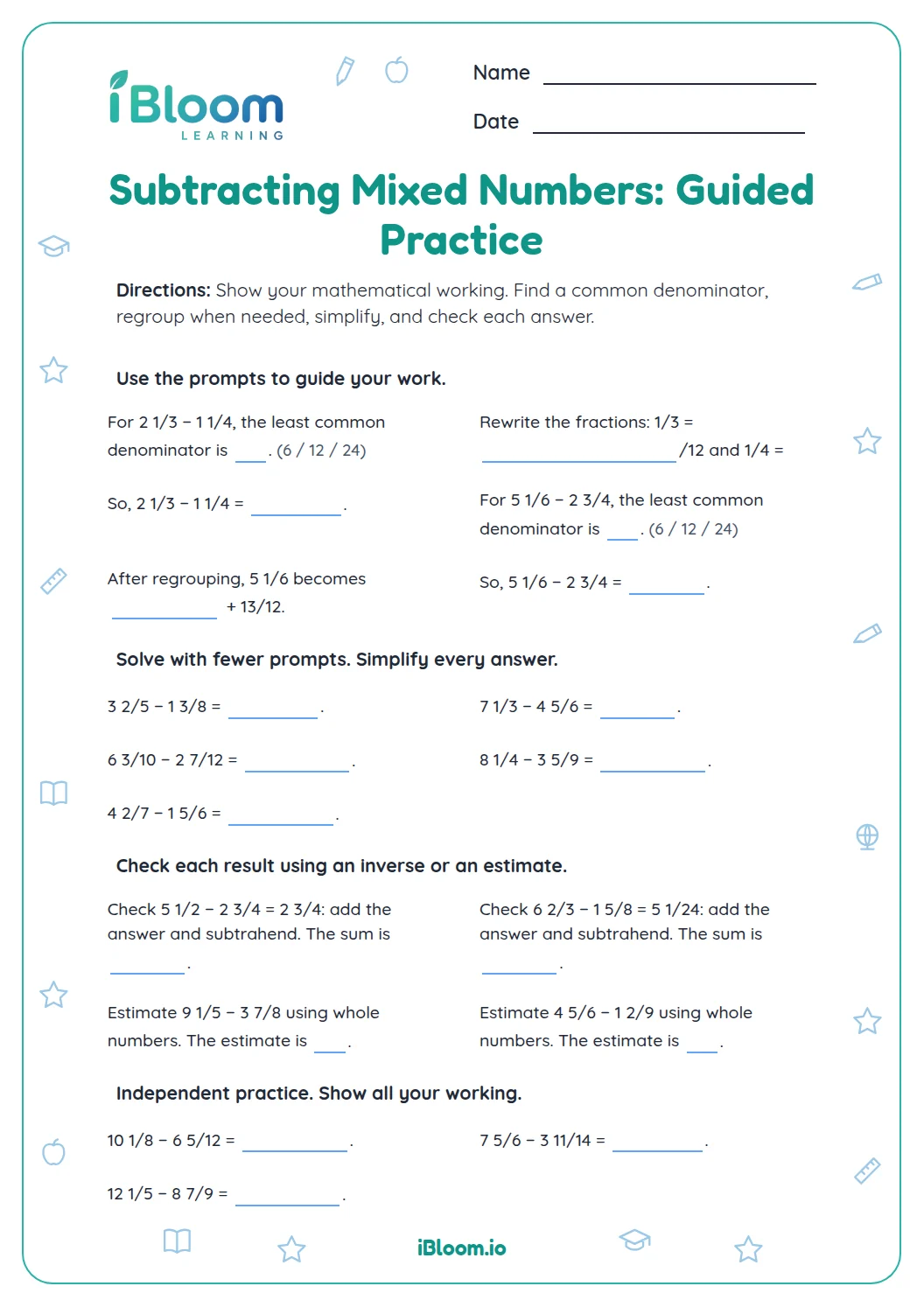
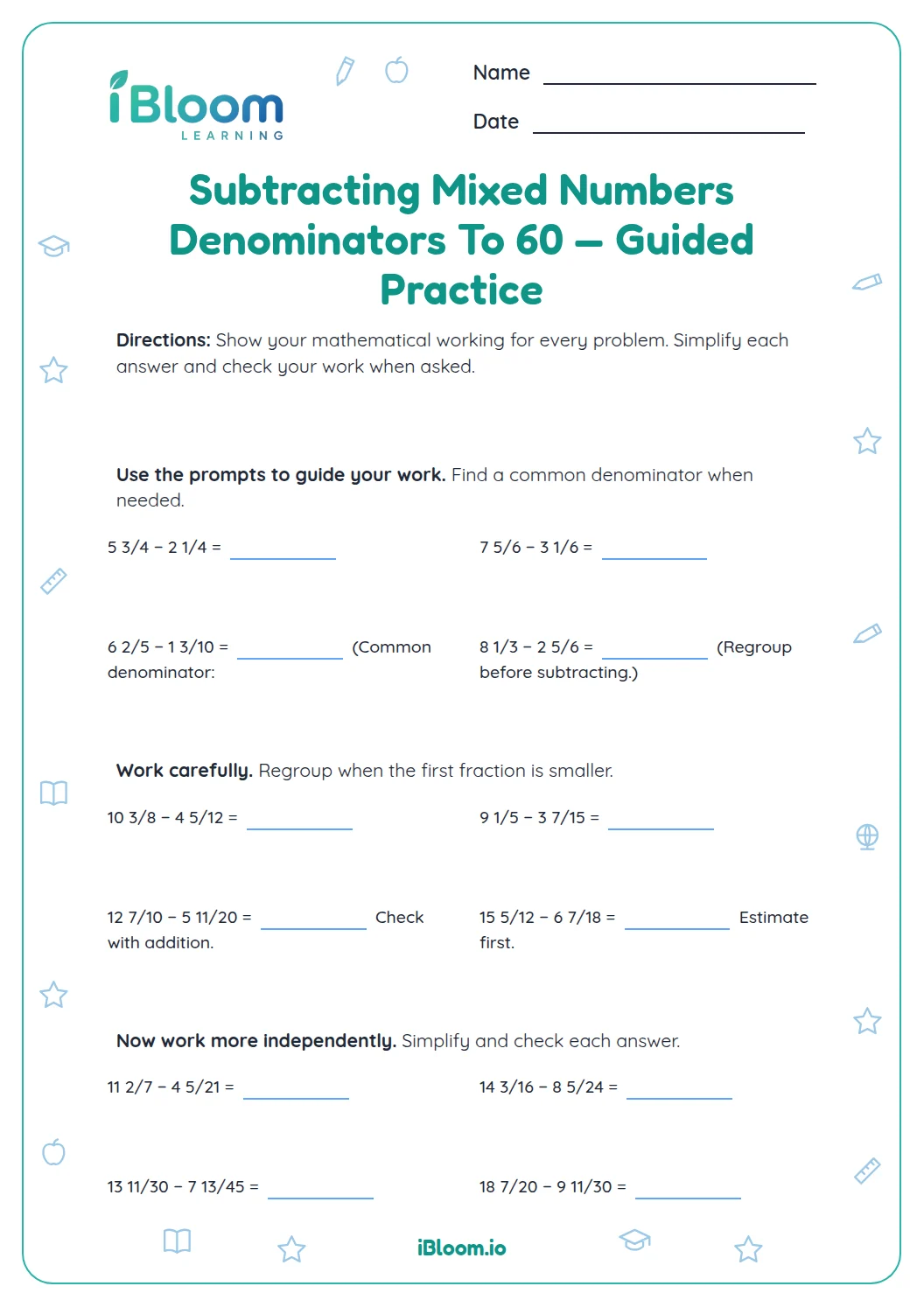
This Grade 6 printable develops subtraction of mixed numbers with denominators through 30. Children practice matching denominators, renaming a whole when regrouping is needed, checking a likely error and solving two measurement situations. The sixteen problems connect to Common Core 5.NF.A.1 and 5.NF.A.2 through equivalent fractions and fraction word problems. A separate key lists simplified mixed-number answers.
Aligned to 5.NF.A.1 and 5.NF.A.2
Why do mixed numbers need common denominators?
The fractional parts must name equal-sized pieces before they can be subtracted. For 4 5/6 − 2 1/6, the pieces already match, so subtract the wholes and sixths separately. When they do not match, rewrite one or both fractions using a common denominator.
Question 1 gives 4 5/6 − 2 1/6. Subtract 4 − 2 = 2 and 5/6 − 1/6 = 4/6 = 2/3, for 2 2/3.
- 14 5/6 − 2 1/6
- 24 − 2 = 2
- 35/6 − 1/6 = 4/6 = 2/3
- 4Difference: 2 2/3
What if the top fraction is smaller?
Sometimes the fractional part in the first number is less than the fraction being subtracted. Rename one whole as fraction pieces, then subtract. For 6 1/4 − 2 3/4, think of 6 1/4 as 5 5/4; the result is 3 1/2.
How can you check if a difference is reasonable?
Estimate before or after calculating. Subtracting a little over 2 from a little over 6 should leave close to 4. In the final situations, include the unit and make sure the remaining amount is smaller than the starting amount.
How to use this worksheet
- 1Find a common denominator for the fractional parts.
- 2Rewrite each fraction as an equivalent fraction.
- 3Check whether regrouping one whole is needed.
- 4Subtract whole-number and fractional parts.
- 5Simplify the fraction and combine it with the whole number.
- 6Estimate the result and compare with the answer key.
Common mistakes and quick fixes
The mistake
Subtracting denominators as well as numerators.
The fix
Use equivalent fractions with one shared denominator, then subtract only the numerators.
The mistake
Leaving a negative fractional part when the first fraction is smaller.
The fix
Rename one whole from the mixed number into fractional pieces before subtracting.
The mistake
Keeping an unsimplified fraction such as 4/6.
The fix
Divide numerator and denominator by a common factor; 4/6 = 2/3.
Common Core alignment
This worksheet practices the math skills named below through its sequence problems and explanations.
Subtract mixed numbers by making equivalent fractions with a common denominator.
On this sheet: The problems subtract mixed numbers with unlike denominators, using equivalent fractions.
Show the official wordingHide the official wording
Add and subtract fractions with unlike denominators (including mixed numbers) by replacing given fractions with equivalent fractions in such a way as to produce an equivalent sum or difference of fractions with like denominators. For example, 2/3 + 5/4 = 8/12 + 15/12 = 23/12. (In general, a/b + c/d = (ad + bc)/bd.)
Model mixed-number subtraction in short real-world situations and judge the remaining amount.
On this sheet: The last two questions represent quantities with subtraction equations and interpret the remainder.
Show the official wordingHide the official wording
Solve word problems involving addition and subtraction of fractions referring to the same whole, including cases of unlike denominators, e.g., by using visual fraction models or equations to represent the problem. Use benchmark fractions and number sense of fractions to estimate mentally and assess the reasonableness of answers.
What to practice next
Make more practice
Further reading
Questions parents and teachers ask
How do I subtract 4 5/6 − 2 1/6?
The denominators already match. Subtract the whole numbers, 4 − 2 = 2, and subtract the sixths, 5/6 − 1/6 = 4/6. Simplify 4/6 to 2/3, so the difference is 2 2/3. Question 1 uses this direct case before later items require renaming.
What is a common denominator?
It is a denominator that can name equal-sized pieces for both fractions. For fifths and tenths, 10 works because 1/2 can be renamed 5/10. In this sheet, finding equivalent fractions lets the fractional parts be subtracted without changing their value.
When should a child regroup a mixed number?
Regroup when the fraction being subtracted is larger than the starting fraction. For 6 1/4 − 2 3/4, rename 6 1/4 as 5 5/4. Then subtract 3/4 from 5/4 and subtract the whole numbers, giving 3 1/2. The whole-number part decreases because one whole was renamed as fourths.
Why should answers be simplified?
Simplifying gives the fraction in its usual reduced form and makes comparisons easier. For example, 4/6 and 2/3 name the same amount, but 2/3 is reduced. The answer key uses simplified mixed numbers so a child can compare each result clearly.
How can I check a word-problem answer?
First make sure the subtraction matches the story, then confirm the remainder is less than the starting amount. For the ribbon problem, cutting off 2 3/4 yards from 6 1/2 yards leaves 3 3/4 yards. The unit stays yards because both quantities use yards.