




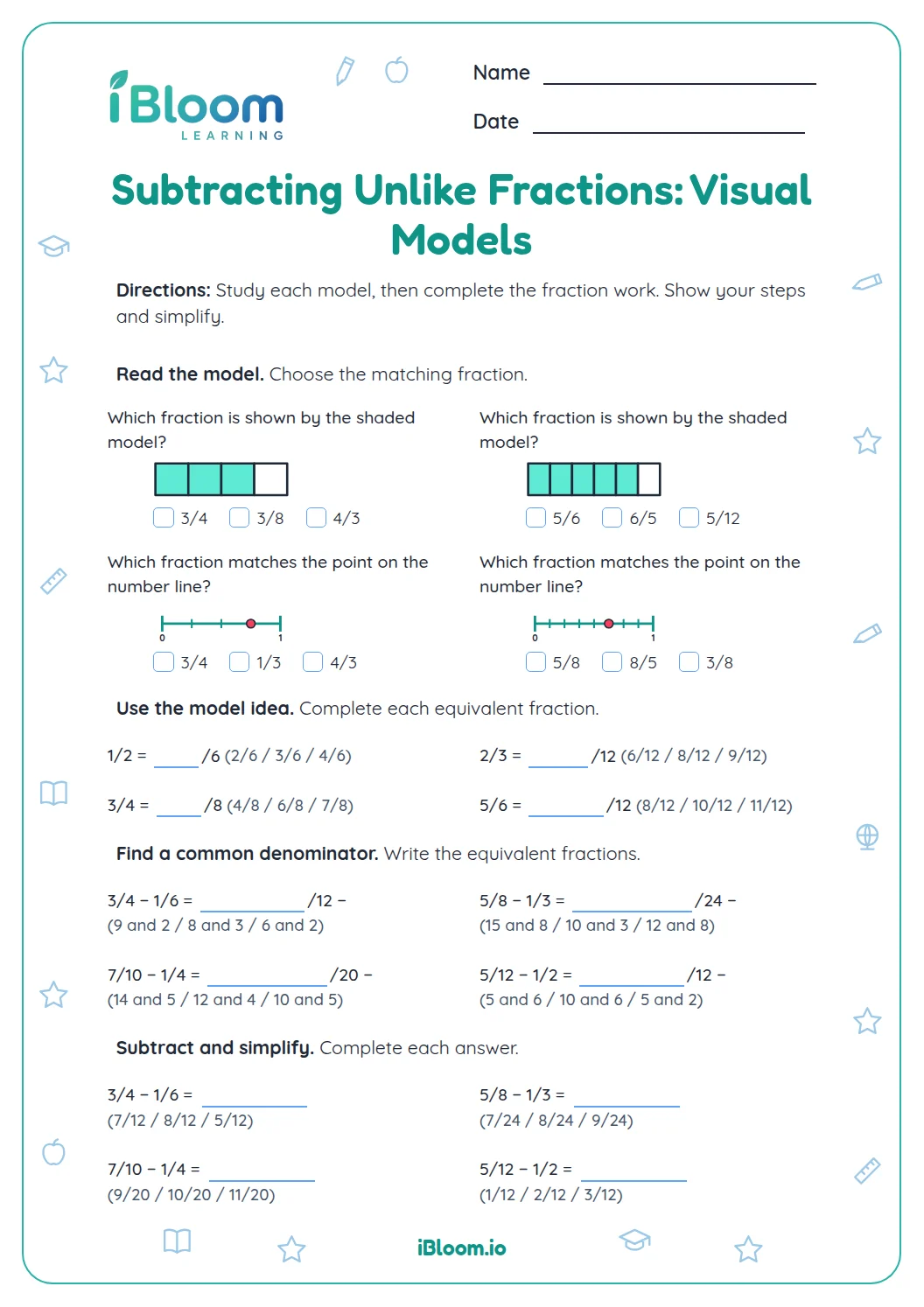


About this worksheet
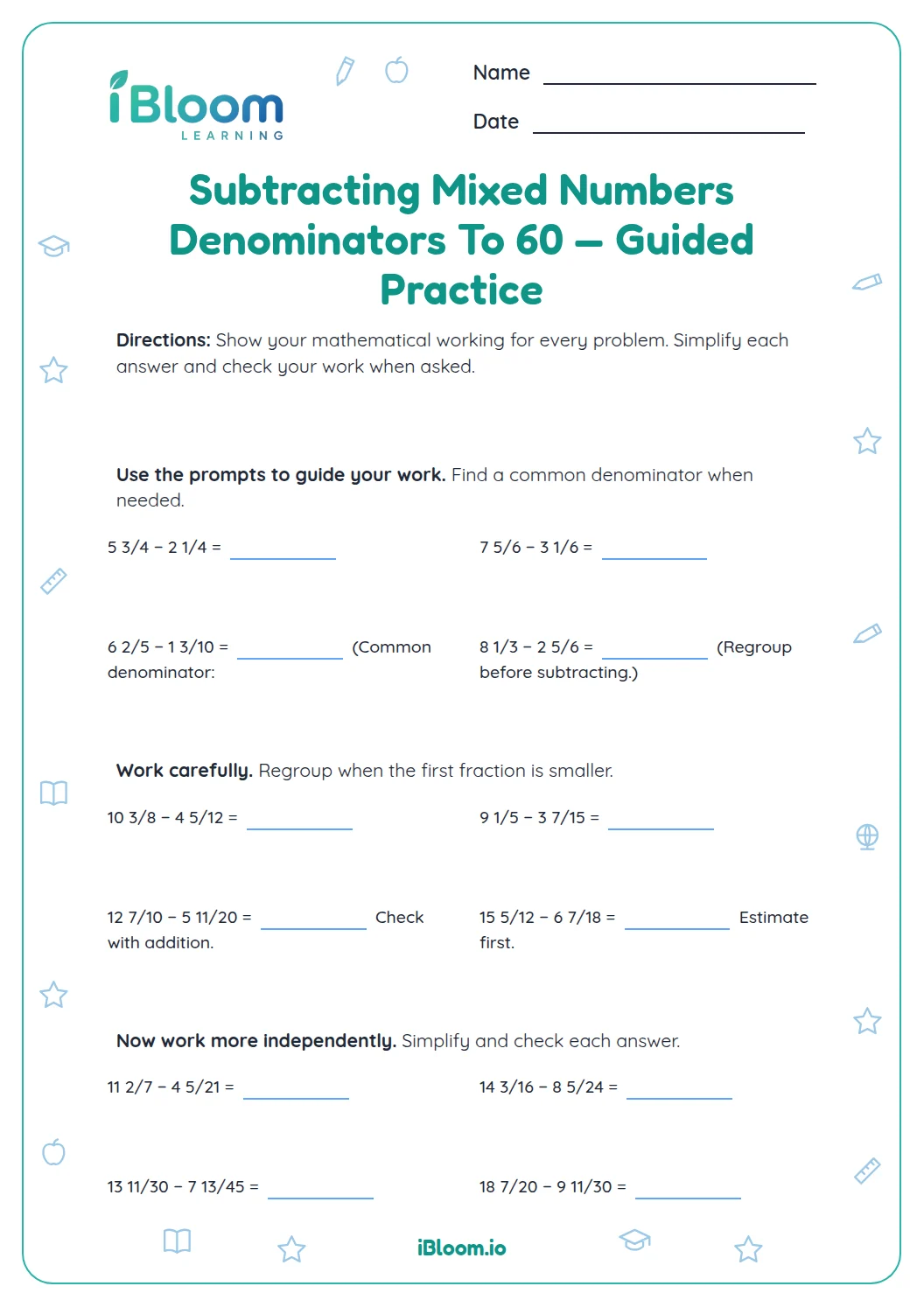
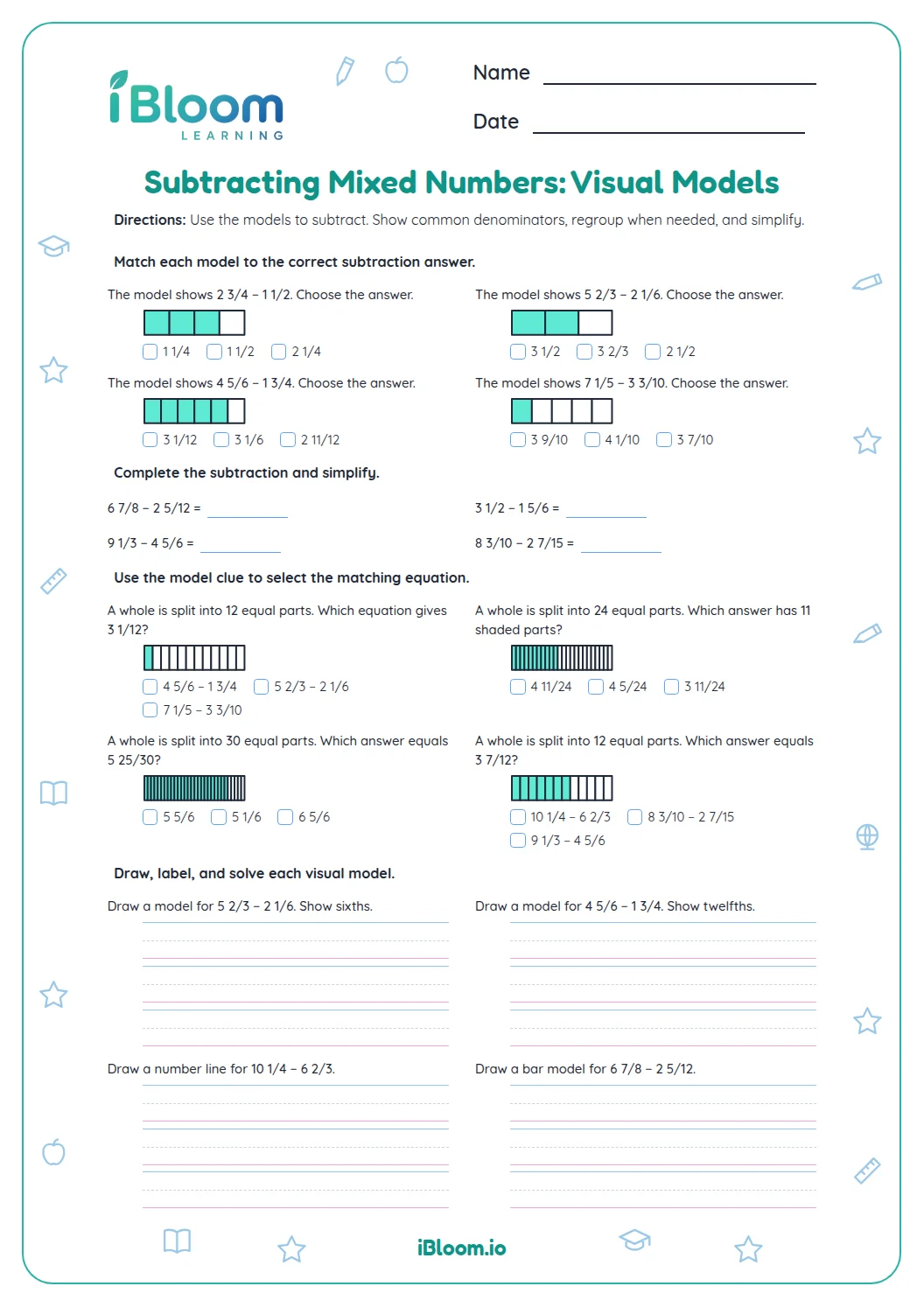
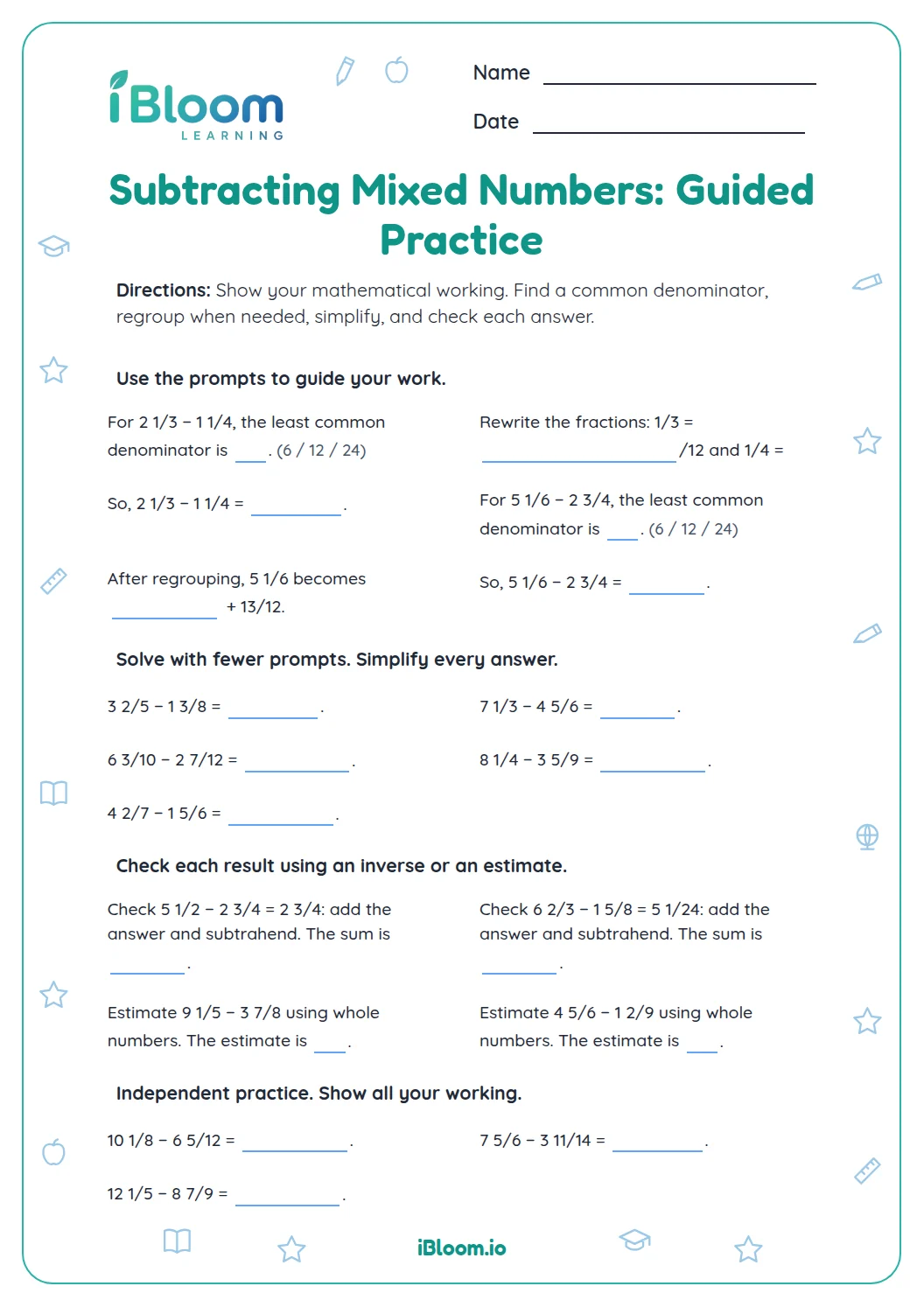
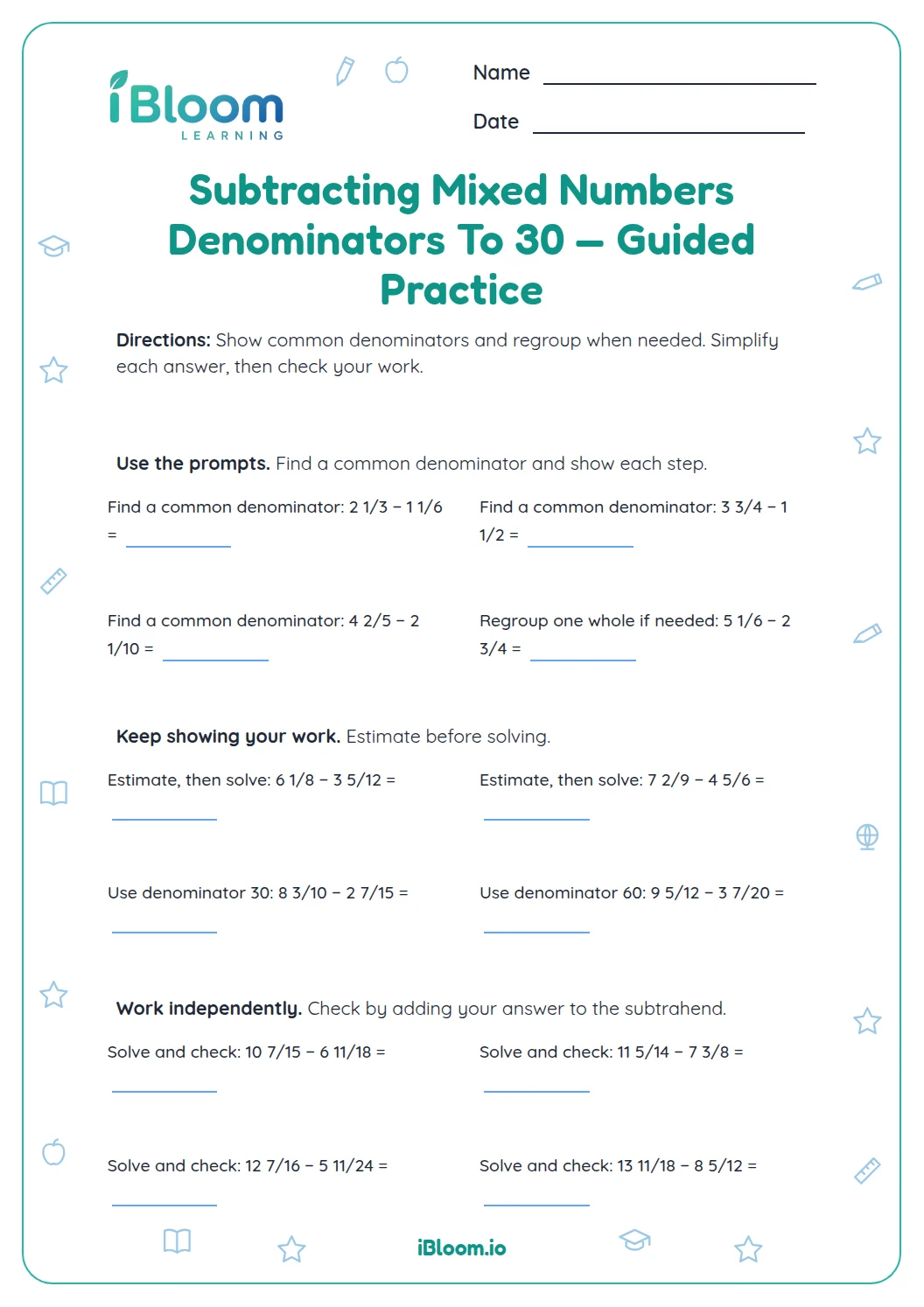
This printable introduces the steps behind subtracting mixed numbers. Learners identify whole-number and fraction parts, make equivalent fractions, subtract like denominators, regroup when needed, and find a common denominator. The 14 questions use denominators no greater than 15 and build toward unlike-denominator subtraction. A separate answer key shows each result in simplest form.
Aligned to 5.NF.A.1
What steps does the worksheet practice?
The four parts start with the pieces of a mixed number, then move to equivalent fractions and subtraction. Learners first subtract fractional parts that already share a denominator, then regroup when the top fraction is too small, and finish by renaming fractions with a common denominator.
- Part A: identify the whole number and denominator; spot matching denominators
- Part B: make equivalent fractions and identify a common denominator
- Part C: subtract like denominators, including regrouping
- Part D: rename unlike denominators, subtract, and simplify
Why do fractions need a common denominator?
The denominator names the size of the parts. To subtract, the fractional parts must be the same size. For 2/3 = ___/12, each third is replaced with four twelfths, so the missing numerator is 8.
- 12/3 = 8/12
- 2Multiply both numerator and denominator by 4.
How do you regroup a mixed number before subtracting?
If the first fraction is smaller than the fraction being subtracted, trade one whole for fractional parts. In 5 1/4 − 2 3/4, rename 5 1/4 as 4 5/4. Then subtract the whole numbers and the fourths to get 2 1/2.
How do you subtract mixed numbers with unlike denominators?
Find a denominator that both fractions can use, rename each fraction, and subtract. For 5 1/4 − 2 1/6, twelfths work: 1/4 is 3/12 and 1/6 is 2/12. The difference is 3 1/12. Reduce the fraction if its numerator and denominator share a factor.
A reliable subtraction routine
- 1Read the mixed numbers as whole parts and fractional parts.
- 2Check whether the fractional denominators already match.
- 3If they do not, choose a common denominator and rename both fractions.
- 4If the first numerator is smaller, regroup one whole into fractional parts.
- 5Subtract the whole numbers and fractional parts, then simplify.
- 6Check by adding the difference to the subtrahend.
Common mixed-number subtraction mistakes
The mistake
Subtracting denominators along with numerators, such as 5/8 − 3/8 = 2/0.
The fix
Keep the denominator because the parts stay eighths; subtract only the numerators.
The mistake
Changing 1/4 to 3/12 but leaving the denominator of the other fraction unchanged.
The fix
Rename both fractions with the same denominator before subtracting.
The mistake
Subtracting 3/4 from 1/4 without regrouping a whole.
The fix
Trade one whole for four fourths, then subtract 5/4 − 3/4.
Common Core alignment
The worksheet practices equivalent-fraction reasoning as a step in adding and subtracting fractions.
Rename fractions with unlike denominators to make an equivalent difference with like denominators.
On this sheet: The final questions rename unlike fractional parts before subtracting; earlier questions build equivalent-fraction and regrouping fluency.
Show the official wordingHide the official wording
Add and subtract fractions with unlike denominators (including mixed numbers) by replacing given fractions with equivalent fractions in such a way as to produce an equivalent sum or difference of fractions with like denominators.
What to practice next
Make more practice
Further reading
Questions parents and teachers ask
What does “common denominator” mean?
A common denominator is a shared number of equal-sized parts for two fractions. For example, fourths and sixths can both be renamed as twelfths. Part D uses this idea so learners can subtract the fractional portions of mixed numbers accurately.
Why does a mixed number sometimes need regrouping?
Regroup when the fraction being subtracted has a larger numerator than the starting fraction. In 5 1/4 − 2 3/4, one whole becomes 4/4, making 1/4 into 5/4. Then the fractional subtraction is possible, and the result is 2 1/2.
Are the answers simplified?
Yes. The key gives each subtraction result in simplest form. For instance, 4 7/12 − 2 3/12 equals 2 4/12, which simplifies to 2 1/3. Encourage the learner to check whether the numerator and denominator have a common factor after subtracting.
What denominator sizes appear?
The practice uses denominators from 4 through 15, all within the worksheet title’s “to 60” range. Several items have like denominators, while the final part asks learners to use common denominators. The questions focus on understanding the method rather than maximizing denominator size.
How many questions are on the page?
There are 14 questions in four parts, on two worksheet pages, with a separate two-page answer key. The sequence moves from vocabulary to equivalent fractions, then subtraction and regrouping. About 25 minutes is a reasonable estimate for completing the sheet carefully.
What should learners check after subtracting?
Check that the fractions had like denominators before subtracting and that the final fraction is simplified. A useful inverse check is to add the answer to the number being subtracted; it should return the starting mixed number. The key provides the expected simplified answer for each item.