



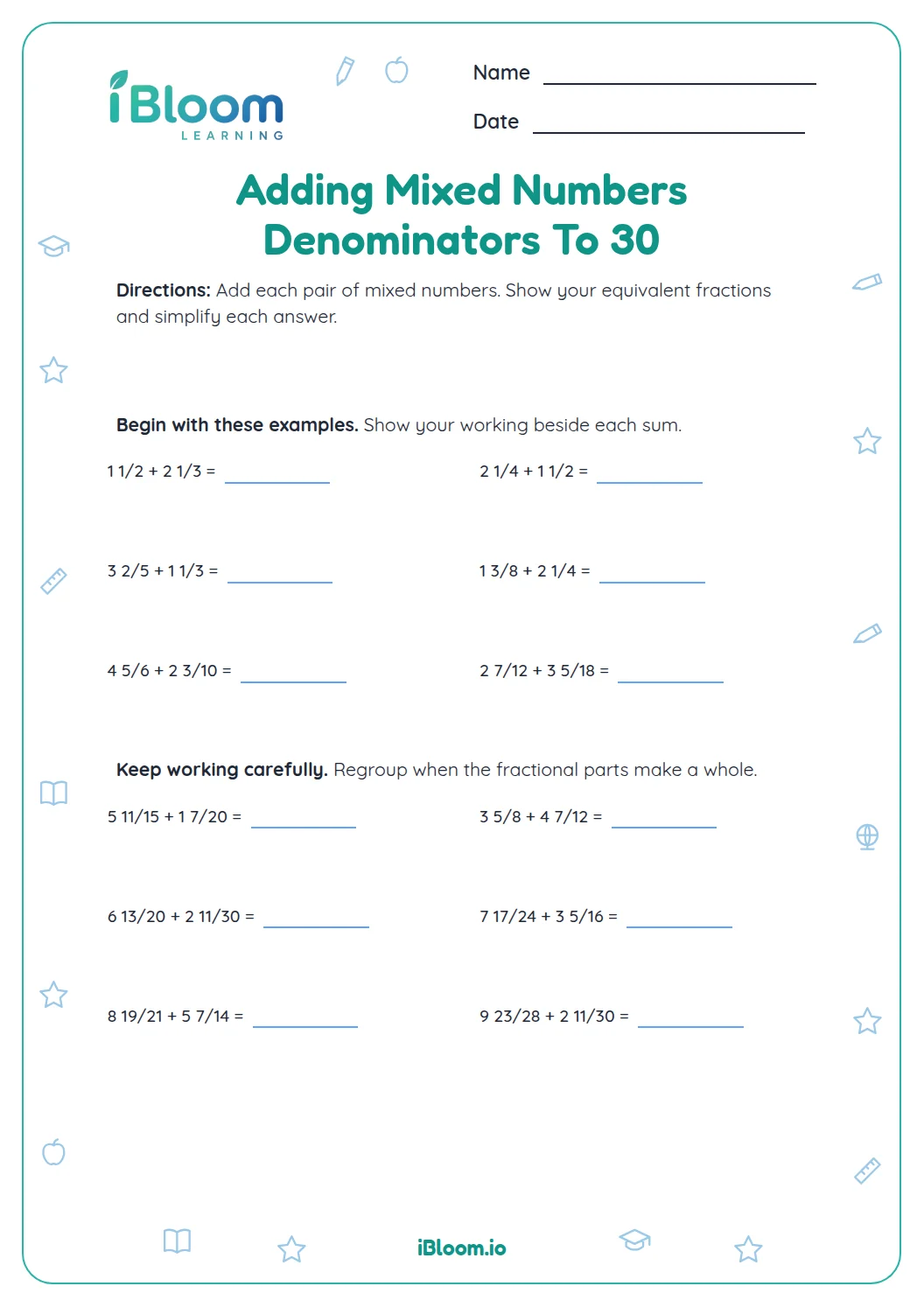
About this worksheet
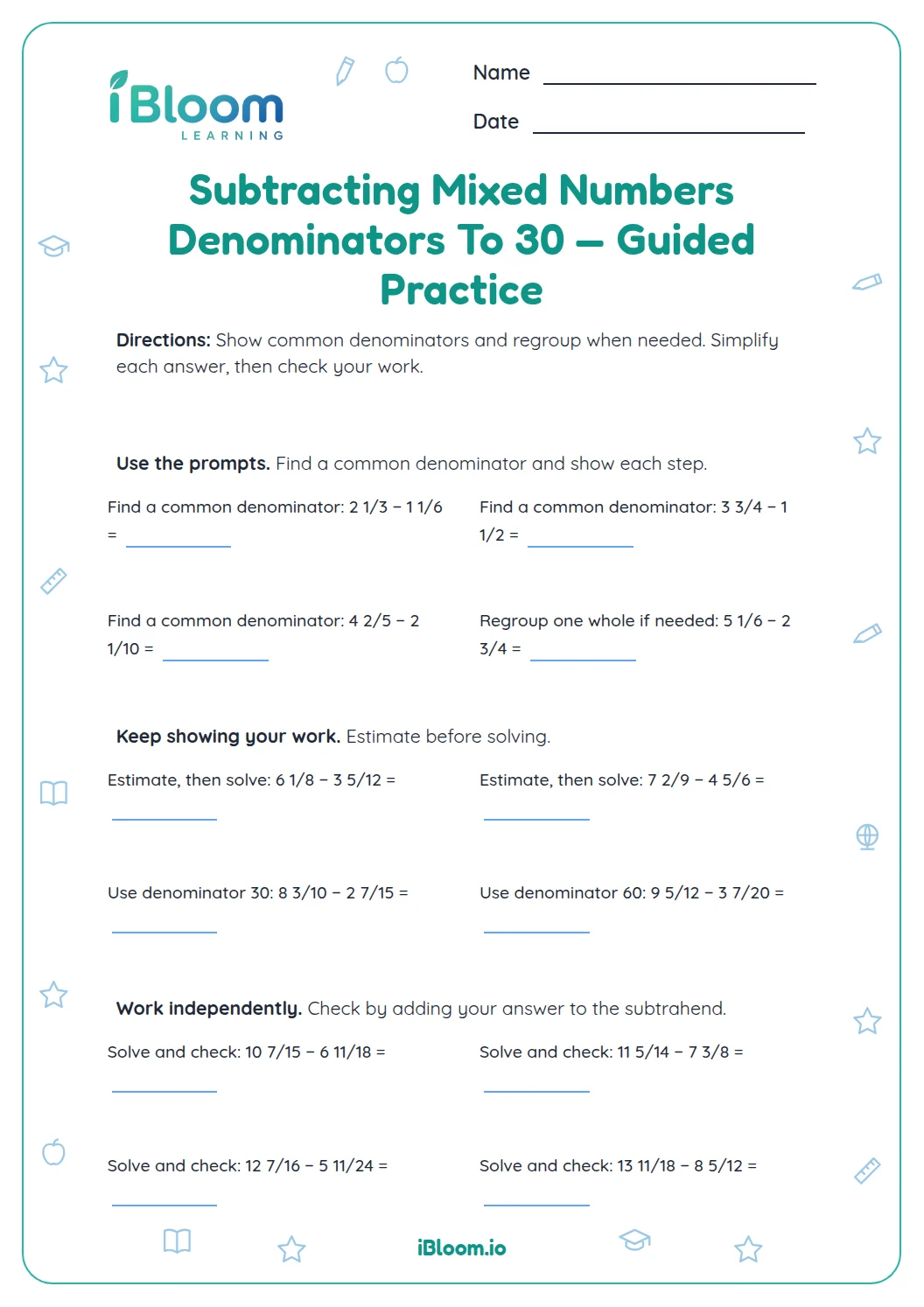
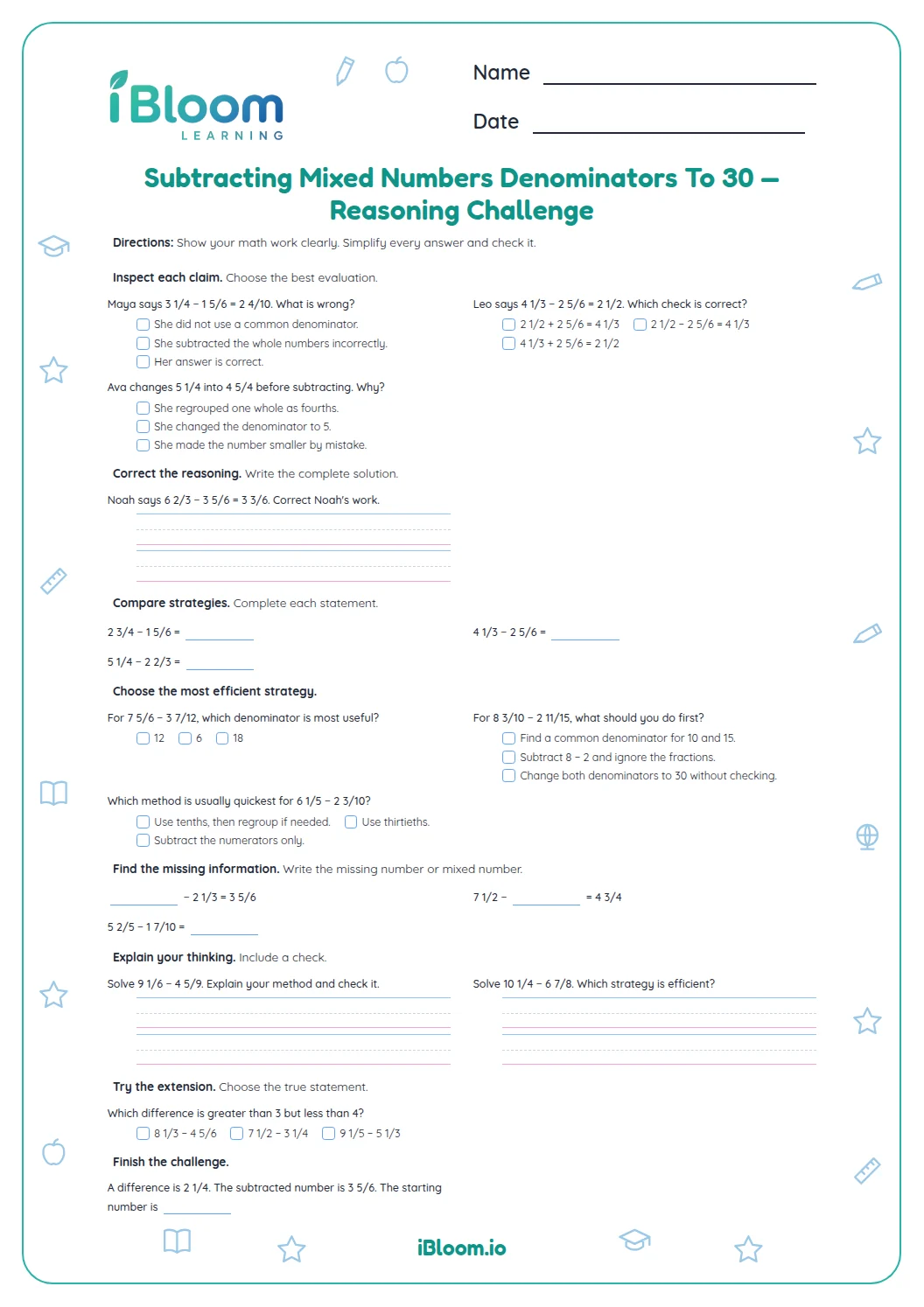
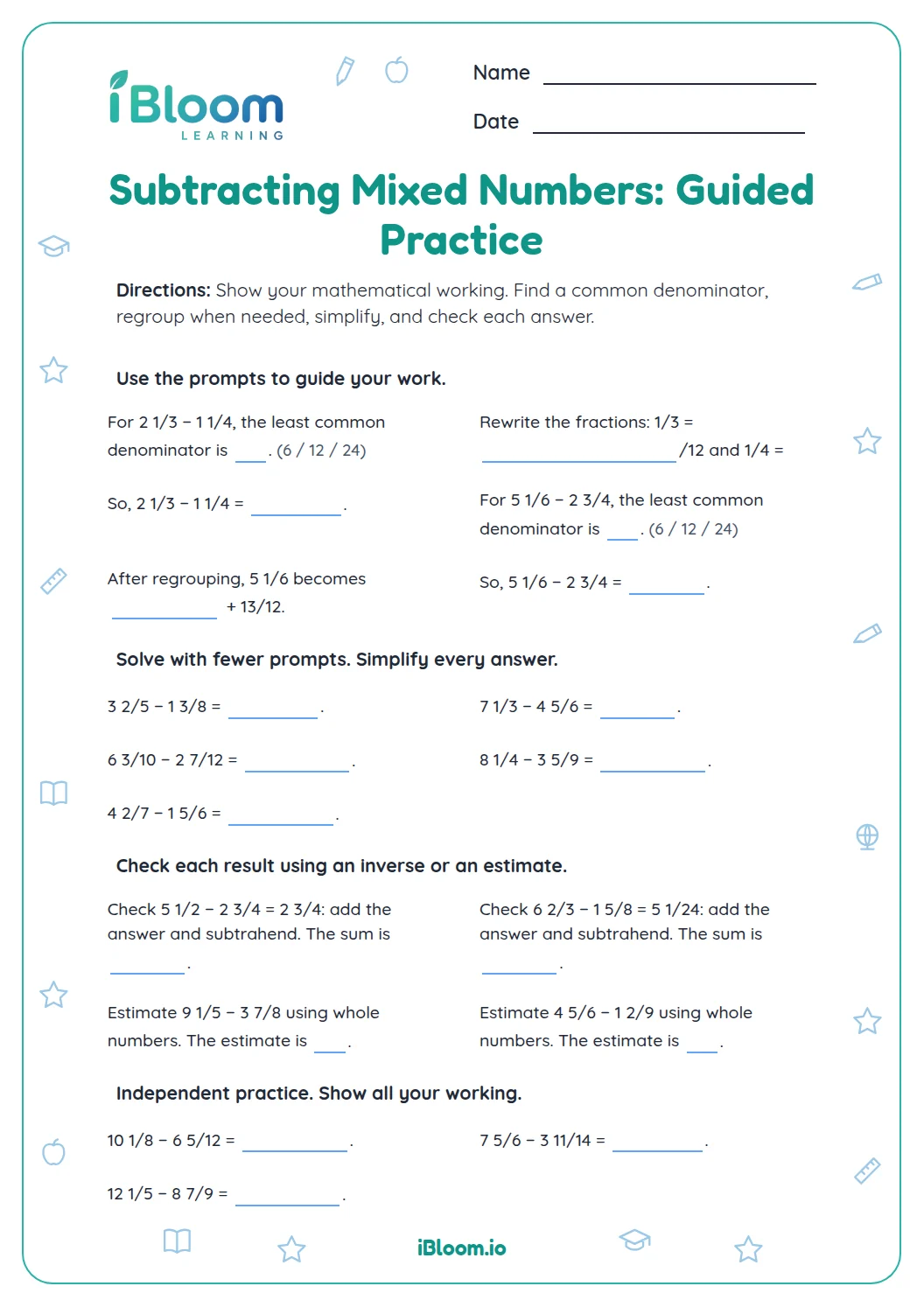
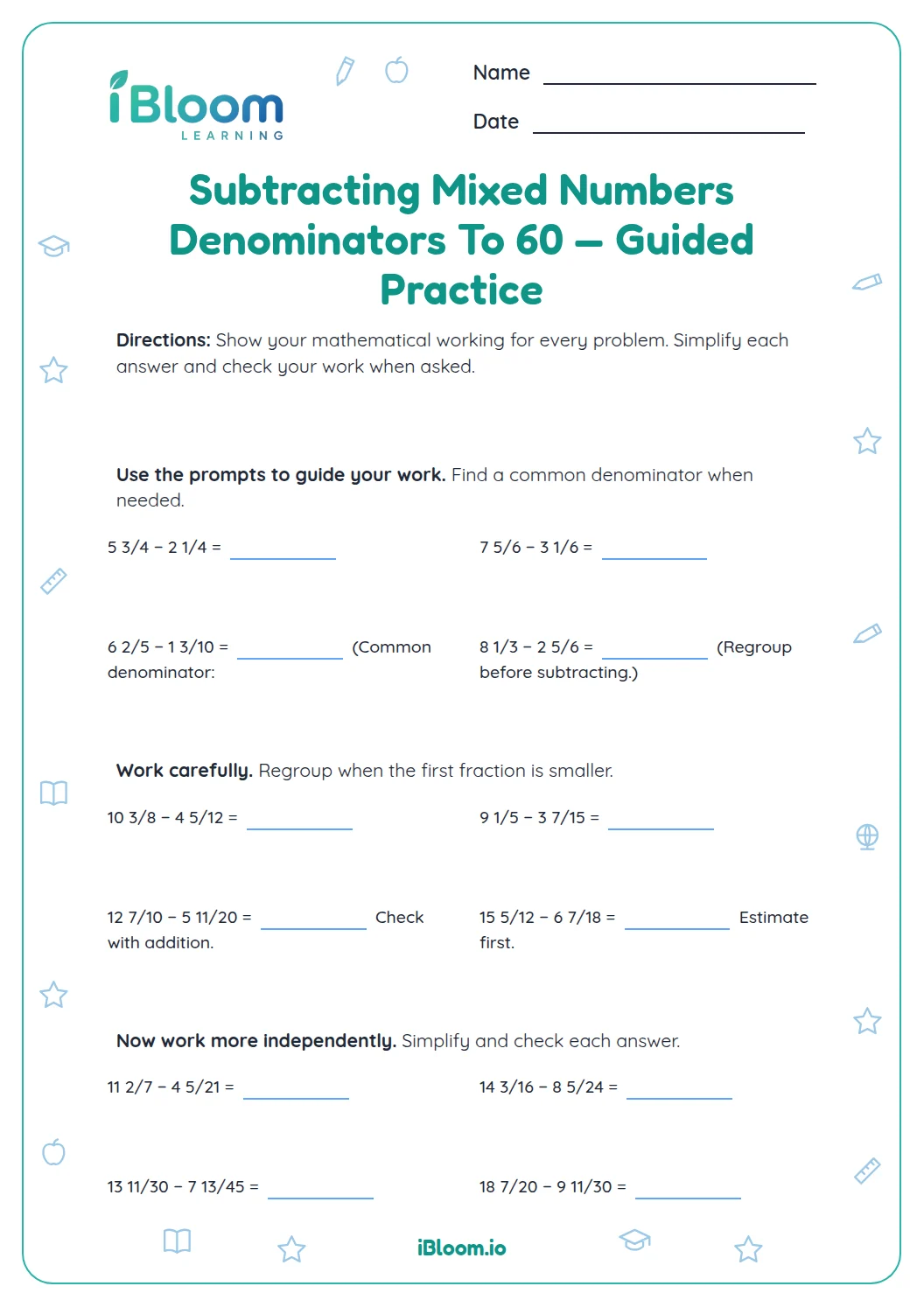
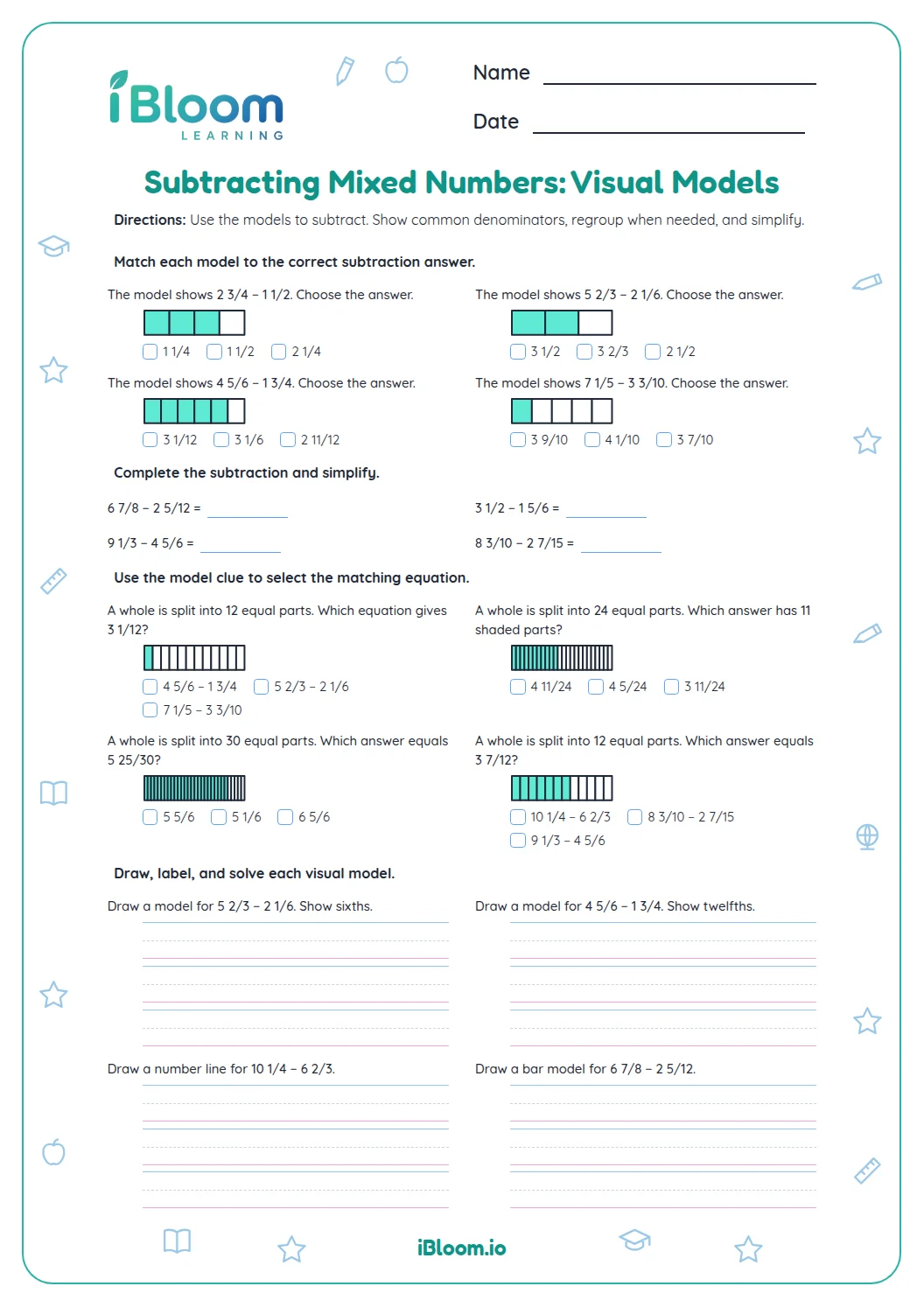
This two-page Grade 6 worksheet gives students 16 mixed-number subtraction problems with denominators through 30. The set moves from like denominators to regrouping and then to short measurement and route problems. The answer key is on a separate page. Students rename fractions to a common denominator before subtracting, practicing the equivalent-fraction method in CCSS 5.NF.A.1.
Aligned to 5.NF.A.1
How do you subtract mixed numbers with like denominators?
Subtract the fractional parts because the pieces are the same size, then subtract the whole numbers. For 5 7/12 − 2 1/12, the fractions leave 6/12, which is 1/2, and the whole-number difference is 3.
- 17 1/4 − 2 3/4
- 2Rename 7 1/4 as 6 5/4.
- 3Subtract: 6 5/4 − 2 3/4 = 4 2/4 = 4 1/2.
How does renaming help?
If the starting fraction is smaller than the fraction being subtracted, trade one whole for a fraction equal to one. For fourths, one whole is 4/4. For a problem with unlike denominators, first rewrite both fractional parts using a common denominator, then regroup if needed.
For example, in 7 1/4 − 2 3/4, rewrite 7 1/4 as 6 5/4. Then subtract 2 3/4 to get 4 2/4, or 4 1/2.
How do the word problems use subtraction?
Each story gives a starting length or amount and a smaller part to remove. For question 13, subtract 2 3/4 feet from 7 1/2 feet; the board is 4 3/4 feet long. Keep the unit from the question in the answer.
A steady subtraction routine
- 1Compare the denominators. If they differ, rewrite both fractions with a common denominator.
- 2Compare the fractional parts. If the first is smaller, rename one whole.
- 3Subtract the fractions and whole numbers. Simplify the fractional part.
- 4For word problems, identify the starting amount and the amount taken away or the difference described.
- 5Estimate whether the result is positive and smaller than the starting amount.
Common mistakes
The mistake
Subtracting the smaller numerator from the larger without considering which fraction is being subtracted.
The fix
Rename one whole so the first fractional amount is large enough, then subtract in order.
The mistake
Leaving a fraction unsimplified when its numerator and denominator have a common factor.
The fix
Reduce the fraction, such as 6/12 to 1/2.
The mistake
Using different-sized pieces as though their numerators could be subtracted directly.
The fix
Rewrite both fractions with a common denominator before subtracting.
Common Core alignment
The worksheet practices subtraction with equivalent fractions and mixed numbers.
Rename unlike fractions with equivalent fractions before finding a difference.
On this sheet: Several problems require equivalent fractions with a common denominator before subtracting mixed numbers.
Show the official wordingHide the official wording
Add and subtract fractions with unlike denominators (including mixed numbers) by replacing given fractions with equivalent fractions in such a way as to produce an equivalent sum or difference of fractions with like denominators.
What to practice next
Make more practice
Further reading
Questions parents and teachers ask
How do you subtract mixed numbers with unlike denominators?
Rewrite the fractional parts with a common denominator. If the starting fraction is smaller than the fraction being subtracted, rename one whole as an equivalent fraction. Then subtract the fractions and whole numbers, and simplify the answer when possible. carefully.
Why are denominators up to 30 included?
The worksheet title sets the denominator range. The problems use denominators such as 12, 15, 18, 20, and 30, so students practice finding equivalent fractions before they subtract rather than working only with familiar unit fractions. for subtraction practice. These are unlike-denominator examples.
Should students simplify each answer?
Yes. Simplify a fractional part when its numerator and denominator share a common factor. For example, 6/12 reduces to 1/2. The answer key gives simplified forms, while students can show equivalent fractions in their work. before writing the final form.
Which standard is the closest match?
Common Core 5.NF.A.1 directly includes adding and subtracting unlike-denominator fractions, including mixed numbers. The source page is labeled Grade 6, so this set can serve as review or added support for that fraction skill. rather than a first introduction to fractions.
Is an answer key included?
Yes. The printable comes with a separate answer key listing simplified results for all sixteen questions. Students should show how they found a common denominator or renamed a whole before checking their final answers. before they decide the work is complete.