





About this worksheet
This Grade 6 printable gives learners visual support for subtracting mixed numbers with denominators from 2 to 12. Fraction bars anchor the first problems; later items ask learners to calculate, choose a correct regrouping, compare differences, and solve real situations. It replaces the old sheet’s unsupported drawn-model prompts with actual template models where possible and answerable subtraction practice. The page practices fraction computation in CCSS 6.NS.A.1.
Aligned to 6.NS.A.1
What does a fraction bar show?
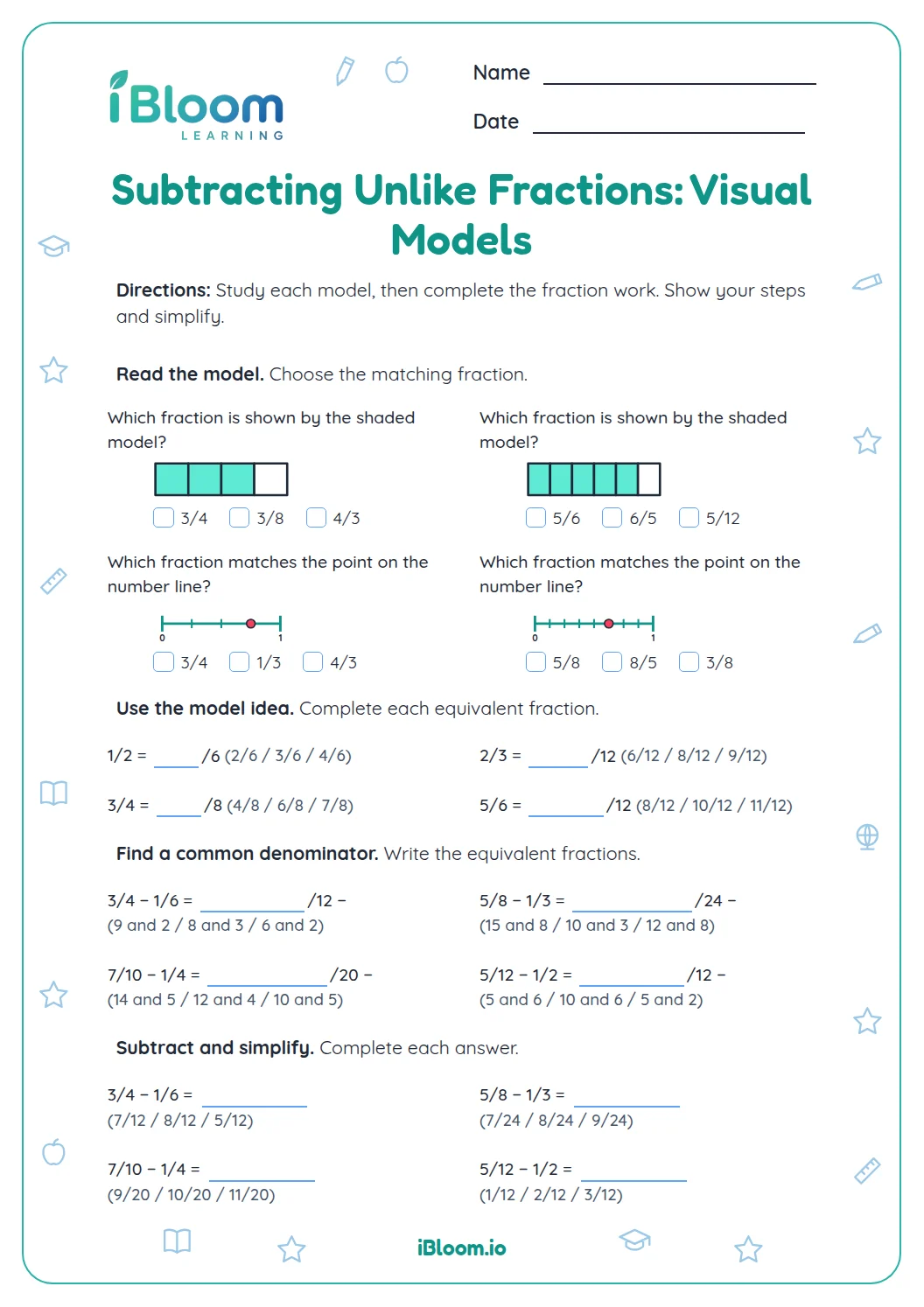
A bar partitioned into equal pieces shows fractional amounts and the whole units beside them. In question 1, subtracting 1 1/2 from 3 3/4 leaves 2 1/4.
- 13 3/4 − 1 1/2
- 23 3/4 − 1 2/4
- 32 1/4
How can a number line show a difference?
A difference is the distance between the starting value and the amount taken away. A number line makes both values visible so learners can count or reason about the remaining distance.
When should a learner regroup?
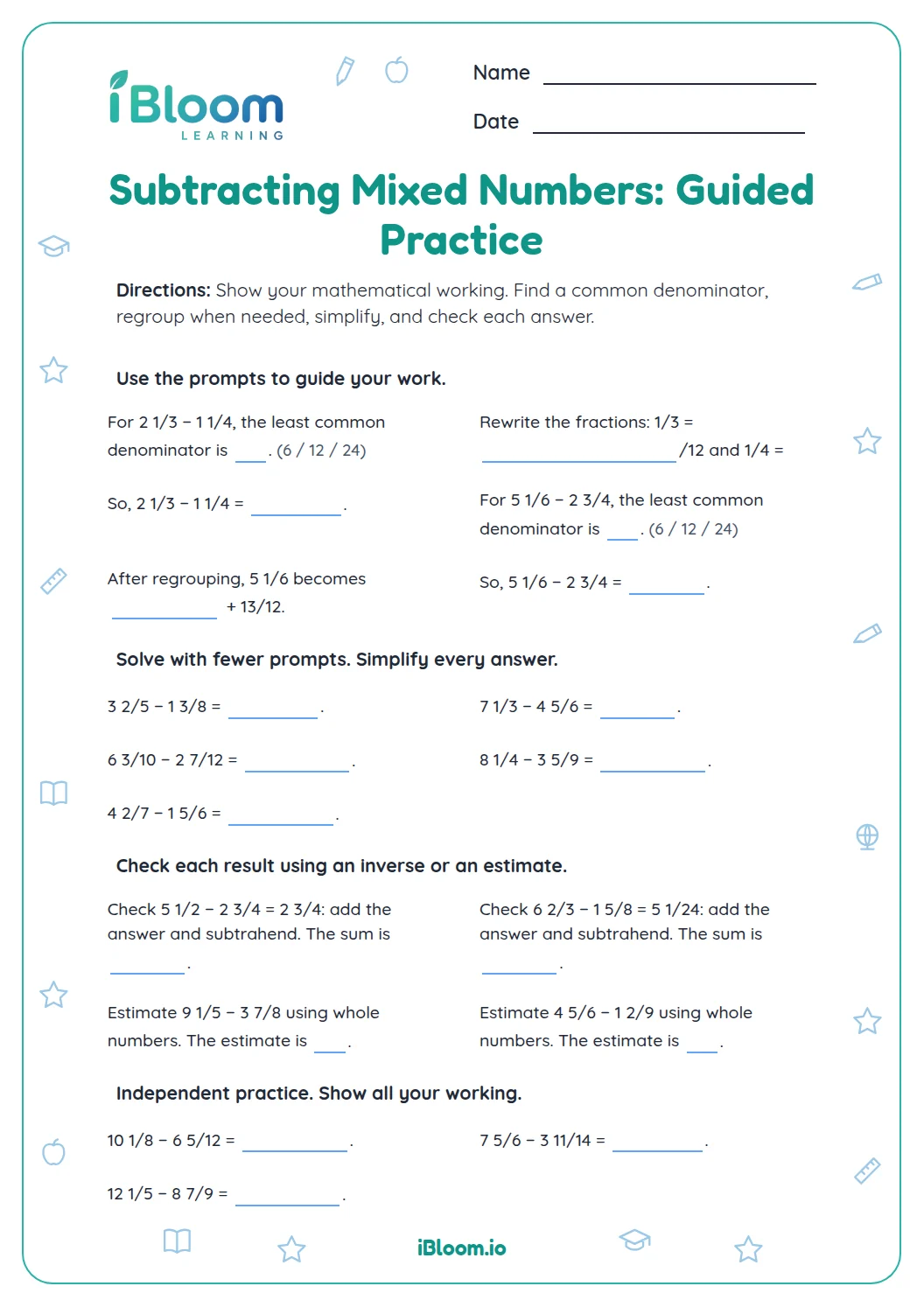
If the fraction being subtracted is larger than the starting fractional part, rename one whole. For example, 6 1/4 becomes 5 5/4, which makes it possible to subtract 2 3/4.
How does subtraction answer a story problem?
Identify the starting amount and the amount used, walked, or removed. Question 14 subtracts 3 3/4 miles from a 7 1/2-mile trail, leaving 3 3/4 miles.
How can I use this page?
- 1Read the denominator and count equal parts before subtracting.
- 2For unlike denominators, rename the fractions with a common denominator.
- 3Regroup a whole only when the fractional part needs more pieces.
- 4Simplify the fractional result and check it on the model.
- 5Attach the unit in a word problem.
What should learners check?
The mistake
Subtracting denominators along with numerators.
The fix
Rename both fractions with a common denominator before subtracting.
The mistake
Forgetting the whole kept after regrouping.
The fix
Rewrite the mixed number as one fewer whole plus an equivalent fraction.
The mistake
Leaving an answer in an unsimplified form.
The fix
Check whether numerator and denominator share a factor.
Common Core alignment
This worksheet practices the following Common Core skill.
Use fraction division to solve problems and explain what a quotient means.
On this sheet: The sheet divides mixed numbers by rewriting them as improper fractions and using reciprocals.
Show the official wordingHide the official wording
Interpret and compute quotients of fractions, and solve word problems involving division of fractions by fractions, e.g., by using visual fraction models and equations to represent the problem.
What to practice next
Make more practice
Further reading
Questions parents and teachers ask
How do fraction bars support subtraction?
They partition wholes into equal-sized pieces so learners can see what remains after an amount is taken away. Question 1 aligns the denominators as fourths: 3 3/4 − 1 2/4 = 2 1/4. The visual helps connect the remaining pieces to the written difference.
When is regrouping needed?
Regroup when the fraction in the starting number is smaller than the fraction being subtracted. One whole is renamed as fractional pieces. For example, 6 1/4 can become 5 5/4, which makes subtraction of 2 3/4 possible. The worksheet key accepts an equivalent mixed-number form when it has the same value.
Why do some problems use a common denominator?
Pieces must be the same size before they can be subtracted. A sixth and a fourth are not matching units, so they need equivalent fractions with a common denominator first. Simplify the result if its numerator and denominator share a factor.
What does a number line show in a subtraction problem?
It shows the two amounts and the distance between them. That distance is the difference. Learners can count back by fractional steps or compare the marked positions to check a calculation. The visual distance and the equation should agree.
How should a learner check a context answer?
Subtract the amount removed from the original amount, then make sure the result has the right unit and is less than the starting amount. Question 14 begins with a 7 1/2-mile trail, so the remaining distance is expressed in miles.
Is an answer key included?
Yes. A separate answer key gives the differences and context answers. Learners may show equivalent fractions or a different correct regrouping path; the important check is that the final value matches the amount represented by the problem. It also accepts equivalent, simplified forms of the same difference.