






About this worksheet
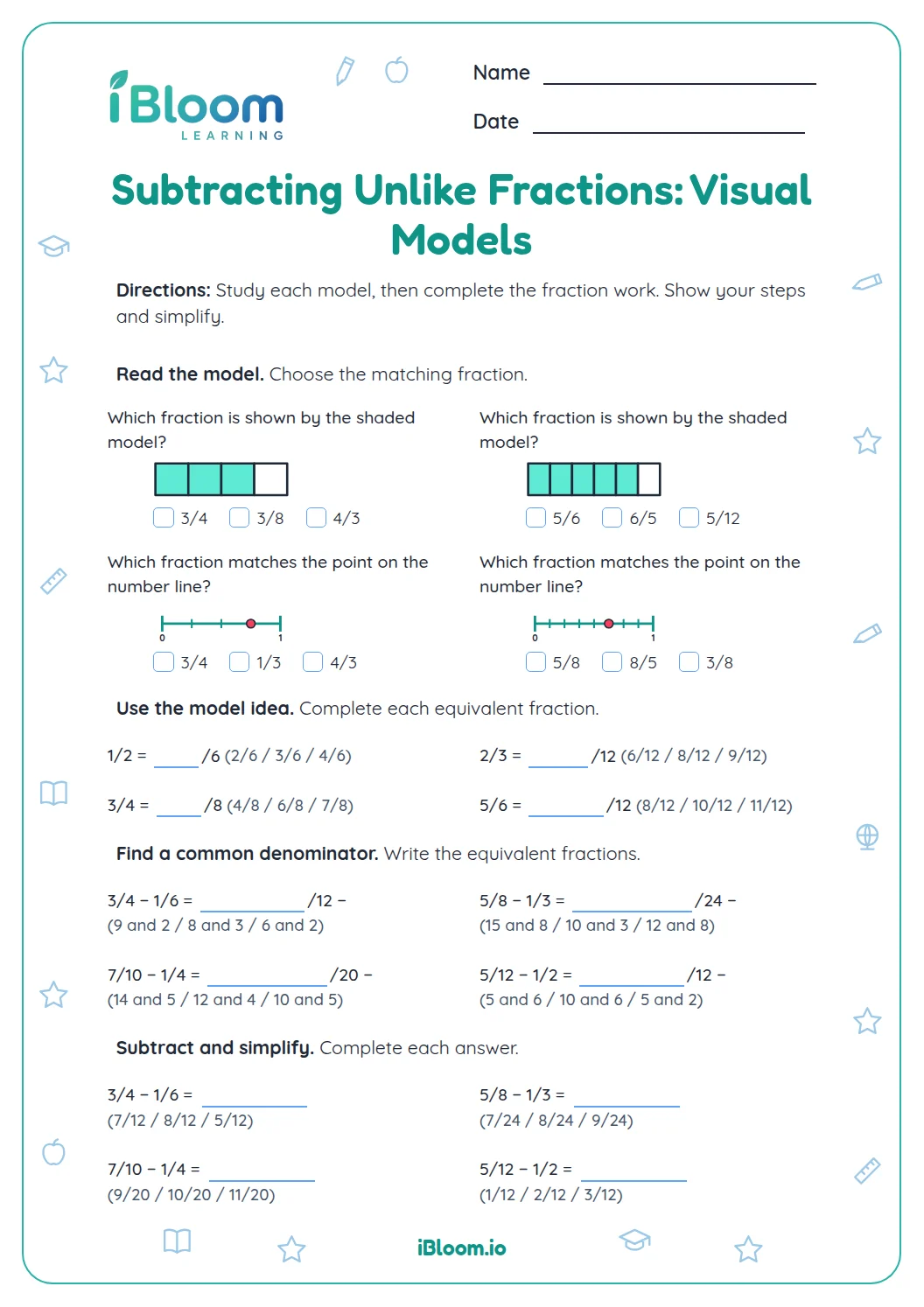
This Grade 6 printable has 16 subtraction problems with unlike denominators from 2 through 12. Learners find a common denominator, subtract, and simplify each difference; a three-item equivalent-fraction bonus reinforces the renaming step. The page practices CCSS 5.NF.A.1 and includes a separate answer key.
Aligned to 5.NF.A.1
Why find a common denominator?
Fractions can be subtracted only when their parts have the same size. A common denominator renames each fraction in equal-sized pieces. The least common denominator is often efficient, but any shared multiple works.
Question 1 uses sixths and fourths. Twenty-four is a shared denominator: 5/6 = 20/24 and 1/4 = 6/24. Subtract to get 14/24, then reduce to 7/12.
- 15/6 − 1/4
- 220/24 − 6/24
- 314/24 = 7/12
When should you simplify?
After subtracting, look for a number that divides both the numerator and denominator. In 14/24, both numbers divide by 2, so the reduced answer is 7/12. If no common factor is greater than 1, the fraction is already simplified.
What does this practice include?
The first 16 items are subtraction equations, so learners can focus on denominator choice and equivalent fractions. Their denominators range from 2 to 12, and several differences reduce. A three-item bonus then checks equivalent-fraction renaming.
- Part A builds common-denominator fluency.
- Part B includes reducible and already simplified answers.
- Part C varies denominator pairs and checks subtraction.
- Part D is a three-item equivalent-fraction bonus.
How to use this worksheet
- 1Read both denominators and find a shared multiple.
- 2Rewrite each fraction using that denominator.
- 3Subtract the numerators and keep the denominator.
- 4Reduce the fraction when the numerator and denominator share a factor.
- 5Check that the difference is positive and less than the first fraction.
Common mistakes and quick fixes
The mistake
Subtracting the denominators too.
The fix
Use equivalent fractions so the denominators match, then subtract only the numerators.
The mistake
Choosing a common denominator but not changing both numerators.
The fix
Multiply the numerator and denominator by the same factor for each fraction.
The mistake
Stopping before simplifying.
The fix
Check whether numerator and denominator share a factor after subtracting.
Common Core alignment
This worksheet gives focused practice with the standard below.
Find equivalent fractions to add or subtract fractions with unlike denominators.
On this sheet: Each problem subtracts fractions with unlike denominators and simplifies the difference.
Show the official wordingHide the official wording
Add and subtract fractions with unlike denominators (including mixed numbers) by replacing given fractions with equivalent fractions in such a way as to produce an equivalent sum or difference of fractions with like denominators. For example, 2/3 + 5/4 = 8/12 + 15/12 = 23/12. (In general, a/b + c/d = (ad + bc)/bd.)
What to practice next
Make more practice
Further reading
Questions parents and teachers ask
Can I use a denominator larger than necessary?
Yes. Any common multiple can rename both fractions in equal-sized pieces, though the least common denominator usually keeps the arithmetic smaller. For 5/6 and 1/4, twenty-four is the least common denominator. Show the equivalent fractions beside each item so the matching pieces are easy to check.
Why can only like denominators be subtracted?
The denominator names the size of the fractional pieces. Subtracting numerators makes sense only after both fractions count pieces of the same size. Rename each fraction with equivalent fractions before subtracting. Show the equivalent fractions beside each item so the matching pieces are easy to check.
What if the difference can be reduced?
Divide the numerator and denominator by the same common factor. For example, 14/24 reduces to 7/12 by dividing both numbers by 2. The fraction keeps the same value while its numbers become smaller. Show the equivalent fractions beside each item so the matching pieces are easy to check.
How can I check a subtraction answer?
Subtract equivalent fractions with matching denominators, simplify, then check by adding the difference to the amount subtracted. The result should equal the starting fraction. You can also estimate to make sure the answer is positive and reasonable. Show the equivalent fractions beside each item so the matching pieces are easy to check.
How many problems are on this sheet?
There are 16 subtraction equations. Across the set, the denominators run from 2 through 12, and answers include both fractions that reduce and fractions already in simplest form. Show the equivalent fractions beside each item so the matching pieces are easy to check.
Is an answer key included?
Yes. A separate answer key lists the simplified difference for every equation. Compare your common-denominator work as well as the final fraction, since equivalent answers may use different steps. Show the equivalent fractions beside each item so the matching pieces are easy to check.