




About this worksheet
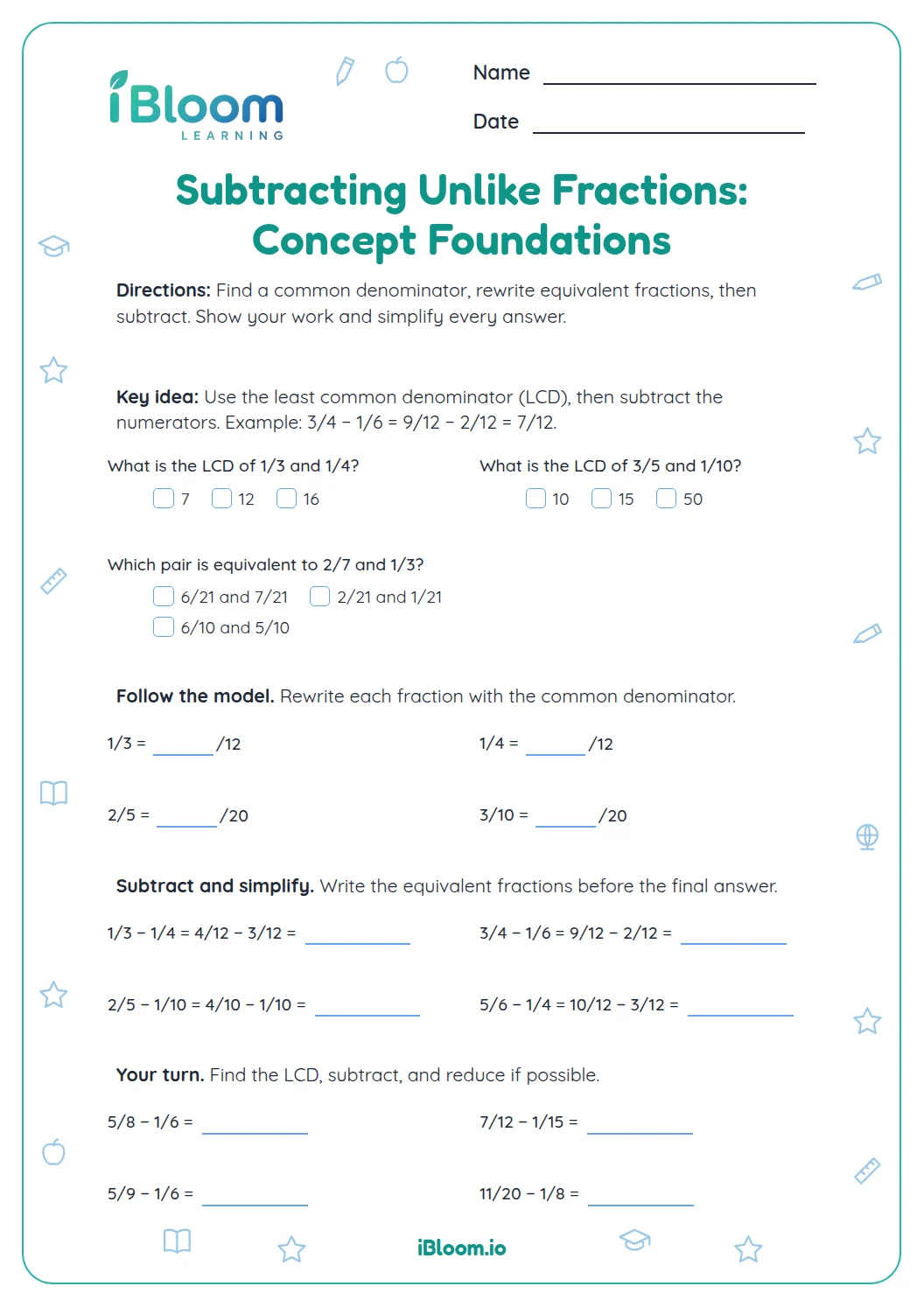
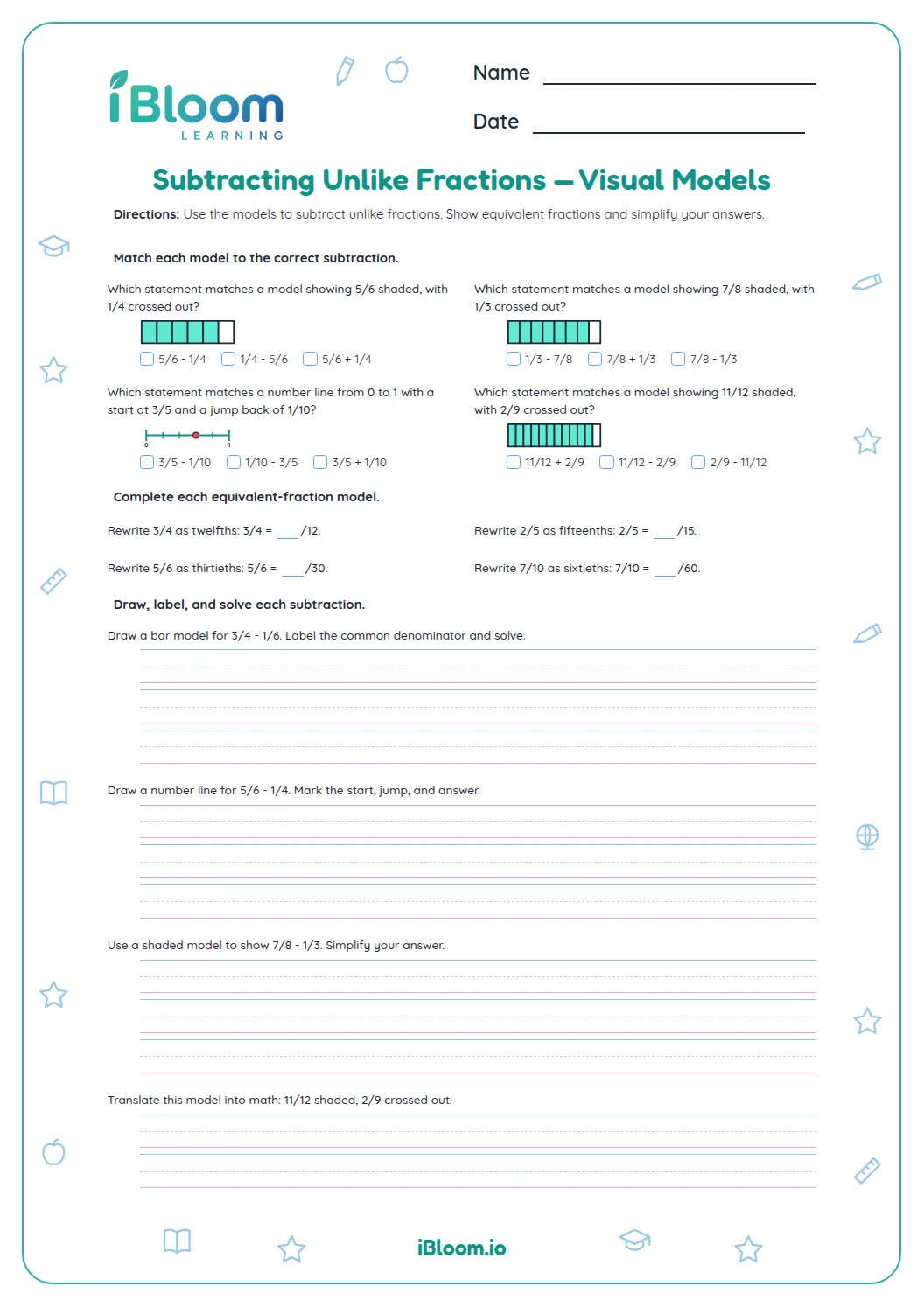
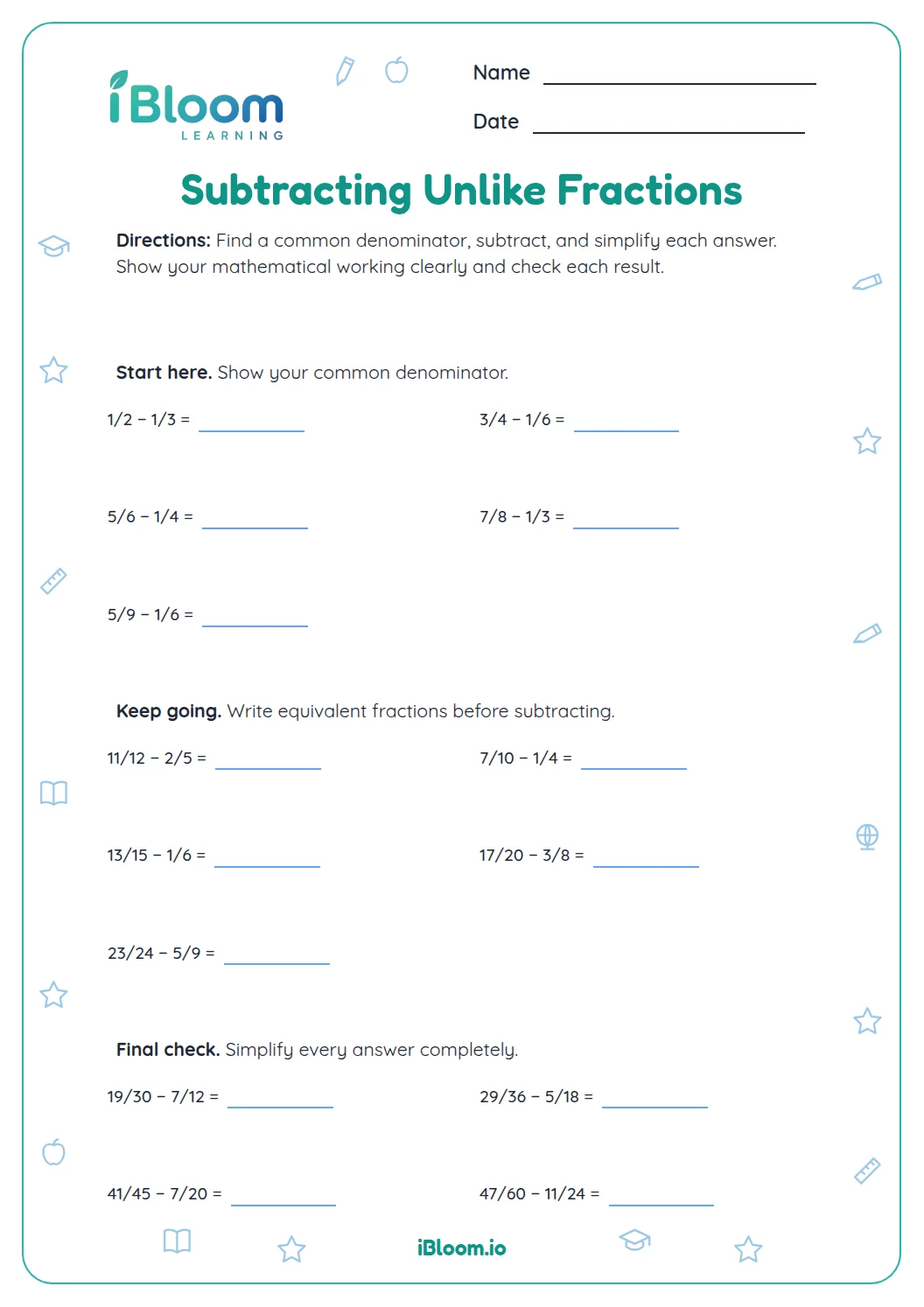
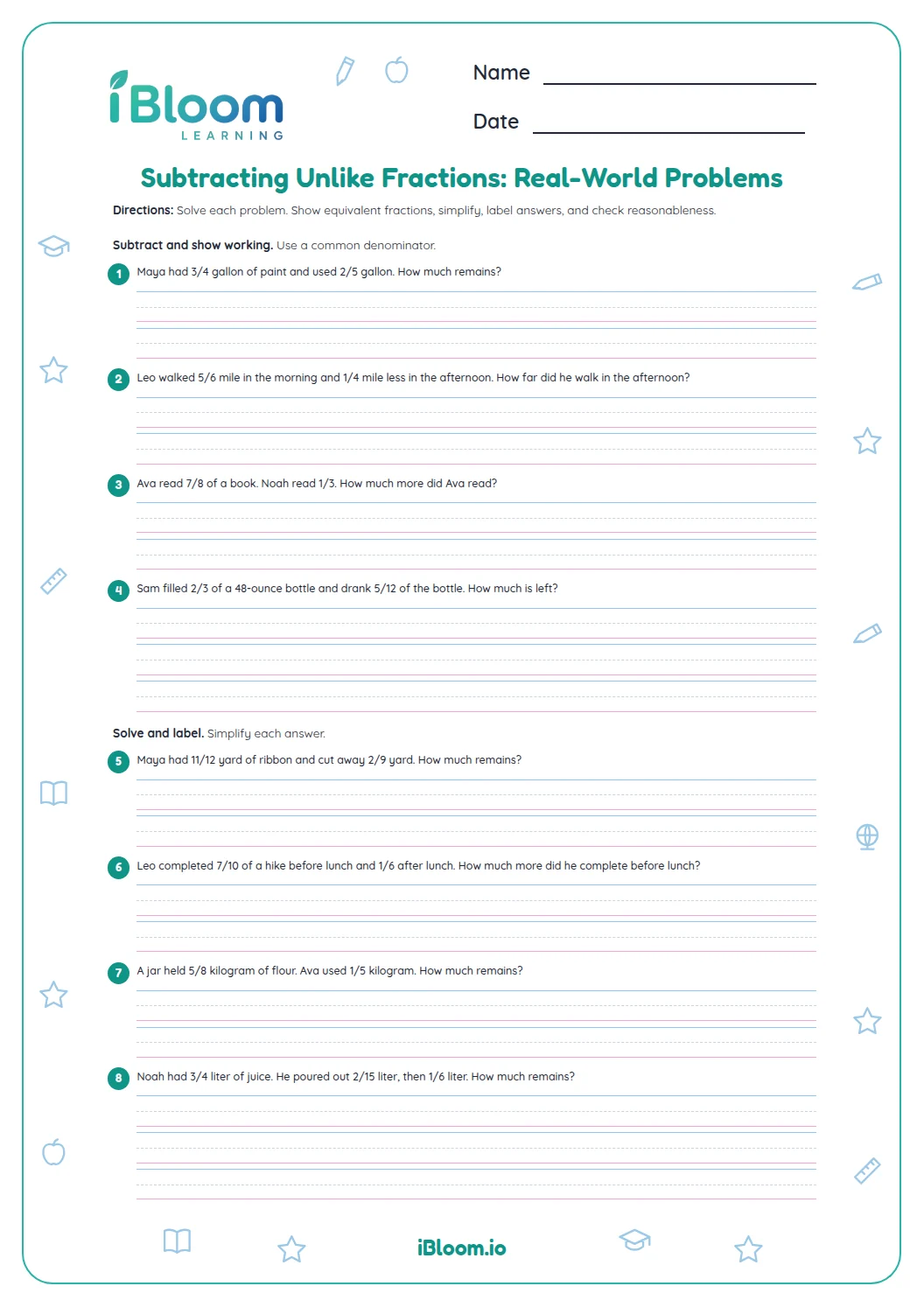
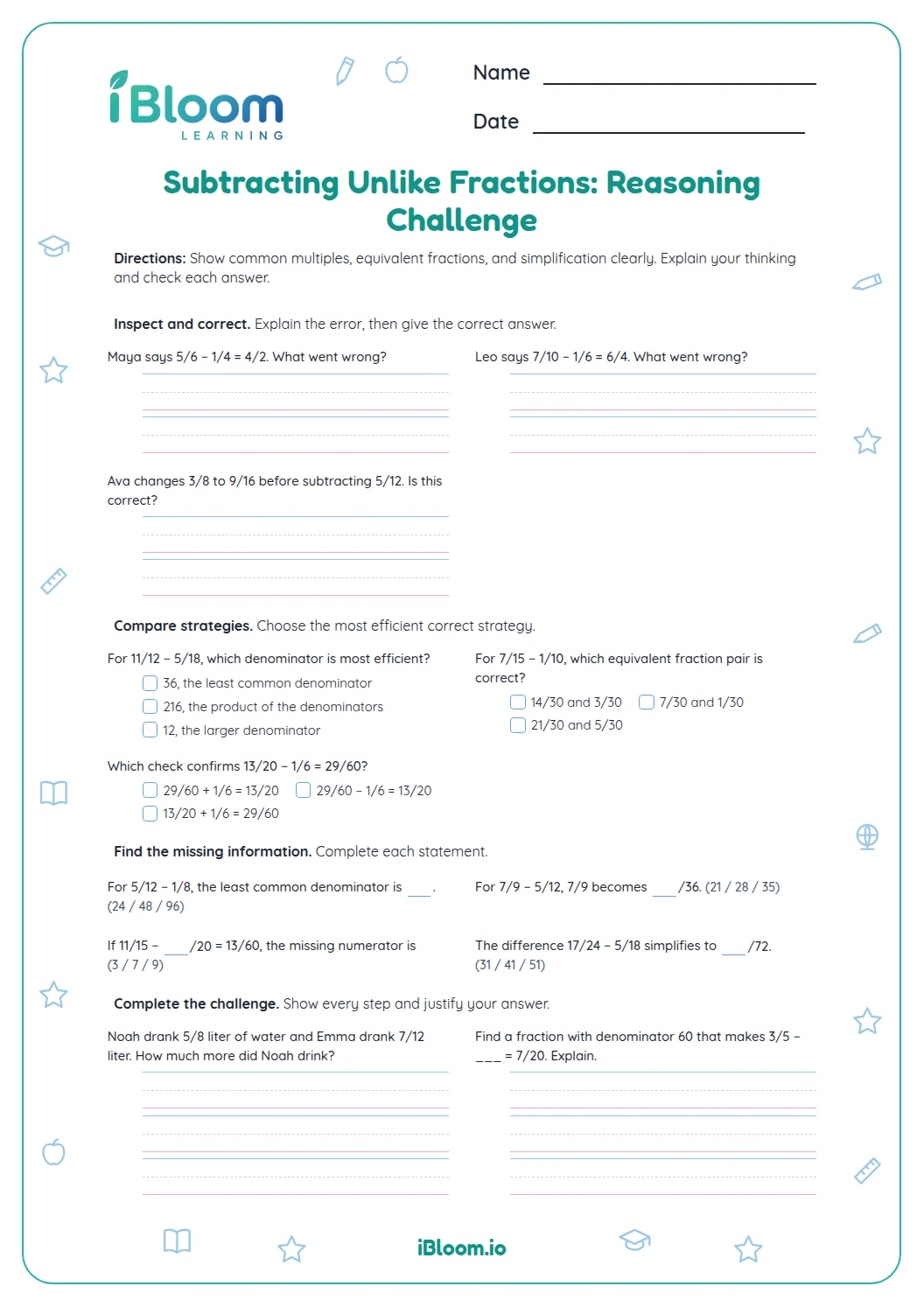
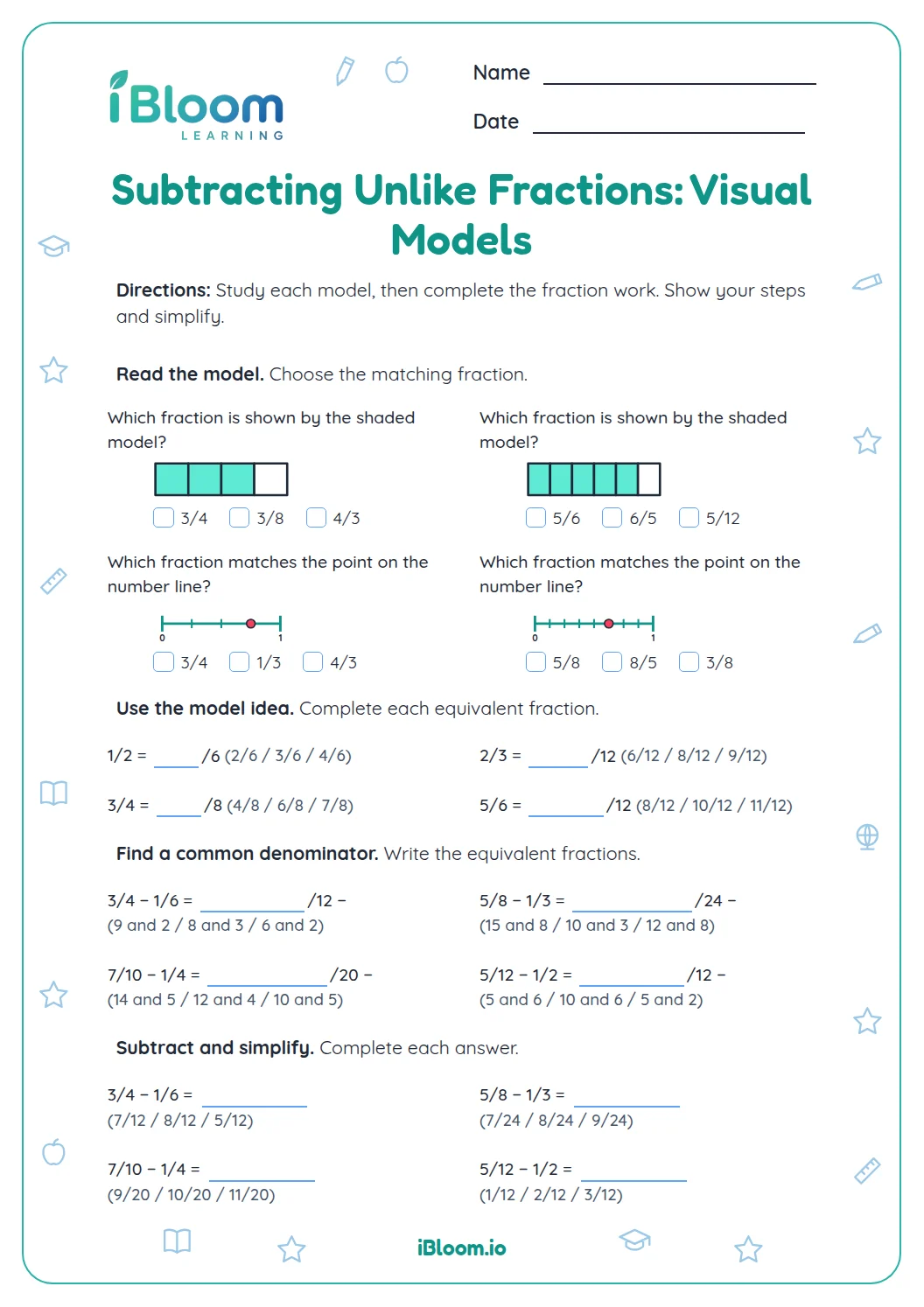
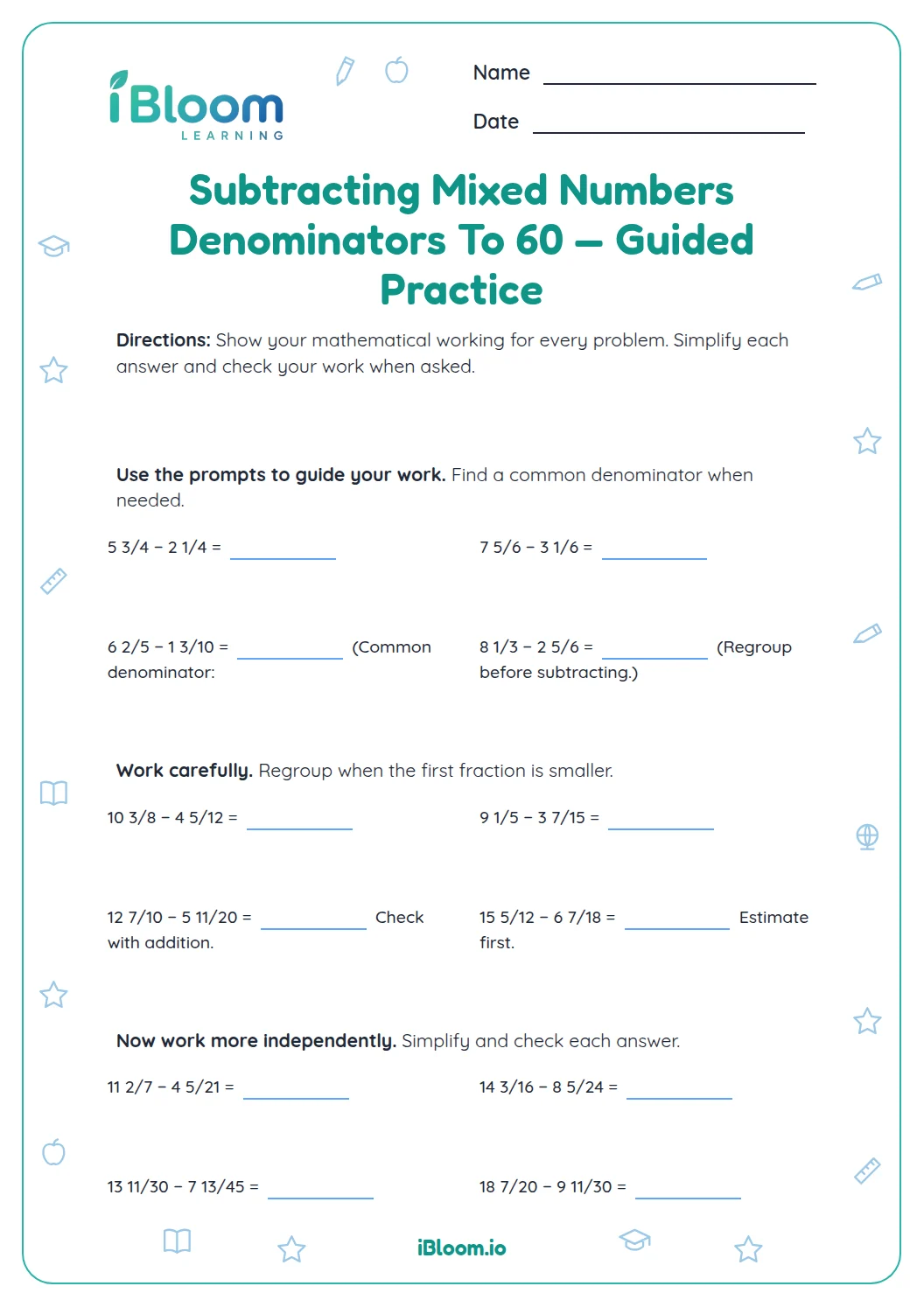
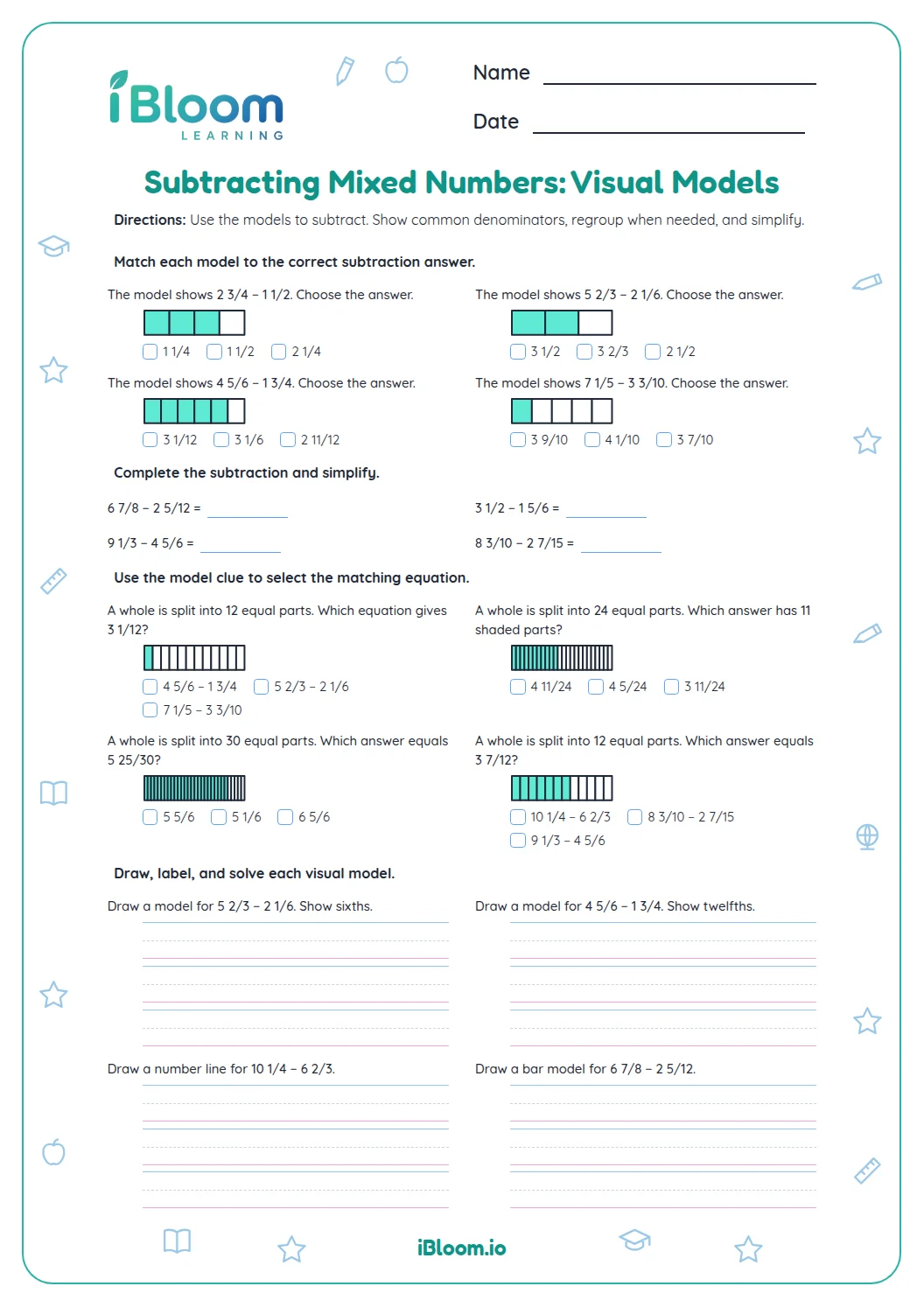
This free Grade 6 worksheet gives guided practice subtracting fractions with unlike denominators up to 60. Part A breaks 5/6 − 3/10 into four small steps: rename each fraction in thirtieths, subtract and simplify. Part B supplies a useful common denominator for four more problems. Part C asks students to choose their own denominator for eight final differences. The worksheet practices Common Core 5.NF.A.1 through equivalent fractions and subtraction. Students simplify each result, then use the separate answer key to check their work.
Aligned to 5.NF.A.1
Why do the denominators need to match?
The denominator names the size of each fractional part. Sixths and tenths are different-sized parts, so rename them before subtracting. Multiplying a fraction’s numerator and denominator by the same number preserves its value.
In Part A, both denominators divide evenly into 30. Five sixths becomes twenty-five thirtieths, and three tenths becomes nine thirtieths.
How do the first four questions guide one subtraction?
Questions 1–4 form one worked path. Students fill the two equivalent numerators, subtract in thirtieths and simplify. The answer to question 4 is the final result of 5/6 − 3/10.
- 15/6 − 3/10
- 25/6 = 25/30 and 3/10 = 9/30
- 325/30 − 9/30 = 16/30
- 416/30 = 8/15
Can the common denominator be greater than 60?
Yes. The title’s limit describes the denominators in the original fractions. A shared denominator can be larger: question 11 uses 120 to rename fortieths and sixtieths.
Part B gives the denominator in words so students can concentrate on equivalent fractions. Part C removes that hint. Leave the denominator unchanged when subtracting the renamed numerators, then reduce the final fraction.
How to use this worksheet
- 1Identify the two original denominators.
- 2Estimate the difference before calculating in Part C.
- 3Find a common multiple, using the printed hint in Part B.
- 4Multiply each numerator and denominator by the same factor.
- 5Subtract the renamed numerators and keep the shared denominator.
- 6Reduce the difference and check that it is positive and smaller than the first fraction.
Mistakes to notice and fix
The mistake
Subtracting 6 − 10 while subtracting 5 − 3.
The fix
Rename sixths and tenths as thirtieths; subtract only their numerators.
The mistake
Changing 5/6 to 5/30.
The fix
The denominator was multiplied by 5, so multiply the numerator by 5 too.
The mistake
Leaving question 7 as 3/18.
The fix
Divide numerator and denominator by 3 to write 1/6.
Common Core alignment
Rename unlike fractions with equal denominators, subtract and simplify.
On this sheet: Students use equivalent fractions to subtract fractions with denominators up to 60.
Show the official wordingHide the official wording
Add and subtract fractions with unlike denominators (including mixed numbers) by replacing given fractions with equivalent fractions in such a way as to produce an equivalent sum or difference of fractions with like denominators.
What to practice next
Make more practice
Further reading
Questions parents and teachers ask
What does “denominators to 60” mean here?
It means the denominators in the starting fractions are no greater than 60. The common denominator used while solving may be larger. For instance, 19/40 and 7/60 can both be expressed in one hundred twentieths, which lets students subtract equal-sized parts accurately.
Must students use the least common denominator?
Part A uses thirtieths to model the subtraction, and Part B provides a denominator to use. In Part C, students choose a common denominator themselves. Any common multiple works if both fractions are renamed correctly; the least one keeps the numbers smaller and can make simplifying easier.
Why are the first four questions connected?
They break one subtraction into manageable steps. Students rename 5/6 and 3/10 as thirtieths, subtract the numerators and simplify the difference. Treat these as four responses within one guided example. The next twelve questions each ask for a complete subtraction using the same process.
What work should students put in the spaces?
Students should show the equivalent fractions and the subtraction before recording a simplified answer. For 7/12 − 3/8, they can write 14/24 − 9/24 = 5/24. The visible steps make it easier to see whether an error came from renaming, subtracting or simplifying.
How can a student check a fraction difference?
Add the difference back to the fraction that was subtracted. For the first example, 8/15 + 3/10 becomes 16/30 + 9/30 = 25/30, which equals 5/6. Students can also estimate: subtracting a positive fraction must leave less than the original starting amount.