


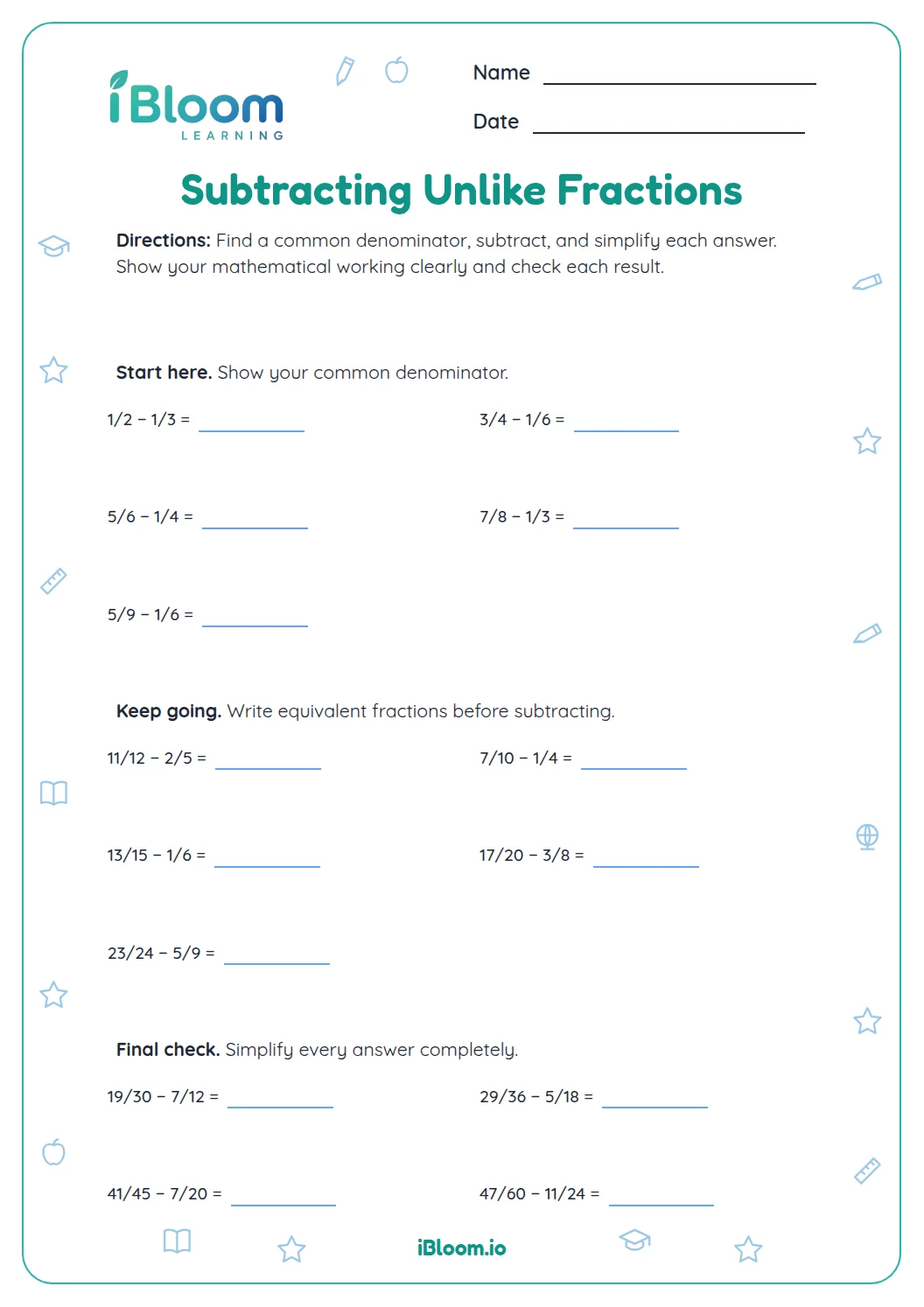
About this worksheet
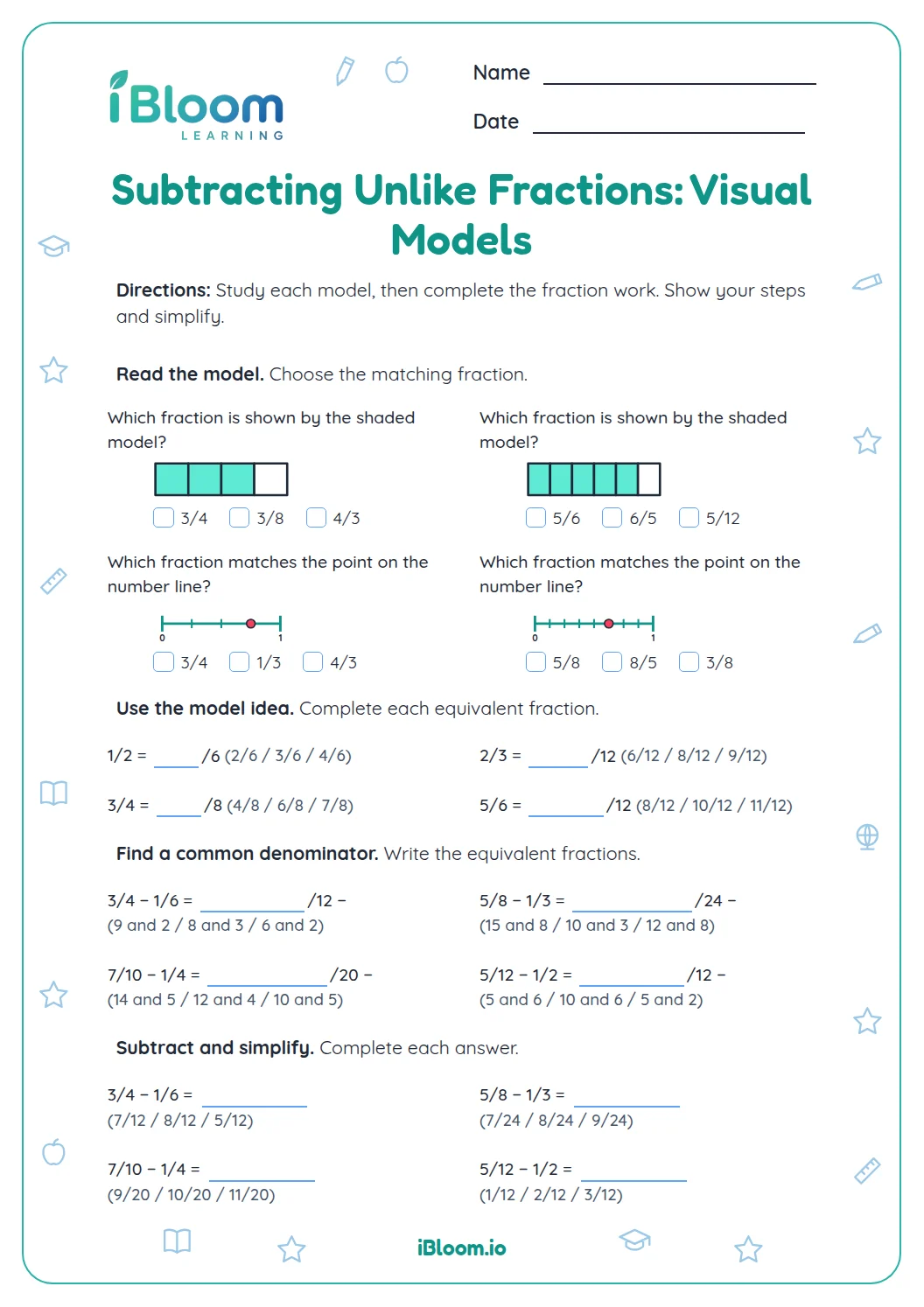
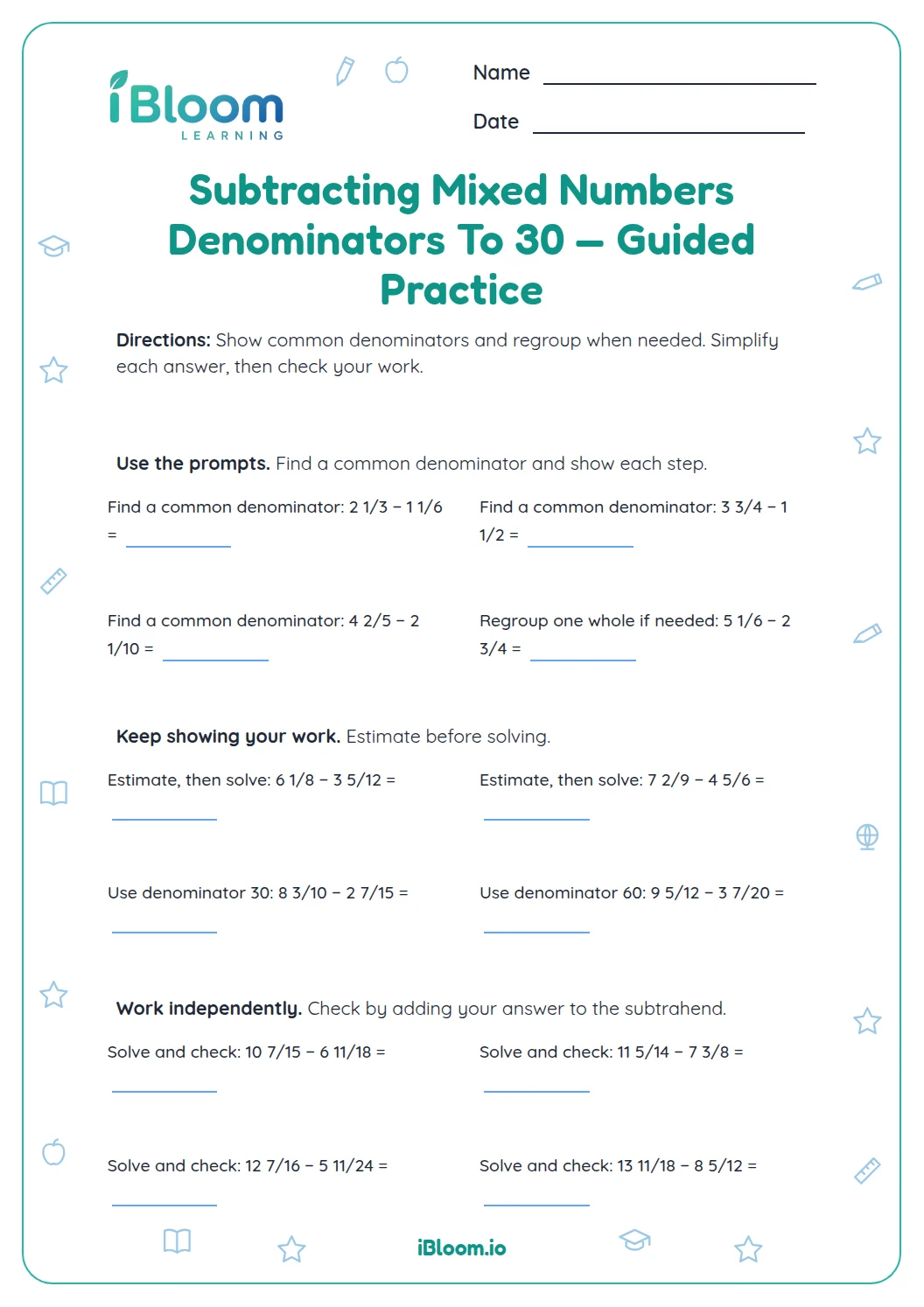
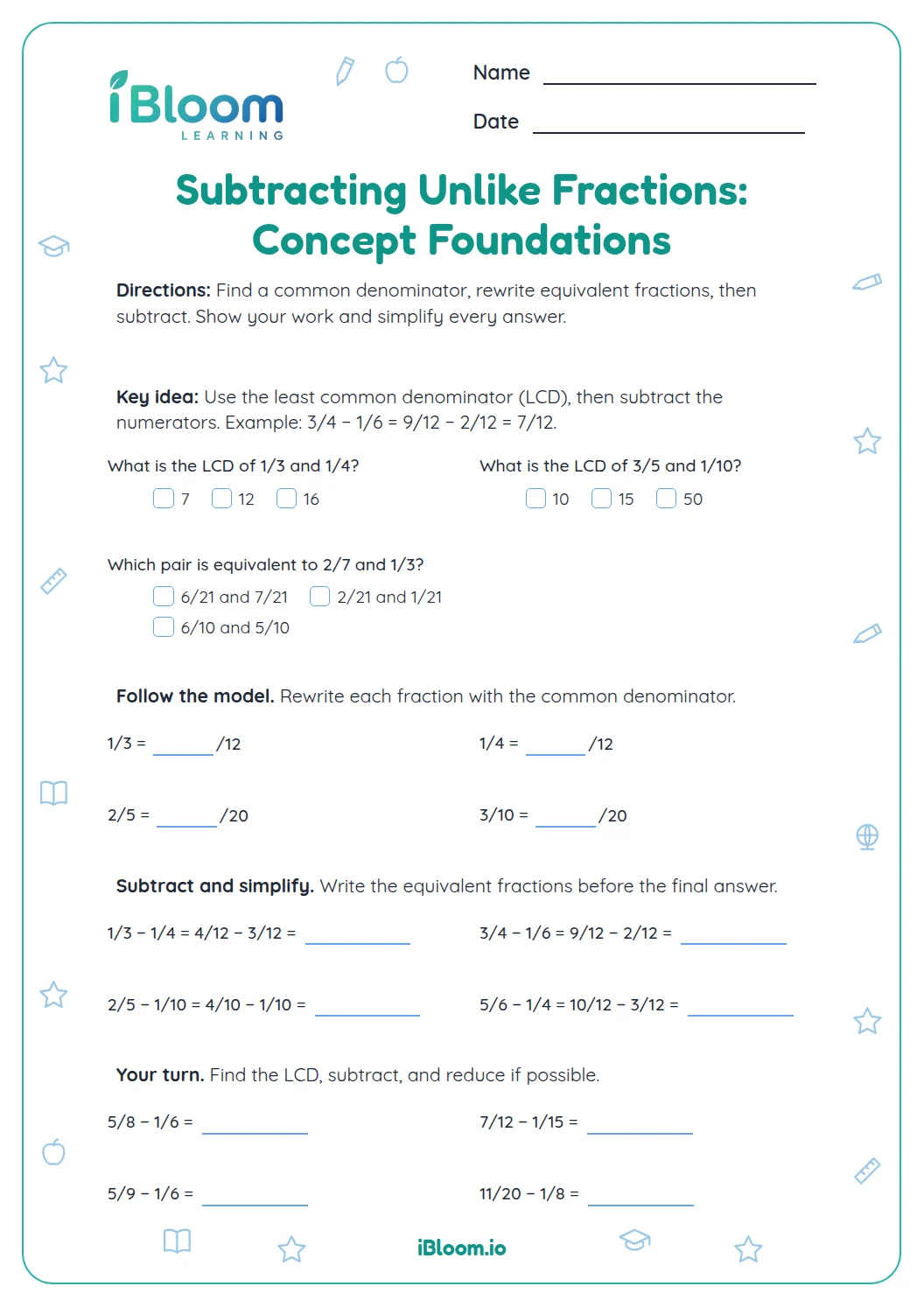
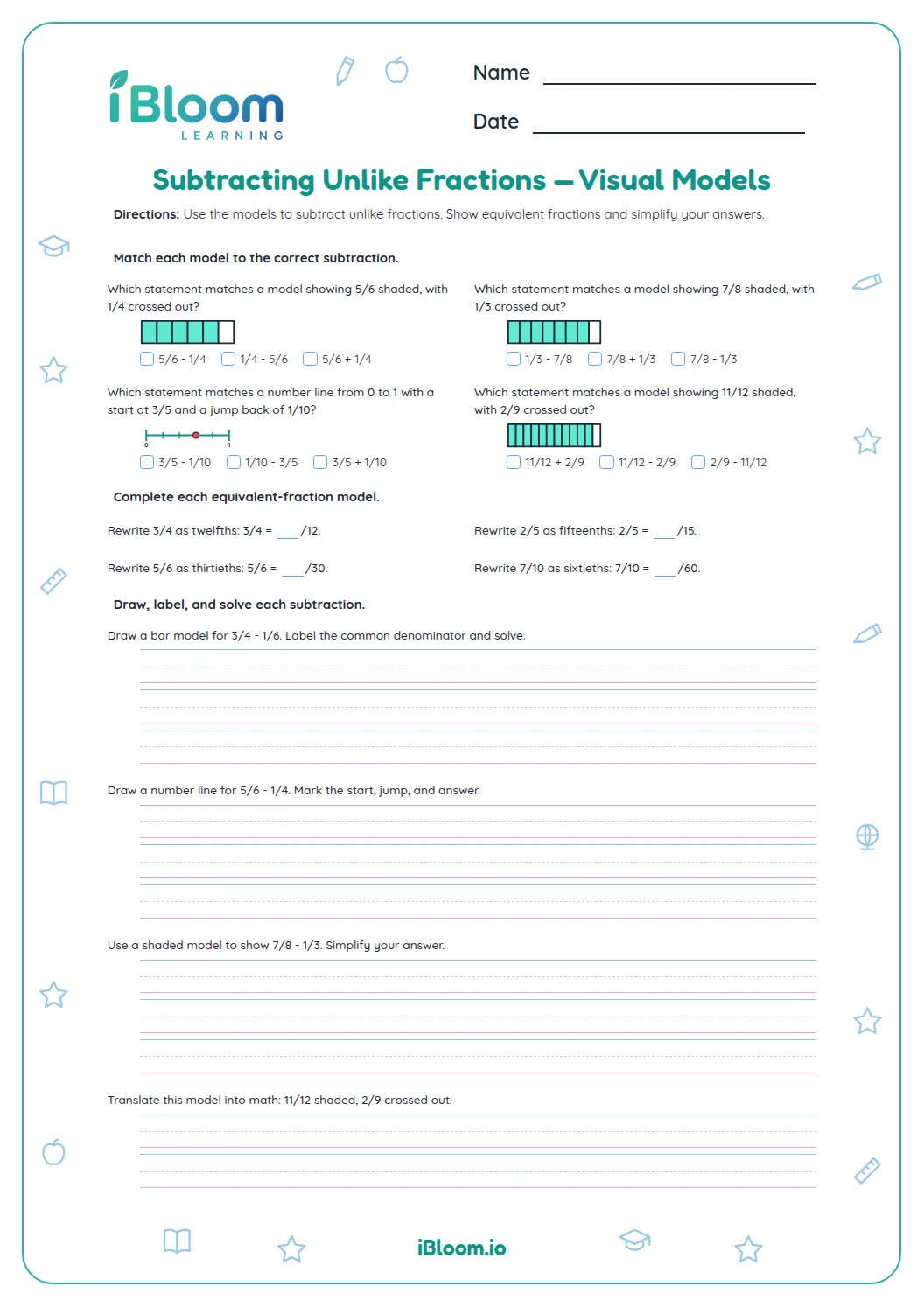
This printable gives practice subtracting unlike fractions whose denominators are no greater than 30. Children find common denominators, simplify, compare two differences, and solve short real-world problems about lengths, amounts, and routes. The answer key includes labeled results and reduced fractions.
Aligned to 5.NF.A.1
A reliable way to subtract unlike fractions
The denominators name the size of the pieces. Before subtracting, rename each fraction so both fractions use the same size pieces.
For 5/6 − 1/4, twelfths work: 10/12 − 3/12 = 7/12. Reduce if the numerator and denominator share a factor.
What does the practice include?
The sheet moves from fraction differences to situations about ribbon, tanks, trails, and recipes, then asks students to compare and check subtraction.
How to use this worksheet
- 1Find a common denominator for the two fractions.
- 2Subtract the numerators and keep the common denominator.
- 3Simplify the difference when possible.
- 4For a story, keep the unit named in the question.
Common mistakes and quick fixes
The mistake
Subtracting the denominators as well as the numerators.
The fix
Rename both fractions as equal-sized parts first; subtract only the numerators.
The mistake
Stopping at an equivalent fraction that can still be reduced.
The fix
Check whether numerator and denominator share a factor.
The mistake
Subtracting a larger amount from a smaller amount in a story without noticing the context.
The fix
Check what remains or how much more the situation asks for before choosing the operation.
Curriculum alignment
This worksheet practices the named skill with grade-appropriate examples.
Add and subtract fractions with unlike denominators.
On this sheet: Each problem subtracts unlike fractions by finding equivalent fractions with a common denominator.
Show the official wordingHide the official wording
Add and subtract fractions with unlike denominators (including mixed numbers) by replacing given fractions with equivalent fractions in such a way as to produce an equivalent sum or difference of fractions with like denominators.
What to practice next
Make more practice
Further reading
Questions parents and teachers ask
How do I subtract fractions with unlike denominators?
Rename both fractions with a common denominator, subtract the numerators, then simplify. For 3/4 − 1/6, use twelfths: 9/12 − 2/12 = 7/12. Read each item aloud and check that the response preserves the key idea in the question. The separate answer key is useful for checking both the calculation and the wording.
Is there an answer key?
Yes. A separate key page gives the answer to every question, including model responses where wording may vary. It is printed as a separate page so a teacher or caregiver can keep it nearby while the student works.
What should a student do first?
Start by identifying what the question asks and which information matters. Use the strategy practiced on the page, write a response in the space provided, and check that it answers the prompt clearly. Ask the student to explain one answer aloud to show understanding.
Can students show their work?
Yes. The worksheet includes space for calculation or written thinking where useful. Encourage students to show enough work to explain a choice, then use the answer key to review the result and revisit any step that was difficult.