

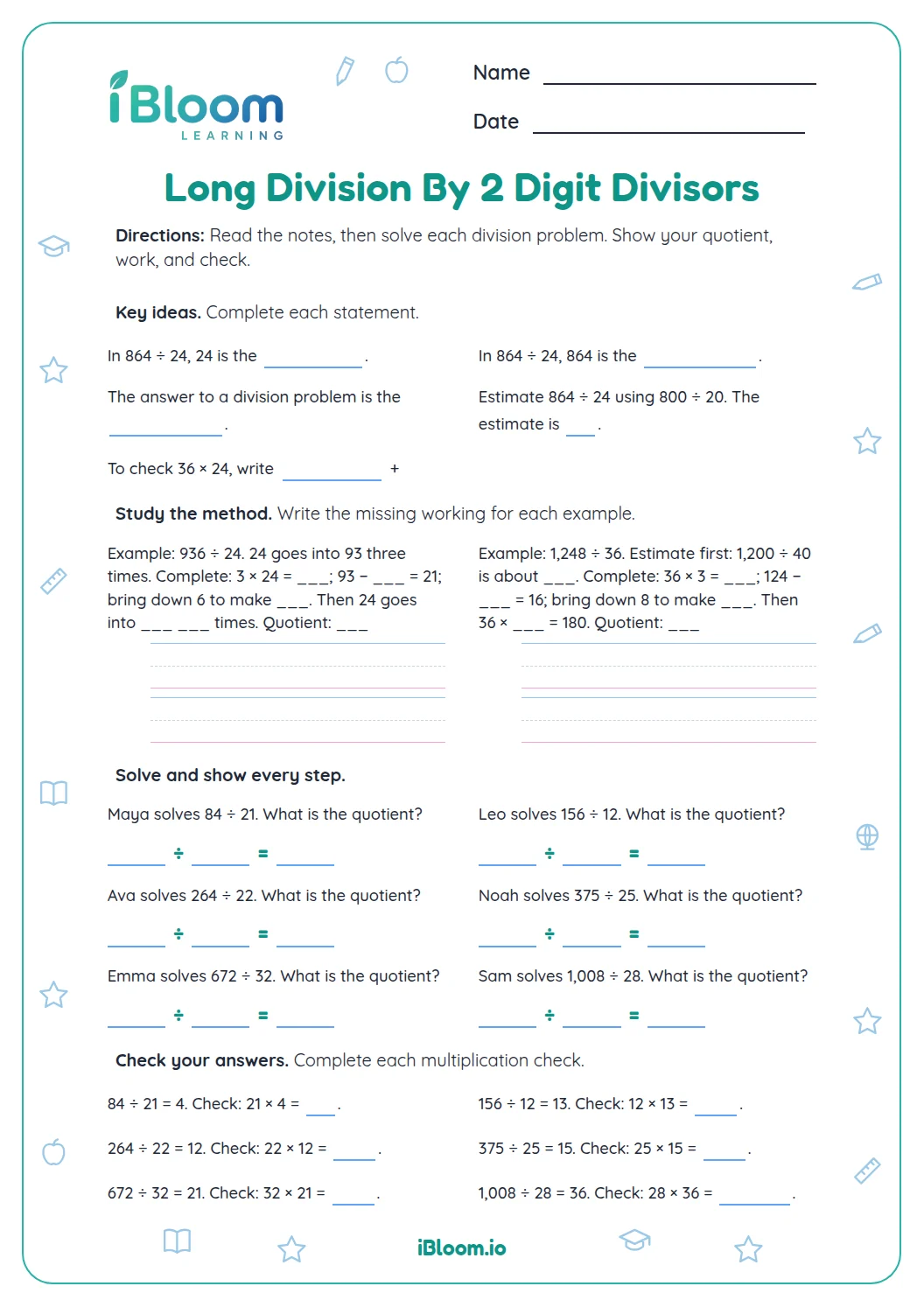


About this worksheet
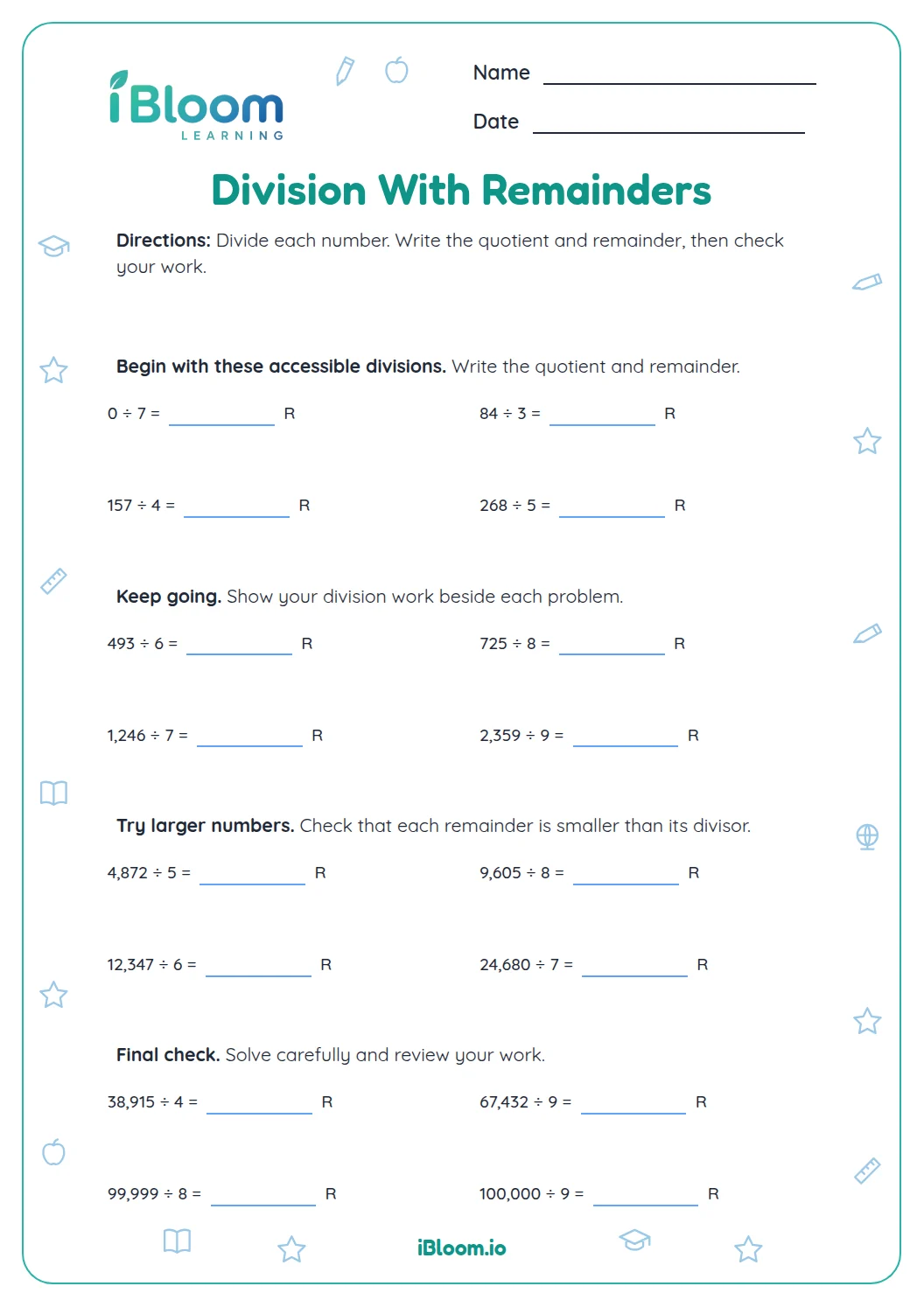
This free printable Grade 6 worksheet asks students to calculate and defend division answers. Fourteen questions use one-digit divisors and whole-number dividends from 0 through 10,000, with exact quotients throughout. Students solve six divisions, choose four answers about checks and number relationships, and explain four reasoning challenges. Common Core 6.NS.B.2 connects the standard division algorithm to accurate quotient digits. Internal zeros, a one-digit divisor of 1, and a zero dividend give students specific cases to examine. A separate answer key includes model explanations for written responses.
Aligned to 6.NS.B.2
Why does 4,824 ÷ 6 need a zero in its quotient?
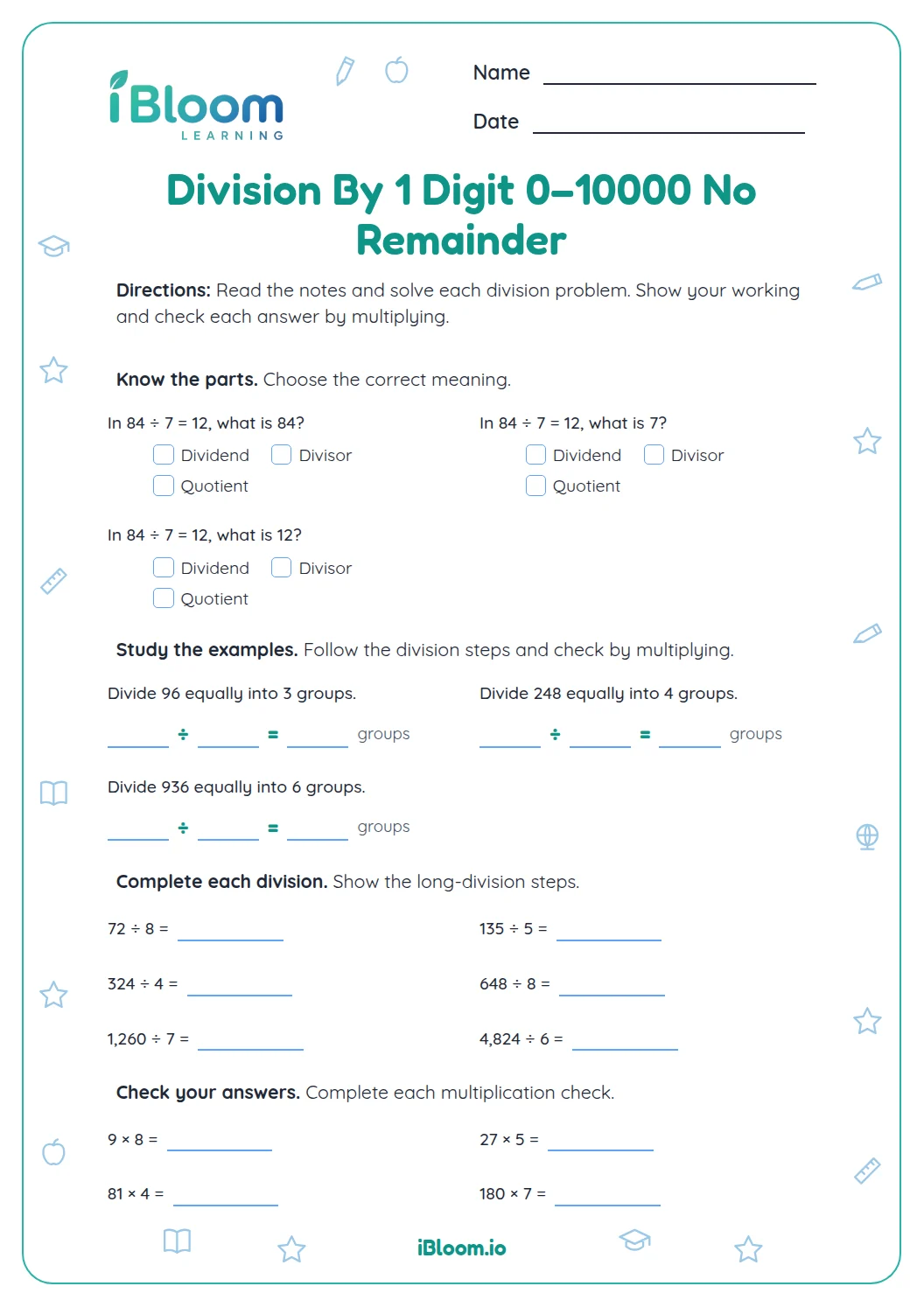
Divide from left to right, keeping each quotient digit above its matching place. In 4,824 ÷ 6, 48 hundreds give 8 hundreds. The remaining 2 tens give 0 whole tens to each of six groups, so write 0 in the tens place before bringing down the 4 ones. Use separate paper for the algorithm, then multiply the quotient by 6 to check that it rebuilds 4,824.
- 148 hundreds ÷ 6 = 8 hundreds.
- 22 tens ÷ 6 gives 0 whole tens per group.
- 324 ones ÷ 6 = 4 ones.
- 4The quotient is 804; 804 × 6 = 4,824.
What does a multiplication check tell us?
A correct exact quotient rebuilds the dividend when multiplied by the divisor. Question 5 asks students to select the matching multiplication equation. Question 10 asks them to create a division with a quotient in a given range and check it. Part D closes with two exact quotients to solve and verify. Check every digit of each product: a nearby number cannot confirm an exact division.
Check every digit of the product. A nearby number is useful for estimating, but an exact division must return the original dividend. For example, 84 × 6 gives 504, which cannot confirm a dividend of 4,824.
How do the reasoning questions go beyond calculation?
Part B includes a change from dividing by 4 to dividing by 8. With the same dividend and twice as many equal groups, each group gets half as much. Students also reconstruct a dividend and examine a zero dividend.
Part C combines a missing-zero error, a student-created division, division by 1 and a two-step ticket problem. Part D adds two exact quotients for students to solve and check. For the tickets, distinguish one club’s share from the combined amount for two clubs before writing the final answer.
How to use this worksheet
- 1Use the standard algorithm on separate paper for questions 1–4, write each quotient, and check by multiplying.
- 2Inspect the quotient zeros in questions 1 and 3 before checking the key.
- 3For each Part B choice, ask which division relationship supports it.
- 4In Part C, require an explanation or calculation that proves the answer.
- 5Review the ticket problem by labeling the amount for one club and the amount for two clubs.
Mistakes to discuss
The mistake
Dropping the zero and writing 84 for 4,824 ÷ 6.
The fix
Keep a quotient digit in every place after division begins; 804 × 6 rebuilds 4,824.
The mistake
Doubling 804 when the divisor changes from 4 to 8.
The fix
The total stays fixed. Twice as many groups means half as much in each, so use 402.
The mistake
Stopping at 1,200 tickets in question 12.
The fix
That is one club’s share. Multiply it by 2 to find the two clubs’ combined share.
Common Core alignment
Divide multi-digit whole numbers and check quotient digits with multiplication.
On this sheet: Students calculate exact quotients, diagnose missing zeros and check division reasoning.
Show the official wordingHide the official wording
Fluently divide multi-digit numbers using the standard algorithm.
What to practice next
Make more practice
Further reading
Questions parents and teachers ask
Are all of these divisions exact?
Yes, every division on the sheet has a whole-number quotient with no remainder. The largest dividend is 10,000, and the divisors are one digit. Students still need to watch place value carefully, especially when a quotient includes an internal zero, as in 804 and 1,008.
Should students show long division in Part A?
Use long division on separate paper for Part A, then write each quotient in its blank. Check the product by multiplying the quotient by its divisor and comparing it with the dividend. The answer key shows the exact quotients and model checks for the reasoning questions.
Why does doubling the divisor halve the answer in question 6?
The dividend stays 3,216 while the number of equal groups doubles from four to eight. Each group therefore receives half as much: half of 804 is 402. Students can confirm the relationship by multiplying 402 by 8 and checking that the result is still 3,216.
How do we explain a zero dividend?
Zero divided into seven equal groups leaves zero in each group. In question 8, the multiplication check is 7 × 0 = 0. Ask the student to compare that with 7 × 1 = 7, which produces a different total and therefore cannot check this division.
How should I grade the explanations?
Accept correct answers supported by valid reasoning, even when wording differs from the key. The missing-zero answer should identify the tens place. Question 10 needs a quotient between 1,000 and 1,500, division by 6 and a matching multiplication check. The ticket response should show equal sharing and combining two shares; Part D answers must multiply back to their dividends.