





About this worksheet
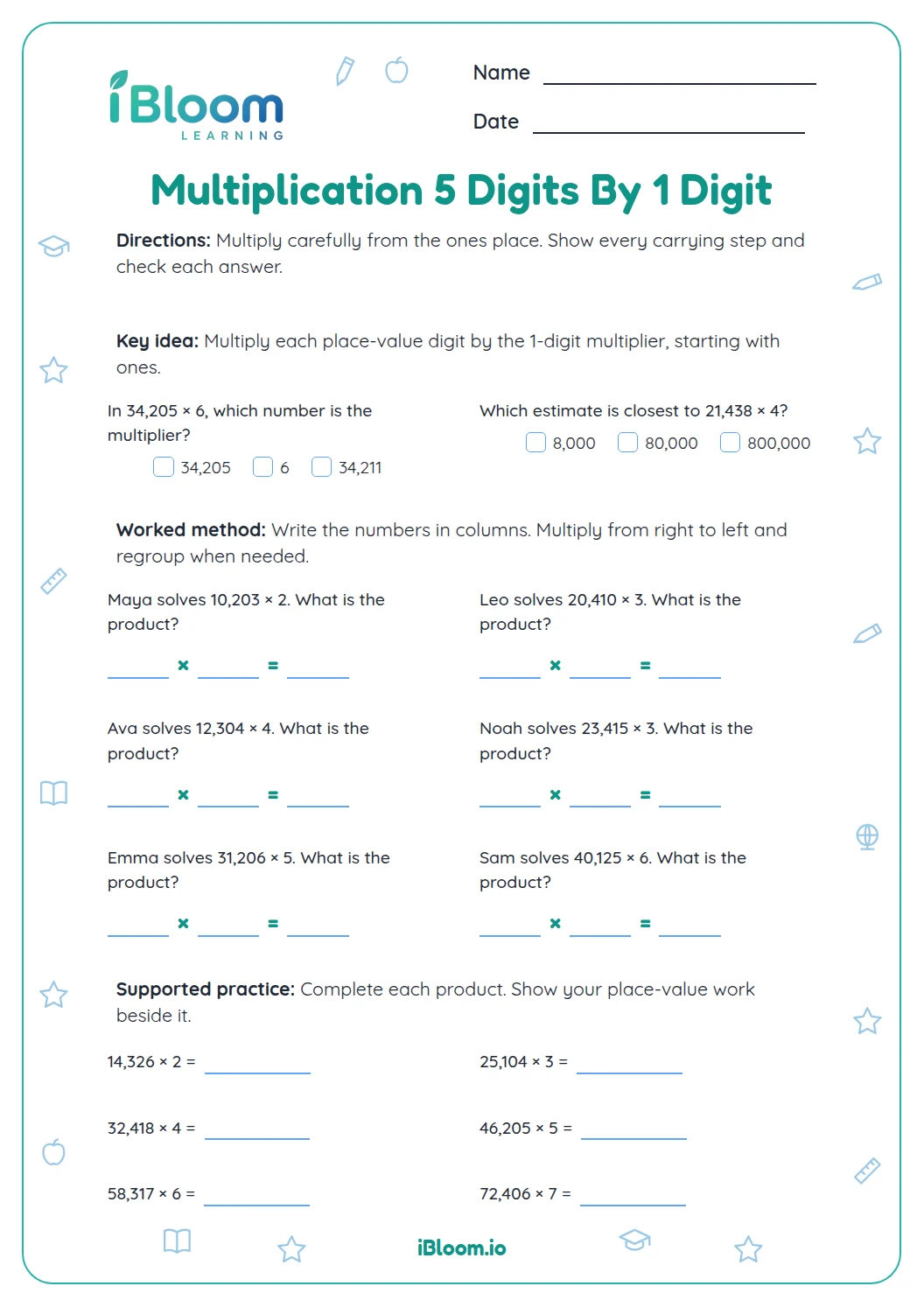
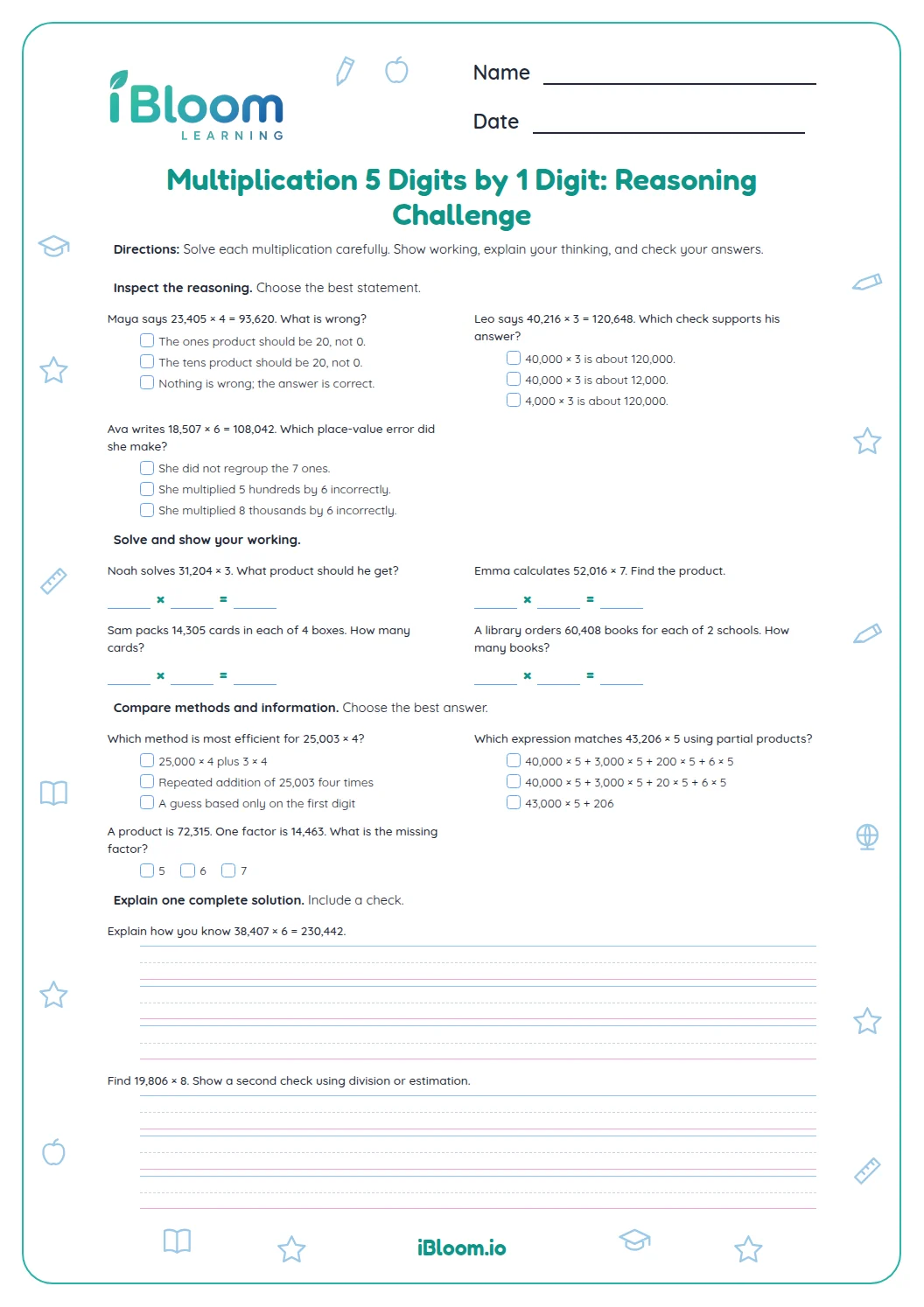
This Grade 6 printable gives students 14 independent problems multiplying a five-digit whole number by a one-digit factor. It starts with four number sentences, moves to five equal-group stories, and ends with five more products. A separate answer key lists all 14 results. The practice uses the standard algorithm described in CCSS 5.NBT.B.5.
Aligned to 5.NBT.B.5
How do you multiply a five-digit number by one digit?
Multiply from the ones place toward the left, regrouping whenever a product reaches ten or more. Keep each carried ten above the next place so it is included in the next multiplication.
Question 2 is 50,827 × 3. First, 3 × 7 = 21: write 1 and carry 2 tens. Then 3 × 2 tens plus 2 tens is 8 tens; continue place by place. The product is 152,481.
- 150,827 × 3
- 23 × 7 = 21; write 1, carry 2
- 3Continue left, adding each carried value
- 4Product: 152,481
How can a quick estimate help check a product?
Round the five-digit factor to a nearby ten thousand, multiply the estimate by the one-digit factor, and compare the result with your exact product. For 23,416 × 4, about 20,000 × 4 is 80,000, so 93,664 is a sensible exact product.
What kinds of multiplication practice are included?
The worksheet starts with four number sentences, moves to five equal-group situations, and finishes with five more products. The separate key lists all 14 answers.
How to use this worksheet
- 1Line up the factors so the one-digit number is under the ones place.
- 2Start at the ones place and multiply one column at a time.
- 3Write the ones digit of each partial product and carry the tens.
- 4Add the carried value before multiplying the next place.
- 5Estimate the product to see whether its size is reasonable.
Mistakes to watch for
The mistake
Leaving out a carried ten in the next column.
The fix
Write the carried value above the next digit and add it before multiplying.
The mistake
Writing both digits of a two-digit partial product in one column.
The fix
Keep the ones digit in the current column and carry the tens left.
The mistake
Misplacing a digit in the final product.
The fix
Read the answer from left to right and check its size with rounding.
Common Core alignment
The problems practice multiplying a multi-digit whole number by a one-digit factor.
Multiply multi-digit whole numbers with the standard algorithm.
On this sheet: All 14 questions multiply a five-digit whole number by a one-digit factor.
Show the official wordingHide the official wording
Fluently multiply multi-digit whole numbers using the standard algorithm.
What to practice next
Make more practice
Further reading
Questions parents and teachers ask
What does regrouping mean in these problems?
A five-digit factor has ten-thousands, thousands, hundreds, tens, and ones places. Multiply each place from right to left, regrouping as needed, and record the product in the blank. The answer key gives the finished products for checking. Then check that the result has the expected number of digits.
How can my child check a five-digit product?
Round the five-digit factor to a nearby ten thousand, multiply the estimate by the one-digit factor, and compare sizes. For 23,416 × 4, about 20,000 × 4 is 80,000, close to the exact product 93,664, so its size is reasonable.
Are the word problems also multiplication problems?
Yes. Each story gives the amount in one equal group and the number of groups. Multiply those amounts, then write the total in the blank. The situations involve flyers, bookmarks, seats, seeds, and bolts, so the answer names what was counted.
How many questions are on this worksheet?
There are 14 questions: four direct multiplication number sentences, five equal-group stories, and five additional products. The separate key lists each result, including totals for the story problems. Students can use it to check the product after finishing each item.
Which multiplication standard does this page practice?
The sheet practices CCSS 5.NBT.B.5, which calls for multiplying multi-digit whole numbers with the standard algorithm. Each problem uses a five-digit number and a one-digit factor. Students write the product and can compare it with the separate answer key.