





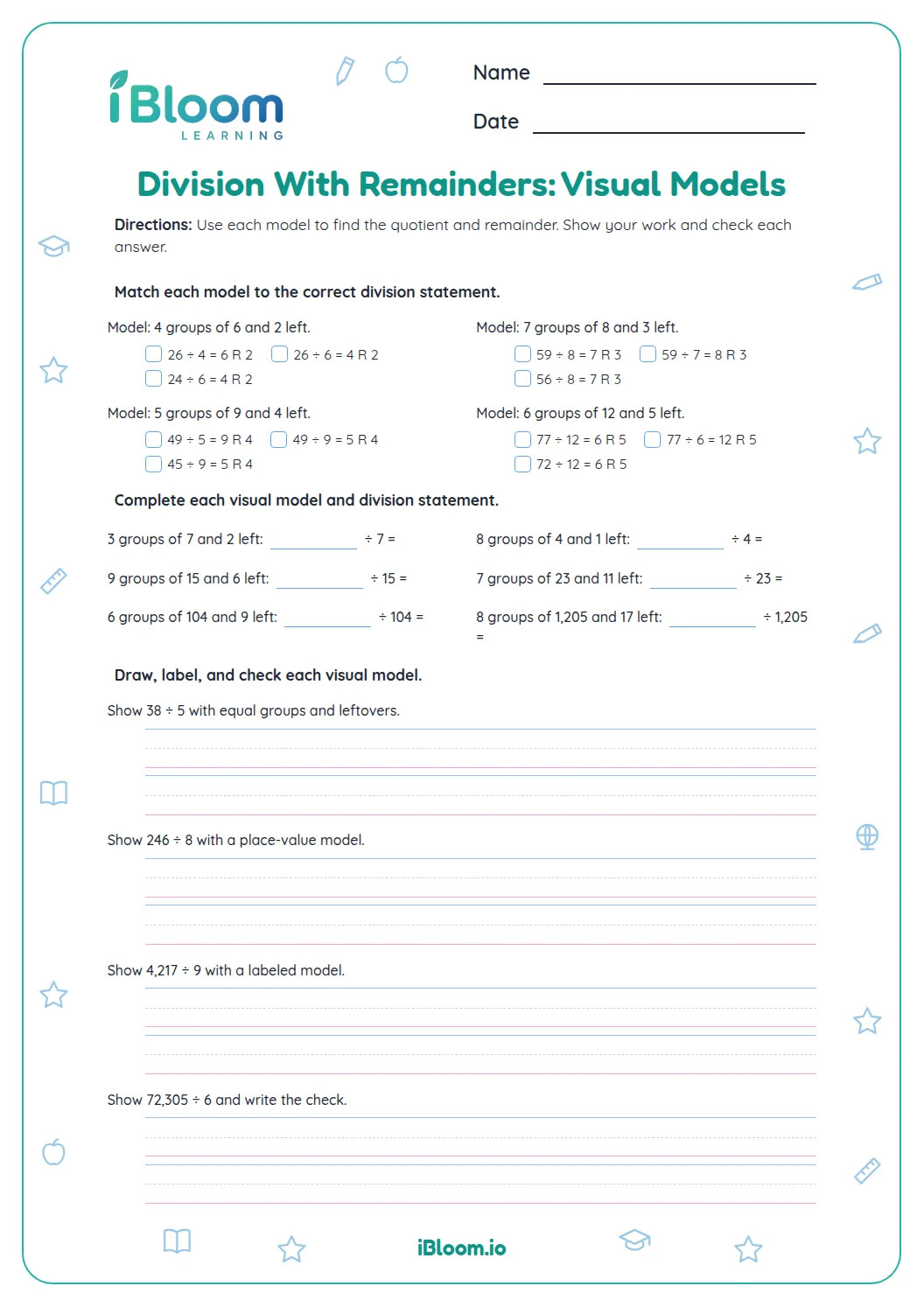
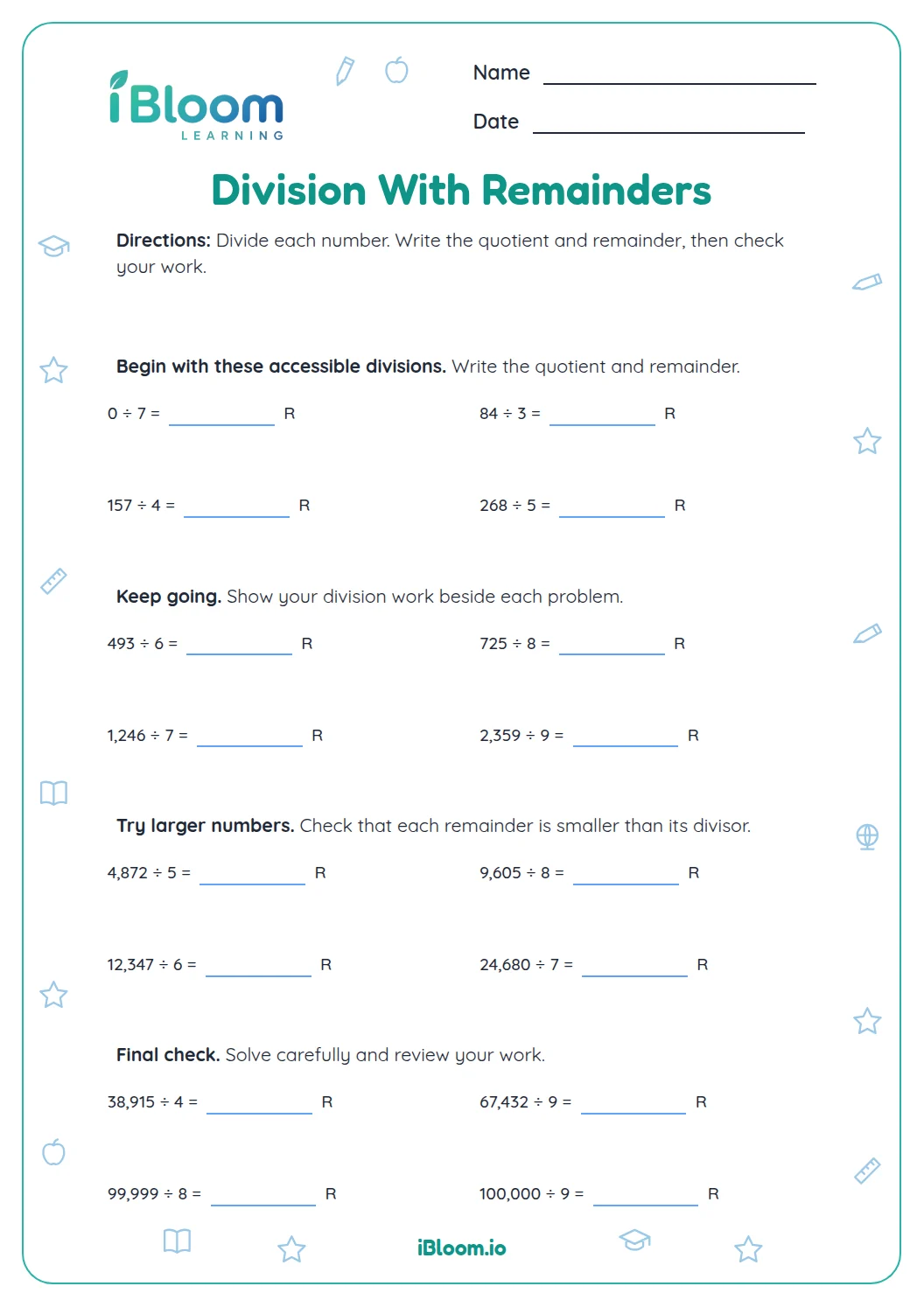
About this worksheet
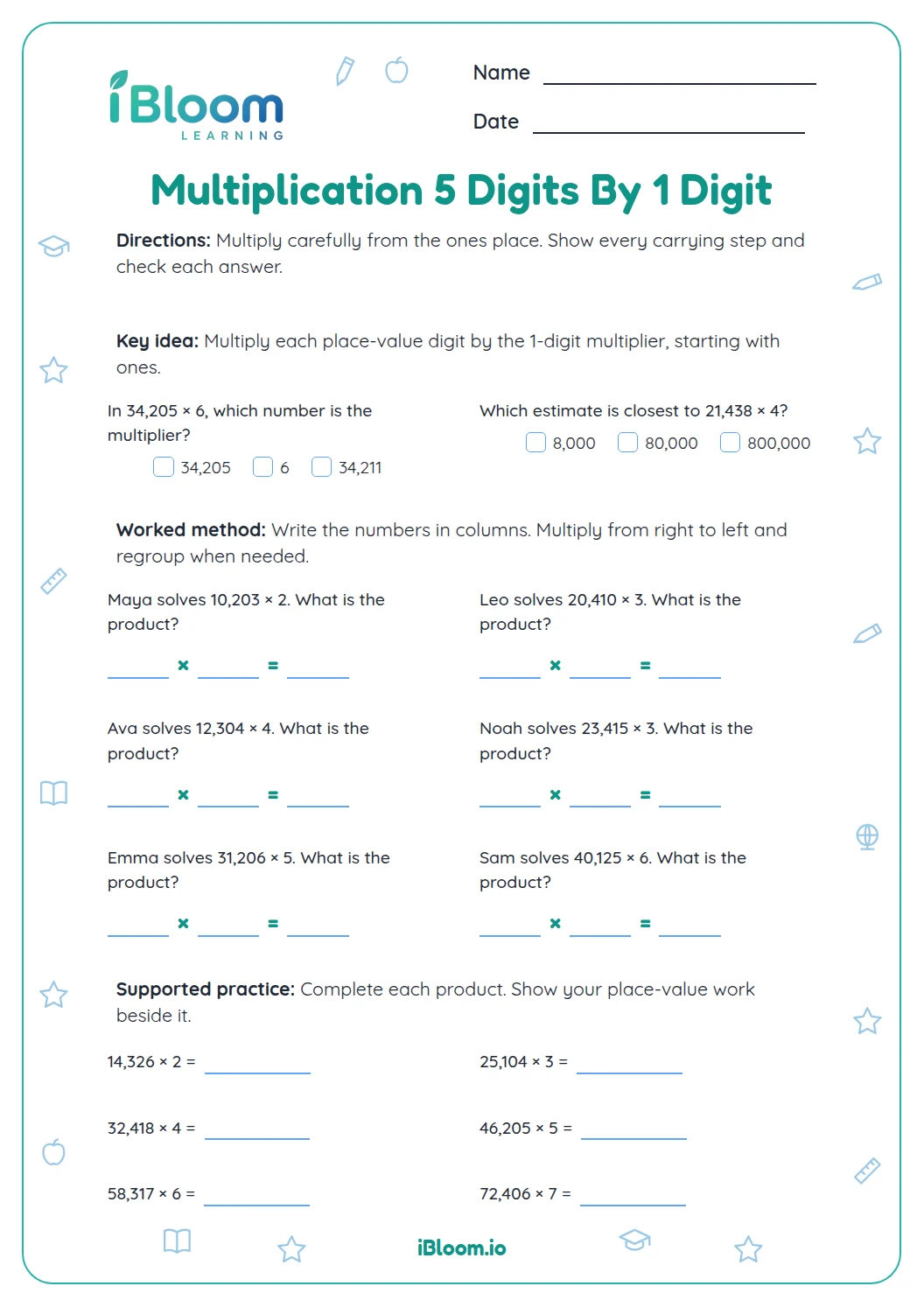
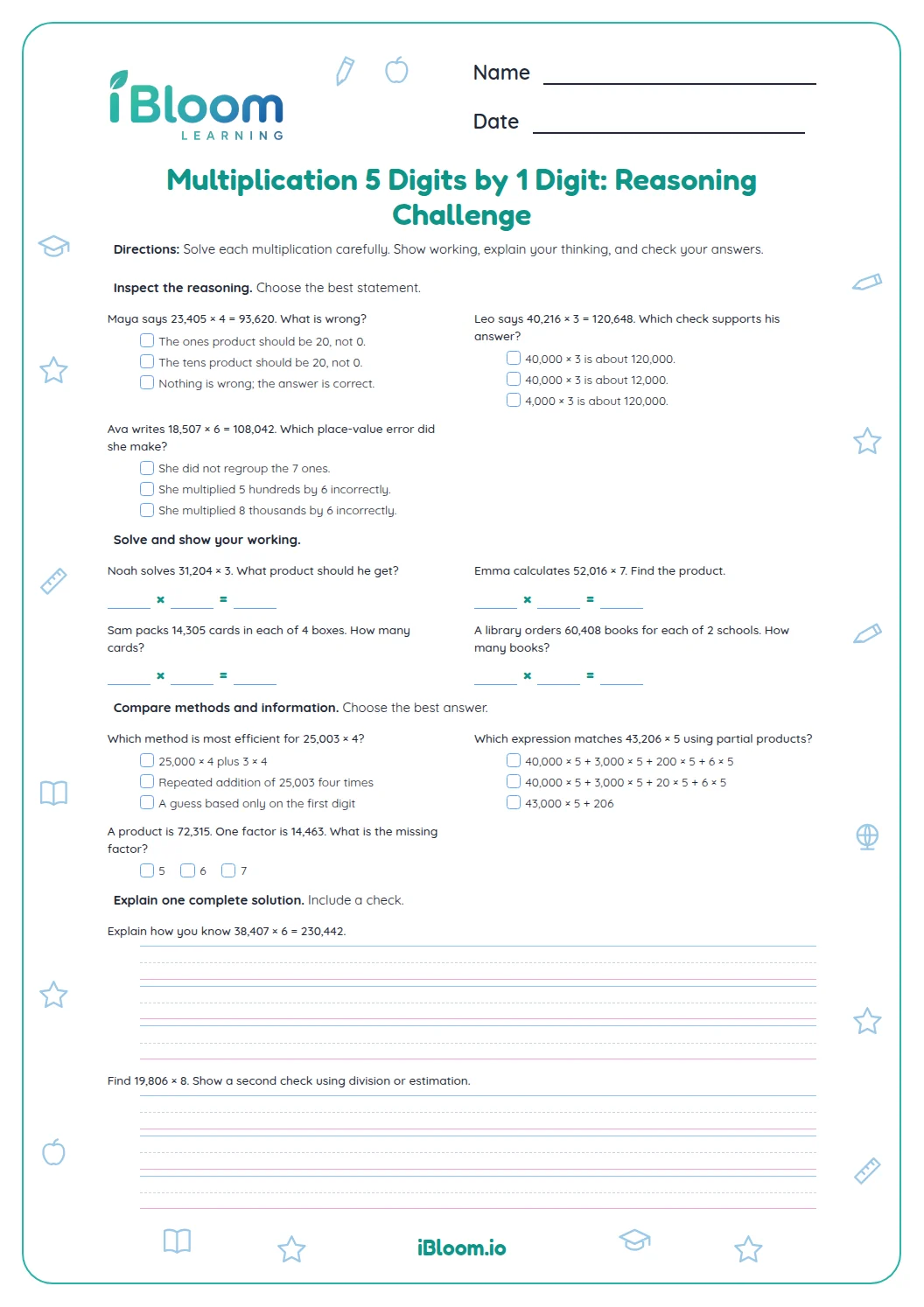
This free Grade 6 worksheet gives five-digit by one-digit multiplication a practical setting. Students calculate repeated quantities such as flyers, bottles, seats and shipments using the standard algorithm. Fourteen problems ask for a product and its unit; the final two also ask students to estimate first. The factors range from 2 to 9, including multiplicands with zero digits.
Aligned to 5.NBT.B.5
How does each story become a multiplication problem?
Each story gives an amount repeated a stated number of times. In q4, 16,408 seedlings are shipped each week for five weeks, so calculate 16,408 × 5 and label the result “seedlings.”
Write the larger factor above the smaller one, with the smaller factor under the ones place. Keep the story’s unit nearby so the final number answers the question.
How should students handle regrouping across zeros?
Multiply the current digit first, then add the amount carried from the place to its right. A zero digit still has a place and may receive a carried amount. In 16,408 × 5, the zero tens receive four tens from multiplying the eight ones.
- 116,408 × 5
- 2Ones: 8 × 5 = 40; write 0, carry 4.
- 3Tens: 0 × 5 + 4 = 4.
- 4Hundreds: 4 × 5 = 20; write 0, carry 2.
- 5Thousands: 6 × 5 + 2 = 32; write 2, carry 3.
- 6Ten-thousands: 1 × 5 + 3 = 8.
- 7Answer: 82,040 seedlings.
How can students check a large product?
Check a product with an estimate before writing the unit. For q13, 45,206 × 4 is close to 45,000 × 4 = 180,000; the exact product is 180,824 programs.
How to use this worksheet
- 1Underline the quantity in one group and circle the number of equal groups.
- 2Estimate the total using a nearby whole thousand or ten-thousand.
- 3Align the one-digit factor under the ones digit of the five-digit factor.
- 4Multiply from right to left, writing carried amounts above the next place.
- 5Write the unit and compare the exact answer with the estimate.
Mistakes to notice and fix
The mistake
Multiplying only the last digit by the one-digit factor.
The fix
Move across all five places, including places whose digit is zero.
The mistake
Dropping the carried 4 when multiplying the zero tens in 16,408 × 5.
The fix
Compute 0 × 5 + 4; the tens digit in the answer is 4.
The mistake
Writing 82,040 weeks for the seedlings problem.
The fix
Weeks counts the groups; seedlings counts what is being totaled. Label the product seedlings.
Common Core alignment
Use the standard algorithm to multiply five-digit quantities by one-digit factors.
On this sheet: All twelve real-world problems require a five-digit by one-digit product.
Show the official wordingHide the official wording
Fluently multiply multi-digit whole numbers using the standard algorithm.
What to practice next
Make more practice
Further reading
Questions parents and teachers ask
Do all twelve problems use five-digit numbers?
Yes. Every story multiplies a five-digit whole number by a one-digit factor from 2 through 9. The contexts change, but each asks for the total across equal groups. Several products have six digits, so students need to leave room for a final carried amount on the left.
What should students do when a digit is zero?
Keep the zero’s place and include any amount carried into it. In question 4, multiplying 8 ones by 5 produces 40 ones, or 4 tens. The next step is 0 tens times 5, plus those 4 tens. Skipping that place would change the product.
Should students estimate or give exact answers?
Students should give exact answers to all twelve stories. An estimate is a useful check before or after the written calculation. For 16,408 seedlings each week over five weeks, 80,000 is a nearby estimate; the exact answer is 82,040 seedlings. Discuss any result far from that estimate.
Is a calculator needed for this worksheet?
No calculator is needed for the intended practice. Students write the standard algorithm in the working space and use multiplication facts and place value to finish. Afterward, an adult can check against the answer key. Ask students to explain one regrouping step if an answer needs correction.
How should I mark the answers with units?
Check both the product and the unit named by the story. The cable answer uses meters, while the final grain answer uses grams; the key abbreviates them as m and g. Accept correctly spelled unit names too, and discuss a missing unit separately from a calculation error.