

About this worksheet
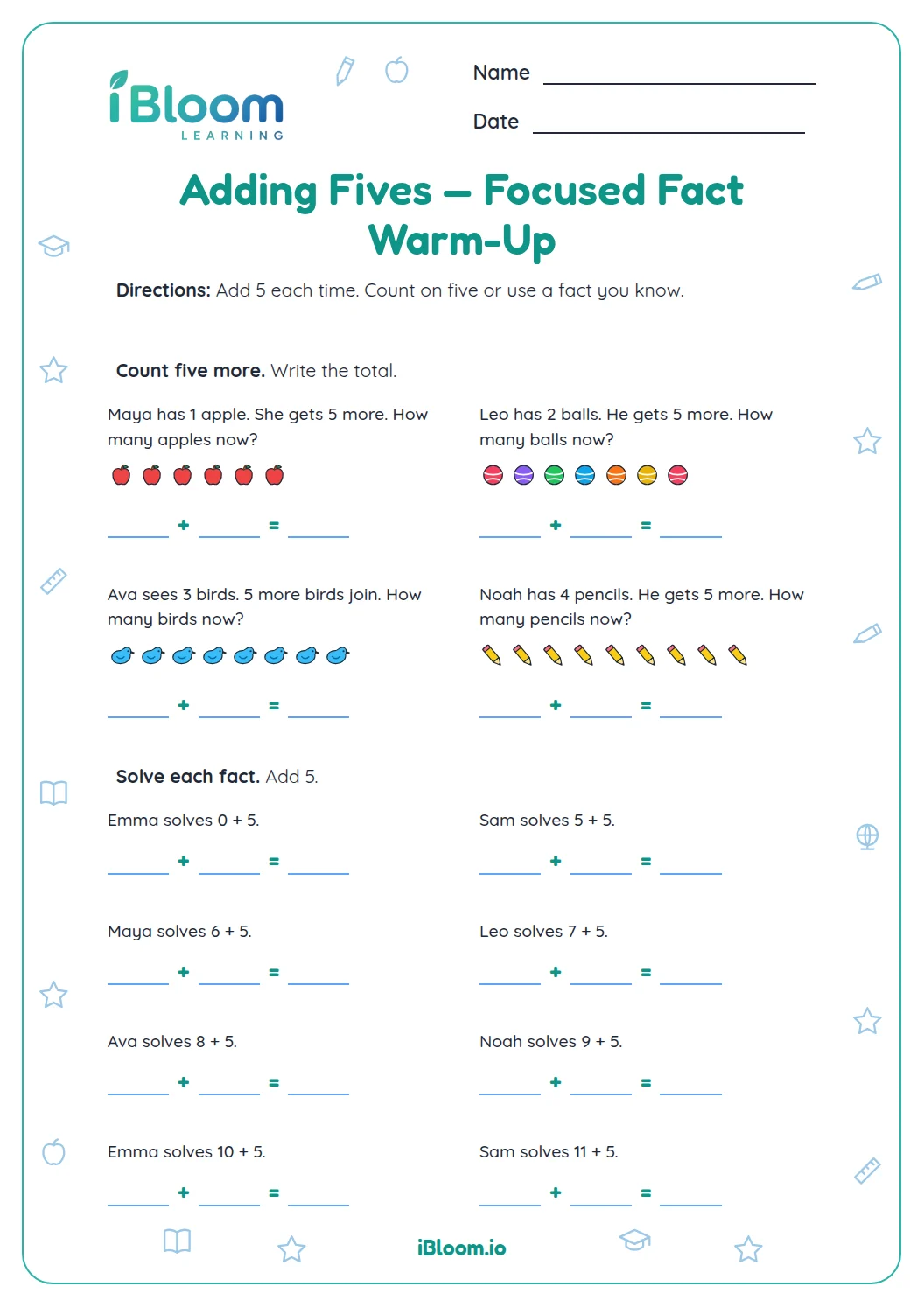
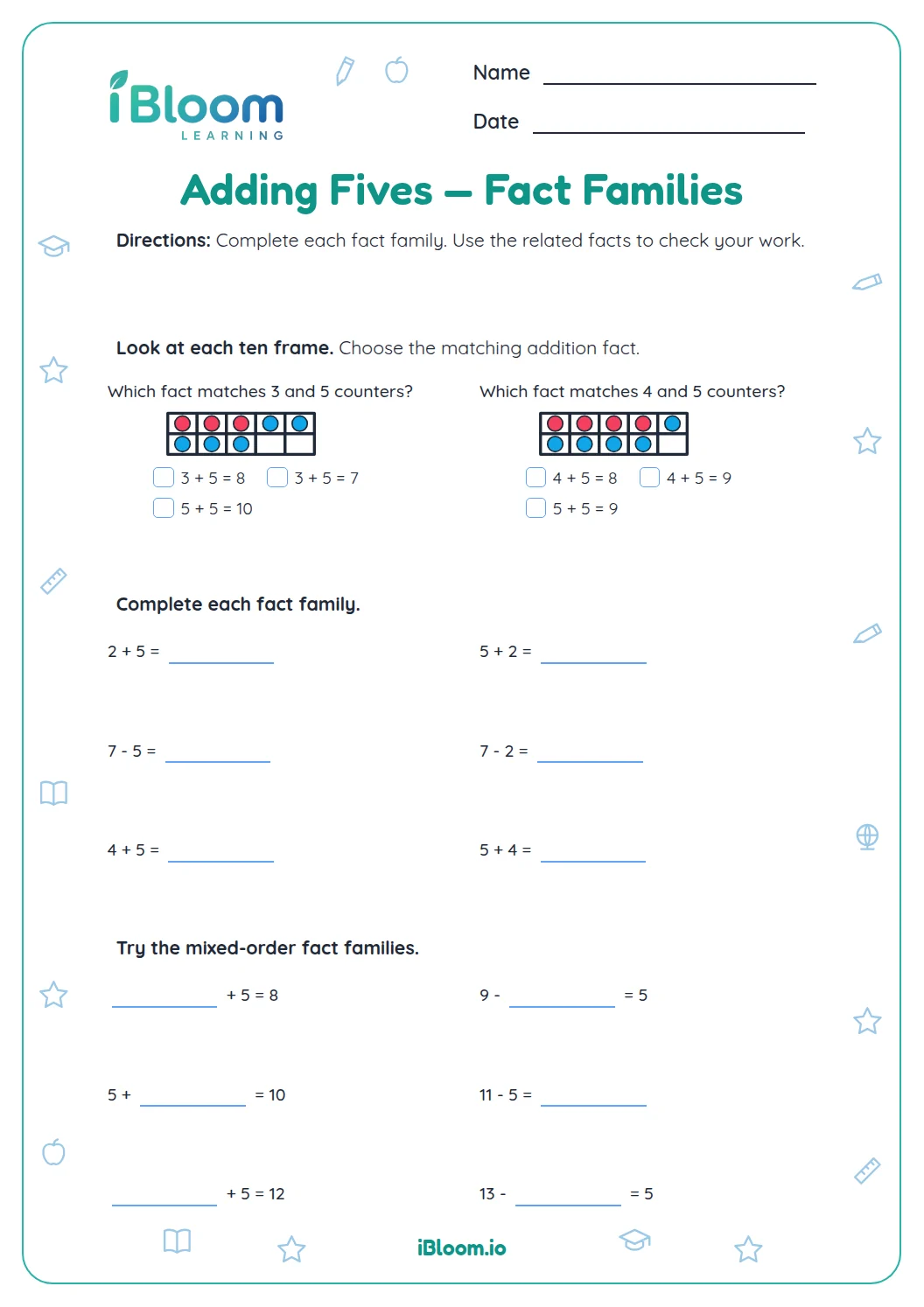
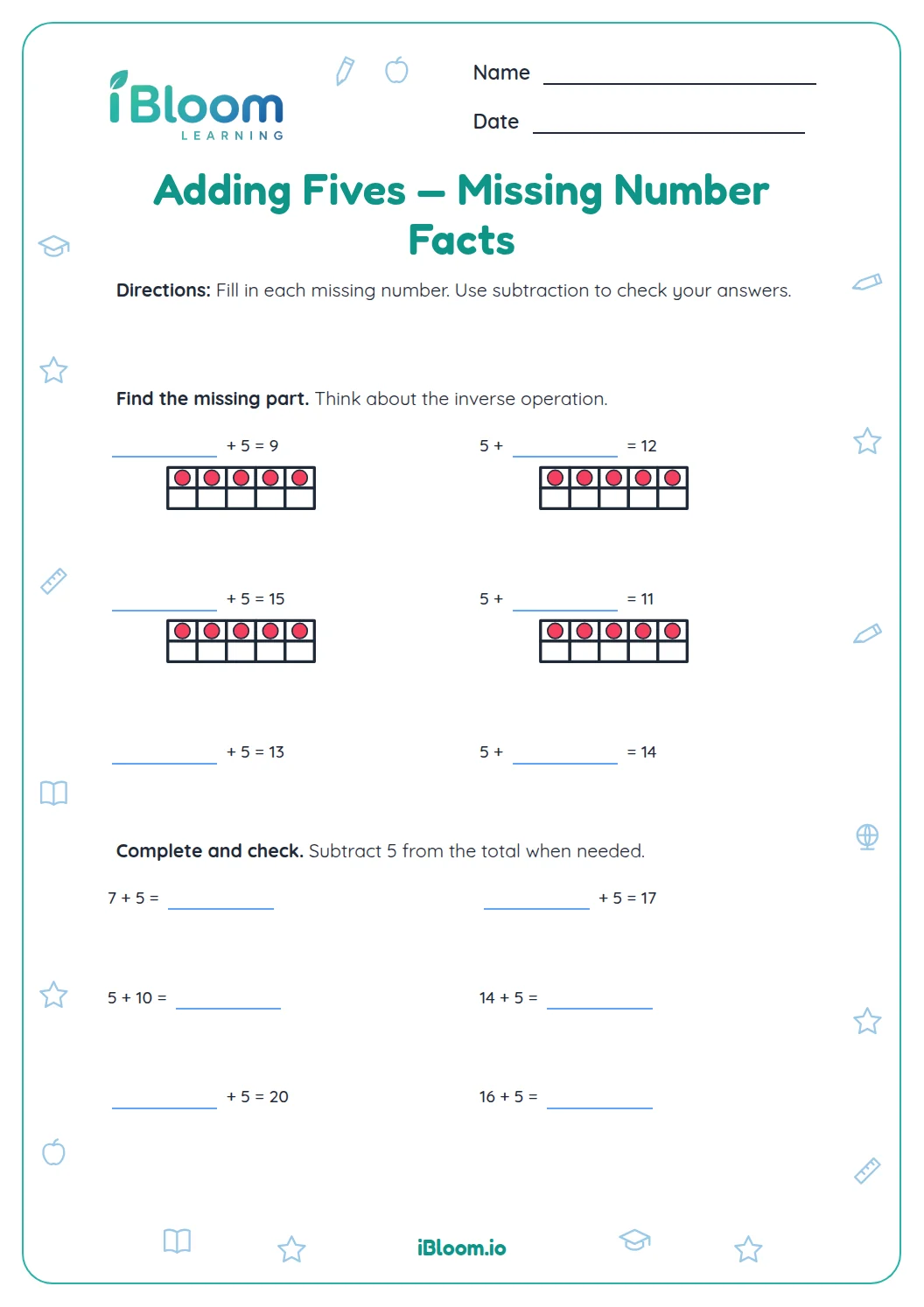
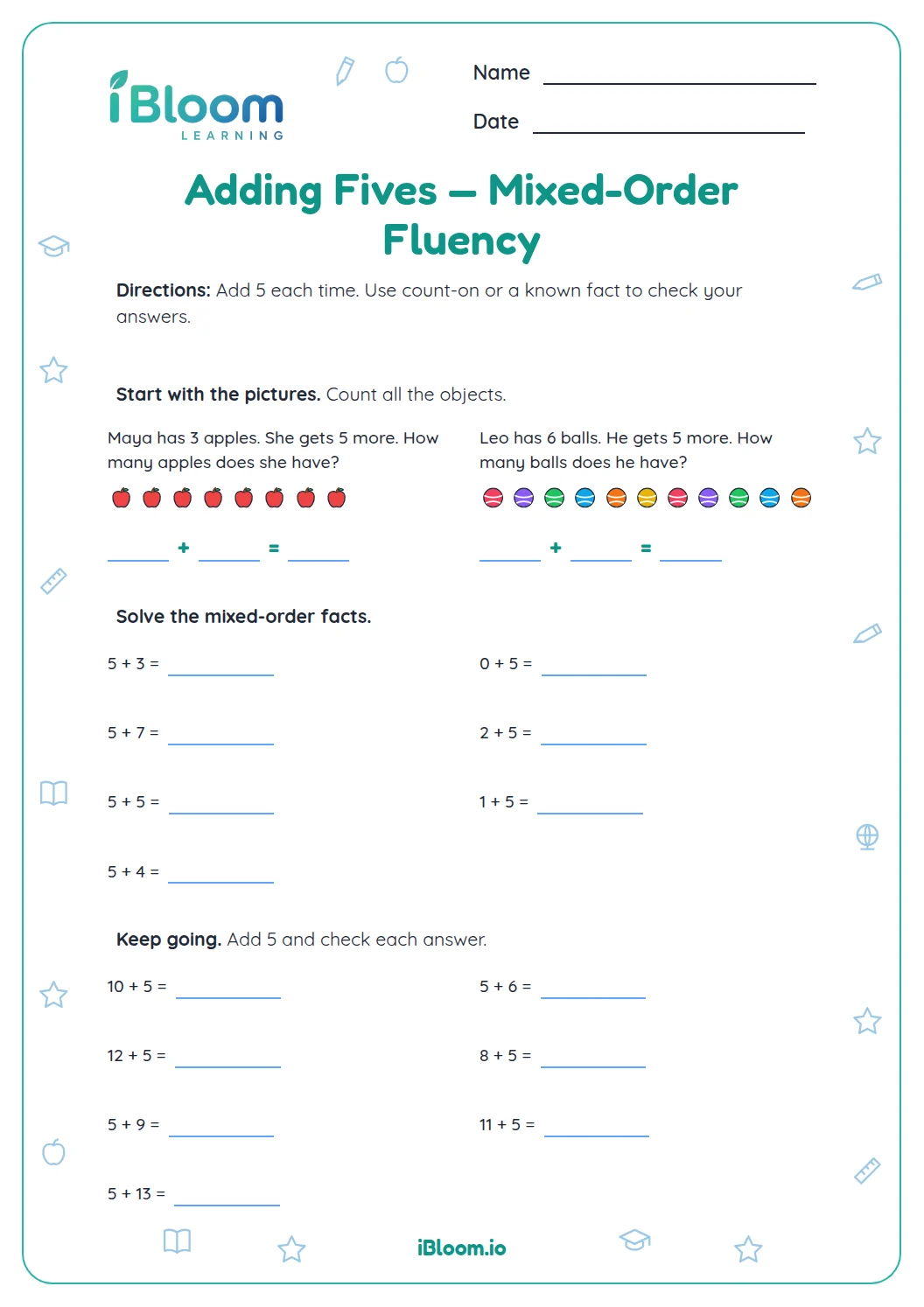
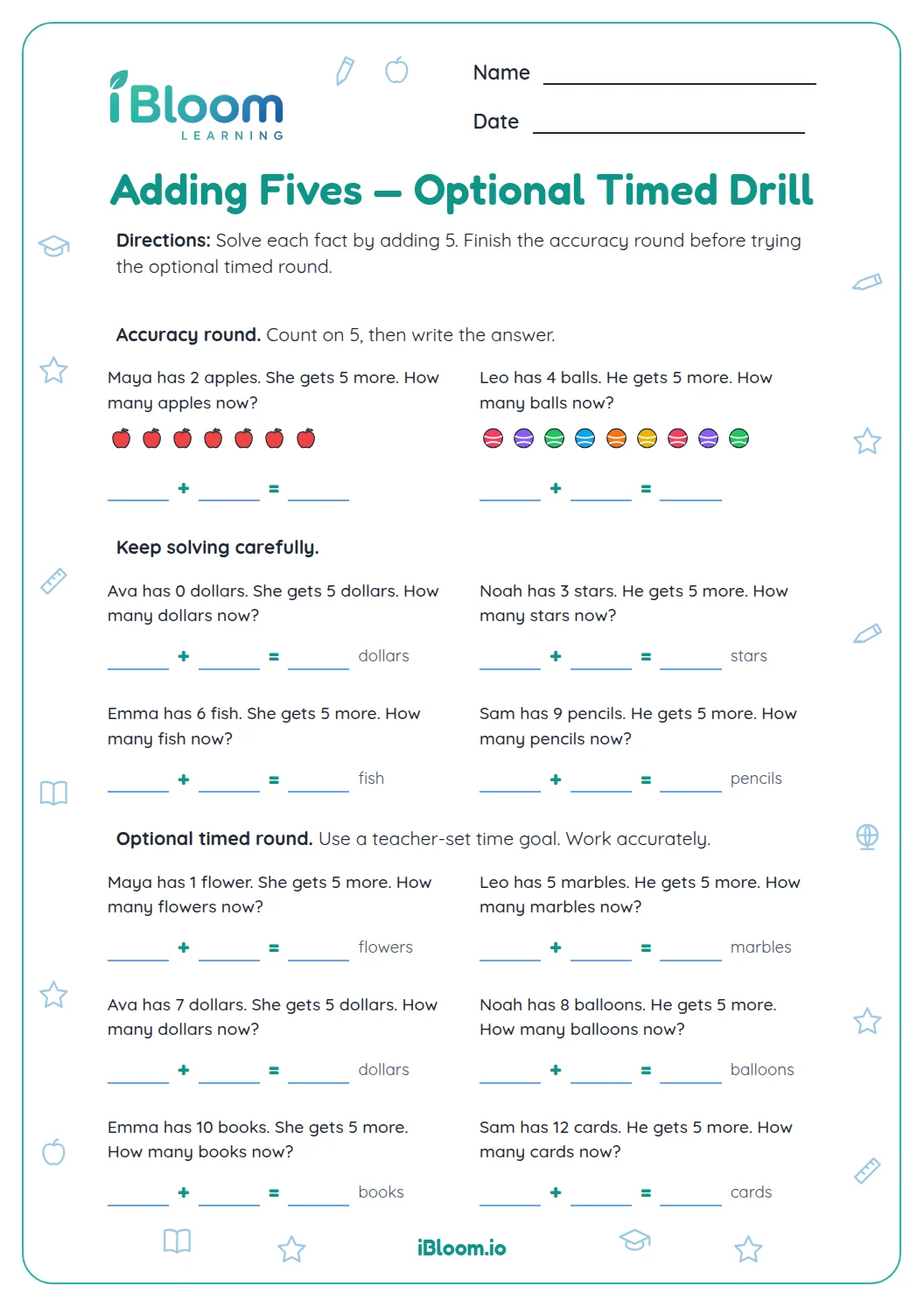
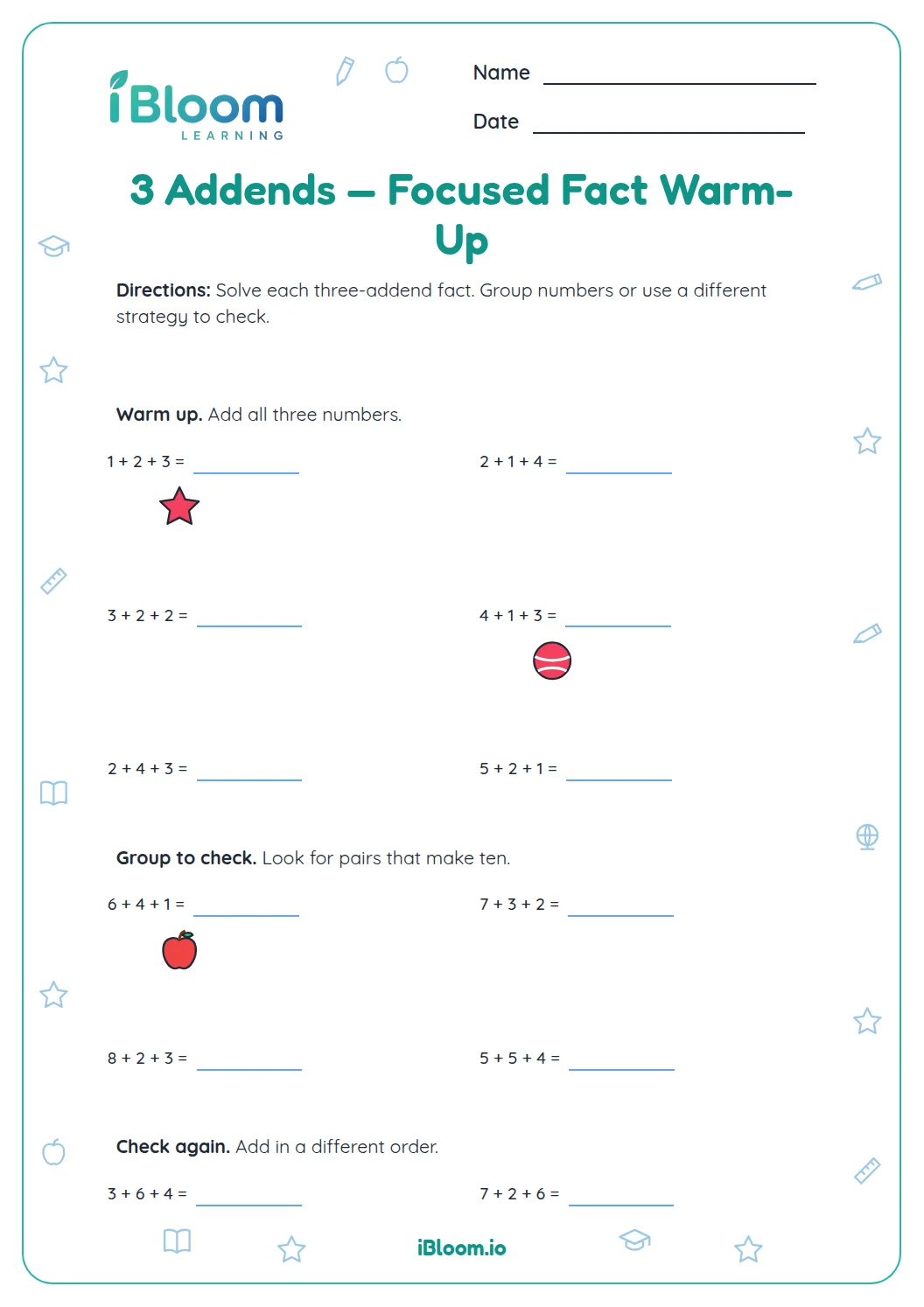
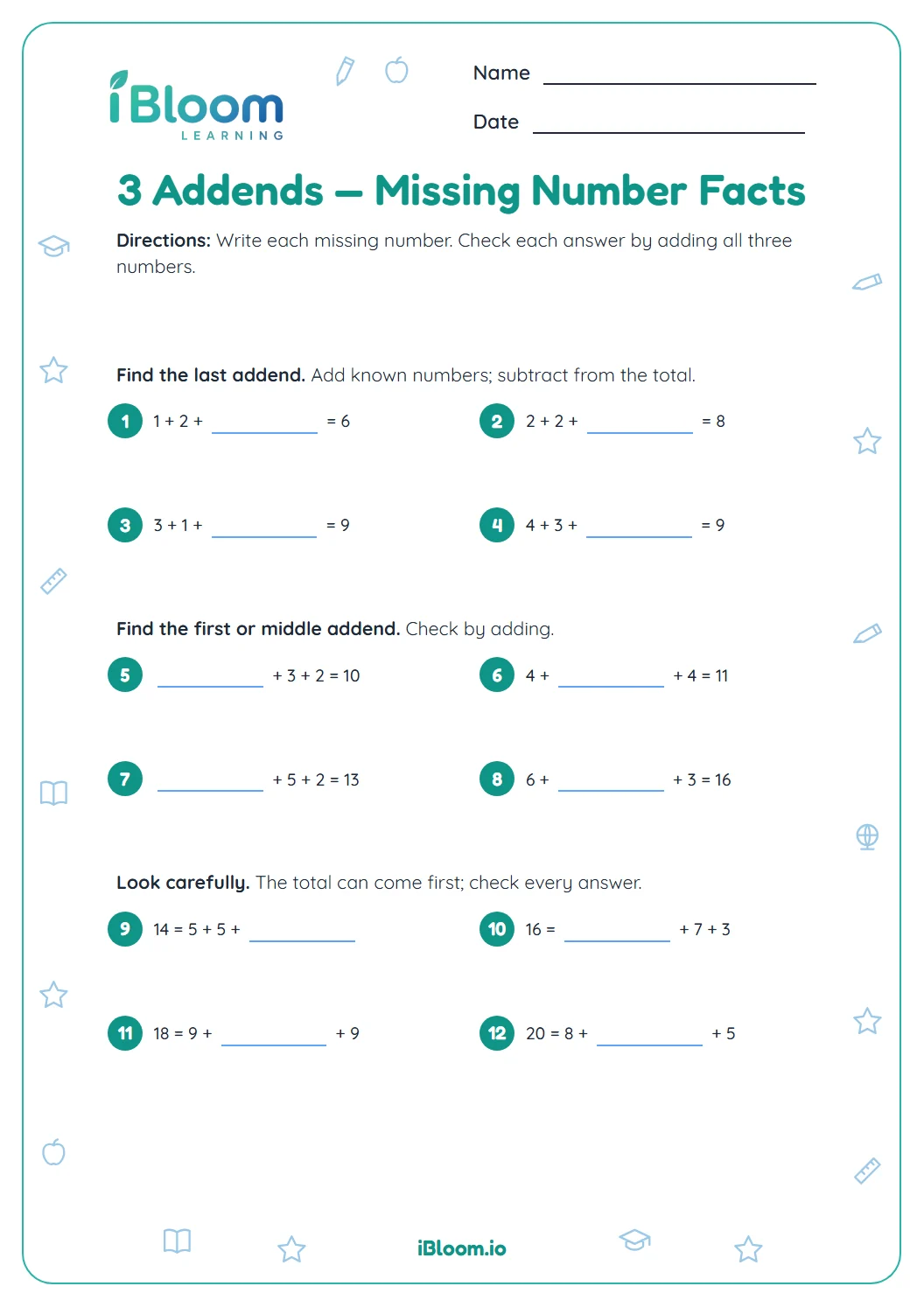
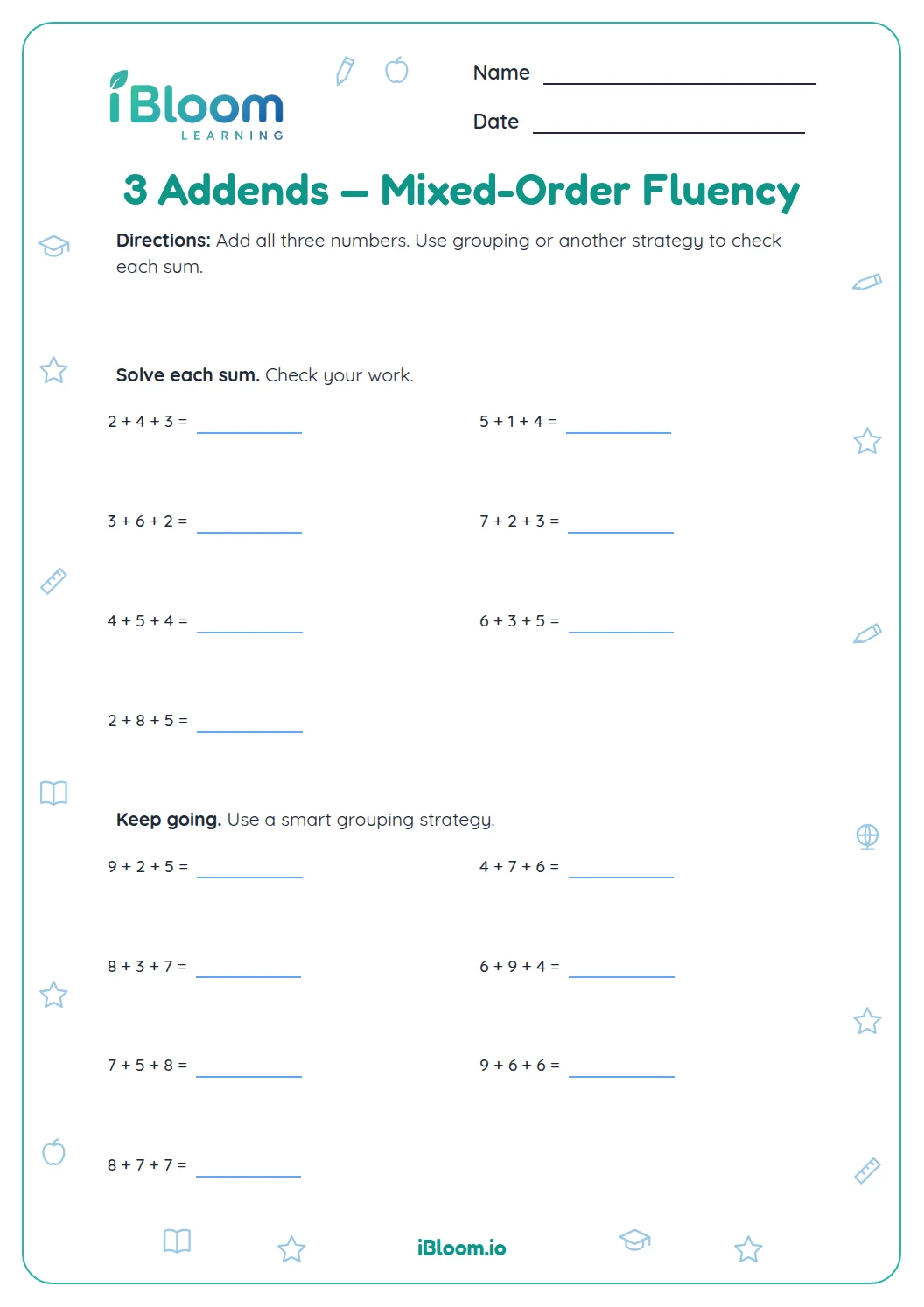
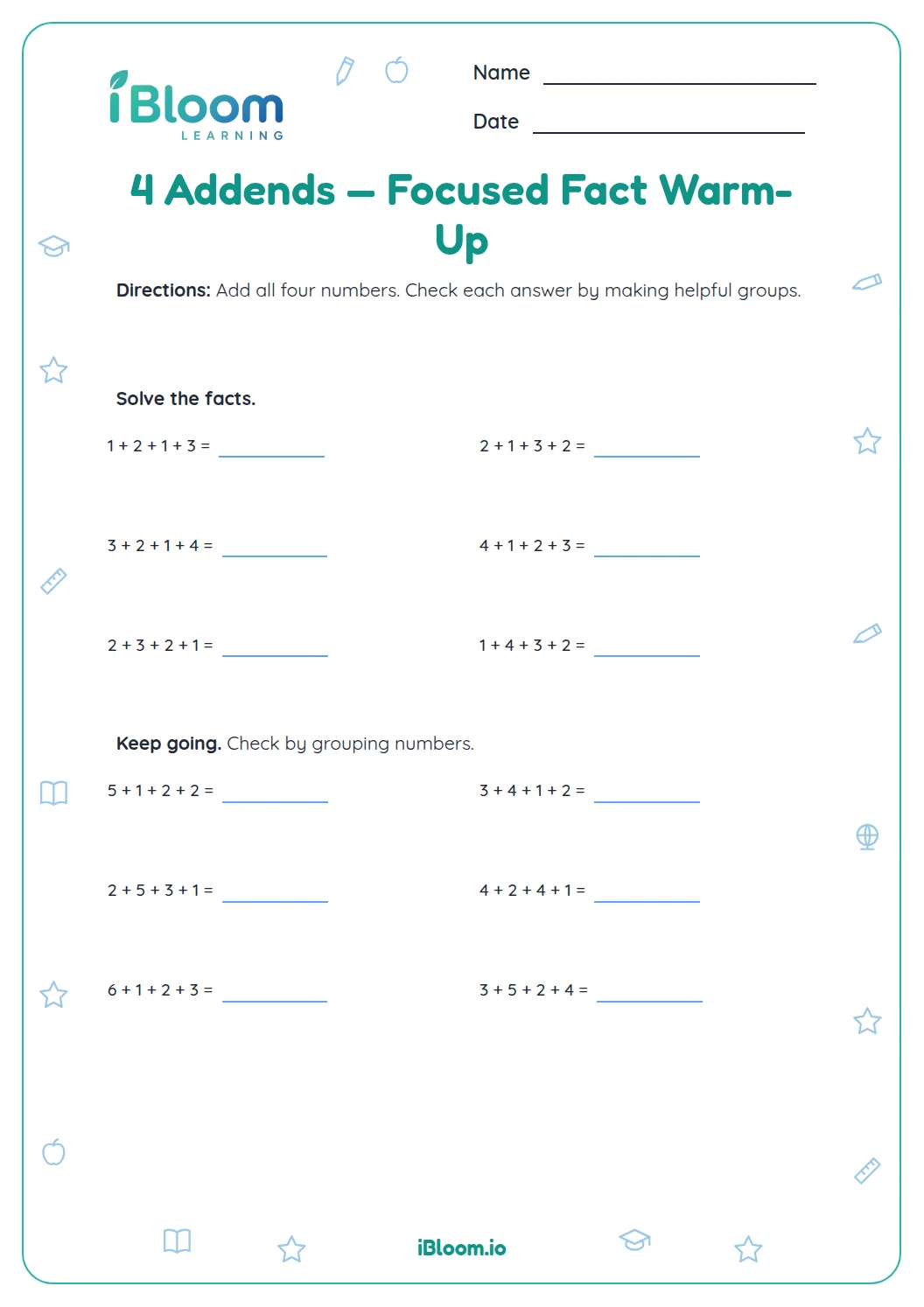
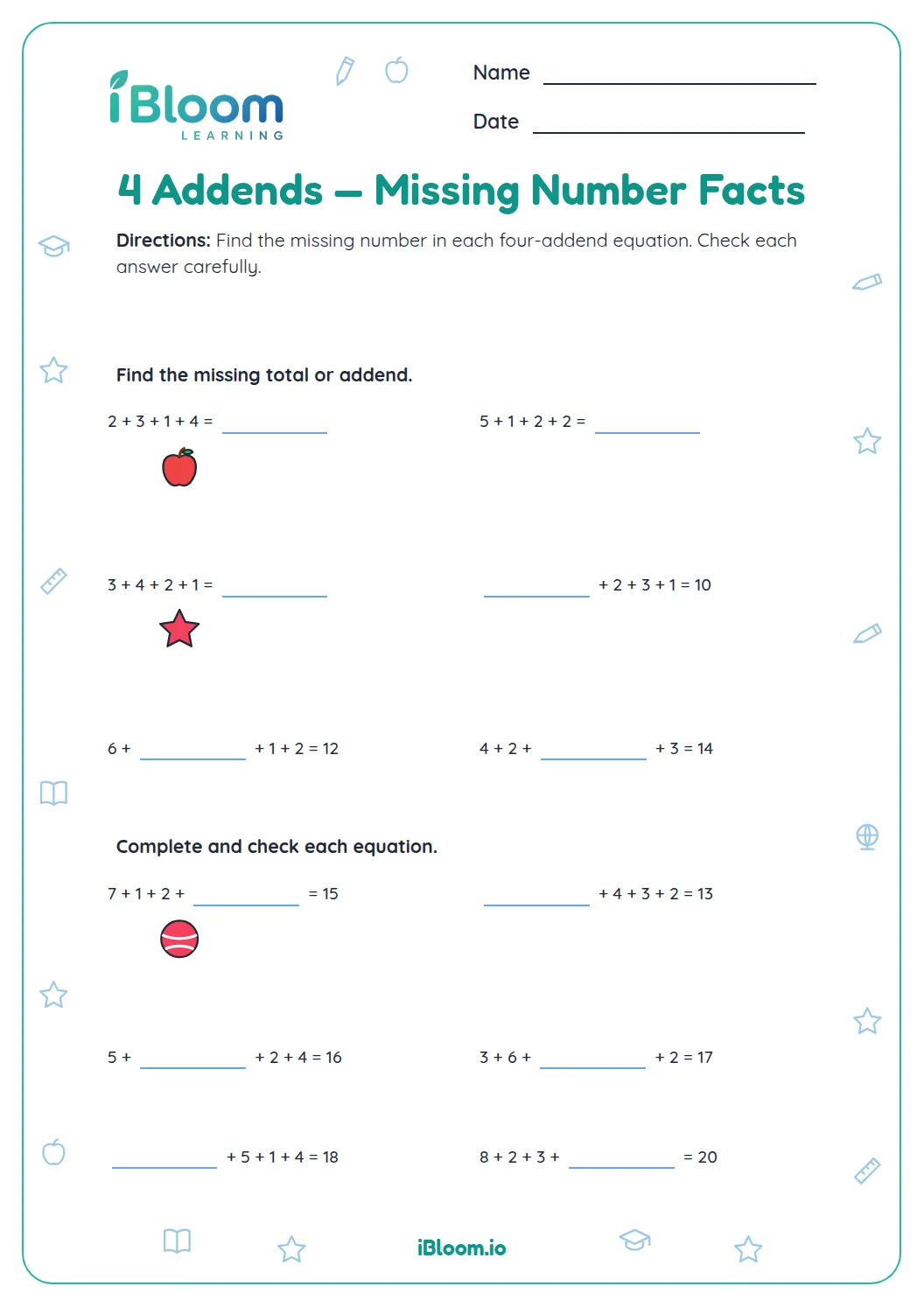
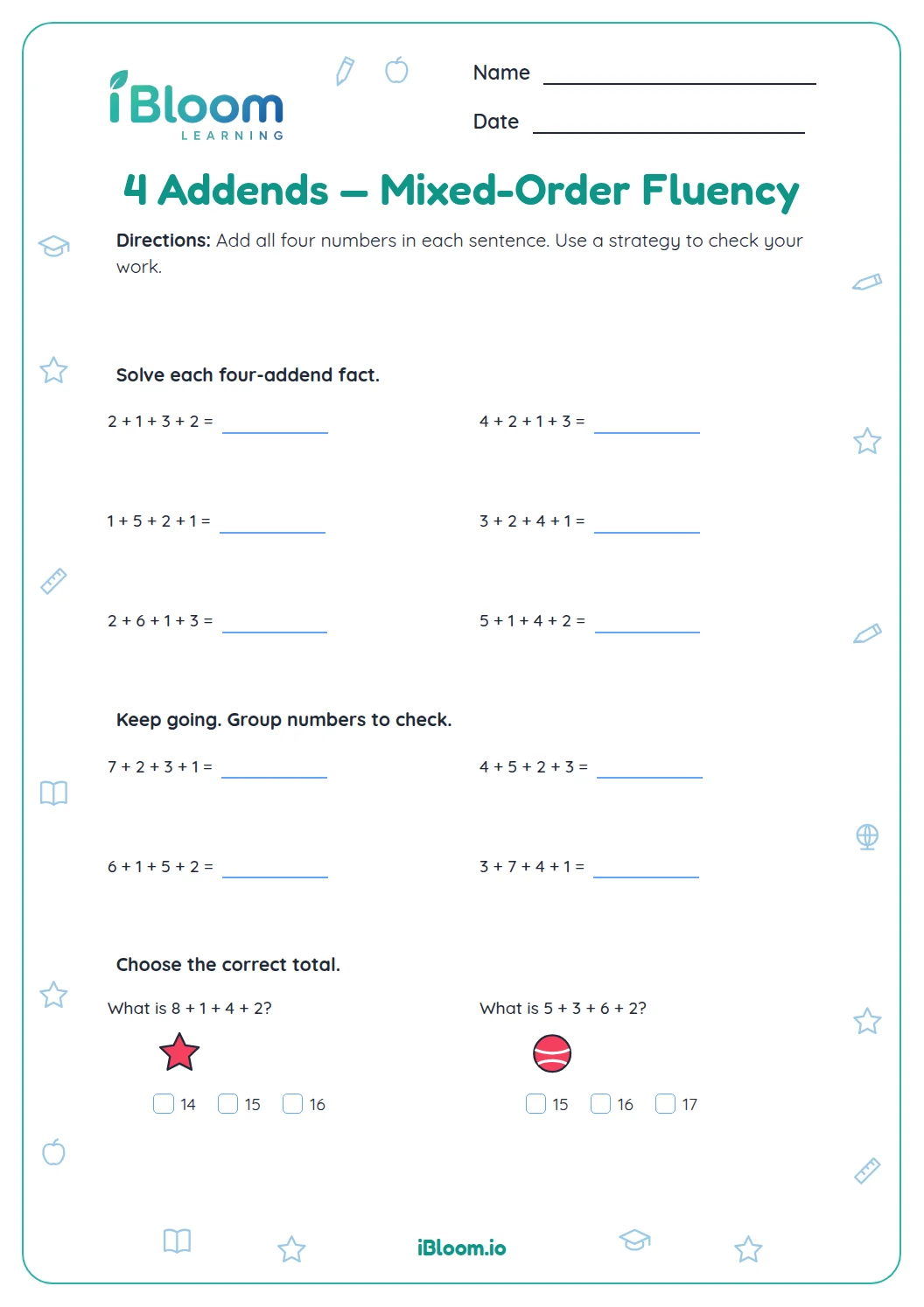
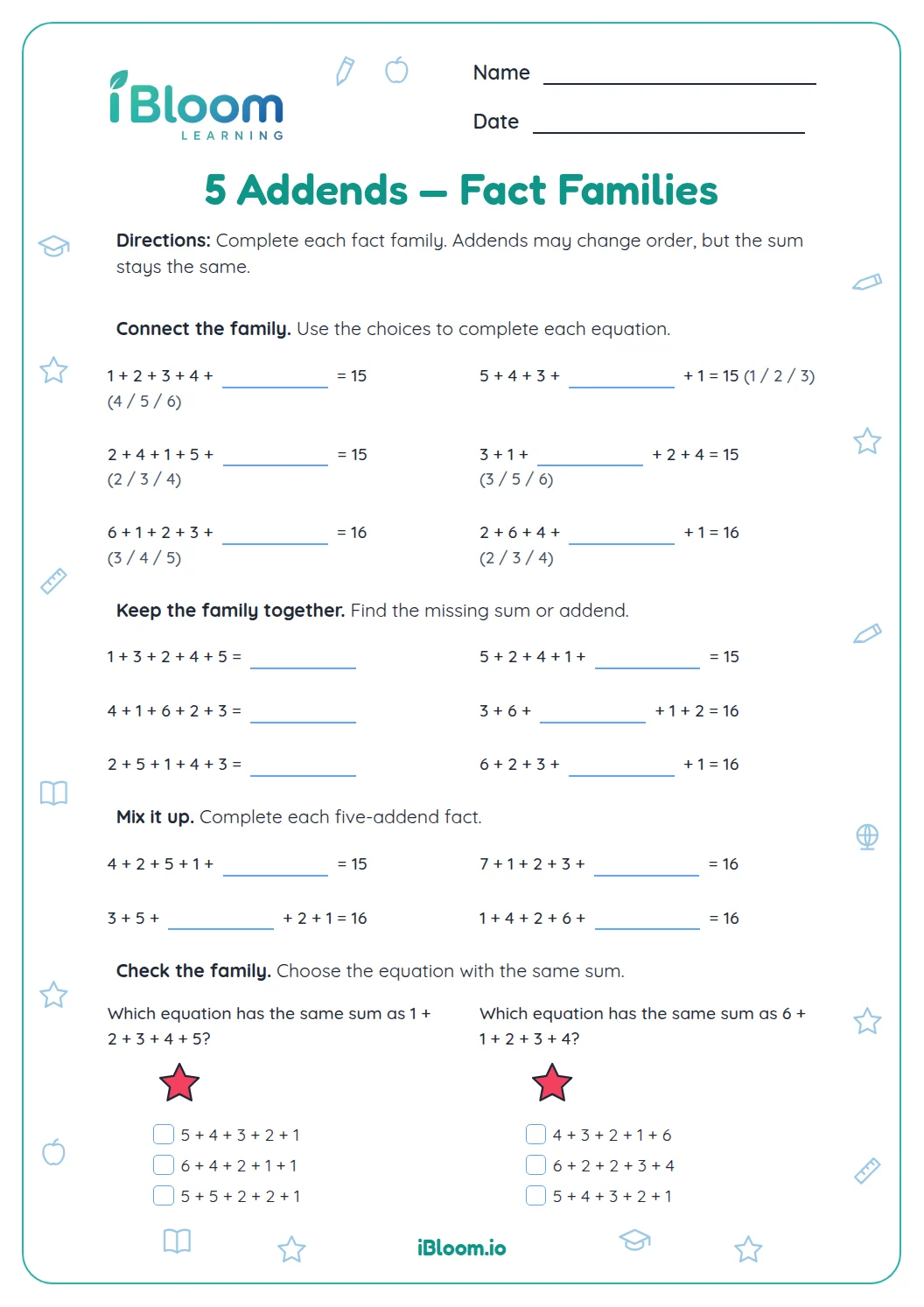
This printable addition drill gives Grade 1 and Grade 2 learners 20 facts that add five to a number from 0 through 15, with four missing-addend checks. The facts move from small addends to teen numbers, so students can use counting on, doubles, or a known sum. A separate answer key supports quick review. The sheet focuses on CCSS 1.OA.C.6.
Aligned to 1.OA.C.6
How does counting on five work?
Keep the larger number in mind and say five numbers after it. For 7 + 5, count 8, 9, 10, 11, 12; the sum is 12. Repeating the pattern helps connect counting to addition.
- 16 + 5
- 2Count five on from 6: 7, 8, 9, 10, 11.
- 36 + 5 = 11
Can a known fact make a new fact easier?
Yes. Since 5 + 5 = 10, adding one more to 5 + 6 makes 11. Children can also notice that switching the addends keeps the same sum: 8 + 5 and 5 + 8 are both 13.
How should students use the drill?
Solve carefully and check facts with a strategy if needed. The final facts go beyond ten, where counting on or breaking apart the number can help. The goal is accurate recall and flexible thinking, not a timed score.
How to use this worksheet
- 1Read both addends and notice the 5.
- 2Keep the larger addend in mind.
- 3Count on five or use a known double or ten fact.
- 4Write one sum in the blank.
- 5Check missed facts with the answer key and solve them again.
Common mistakes and quick fixes
The mistake
Counting the starting number as one of the five counts.
The fix
Say the next number first, then count five numbers forward.
The mistake
Adding only the ones digit to the 5 and forgetting the tens.
The fix
For 12 + 5, count on from 12 to reach 17.
The mistake
Changing the total when addends switch places.
The fix
Addition can be read in either order: 5 + 8 equals 8 + 5.
Common Core alignment
This worksheet gives focused practice with the standard below.
Use flexible strategies to add and subtract within 20.
On this sheet: Children solve addition facts with 5 and related missing-addend facts.
Show the official wordingHide the official wording
Add and subtract within 20, demonstrating fluency for addition and subtraction within 10. Use strategies such as counting on; making ten (e.g., 8 + 6 = 8 + 2 + 4 = 10 + 4 = 14); decomposing a number leading to a ten (e.g., 13 - 4 = 13 - 3 - 1 = 10 - 1 = 9); using the relationship between addition and subtraction (e.g., knowing that 8 + 4 = 12, one knows 12 - 8 = 4); and creating equivalent but easier or known sums (e.g., adding 6 + 7 by creating the known equivalent 6 + 6 + 1 = 12 + 1 = 13).
What to practice next
Make more practice
Further reading
Questions parents and teachers ask
How can my child remember addition facts that add five?
Start with the other addend and count on five, or use a known fact such as 5 + 5 = 10. This sheet practices 20 questions: 16 sums from 0 + 5 through 15 + 5 and four related missing-addend facts, with an answer key for checking accuracy rather than racing.
Is an answer key included?
Yes. The separate answer key includes responses for all 20 questions, including sample responses where wording may vary. Review it after the learner has tried each part, then revisit any item that needs another strategy. The key also shows the missing number in each related addition fact, so the child can check a second way to use five.
How many questions are on the sheet?
There are 20 questions in four parts. The first 16 are sums from 0 + 5 through 15 + 5; the final four ask for a missing addend in a fact that includes 5. Each answer appears in the separate key.
How can we use this for practice at home?
Work through one group of facts at a time and invite the learner to explain a strategy, such as counting on five. The first 16 items add five to 0 through 15; the last four reverse the task by asking for the missing addend.
What should I do when an answer is incorrect?
For a sum such as 12 + 5, start at 12 and count five more numbers: 13, 14, 15, 16, 17. For a missing addend, use the total to find the number that combines with 5. The answer key confirms both forms.