



About this worksheet
This free printable adding-sixes worksheet gives Grade 1 and Grade 2 learners 19 sums. Part A has two picture-supported warm-ups. Part B has four untimed story sums. Part C has 13 mixed-order facts pairing six with every number from 0 through 12, for totals from 6 through 18. Children can count on, make ten, or use a known double. The practice supports Common Core 1.OA.C.6 and 2.OA.B.2. Timing is optional; record the number correct separately from elapsed time. A separate answer key shows every total.
Aligned to 1.OA.C.6 and 2.OA.B.2
How does making ten help with six?
When adding six to eight, use two of the six to reach ten. Four remain, so the total is fourteen. Children can use this strategy before they know the fact from memory.
- 1Split 6 into 2 and 4.
- 28 + 2 = 10
- 310 + 4 = 14
- 4Write 14 in the blank.
What changes between the three parts?
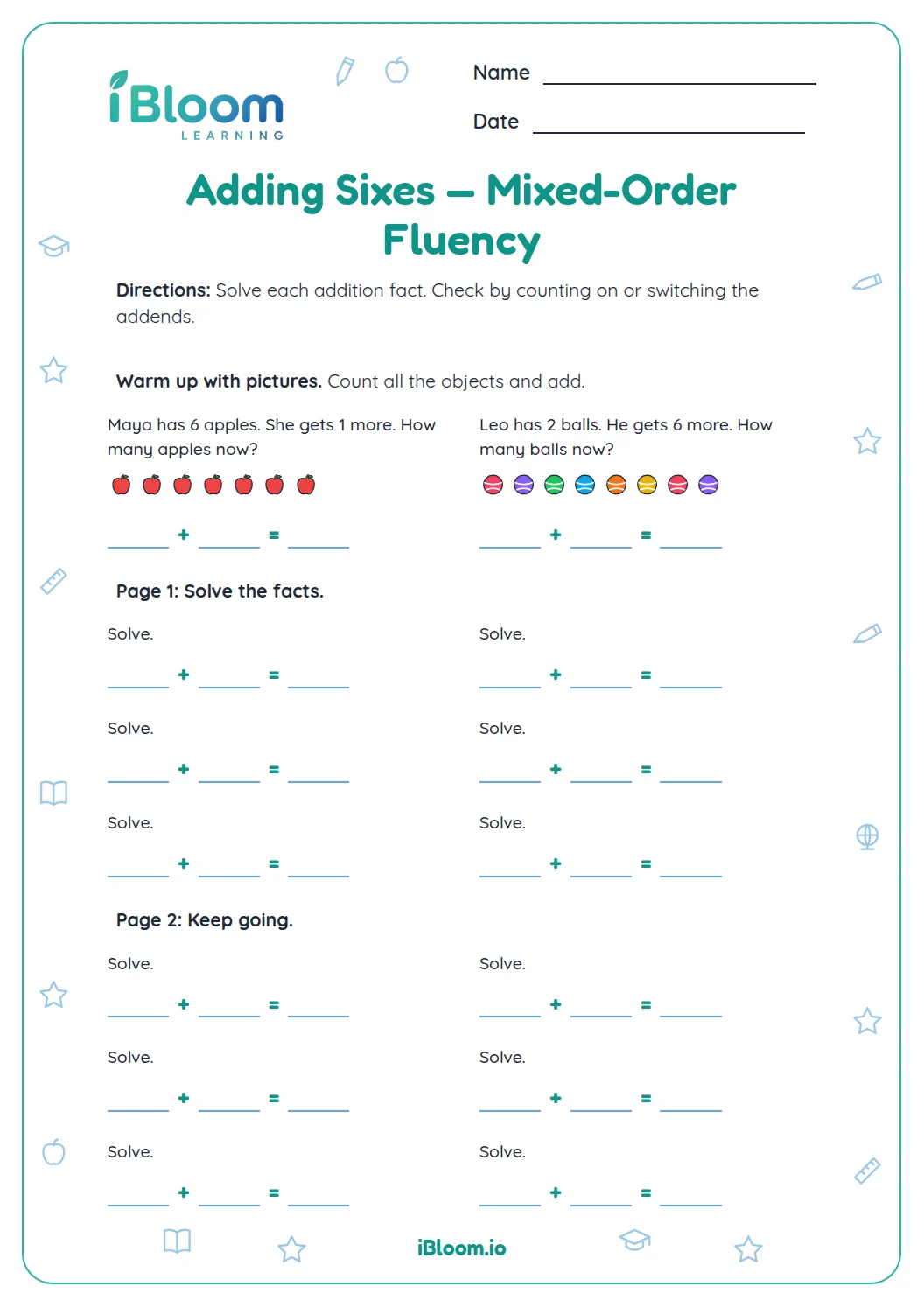
Part A shows the totals as stars and balls, so children can count to check their addition. Part B keeps the word problems but removes the picture support. These six questions are untimed.
Part C gives 13 number sentences in mixed order. It includes six plus every number from 0 through 12 once, with six sometimes first and sometimes second. This round includes the larger facts 11 + 6 and 12 + 6.
How should optional timing work?
Finish and check Parts A and B first. Complete Part C without a timer until the facts are comfortable. For a later attempt on a fresh copy, record the elapsed time and number correct in the top margin.
Compare a child’s own accurate attempts. If a fact needs a strategy, allow time to work it out. There is no required speed or printed cutoff.
How to use this worksheet
- 1Name and count the stars and balls in Part A.
- 2Solve the four Part B stories without a timer.
- 3Read Part C’s directions and choose whether to use a timer.
- 4Complete all 13 facts, using a known double or making ten when needed.
- 5Check all 19 answers and record accuracy separately from time.
Mistakes to notice and fix
The mistake
Writing 6 + 0 = 0.
The fix
Adding zero leaves the six unchanged. Start with six objects and add none.
The mistake
Giving 6 + 8 as 13 by counting six as the first added number.
The fix
Start at six, then count eight more: seven through fourteen.
The mistake
Treating 8 + 6 as a new fact after solving 6 + 8.
The fix
Place the two facts side by side and match their addends; each has the same total.
Common Core alignment
Use counting on, making ten, or a known double to add six.
On this sheet: Picture sums, story sums, and mixed-order facts all add six within 20.
Show the official wordingHide the official wording
Add and subtract within 20, demonstrating fluency for addition and subtraction within 10. Use strategies such as counting on; making ten (e.g., 8 + 6 = 8 + 2 + 4 = 10 + 4 = 14); decomposing a number leading to a ten (e.g., 13 - 4 = 13 - 3 - 1 = 10 - 1 = 9); using the relationship between addition and subtraction (e.g., knowing that 8 + 4 = 12, one knows 12 - 8 = 4); and creating equivalent but easier or known sums (e.g., adding 6 + 7 by creating the known equivalent 6 + 6 + 1 = 12 + 1 = 13).
Build fluent recall of addition facts with six.
On this sheet: The fact round builds recall with six and one-digit addends, using mental strategies for the sums.
Show the official wordingHide the official wording
Fluently add and subtract within 20 using mental strategies. By end of Grade 2, know from memory all sums of two one-digit numbers.
What to practice next
Make more practice
Further reading
Questions parents and teachers ask
Does my child have to use a timer?
No, timing is optional for Part C. Complete the picture warm-up and story sums without a timer first. Let your child try the fact round at a comfortable pace, then use a fresh copy for a timed attempt if wanted. Record accuracy separately from elapsed time.
Which facts are on this sheet?
Part C pairs six with every number from 0 through 12, once each, in mixed order. Its 13 answers range from 6 through 18. Before that round, two picture sums and four story sums give untimed practice with six plus 1, 2, 3, 4, 5, and 6.
What can I do when 6 + 7 is difficult?
Use the double 6 + 6 = 12, then add one more to get 13. Question 11 gives children a chance to use that connection. Ask your child to explain where the extra one comes from before trying the same fact again on a fresh copy.
What do the stars and balls show?
The pictures show the whole total after more items are added. Question 1 has eight stars for 6 + 2, and question 2 has eleven balls for 6 + 5. Children can find a group of six, count the remaining items, and check the total.
How should I respond to a fast attempt with errors?
Review the errors before trying another timed round. Ask your child to explain one missed sum with counting on, a double, or making ten. Write the corrected answer and solve that fact again later. Keep the time as a personal record, alongside the number correct.