


About this worksheet
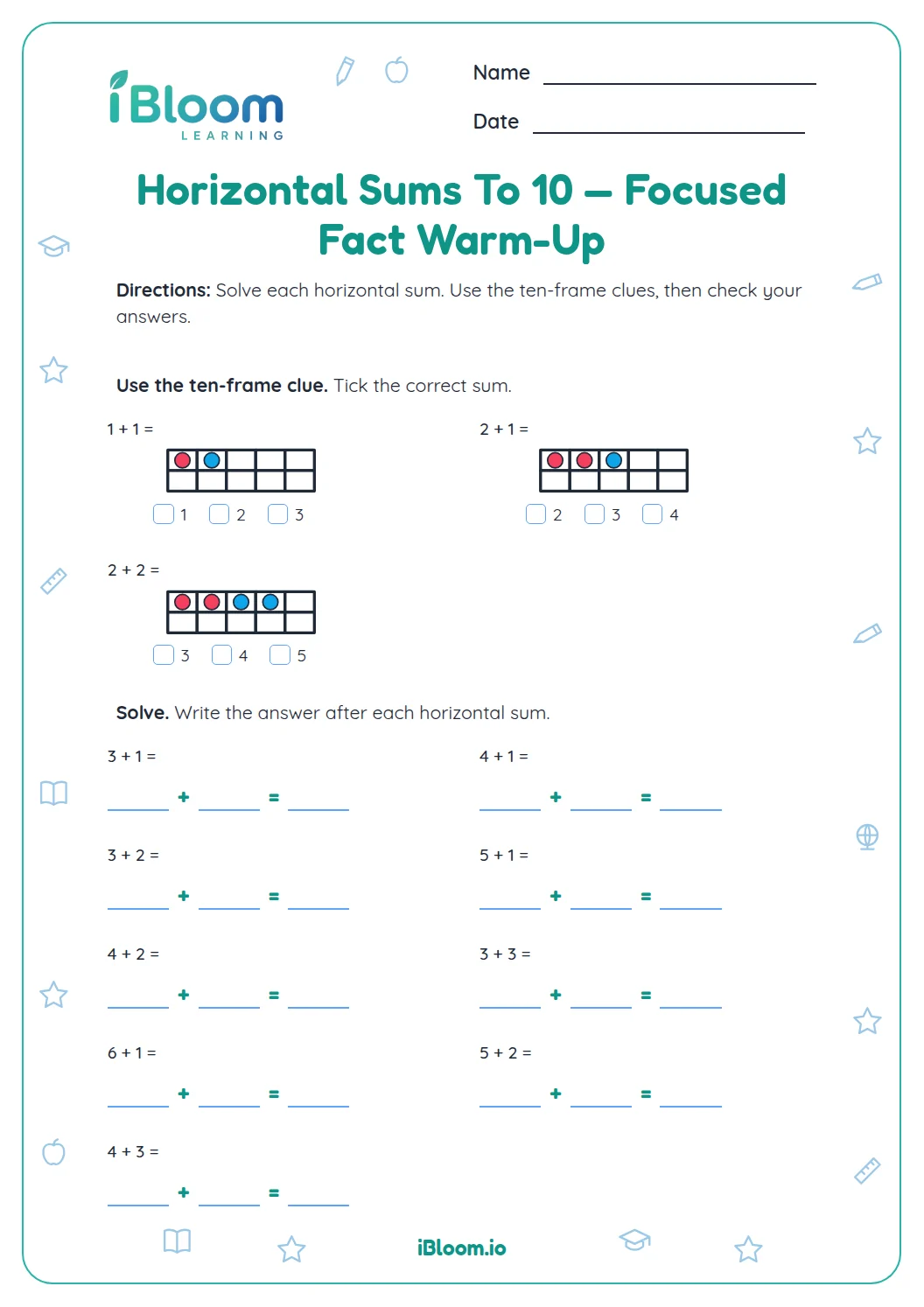
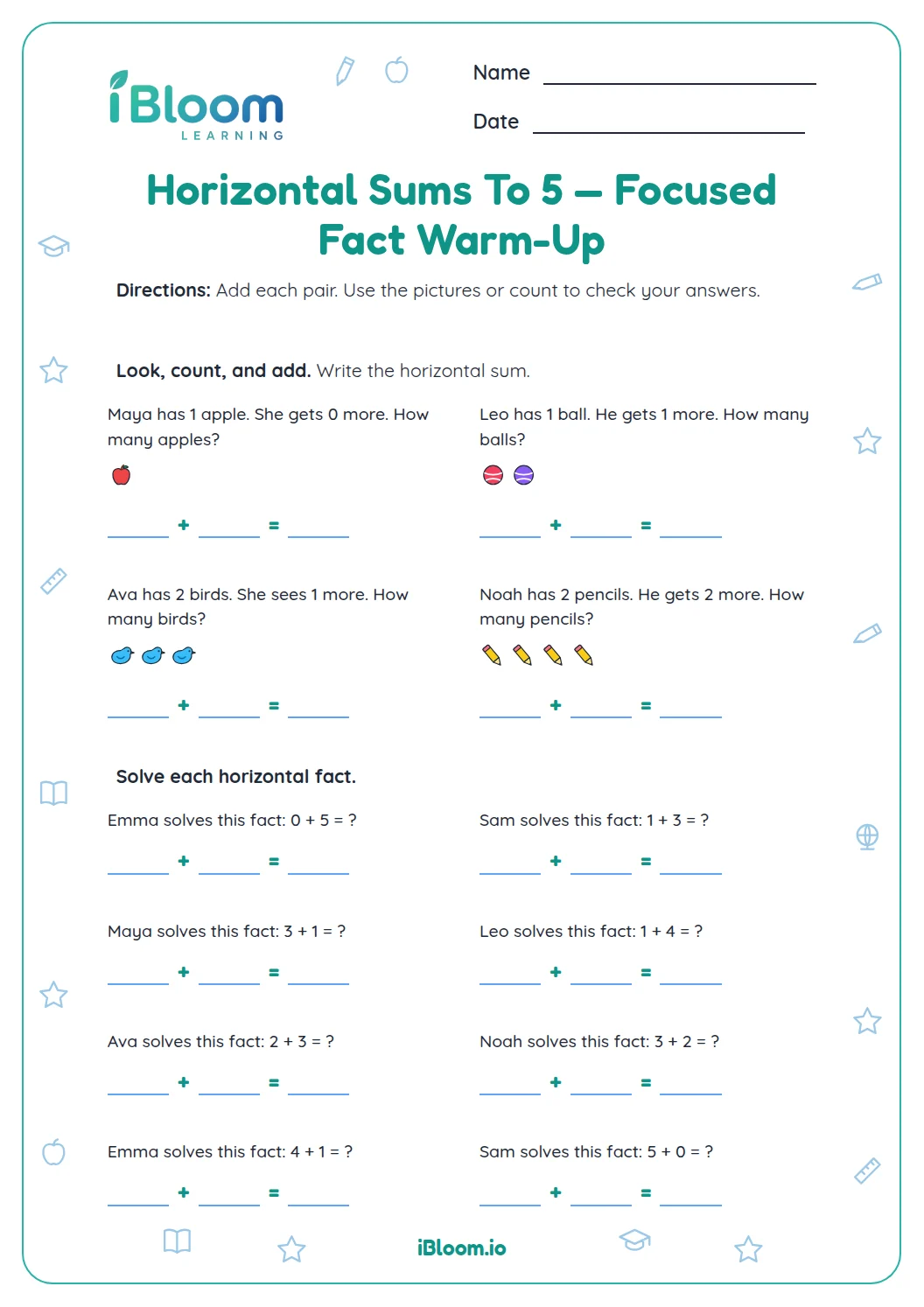
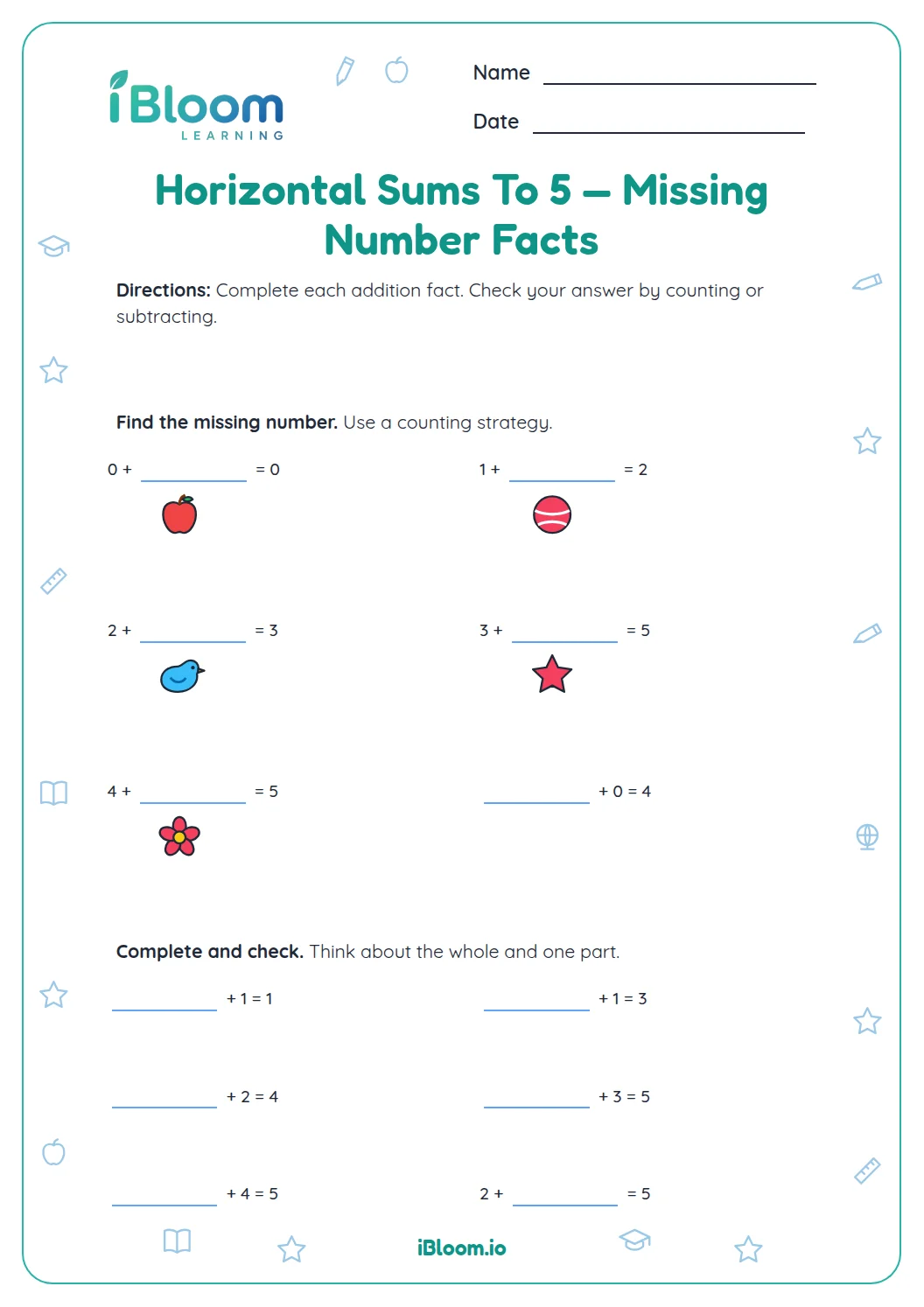
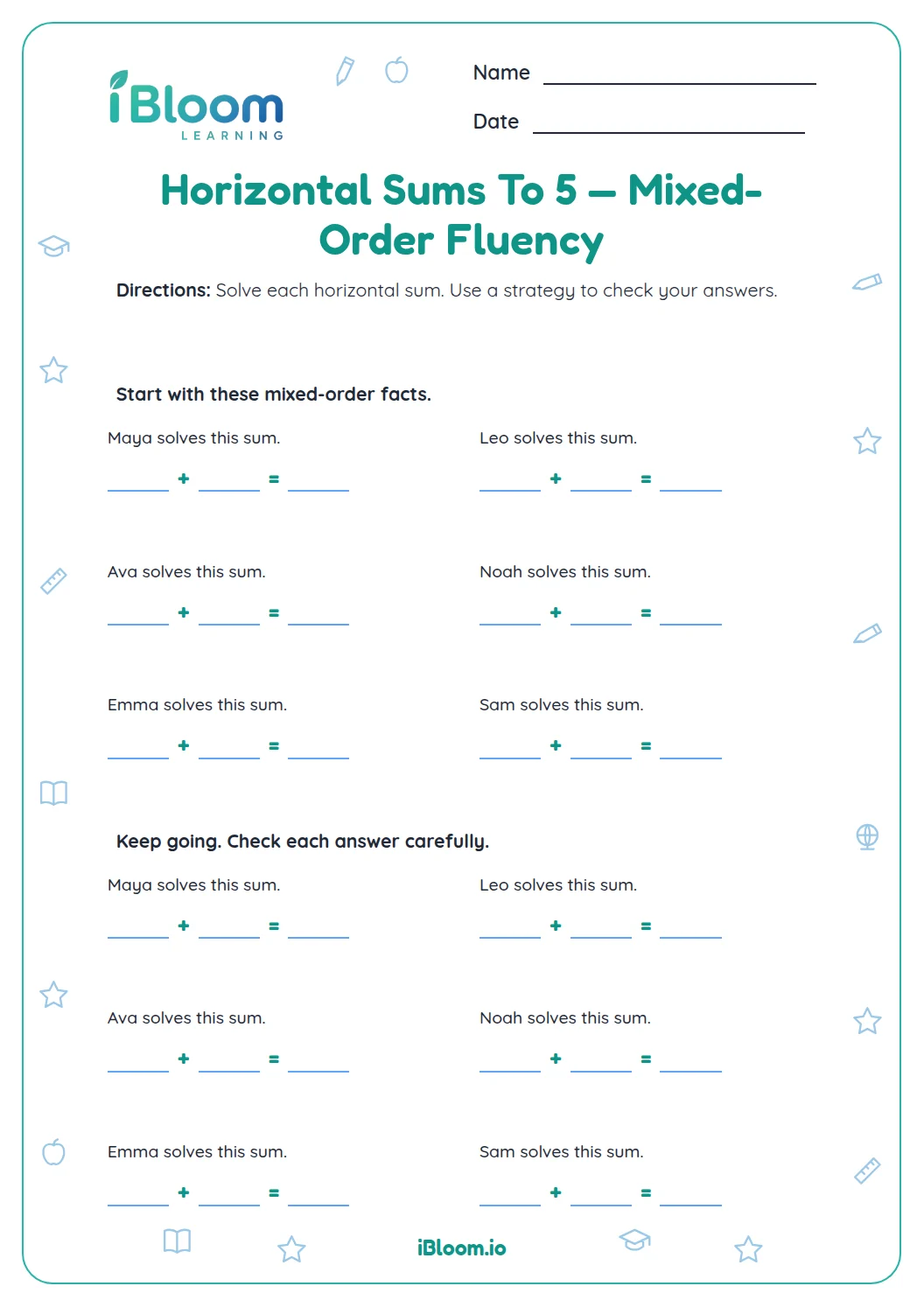
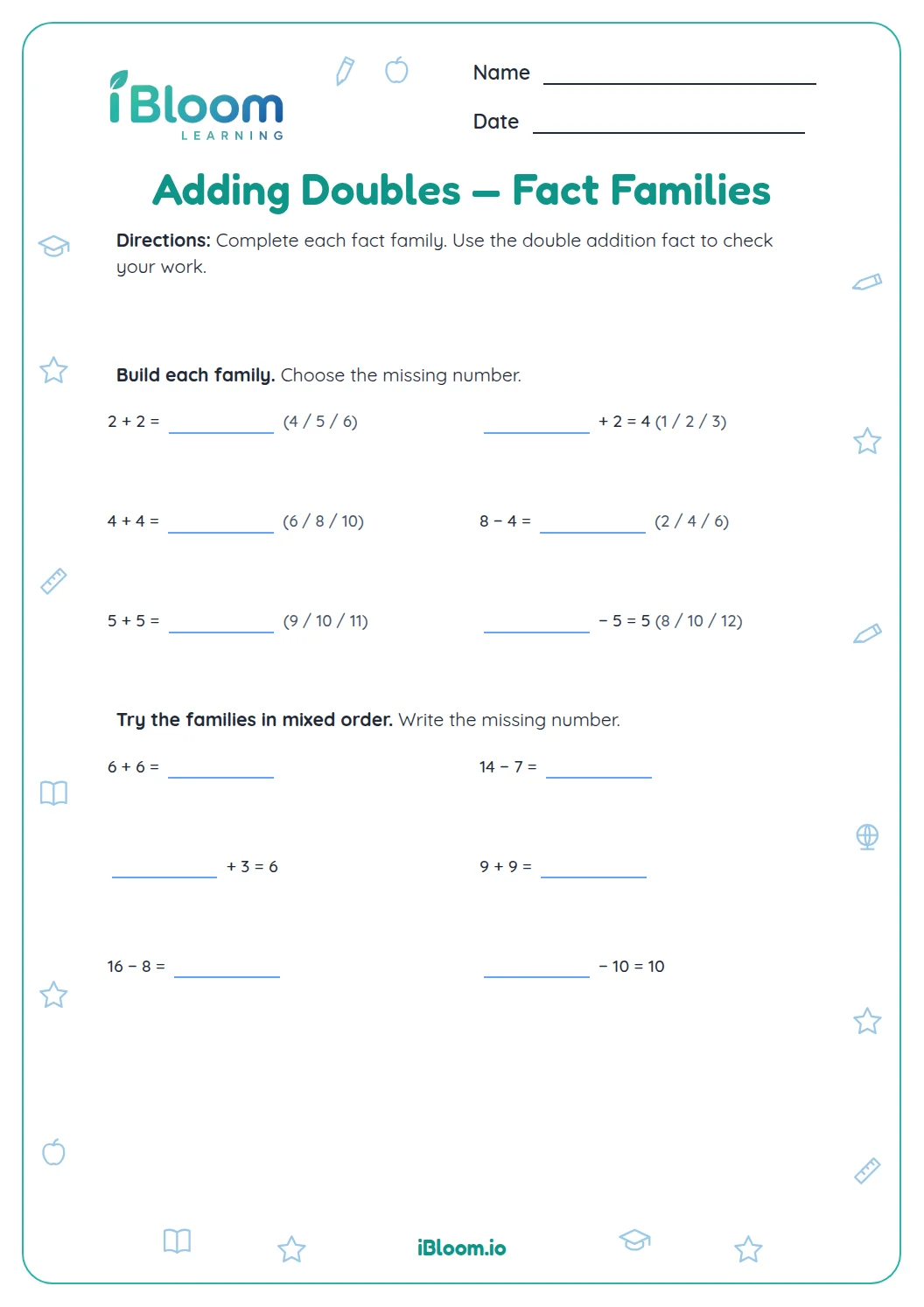
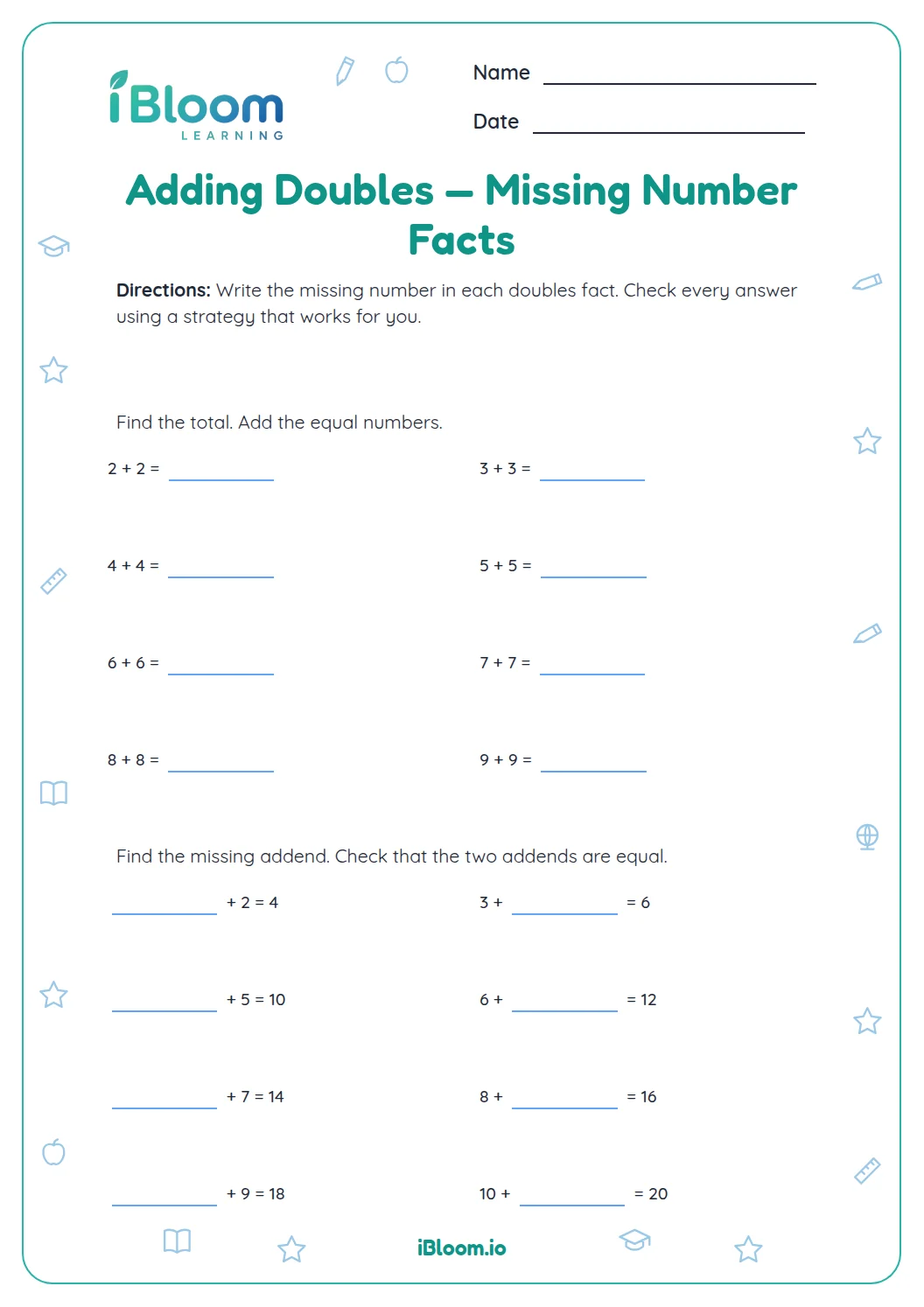
This Grade 1 worksheet gives students 20 addition questions with totals no greater than 10. The first part practices horizontal facts, the next part finds missing addends, and the final part applies addition to short stories. Children can work for accuracy first; timing is optional. A separate answer key is included.
Aligned to 1.OA.C.6
How can students build accurate facts?
Students can count on, use a known double or make ten to find a sum. This drill keeps totals within 10 so learners can focus on strategies and accurate answers.
A timer is optional. If used, keep the focus on careful work as well as pace.
- 12 + 5 = 7
- 2Start at 2 and count on five steps to reach 7.
How can you find a missing addend?
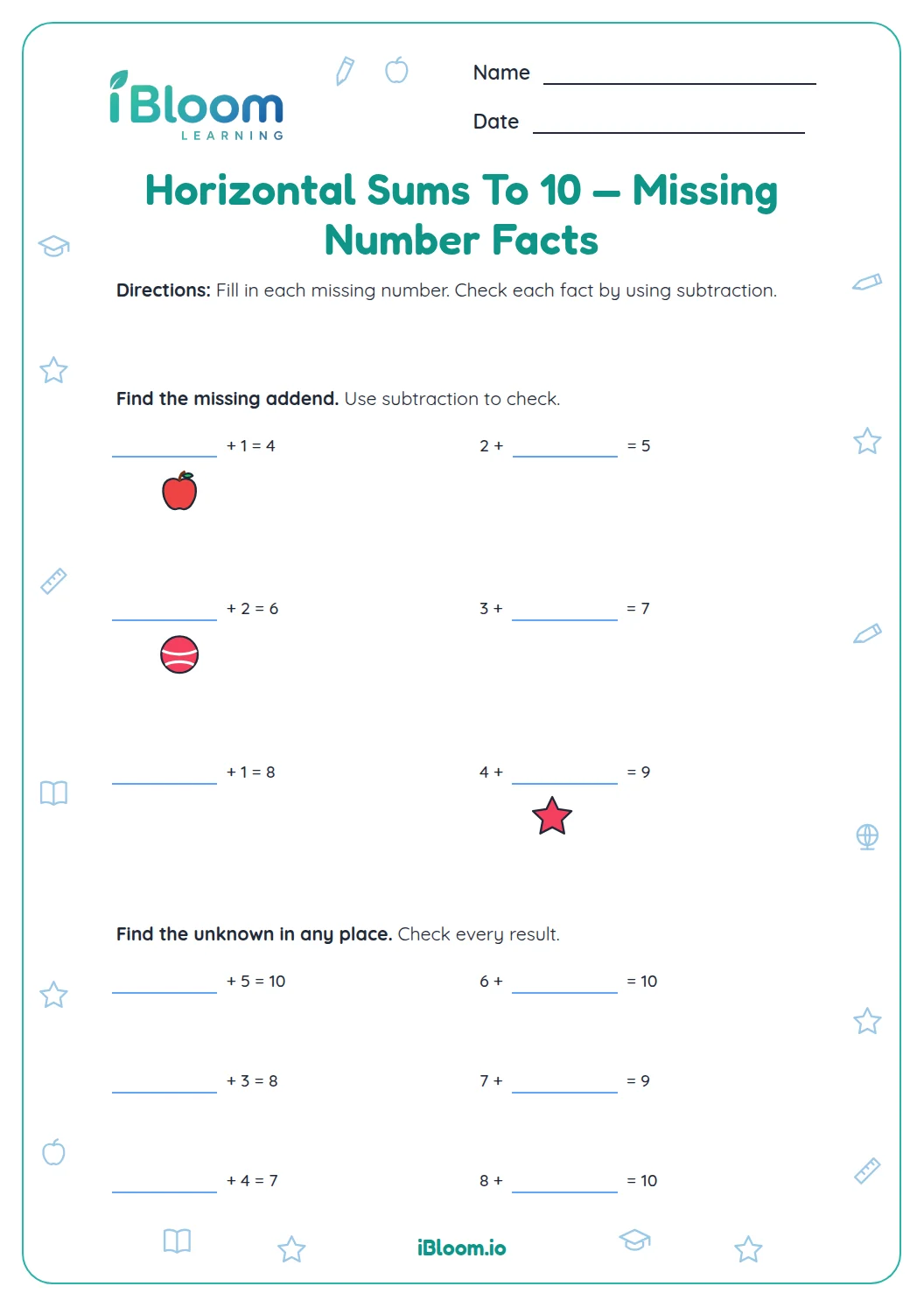
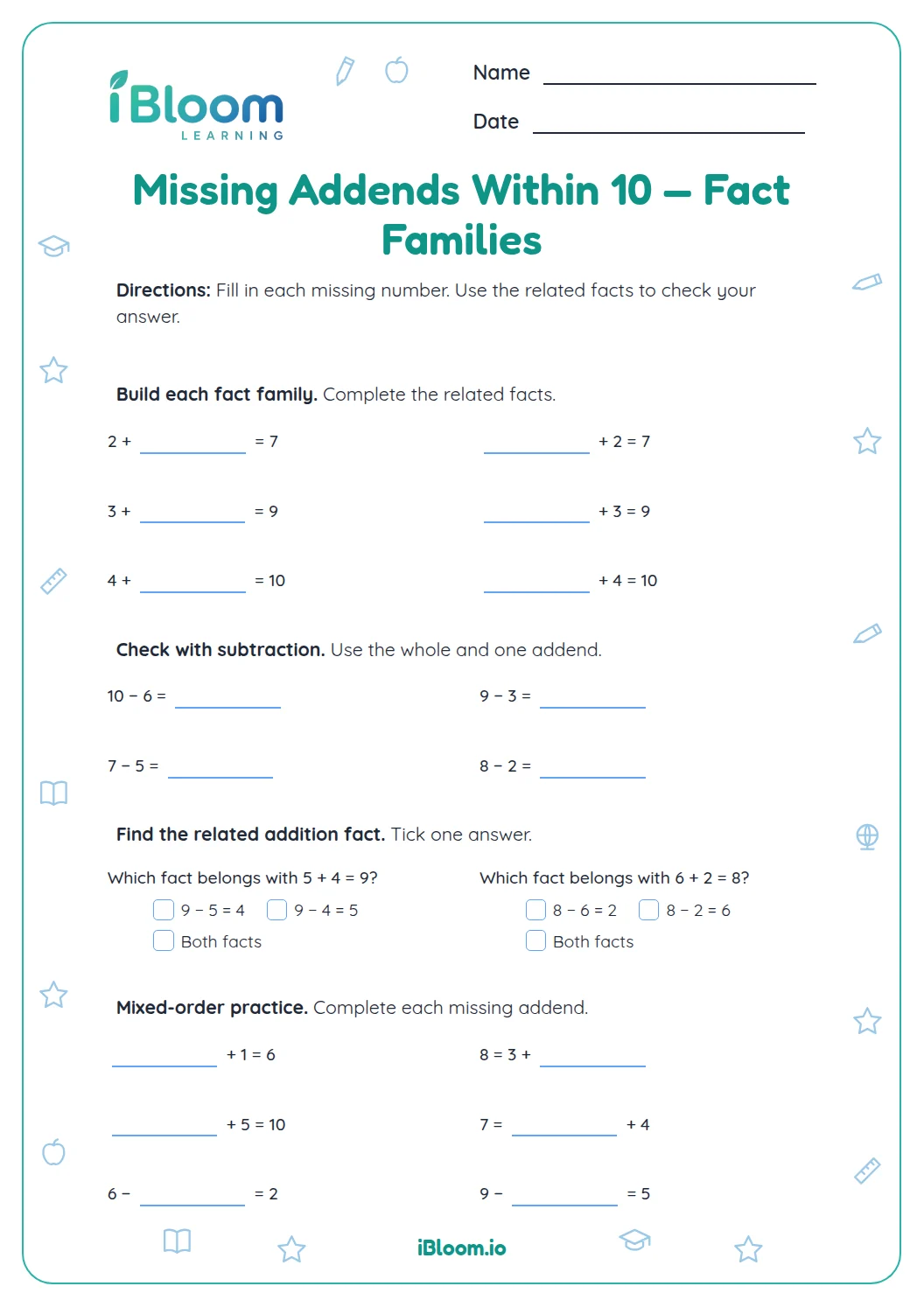
A missing addend is the number that joins a known addend to make the total. For 6 + ___ = 8, count on from 6 to 8 or think 8 − 6. Both show that 2 is missing.
Put the addends back together to check the equation.
What is on the addition drill?
Part A has eight horizontal addition facts. Part B has eight equations with one missing addend. Part C uses four short stories to apply addition. All totals are within 10, and the separate key gives each answer.
How to use this worksheet
- 1Ask the child to solve a few facts aloud before starting.
- 2Complete Part A without a timer and check each total.
- 3For Part B, use count-on or a related subtraction fact.
- 4Check every answer by adding both parts.
- 5If the child wants a challenge, time a second try while keeping accuracy the goal.
Common mistakes and quick fixes
The mistake
Writing the known addend as the missing addend without checking the total.
The fix
Add the two parts to see whether they make the number after the equals sign.
The mistake
Rushing with a timer and skipping a fact.
The fix
Use the timer only after a careful untimed round, and keep a finger under the fact being solved.
Common Core alignment
This worksheet focuses on the named skill and the grade-level work that supports it.
Add and subtract within 20, demonstrating fluency within 10.
On this sheet: All sums and missing-addend equations stay within 10 and build addition-fact fluency.
Show the official wordingHide the official wording
Add and subtract within 20, demonstrating fluency for addition and subtraction within 10.
What to practice next
Make more practice
Further reading
Questions parents and teachers ask
Is the timer required?
No. Timing is optional, and children can complete all 20 questions at their own pace. A first round can focus on accurate answers. If a child wants to repeat the drill later, a timer can track fluency without replacing careful work.
What is a missing addend?
A missing addend is the number that joins the known addend to make the total. In 6 + ___ = 8, counting on two from 6 shows that 2 is missing. Adding 6 and 2 checks the result. Students can check by adding both parts to make the total.
Are all the sums within 10?
Yes. Every question has a total of 10 or less, including the missing-addend equations and short stories. The worksheet focuses on addition facts to 10, and its separate answer key gives the result for each fact, equation and story. Every listed result stays in that range.
What is included in the answer key?
The key lists the result for each addition fact, the missing number in each equation and the answer to each story problem. For an extra check, students can put the two addends back together and see whether they make the stated total.
What strategies can children use?
Children may count on, use a known double, make ten or connect addition with subtraction. For example, a missing addend in 6 + ___ = 8 can be found by counting two steps from 6 or by calculating 8 − 6.