


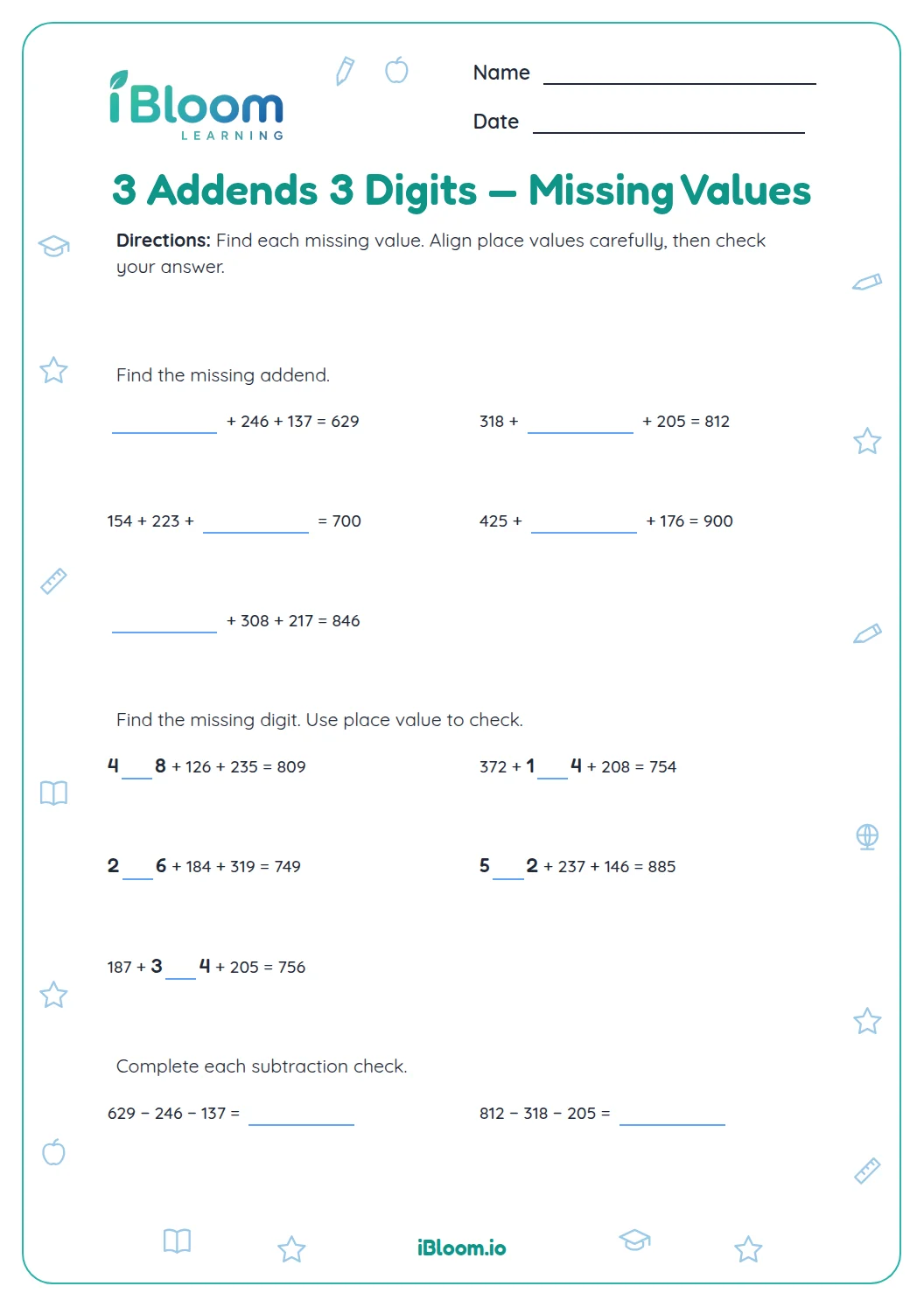
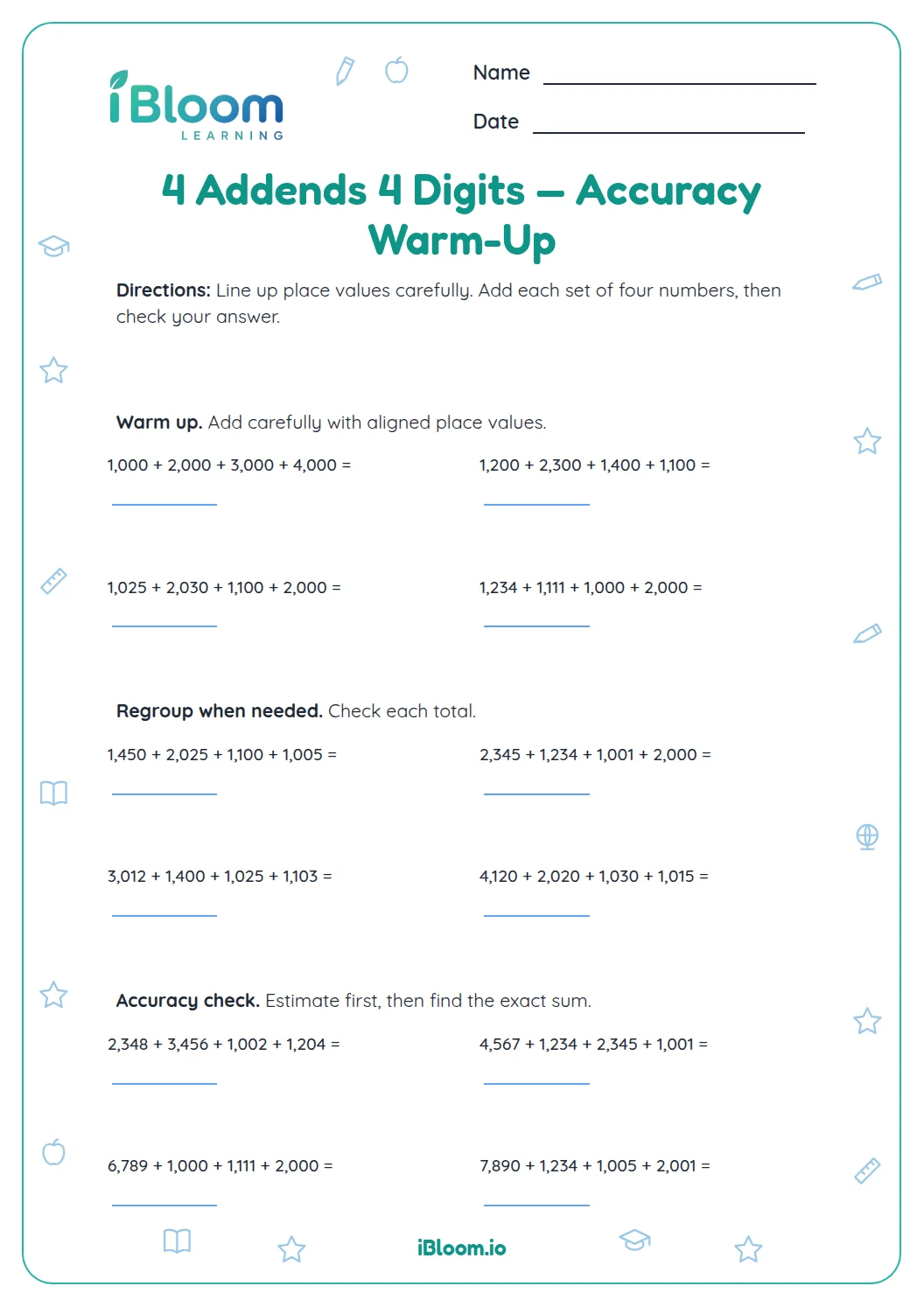
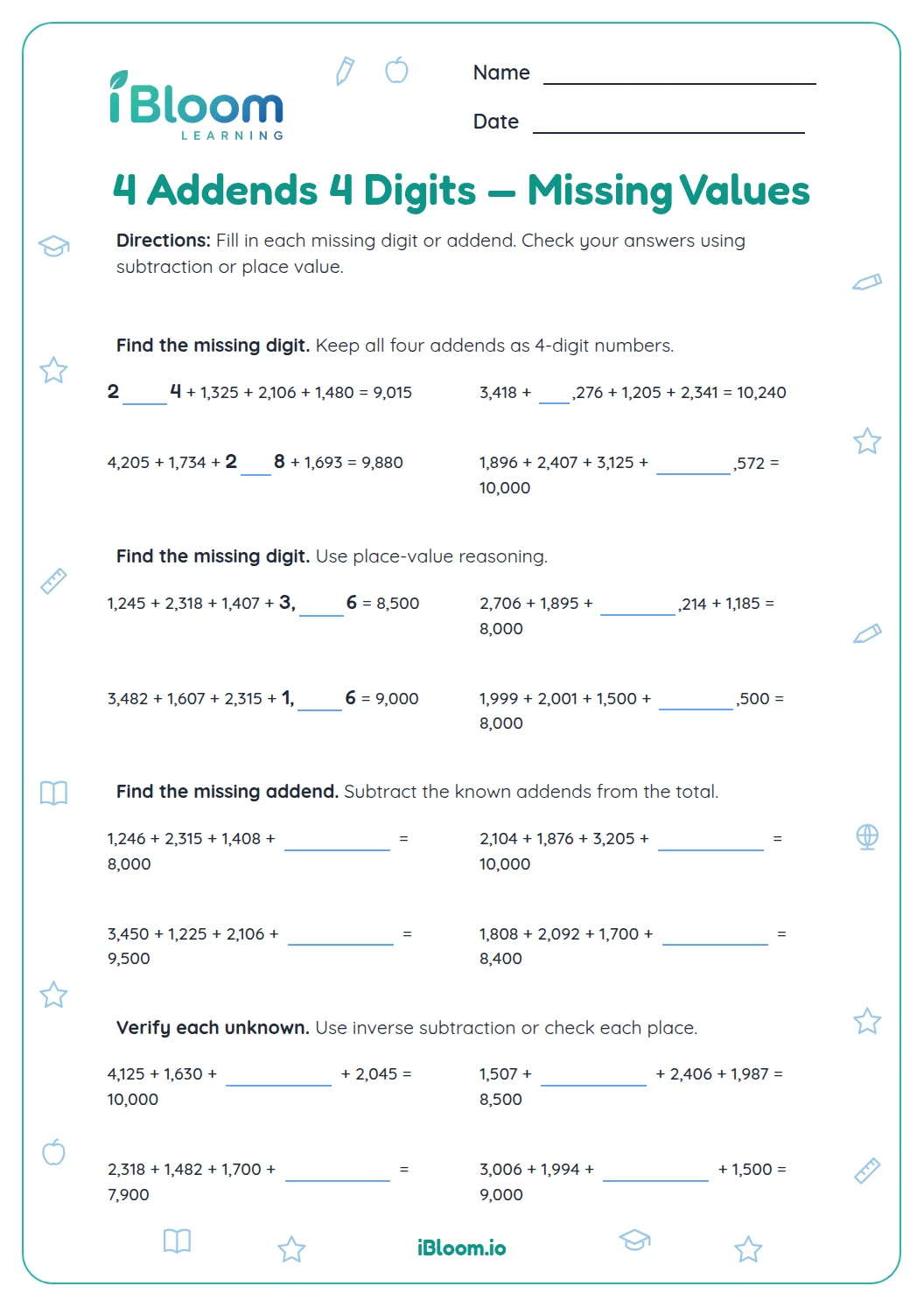
About this worksheet
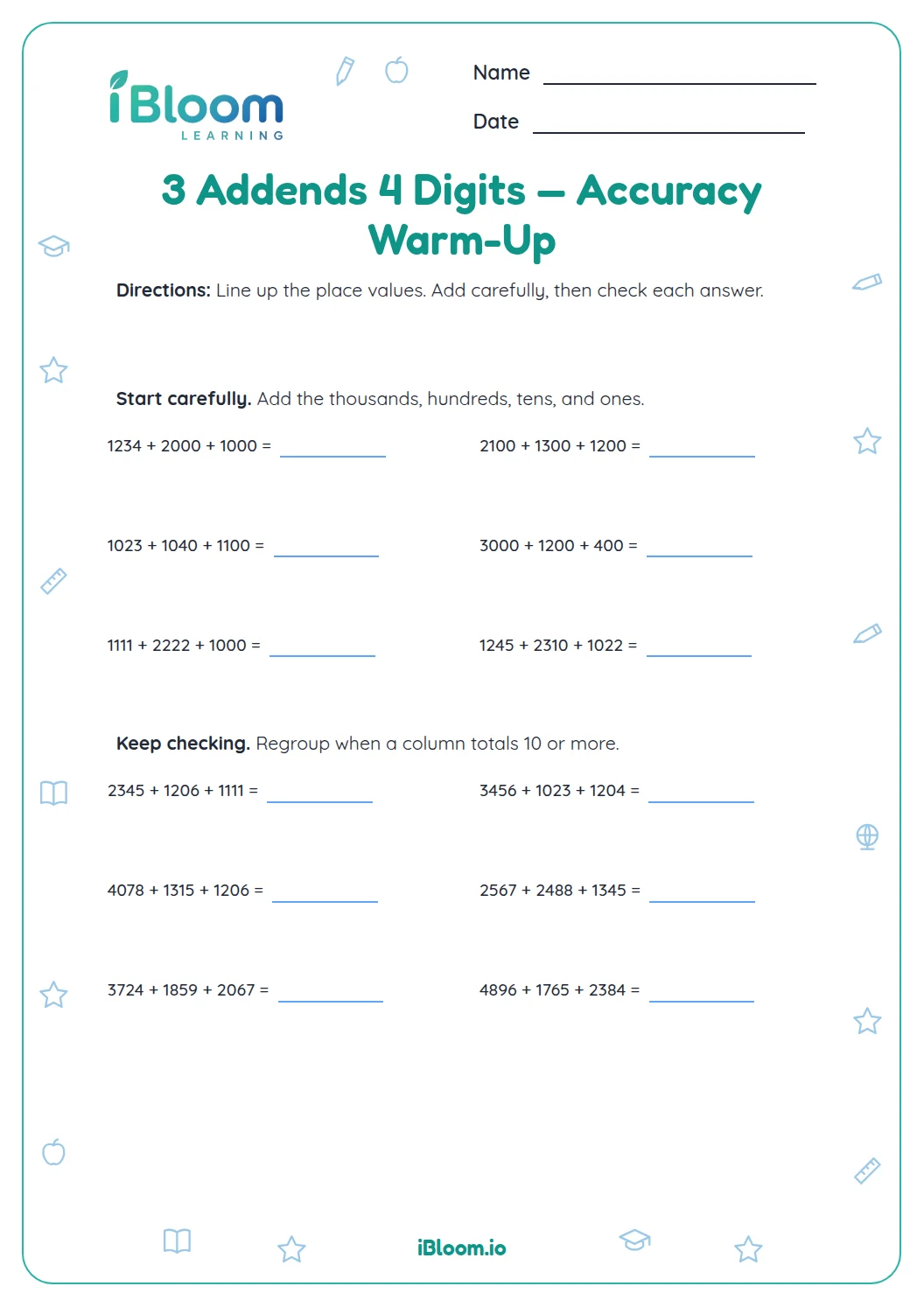
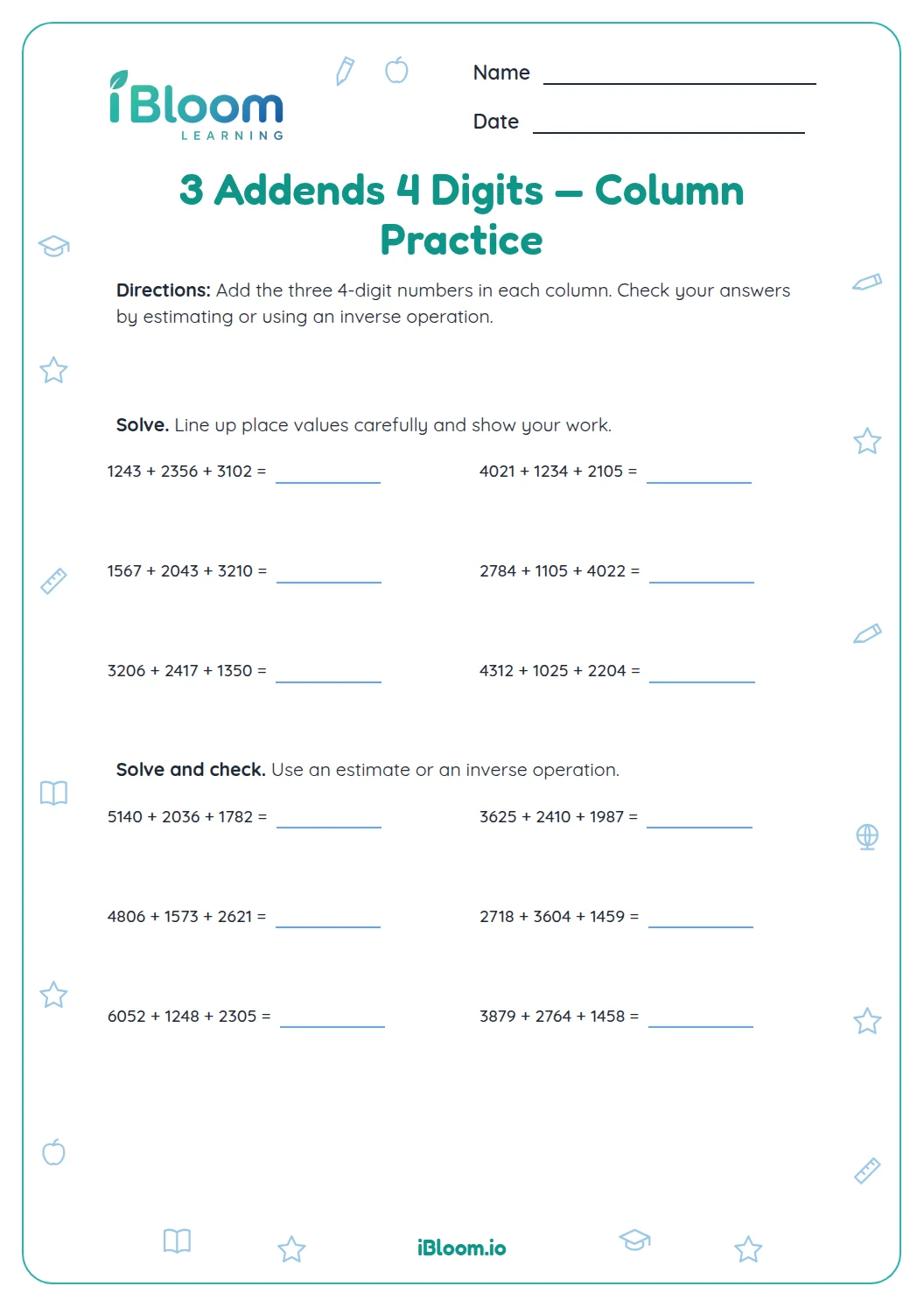
This free addition worksheet gives students in Grades 4–5 twelve horizontal sums, each with three four-digit addends. Students arrange every sum vertically in a working grid before adding. Part A begins with columns whose totals stay below ten; Part B introduces regrouping; Part C includes totals above 10,000 and columns that carry two. The sheet practices the standard addition algorithm in Common Core 4.NBT.B.4. A separate answer key gives the twelve totals, while students keep their column setups on the worksheet for review.
Aligned to 4.NBT.B.4
How do students keep all three addends aligned?
Use the grid to make a column for each place. Start from the ones digits at the right, and keep a space above the addends for regrouped amounts. Put the plus sign beside the last addend and a line beneath it.
Zeros are placeholders. In 2,403, the zero keeps the tens column in its proper position; it should remain in the copied vertical setup.
- 11,234 + 2,132 + 3,421
- 2Ones: 4 + 2 + 1 = 7
- 3Tens: 3 + 3 + 2 = 8
- 4Hundreds: 2 + 1 + 4 = 7
- 5Thousands: 1 + 2 + 3 = 6
- 6Total: 6,787
Can a column carry more than one?
Yes. Three addends can produce a column total of twenty or more. In question 10, the ones digits give 9 + 8 + 6 = 23. Write 3 in the ones place and carry 2 tens.
The tens column then includes that carried 2: 7 + 6 + 9 + 2 = 24. Write 4 tens and carry 2 hundreds. The completed sum is 14,243.
How does the practice become more demanding?
Part A has four sums without regrouping, so students can concentrate on copying all twelve digits into the correct columns. Part B has four sums that need regrouping. Part C has four sums with five-digit totals.
The same instructions apply throughout: arrange, add, and check. Review the written columns as well as the total, especially when a zero or a carried 2 appears.
How to use this worksheet
- 1Copy all three addends into the grid, one digit per column.
- 2Check the copied digits against the horizontal sum before calculating.
- 3Add the ones column and record any regrouped tens above the next column.
- 4Continue left, including each carried amount exactly once.
- 5Check the total by adding the first two addends, then the third, in a second calculation.
Mistakes to check and how to fix them
The mistake
Copying only two of the three addends.
The fix
Point to each number in the horizontal sum and match it to one row in the grid.
The mistake
Carrying 1 whenever a column total has two digits.
The fix
Read the full column total: 23 ones becomes 3 ones and 2 tens.
The mistake
Stopping at four answer digits.
The fix
If the thousands column totals ten or more, record the extra ten-thousands digit to its left.
Common Core alignment
Arrange three four-digit addends in columns and add with regrouping.
On this sheet: Every question requires rewriting a horizontal sum vertically and using the standard addition algorithm.
Show the official wordingHide the official wording
Fluently add and subtract multi-digit whole numbers using the standard algorithm.
What to practice next
Make more practice
Further reading
Questions parents and teachers ask
Must students rewrite every sum vertically?
Yes, rewriting is the main task as well as finding the total. Each question begins horizontally and provides a working grid. Ask students to show all three addends in aligned columns so you can see whether an incorrect total came from copying, alignment, or regrouping.
Why do the first four sums need no regrouping?
They let students focus on placing three four-digit numbers in the correct columns. The ones, tens, hundreds, and thousands column totals each stay below ten. Once those setups are accurate, Part B adds regrouping without changing the routine for copying the numbers into the grid.
Can the carried digit be 2?
Yes, a column with three addends can total twenty or more. In question 10, the ones digits total 23, so students write 3 and carry 2. That 2 joins the tens column and must be counted along with all three original tens digits.
Are five-digit answers expected on this sheet?
Yes, all four sums in Part C produce five-digit totals. Four digits in each addend do not limit the total to four digits. Leave room at the left of the grid for the ten-thousands place, and check that the final carried amount has been recorded.
What does the answer key show?
The key gives the final total for each of the twelve sums. Students show their vertical setups and regrouping in the worksheet grids. When reviewing a wrong answer, compare the copied addends first, then check each column from ones through thousands, including any carried amounts.